Table of Contents
Key Takeaway
- 📦 The ceiling is annual, not per box: balikbayan box rules exempt shipments of personal and household effects up to ₱150,000 in value per sender per calendar year, with the privilege available up to three boxes in that year, so three December boxes have to share one ceiling.
- 🚫 Commercial intent is the kill switch: quantities that look like stock for barter, sale or hire lose the exemption outright regardless of value, per the consulate’s published guidance.
- 🧾 The declared value list is your legal shield: a box whose contents exceed the exemption pays duties and taxes on the excess, which is why the packing list and declared values protect the sender, not just the forwarder.
- 🔌 The OFW appliance slot sits beside the box privilege: returning OFWs may bring one of each kind of home appliance per calendar year within a ₱150,000 cap, a separate lane from the door-to-door boxes.
- ⏰ December boxes need summer planning: the peak-season pipeline runs two to three months, so the senders who book by September receive by the holidays; the boxes booked late arrive by Valentine’s.
The balikbayan box is the Philippines’ most personal trade lane, and the balikbayan box rules that govern it are mostly older than the boxes’ viral reputation, built on Section 800(f) of the Customs Modernization and Tariff Act and the Bureau of Customs’ consolidated-shipment issuances that followed, documented in the agency’s own information sheet. The result is a privilege that genuinely works, boxes of clothes, toys, groceries and appliances arriving duty-free for millions of homes, wrapped in three limits that decide every dispute: what may ride inside, how much value per sender, and how many boxes a sender may send each year.
This guide reads the rules the way customs does, from the statute to the administrative orders to the consulates’ own published pages, then translates them into the steps a sender actually runs: choosing what qualifies, valuing contents, booking an accredited forwarder, packing a defensible box, and the inspection and December-timing realities that no brochure prints. If you ship two boxes a year or plans the holiday pipeline now, the numbers and dates below are the ones that matter.
The Legal Base for the Balikbayan Box Rules
The exemption lives in Section 800(f) of the CMTA, which exempts personal and household effects of returning residents and overseas workers from duties and taxes, plus the implementing layer the Bureau of Customs built for the box format: Customs Administrative Order 5-2016 on balikbayan boxes, the amended consolidated-shipment rules of CAO 1-2018, and Customs Memorandum Order 18-2018 which operationalized them.
Under that stack, Filipinos abroad, including OFWs and former Filipinos who stayed abroad, may send balikbayan boxes to their families and relatives in the Philippines that arrive exempt from the duties and taxes the tax code would otherwise impose.
Three conditions carry the whole privilege, and the consulate pages state them plainly: the box contains personal and household effects only, the contents are not in commercial quantities and not intended for barter, sale or hire, and the shipment falls within the value and frequency ceilings below. Miss one and the exemption can fail item by item, box by box.
Our balikbayan privilege guide covers a related but distinct lane, the travel privilege given to returning Filipinos and balikbayans at the airport, which is where many readers first meet the word and assume the box rules are the same.
The Limits That Decide Everything: Value and Frequency
The value ceiling is ₱150,000 of goods per sender per calendar year, and the privilege covers up to three balikbayan boxes in that year. Both numbers bite at the sender level, not the box level, so a family shipping three boxes in December has one declared-value budget across all three, and a fourth box in the same calendar year is outside the exemption lane however modest its contents.
Exceed the ceiling and the excess value pays the applicable duties and taxes; the exemption does not void, it prorates, which is why honest declared values per box are the sender’s shield in exactly these cases.
Two neighboring figures complete the picture. Returning residents who come home for good claim different, higher tiers under the same section, ₱350,000 for ten or more years abroad and ₱250,000 for five to ten years, with the sub-five-year tier at ₱150,000, and those apply to settled household effects shipped to a family that is moving, not to recurring boxes.
And the statute carries an inflation rider, directing the Department of Finance to adjust the thresholds by consumer-price movements every three years, so the ₱150,000 figure is the current anchor, not a permanent one, and the re-verification habit below matters precisely because of that rider.
What May and May Not Ride Inside the Box
Personal and household effects is a term of art, not a mood. Clothing, shoes, toys, school supplies, shelf-stable groceries, cosmetics in personal-use quantities, small electronics for the household and gifts within the value cap ride the exemption. What fails the rules is anything in commercial quantity, stock for a sari-sari store resold case by case, ten identical phone chargers, branded goods in wholesale counts, or anything intended for barter, sale or hire.
Regulated goods, from medicines to restricted plants to firearms of any kind, sit outside the box conversation entirely and follow their own permit lanes.
The OFW appliance privilege lives beside this and trips up many senders: a returning OFW may bring home appliances and durables, limited to one of each kind per calendar year within a ₱150,000 value, accompanying the OFW’s return or arriving within sixty days of it, presented at the port with the original passport. That lane attaches to the person returning, not to a door-to-door box, so an appliance can ride a box only within the box’s own rules, while the OFW’s personal appliance lane runs through the airport with its own conditions.
Splitting the two lanes on paper before you book is what keeps a December shipment out of the exception row.
How Inspection Actually Works at the Border
The rule most senders half-remember is real and published policy: since the 2017 reforms, the balikbayan box rules say shipments may not be opened arbitrarily, and inspection escalates from X-ray to physical opening only when screening raises specific grounds, per the Department of Finance’s circular and the Bureau of Customs’ implementing orders on consolidated shipments.
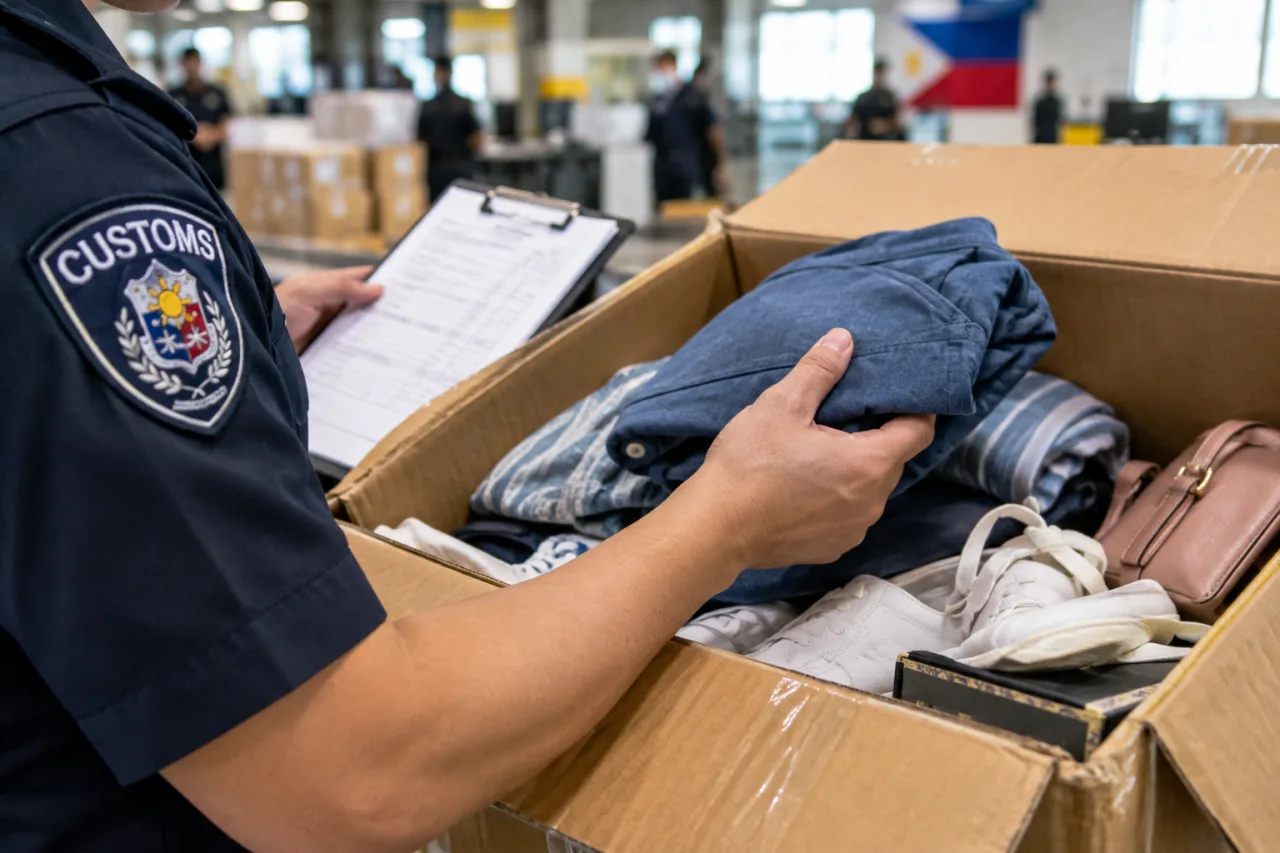
The design intent is speed and dignity in the lane, and the practical consequence is that your paperwork does the talking: an accurate packing list, declared values done right and a sender whose account shows a normal pattern almost never triggers the second tier.
When a box does get opened, the process follows the declared list, and discrepancies weigh on the exemption. The failure patterns are predictable: contents valued far above the list, commercial counts hidden among personal items, or a string of boxes in one year brushing the ceiling.
Each is also the cheapest thing in the world to avoid, because the balikbayan box rules reward the sender who keeps a receipt-level inventory of what went where, box by box, which is the same list that proves the ₱150,000 arithmetic if a dispute ever reaches a broker.
Booking, Timing and the December Pipeline
The balikbayan box rules route every shipment through accredited door-to-door forwarders, and accreditation matters because the forwarder’s consolidated entries, the deconsolidation papers and the box manifest are what customs reads, not the sender’s memory. Peak season compresses every service level: boxes collected in September and October typically land by mid-December, while November collections drift toward January and December collections toward February, which is why the practical balikbayan box rules of timing say book early, budget a two-to-three-month transit outside the rush, and keep the per-box fees and insurance receipts with the packing list.
The money side deserves its own minute. The freight fee is a service charge, not a tax, and it buys no exemption; the exemption rides on the contents meeting the rules. Insurance runs on declared value, which couples it to the same list the customs side reads, and senders splitting a shipment across relatives should be careful: forwarding one box under three different relatives’ names to multiply the ₱150,000 ceilings is not a plan, it is the exact pattern the consolidated-shipment rules were amended to catch, since the privilege is per sender regardless of whose name prints on the address label.
What Changed Recently and What to Watch
The lane’s recent history runs through consolidation: the Bureau of Customs moved balikbayan boxes to consolidated-shipment processing years ago to speed the pipeline, amended those rules with CAO 1-2018, and issued CMO 18-2018 to operationalize the flow, with further easing announced by the agency in recent years to cut handling friction at the ports. Watch two moving parts from here. First, the threshold rider: the CPI adjustment the statute directs every three years means the ₱150,000 figure could move in either direction with a Department of Finance notice, and this guide’s figures follow the currently published thresholds, re-verified against the sources named below.
Second, the enforcement climate around commercial-quantity imports disguised as family shipments, which is where new memos have concentrated, and our remittance fee tracker and OFW money tools roundup keep those OFW money questions covered as the rules evolve.
The Arrival Side: Forwarders, Fees and the Philippine-Side Handover
The balikbayan box rules run the same on both ends, but the sender experience divides at the forwarder’s door. Philippine-side partners, in-house couriers or brokered local teams, deliver to barangays and provinces, and their service terms deserve the same reading you give customs rules: who pays a deconsolidation or inland fee, whether home delivery inside the quoted price, and what happens when a box sits in a port backlog, because December volumes have historically pushed dwell times past the brochures’ promises. Reputable forwarders answer each question in writing, and the answers belong in the same folder as the packing list.
The receiving household has a role too, and it is smaller than most senders think. The family does not file exemption paperwork for a compliant box; the consolidated entry carries the privilege, which is precisely why the sender’s list, declared values and shipping receipts decide everything when a box is questioned. The receiving side should simply confirm the count, and within days, photograph the box condition at handover and note any tamper signs, because claims windows for damaged or short-boxed shipments run on the forwarder’s terms, not the customs lane’s. Sender-side insurance receipts pair with those photographs as a complete claims file.
The last habit worth building is the annual ledger. A sender’s running log of boxes shipped, dates, contents at a summary level and declared values keeps the three-box and ₱150,000 accounting effortless across the balikbayan box rules’ calendar year, catches accidental ceiling brushes before they become assessments, and doubles as the household inventory for insurance at home. The families who track their boxes are the ones the rules were written for, and the tracking costs a spreadsheet row per box.
Follow the balikbayan box rules as written and the December box is a non-event: booked early, listed faithfully, valued honestly, tracked once, delivered on time. The rules reward exactly one behavior, documentation, and they punish exactly one, improvisation at the margin of the ceiling. The exemption has outlived every rumor of its death because the paperwork, done once, keeps it alive.
Frequently Asked Questions
What are the balikbayan box rules for duty-free shipping?
Under Section 800(f) of the CMTA and the Bureau of Customs’ implementing orders, balikbayan boxes arrive exempt from duties and taxes when they contain personal and household effects only, carry no commercial quantities intended for barter, sale or hire, stay within ₱150,000 in value per sender per calendar year, and the sender uses the privilege no more than three times in that year.
Is the ₱150,000 limit per box or per sender?
Per sender, per calendar year, counted across the boxes that sender ships, which the balikbayan box rules cap at three per year. Three December boxes share one value ceiling, and any excess value above the exemption pays the applicable duties and taxes rather than voiding the box.
How many balikbayan boxes can one person send in a year?
Three balikbayan boxes per calendar year per sender under the current rules. The count is per sender, not per household or per recipient, so splitting a shipment across relatives’ names does not multiply the ceiling, and the consolidated-shipment rules treat that pattern as exactly what the amendments were written to catch.
Can I send appliances inside a balikbayan box?
Small household appliances ride inside the box lanes as personal and household effects within the value cap, while the separate OFW privilege for larger durables, one of each kind per calendar year up to ₱150,000 attaches to a returning OFW entering through the port with the original passport, not to a door-to-door box. Match each item to the lane that actually carries it before booking.
What happens if my box is worth more than the exemption?
The exemption prorates: duties and taxes apply to the excess value above ₱150,000, assessed per the declared contents. An honest packing list with declared values turns this from a dispute into arithmetic, and commercial quantities or false declarations are where the balikbayan box rules bite hardest, because intent to sell defeats the privilege altogether.
Can customs open my balikbayan box for inspection?
Yes, but only on grounds. Since the 2017 reforms, boxes move through X-ray screening first, and physical opening requires specific findings, not a random sweep, per the Department of Finance circular and the Bureau’s consolidated-shipment orders. The box that passes screening matches its list, and the sender whose paperwork matches almost never sees tier two.
- losangelespcg.org/consular-services-2/notar1als/related-services/duty… — the consulate’s published guidance
- Official customs.gov.ph/wp-content/uploads/2023/04/cmo-18-2018-Information-She… — the agency’s own information sheet
External sources linked in this article, in order of first mention. Spotted an error or a broken link? Tell us.
Cite this pagePublished Nov 24, 2026
Agron, E. (2026, November 24). Balikbayan Box Rules: What the Bureau of Customs Allows Duty-Free. WorldNgayon. https://worldngayon.com/balikbayan-box-rules/
Agron, Edmon. “Balikbayan Box Rules: What the Bureau of Customs Allows Duty-Free.” WorldNgayon, 24 Nov. 2026, worldngayon.com/balikbayan-box-rules/.
Agron, Edmon. “Balikbayan Box Rules: What the Bureau of Customs Allows Duty-Free.” WorldNgayon, November 24, 2026. https://worldngayon.com/balikbayan-box-rules/.
Agron, E. (2026) ‘Balikbayan Box Rules: What the Bureau of Customs Allows Duty-Free’, WorldNgayon, 24 November. Available at: https://worldngayon.com/balikbayan-box-rules/.
E. Agron, “Balikbayan Box Rules: What the Bureau of Customs Allows Duty-Free,” WorldNgayon, Nov. 24, 2026. [Online]. Available: https://worldngayon.com/balikbayan-box-rules/
@online{agron2026balikbayanbox,
  author       = {Agron, Edmon},
  title        = {{Balikbayan Box Rules: What the Bureau of Customs Allows Duty-Free}},
  year         = {2026},
  date         = {2026-11-24},
  organization = {WorldNgayon},
  url          = {https://worldngayon.com/balikbayan-box-rules/},
  urldate      = {}
}TY - ELEC AU - Agron, Edmon TI - Balikbayan Box Rules: What the Bureau of Customs Allows Duty-Free T2 - WorldNgayon PY - 2026 DA - 2026/11/24/ UR - https://worldngayon.com/balikbayan-box-rules/ Y2 - ER -
Cite the version you read; the page may be updated. Zotero and Mendeley can also import this page directly.