

Table of Contents
Key Takeaway
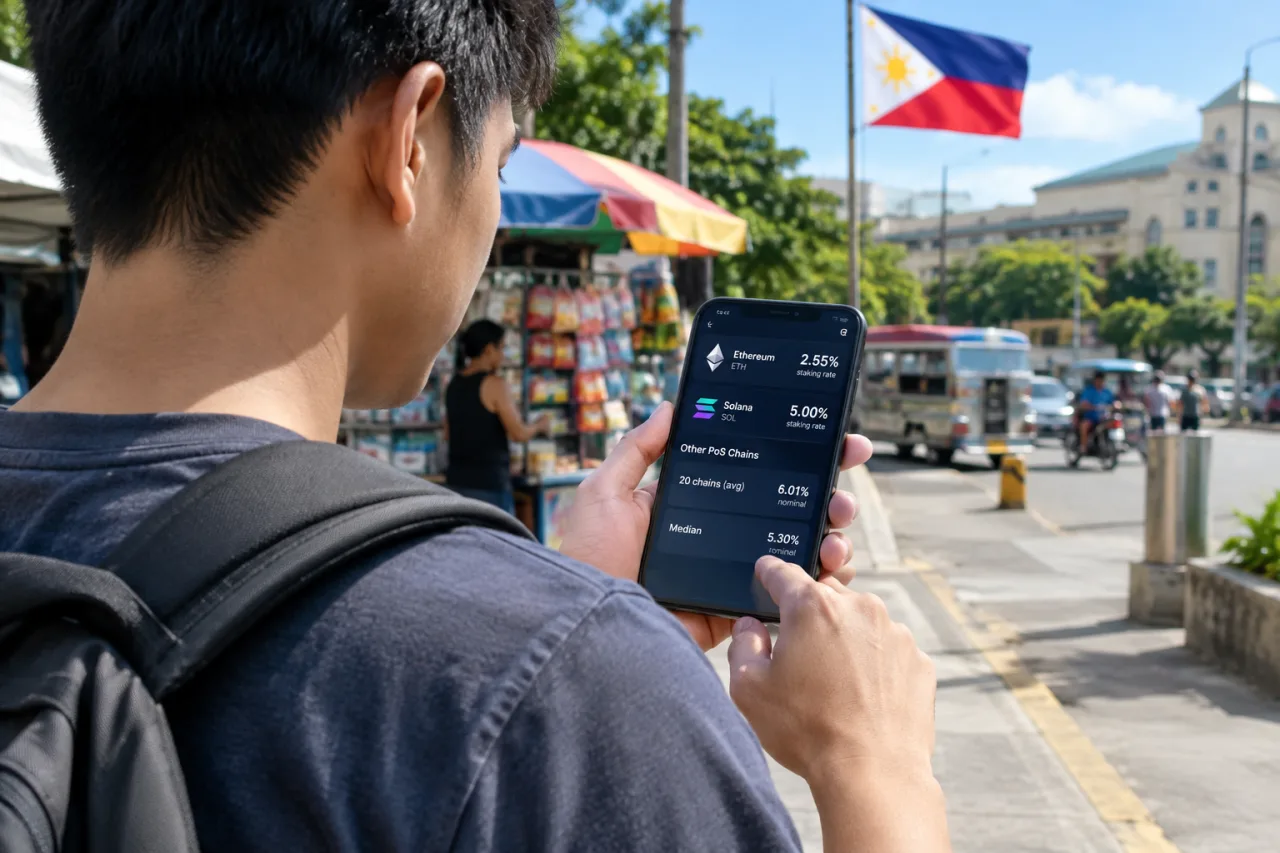
- 🪙 The realistic rates: as of mid-November 2026, Ethereum’s network staking rate sits near 2.55 percent and Solana’s near 5.0 percent before fees, and the 20 largest proof-of-stake chains average about 6.01 percent nominal, with a median of 5.30 percent.
- 📉 The dilution haircut: after each network’s own new-coin issuance, the same set of crypto staking rewards keeps only about 2.97 percent in real terms on average, so a headline rate is not the number that reaches your wallet.
- ⚖️ The Philippine rule of thumb: staking from your own wallet is not prohibited as of 2026, but staking offered as a service to the public can fall under the SEC’s crypto asset service provider rules, and Philippine banks may not route retail customers to offshore platforms that are neither BSP-registered nor SEC-registered.
- 🏦 The registered rails: the BSP’s registered-provider list as of 15 July 2026 names Coins.ph, Maya, Moneybees, PDAX, TopJuan, another licensed operator, GoTyme Bank, and UnionBank as active registrants, with a public list of SEC-registered CASPs still absent at the time of writing.
- 🧾 The tax reality: the BIR treats staking rewards as taxable income at the peso value when received, and a later sale or swap can be a separate taxable event, so the reward is income before it is profit.
Crypto staking gets sold in two dishonest registers at once: the promised-rate brochure that treats a network reward like a fixed deposit, and the fear piece that treats every validator like a scam. The reality sits in between, and this piece holds it there: what staking pays in late 2026 with dated, sourced numbers, how a Filipino can stake within the rules, what the BSP and SEC actually require as of the latest published lists, and the risk stack in the order each risk has historically bitten. No yield promises anywhere; every rate here is a network statistic with a date, not an offer.
What Staking Actually Is
Staking is the work of locking coins into a proof-of-stake network so it can validate transactions. Networks do not pay stakers out of profit; they mint new coins and share them with the participants who secure the ledger. Three consequences follow, and they matter more than any rate table. First, the reward is denominated in the same coin you already hold, so if the coin’s price halves, your peso return halves with it no matter what the brochure printed. Second, rewards arrive because of inflation, which means every non-staking holder is diluted to fund them, and your real edge is the spread between the reward rate and the issuance rate. Third, the rate is a variable: it moves with the share of supply staked, validator commission, and each chain’s own policy changes, so a rate quoted today is a snapshot, not a contract.
One vocabulary alert before the numbers: liquid staking tokens, deposit-style programs, and derivative strategies that happen to pay about 5 percent are routinely marketed as crypto staking. They are not the same instrument. A derivatives-funding product with a variable payout is a different risk entirely from locking coins to a validator, and in crypto staking as in banking, the label on the account rarely matches the instrument inside it.
The 2026 Yield Table, Verified and Dated
These figures were compiled in mid-November 2026 from independent staking trackers and network statistics, and each carries its date because crypto staking rates move weekly.
| Item | Verified figure | Source and date |
|---|---|---|
| Ethereum network rate | About 2.55 to 2.60 percent annualized; roughly 35.6 percent of supply staked; about 0.88 percent issuance, so roughly 1.7 percent real | Independent staking trackers, November 2026 |
| Solana network rate | About 5.0 to 6.6 percent nominal; roughly 69 percent of supply staked; about 4.85 percent issuance, so roughly 1.7 percent real | Independent staking trackers, September to November 2026 |
| 20-chain average | 6.01 percent nominal, median 5.30 percent; 2.97 percent average real after inflation; with Cosmos paying the widest headline, about 19.66 percent nominal, at the top of the set | Streamflow analysis of Staking Rewards data, September 2026 |
| Worked example | $10,000 staked at 2.55 percent earns about $255 over a year before fees, price moves, and tax | Staking Rewards calculator, as cited by trackers, November 2026 |
| Solana’s coming compression | Validators approved doubling the network’s disinflation rate on August 28, 2026, with modeled nominal yields easing to about 4.34 percent in year one and near 3 percent in year two | Network governance coverage, late 2026 |
Read the fourth and fifth rows together and the working picture appears: one major network already pays under 3 percent nominal, the other’s advertised rate is scheduled to compress, and the difference between the highest headline rates and the real yield after dilution is roughly three percentage points across the market. Anyone quoting double digits as normal for 2026 crypto staking is quoting either a high-inflation chain, a one-week snapshot at a peak, or a product that is not staking at all.
The Four Ways Filipinos Stake
One: from your own wallet to a validator. This is crypto staking at its purest. You keep custody, choose the validator, and receive rewards at the network rate minus the validator’s commission, typically 0 to 10 percent. This is the cheapest path to the true network rate and the path with the fewest parties, but you hold the keys, which means you also hold every risk of losing them.
Two: through a BSP-registered exchange. A registered local platform may offer crypto staking products on its own terms, with peso rails for funding, and the governing question is the regulatory status of that specific product, addressed below. Convenience is real: you buy with pesos, stake in two taps, and the reporting is localized. The trade is the platform layer between you and the network; our seven-point exchange checklist covers how to size up that layer before you fund it.
Three: through liquid staking tokens. A protocol pools users’ coins, stakes them, and issues a tradable receipt that earns slightly less than the network rate because of a protocol fee; late-2026 figures show ETH liquid tokens paying between about 1.84 and 2.37 percent against the 2.55 percent network rate, and Solana’s largest tokens at about 4.9 percent against 5.0 percent. You gain liquidity and lose a little yield, and you accept the protocol’s smart-contract risk on top.
Four: through offshore or pooled platforms. Several global platforms restrict crypto staking features for Philippine users precisely because of the rules discussed next, and any platform that promises fixed returns for deposits should be treated as an investment solicitation, not staking, and checked against SEC advisories before a single peso moves.
What the Philippine Rules Actually Say
The short version as of the latest published guidance: personal crypto staking is open, offered staking is regulated territory. A 2026 review of the Philippine position concludes that an individual staking from a personal wallet to help secure a proof-of-stake network is not committing an offence, while a platform that pools user funds and pays staking rewards to the public can fall within the SEC’s Rules on Crypto Asset Service Providers, issued as Memorandum Circular No. 4 in 2025 and effective from July 2025, and where the arrangement behaves like an investment contract it may be treated as a security.
The BSP side is documented on the regulator’s own pages. The BSP’s February 2026 memorandum to supervised institutions directs banks and supervised finance companies to deal only with virtual asset service providers registered with the BSP, crypto asset service providers registered with the SEC, or offshore providers licensed in their home jurisdictions, and it states plainly that direct access of retail customers residing in the Philippines to offshore virtual asset platforms that are neither BSP-registered nor SEC-registered is not allowed. The BSP’s own virtual asset service provider list, dated 15 July 2026, lists Coins.ph, Maya Philippines, Moneybees, the Philippine Digital Asset Exchange, TopJuan, GoTyme Bank, and Union Bank among active registrants.
For retail crypto staking, the practical effect is simple: the platform that touches your coins must appear on one of those regulators’ published lists. What the rules do not yet give you is a completed map: as of the most recent checks in late 2026, no comprehensive public register of SEC-registered crypto asset service providers existed, which makes the verification order practical. Check the platform against the current BSP list, then check the specific crypto staking product’s terms for what it promises, because a product described as yield or returns rather than network rewards is a different regulatory animal, and finally check the SEC’s advisories page for the platform’s name before funding anything.
The Risk Stack, in Order of What Bites First
Price risk comes first. Every crypto staking figure above is denominated in the staked coin. A 5 percent reward on an asset that falls 40 percent is a hard loss wearing a badge, and for most retail balances the price move, not the rate, decides the year.
Lock-up and unbonding come second. Networks impose exit queues, from roughly two to three days on Solana to up to several weeks on Ethereum during peak exits, and tokens inside a lock cannot react to a crash or fund an emergency. Match the lock to the money: balances you may need within weeks do not belong in staking at all.
Platform and counterparty risk come third. An exchange failure or a smart-contract exploit in a liquid staking protocol reaches coins that network rules would have protected, which is why the regulatory list above is not paperwork but risk management.
Slashing and dilution are last in bite order but real. Validators acting badly can be penalized by the protocol, which is a reason to prefer established validators with public uptime records; and across 2026’s data, inflation already consumes about half of the market’s headline rewards, which is the structural cost of high nominal rates.
Rewards Are Income, Not Magic
The BIR treats crypto staking rewards as taxable income under existing rules, valued in pesos when received, and a later sale or swap of the received coins can be a separate taxable event, so the record of value at receipt and at disposal is not optional bookkeeping, it is the difference between an accurate return and a guess. We keep the full treatment, rates, forms, and worked cases, in our crypto tax guide for the Philippines, and the regulatory frame in our regulation explainer; re-read both alongside this piece, because tax treatment rides on the specific dates of your receipts.
The practical takeaway for crypto staking from combining all three: a staking decision is three decisions in one. Whether the network’s real yield, after inflation, justifies the lock; whether the platform or path you use sits inside the published rules; and whether the after-tax number, not the brochure number, still clears the risk you accepted. Run all three, in that order, before the first coin moves.
Frequently asked questions about crypto staking
What is crypto staking?
Crypto staking is locking coins into a proof-of-stake blockchain to help validate its transactions, for which the network mints and shares rewards with the stakers; the reward is paid in the staked coin, varies with network conditions, and is not a fixed rate by nature.
How much do stakers actually earn in 2026?
Mid-November 2026 figures put Ethereum near 2.55 percent nominal and Solana near 5.0 percent nominal, with the 20 largest chains averaging 6.01 percent before dilution; after each network’s inflation, the average real yield across the same set is about 2.97 percent, so the realistic range for major networks is roughly 2 to 3 percent real.
Is staking legal in the Philippines?
Staking from your own wallet is not prohibited as of 2026. When staking is offered as a service to the public, the offering platform can fall under the SEC’s crypto asset service provider rules, and Philippine retail access to offshore platforms that are neither BSP-registered nor SEC-registered is not allowed under the BSP’s 2026 memorandum to supervised institutions.
Which platforms are BSP-registered?
The BSP’s provider directory dated 15 July 2026 lists Coins.ph, Maya, Moneybees, PDAX, TopJuan, another licensed operator, GoTyme Bank, and Union Bank among active registrants; always re-check the current list on the BSP website before transacting, because registrations change.
Do I pay tax on staking rewards?
Yes: the BIR treats staking rewards as taxable income at their peso value when received, and a later disposal can be a separate taxable event; keep the value at receipt and at disposal, and read the full treatment in our crypto tax guide.
Can staking rewards be lost?
Yes, in four layers: the coin’s price can fall below your entry, the exit queue can hold your coins through a crash, the platform or protocol between you and the network can fail, and validators can be slashed for protocol violations. The reward rate is the only part of the stack that is designed to be predictable, and even it moves.
Financial Disclaimer
This article is for information and education only. It is not financial, investment, tax, or legal advice, and nothing here is a recommendation to buy, stake, or sell any asset or to use any platform. Digital assets are volatile and staking involves risks including loss of value, lock-ups, platform failure, and slashing; no rate quoted here is an offer or a promise of return, and every figure reflects third-party trackers and regulator pages as dated in the text and must be re-verified on the primary source before any decision. Availability of platforms and features varies and regulatory treatment can change. Consult a registered professional for your specific situation.
- Official bsp.gov.ph/Regulations/Issuances/2026/M-2026-003.pdf — BSP’s February 2026 memorandum to supervised institutions
- Official bsp.gov.ph/Lists/Directories/Attachments/19/VASP.pdf — BSP’s own virtual asset service provider list
External sources linked in this article, in order of first mention. Spotted an error or a broken link? Tell us.
Cite this pagePublished Nov 20, 2026
Agron, E. (2026, November 20). Staking Crypto From the Philippines: Rewards, Risks, and the Tax Reality. WorldNgayon. https://worldngayon.com/crypto-staking-guide/
Agron, Edmon. “Staking Crypto From the Philippines: Rewards, Risks, and the Tax Reality.” WorldNgayon, 20 Nov. 2026, worldngayon.com/crypto-staking-guide/.
Agron, Edmon. “Staking Crypto From the Philippines: Rewards, Risks, and the Tax Reality.” WorldNgayon, November 20, 2026. https://worldngayon.com/crypto-staking-guide/.
Agron, E. (2026) ‘Staking Crypto From the Philippines: Rewards, Risks, and the Tax Reality’, WorldNgayon, 20 November. Available at: https://worldngayon.com/crypto-staking-guide/.
E. Agron, “Staking Crypto From the Philippines: Rewards, Risks, and the Tax Reality,” WorldNgayon, Nov. 20, 2026. [Online]. Available: https://worldngayon.com/crypto-staking-guide/
@online{agron2026cryptostaking,
  author       = {Agron, Edmon},
  title        = {{Staking Crypto From the Philippines: Rewards, Risks, and the Tax Reality}},
  year         = {2026},
  date         = {2026-11-20},
  organization = {WorldNgayon},
  url          = {https://worldngayon.com/crypto-staking-guide/},
  urldate      = {}
}TY - ELEC AU - Agron, Edmon TI - Staking Crypto From the Philippines: Rewards, Risks, and the Tax Reality T2 - WorldNgayon PY - 2026 DA - 2026/11/20/ UR - https://worldngayon.com/crypto-staking-guide/ Y2 - ER -
Cite the version you read; the page may be updated. Zotero and Mendeley can also import this page directly.