Table of Contents
Key Takeaway
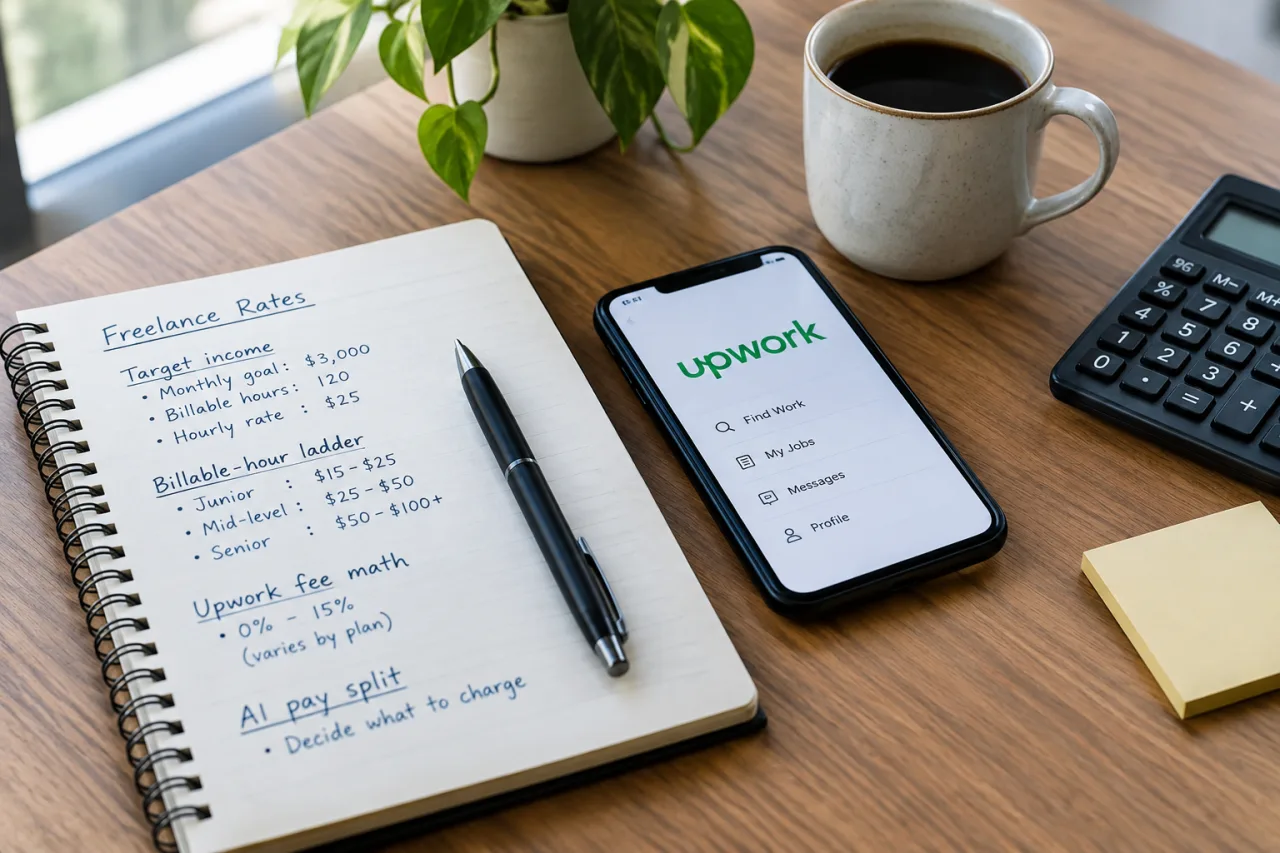
- Freelance Rates end, not start, at the number you quote. Upwork’s service fee now runs 0% to 15% per contract, and its own example says to net $20/hour at a 10% fee you must charge $22.22/hour: the fee sits on top of your take-home target, not under it.
- AI split the market into two price books. Upwork’s Future Workforce Index 2026, a 2,400-worker survey, found earnings for complex AI-augmented work up 45% year over year while high-volume generative work fell 13%.
- The quote ladder: target income, billable hours, then the fee. A $52,000 target over 80 monthly billable hours starts at $54.17/hour, which quotes at $60/hour once a 10% fee loads.
- Hourly punishes you when AI shrinks your hours. Reprice output-heavy work as fixed-scope projects, and let measured AI productivity fund a higher project price instead of a lower hourly rate.
Freelance Rates stopped being a guess in 2026: clients now pay a visible premium for judgment-shaped AI work and visibly discount volume-shaped work. This page computes the ladder from a target income to a quotable number, shows what Upwork’s variable fee does to every quoted figure, and ends with the reprice decision the two AI price books require. Every rate and fee carries its source; the survey tables live in our earlier deep-dive on the freelance AI pay split.
Freelance Rates: The Quote and the Net
Freelance Rates carry two prices: what you charge and what you keep. Upwork’s fee page states the current Freelancer Service Fee as a range of 0% to 15% per contract, decided per contract type, shown to you at proposal time, then fixed for the life of that contract. Many published guides still claim one flat percentage from the older fee eras; the live structure makes each contract carry its own percentage, so the net check happens per offer, not once a year.
Upwork’s own worked examples show the direction of the calculation. To net $20 an hour at a 10% fee, charge $22.22; to net $25, charge $27.78. The formula behind those numbers is one division: quote = net ÷ (1 − fee). At a 15% fee the same $25 target quotes at $29.41; at 0% (the range reaches there on some contract classes) it needs no adjustment. Project prices run the same reverse check: a $1,000 project keeps $900 at 10% and $850 at 15%. The refund rule matters too: when a client gets a refund, Upwork returns the fee on that amount, so the fee applies to money actually kept.

The same $1,000 contract at the fee percentages Upwork may assign, from its own fee page (0 to 15%, set at offer, fixed on contract).
Beginners routinely quote their target income and discover only after the first invoice that the fee landed on top. The one-line habit that prevents it: divide your take-home target by (1 − the shown fee) before every proposal. The variable structure changes who does the checking. Under the old flat-fee eras a freelancer memorized one number; under 0% to 15% per contract the fee follows the work type, so retainer contracts, hourly contracts and fixed projects may each carry their own percentage inside one freelance business. Treat every offer screen as a calculation prompt: read the fee, run the division, then decide whether the net still clears your target. A rate quoted once and forgotten is the cheapest mistake in freelancing; a rate checked per contract is one division away from being right. Upwork’s own 2026 pricing guidance pushes the same order: costs and target first, the platform fee last, then a number the budget can prove.
Freelance Rates and the AI Pay Split
The AI shift did not lower all freelance prices, and it did not raise all of them either. The Upwork Future Workforce Index 2026, built on a survey of 2,400 US skilled knowledge workers, measured the divergence: freelancers doing complex, AI-augmented professional work saw earnings rise 45% year over year, while freelancers in high-volume generative production lost 13%. Across the whole market, AI work earns a 34% hourly premium, and market surveys place AI workflow automation between $30 and $100+ per hour.
Both numbers reprice the same freelancer differently depending on which side of the split the work sits. If your work survives a client’s checklist of judgment (scope design, quality calls, integration, responsibility), the 45% cohort is the raise case: the market moved toward you. If your output is a volume a client could generate or buy cheaper, the 13% cohort is the reprice-or-reshape case: Freelance Rates built on judgment follow the market upward, while volume outputs either reprice in fixed scopes or keep deflating. A worked reprice on the same ladder shows the mechanics. Take a content deliverable that once billed 8 hours at $54 net and now takes 3 AI-assisted hours: billed hourly it slides to $162 per piece, an invitation for the client to cut the rate next quarter. Repriced as a fixed-scope project at $450, the same deliverable keeps $405 after a 10% fee, at an effective $135 net per hour, and the client’s invoice story is a flat project price rather than a rising hourly one. The 13% cohort shrinks by being repriced; the 45% cohort compounds because judgment work resists unitization. The full survey tables and the premium breakdown are in the pay-split analysis.
The Ladder From Target Income to a Quotable Rate
Freelance Rates compute one way for a solo operator, in three steps. First, name the take-home target for the year; a $52,000 example keeps the arithmetic clean. Second, divide by 12 for a monthly figure ($4,333) and by the hours you actually bill: a freelancer who carries 160 working hours in a month rarely bills more than 80 of them after prospecting, admin and rework, so the rate base is $54.17 an hour. Third, load the platform fee before the client ever sees a number: at a 10% fee the quote is $60.19, which rounds to a clean $60, and $60 ÷ 0.9 returns $54 of net, exactly on target.
The same ladder extends to day rates and projects. A day rate uses the net hourly figure across a committed day (8 × $54.17 = $433, quoted around $430-450 at the platform fee included) and trades a small discount for full-day certainty. Project pricing starts from the value delivered and the scope agreed, then runs the same fee division; a $1,000 fixed project keeps $900 at 10%. Billable hours deserve their own reality check, because the ladder’s denominator decides everything. Three months of invoices usually reveal a real billable ratio, not the planned one: prospecting, revisions, scope creep and admin eat the calendar, and a 50% billing reality turns a 160-hour month into an 80-hour denominator. Freelancers who skip this step quote rates that assume a full month of revenue at their target, then carry the shortfall silently. The discipline is one habit in all three forms: set the net first, run the fee division second, and let the client-facing number be the output of the calculation rather than its input.
When Hourly Pricing Costs Money
Freelance Rates that ride an hourly unit carry a hidden tax under AI: the tools compress the hours while the market pays for the outcome. A freelancer who automates half a deliverable and still bills hourly simply earns less; the 13% earnings decline in high-volume generative work is exactly this squeeze, measured. The fix is not to resist the tools but to change the unit: fixed-scope projects let productivity fund margin, because the price quotes from the client’s problem, not from your hours spent. Retainers, the third unit, price ongoing judgment and sit closest to the agency model (the AI automation agency route maps the solo version of that ladder).
The reprice conversation runs on recorded numbers, not feelings: hours actually billed on the last three projects of the same type, outcomes delivered, and the fee-adjusted net per project. When AI compresses those hours by 30%, the correct move is a higher project price with a shorter delivery window, not a quieter hourly invoice. The pattern repeats across the market: two freelancers deliver the same artifact, but the one whose price quotes from the deliverable keeps the productivity gain, and the one whose price quotes from hours donates it to the client. Repricing is a one-email conversation with the numbers attached; it is also the only move that converts AI speed into income instead of into discounts.
The 30-Day Rate Review: A Working Checklist
Freelance Rates decay silently when nobody audits them, so the review runs on a 30-day cycle with four columns on one page:
- Column 1, real net per unit: take each live contract’s last three invoices, subtract the shown platform fee, and write the net you actually kept per project or per hour.
- Column 2, real hours per unit: the measured average, AI-assisted hours included. The gap between column 1 and column 2 is your effective hourly truth.
- Column 3, the market signal: which side of the pay split the work sits on (judgment-shaped or volume-shaped), and whether this month’s prospect conversations mentioned price at all.
- Column 4, the number: recompute the ladder from the current target. If the new quote differs from the live rate by 10% or more, the next client gets the new number, and renewals get the reprice conversation with column 1 and column 2 as the proof.
The review turns the AI shift from a headline into a spreadsheet the freelancer controls. It also produces the cleanest raise script that exists: three projects, three outcomes, one number, and the new quote that follows from them.
Freelance Rates for Filipino and OFW Freelancers
Freelance Rates do not change their arithmetic at the border; the payout layer does. Cross-border freelancers lose a second percentage after the platform fee: conversion and transfer costs. The Wise setup for Filipino freelancers exists precisely because a 2% to 5% payout leak on every invoice can erase a carefully computed rate. State-side registration comes next: the Philippines taxes freelance income under the Form 1901 route with the 8% option covered in the BIR registration guide, and the 8% gross option changes the take-home target, not the ladder. The same three steps hold: net target, billable hours, fee division; only the net target carries the payout-loss buffer baked in. Run the buffer in raw numbers: a freelancer keeping a 2% payout loss quotes 2% higher on the same ladder, which is invisible to the client and decisive to the bank account. Quarterly numbers close the loop — platform fees, payout costs, taxes withheld on the 8% option — because a freelance rate that ignores the second fee in the chain reverts to guesswork.
FAQ
How do freelance rates work with Upwork’s fee?
Backwards from your net. Show the fee at proposal (0% to 15% per contract), divide your take-home target by (1 − fee), and quote the result. Upwork’s own examples: net $20/hour at a 10% fee quotes at $22.22/hour; net $25/hour quotes at $27.78/hour. The fee locks in once the contract starts and returns with client refunds.
Freelance Rates 2026: what should a beginner charge?
Start from the target, not from fear: pick a first-year take-home number, divide by realistic billable hours (80 a month is a workable planning figure), then load the fee. At a $52,000 target with an 80-billable-hour month and a 10% fee, the quote lands near $60/hour; the same ladder scales down for a smaller target rather than guessing.
Should you charge hourly or by project?
Hourly works when scope is genuinely uncertain and your hours stay visible; projects work when AI compresses the hours, because fixed-scope pricing lets productivity stay in your margin. The AI-era pattern measured in the 2,400-worker survey favors the second: volume-shaped work fell in price while judgment-shaped work rose.
How do freelance rates change when AI enters the workflow?
Complex, AI-augmented professional work rose 45% in earnings year over year; high-volume generative production fell 13%. Reprice accordingly: judgment-shaped work justifies a higher project price and a shorter window; volume-shaped work should migrate toward fixed scopes where speed funds margin instead of shrinking the invoice.
How often should freelance rates change?
On a 30-day review cycle, on any platform-fee change notice, and on a measured 20% productivity shift from new AI tooling. The survey evidence behind the current cycle: earnings moved 45% and 13% in opposite directions across work types in a single year, which makes annual-only reviews slower than the market.
What is a day rate and how is it computed?
A day rate multiplies your net hourly rate across a committed day and trims it for the certainty of full-day booking. The worked ladder: $54.17 net hourly × 8 = about $433, quoted near $430-450 with the platform fee loaded. Clients buy the day’s availability; you accept a small discount for not selling fragments of it.
How do freelance rates survive cross-border payouts?
Bake the payout cost into the net target before running the ladder. Conversion and transfer losses of 2% to 5% per invoice are the second fee after the platform fee; a Wise-style receiving setup (documented for Filipino freelancers in our getting-paid-from-abroad guide) is what keeps the computed rate intact.
- support.upwork.com/hc/en-us/articles/211062538-Upwork-Fees — fee page
- upwork.com/resources/how-to-set-your-freelance-rate — 2026 pricing guidance
External sources linked in this article, in order of first mention. Spotted an error or a broken link? Tell us.
Cite this pagePublished Nov 10, 2026
Agron, E. (2026, November 10). Freelance Rates: What to Charge When AI Changed What Clients Pay. WorldNgayon. https://worldngayon.com/freelance-rates-what-to-charge/
Agron, Edmon. “Freelance Rates: What to Charge When AI Changed What Clients Pay.” WorldNgayon, 10 Nov. 2026, worldngayon.com/freelance-rates-what-to-charge/.
Agron, Edmon. “Freelance Rates: What to Charge When AI Changed What Clients Pay.” WorldNgayon, November 10, 2026. https://worldngayon.com/freelance-rates-what-to-charge/.
Agron, E. (2026) ‘Freelance Rates: What to Charge When AI Changed What Clients Pay’, WorldNgayon, 10 November. Available at: https://worldngayon.com/freelance-rates-what-to-charge/.
E. Agron, “Freelance Rates: What to Charge When AI Changed What Clients Pay,” WorldNgayon, Nov. 10, 2026. [Online]. Available: https://worldngayon.com/freelance-rates-what-to-charge/
@online{agron2026freelancerates,
  author       = {Agron, Edmon},
  title        = {{Freelance Rates: What to Charge When AI Changed What Clients Pay}},
  year         = {2026},
  date         = {2026-11-10},
  organization = {WorldNgayon},
  url          = {https://worldngayon.com/freelance-rates-what-to-charge/},
  urldate      = {}
}TY - ELEC AU - Agron, Edmon TI - Freelance Rates: What to Charge When AI Changed What Clients Pay T2 - WorldNgayon PY - 2026 DA - 2026/11/10/ UR - https://worldngayon.com/freelance-rates-what-to-charge/ Y2 - ER -
Cite the version you read; the page may be updated. Zotero and Mendeley can also import this page directly.