
Table of Contents
Key Takeaway

- 📌 The ceiling held, the small caps moved: BSP Circular 1242 (November 2026) keeps the 3 percent monthly finance-charge cap on credit card interest Philippines wide, raises the installment add-on ceiling from 1 to 1.5 percent, and lifts the cash-advance processing fee cap from ₱200 to ₱300.
- 🧮 The formula hides in two windows: the daily rate is the monthly rate times twelve divided by 360, then your balance from purchase date to due date accrues at the full amount, and only the unpaid remainder accrues from due date to next statement.
- 💥 The worked number: a ₱20,000 purchase paid at minimum (₱850) generates ₱507.96 in finance charges the very next cycle, per BPI’s own published sample.
- 📉 The minimum-payment trap compounds: twelve months of minimums on that balance costs ₱4,355 in interest while the principal barely moves — the balance still sits at ₱10,935 after a full year.
- 💸 Cash advances have no grace period: interest runs from the posting date, plus the day-one processing fee, which is why cash is the most expensive thing a card can do.
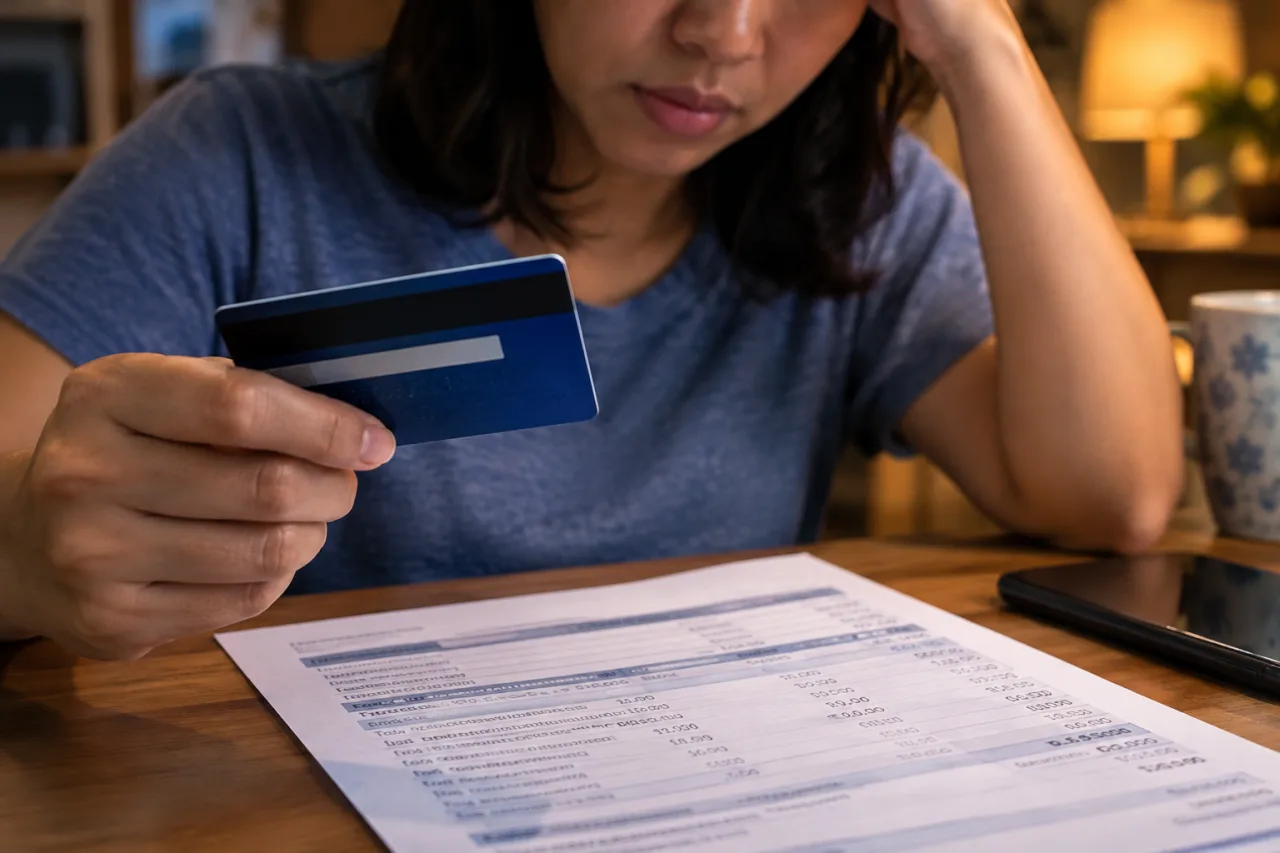
The number arrives padded inside a statement you half-scan: a finance charge of five hundred pesos on a purchase you technically did not finish paying. Where did that number come from, and why did it post even though you paid on time? The answer is the most useful piece of arithmetic a cardholder can learn: how credit card interest Philippines issuers actually compute the charge, on which days of which windows, under which central-bank caps. Everything below is pulled from the regulator’s circulars and a bank’s own worked sample, so the reader can reproduce their own statement line by line.
Credit Card Interest Philippines: the Rules That Set the Ceiling
Credit card pricing in the Philippines operates under ceilings the Bangko Sentral imposed as pandemic-era relief and kept thereafter: a 2 percent monthly finance-charge cap effective November 2020, raised to 3 percent in February 2023, and maintained at 3 percent in BSP Circular 1242 this November, per the BusinessMirror’s report of the issuance. That 3 percent figure is the legal ceiling on what credit card interest Philippines issuers may charge per month on revolving balances. The same circular adjusted the neighbors: the monthly add-on rate ceiling for installment loans rose from 1 percent to 1.5 percent, and the maximum one-time cash-advance processing fee rose from ₱200 to ₱300. The BSP framed the changes as balancing consumer protection against access to credit as operating costs rise, and stressed that no cap existed at all before the pandemic.
Effectivity has teeth worth noting: the adjusted ceilings apply only to new transactions from the circular’s effectivity date, set 15 calendar days after publication in the Official Gazette or a newspaper of general circulation. Installment plans agreed before that date keep their old terms. And all fees stay bound to the existing consumer-protection, disclosure and transparency requirements, which is exactly why every bank publishes a rates-and-fees table with the two numbers you should compare: the nominal monthly rate and the effective monthly rate. BPI’s rates and fees page is the clearest published example of the format.
The Formula Your Statement Hides
Banks compute credit card interest Philippines charges the same shape: a daily rate applied to your daily balance across two day-windows. BPI publishes the clearest worked sample in the industry, and it shows the three steps.
Step i, the factor rate: the monthly finance charge rate times twelve, divided by 360. For a 2.50 percent monthly rate, that is 30.00 percent divided by 360 days, which is 0.000833 per day. A 3 percent card yields 0.001 per day.
Step ii, two windows of accrual: window A runs from the transaction date to the payment due date, accruing on your full balance (the ₱20,000 sits undiminished here if you pay only the minimum). Window B runs from the due date to the next statement date, accruing on the remainder after your payment lands. The split matters because payments made between statement cut-off and due date reduce the balance only inside window B.
Step iii, the sum: the two windows add up to the finance charge that lands on your next statement.
The Worked Example, Line by Line
BPI’s own sample uses its Free+ card at a 2.50 percent monthly rate on a ₱20,000 purchase, statement date January 1, due date January 21, next statement February 1. The cardholder pays the minimum amount due, which on that card is 3.57 percent of the total outstanding balance: ₱850.
Watch the windows run. Window A: January 2 to January 20 is 19 days, so ₱20,000 times 0.000833 times 19 equals ₱316.54. Window B: January 21 to February 1 is 12 days, and the balance after the payment is ₱19,150, so ₱19,150 times 0.000833 times 12 equals ₱191.42. The finance charge posted on the February 1 statement: ₱507.96. Paying exactly the minimum, on time, still produced five hundred pesos of new charges in a single cycle: that is the statement shock, reproduced from the bank’s own arithmetic. Any reader can run the same credit card interest Philippines formula against their own statement, because the inputs are all printed on its face: statement dates, payment dates, the rate, and the amount paid.
The two-window method is also why paying the FULL amount changes everything: a cardholder who pays the total amount due by the due date leaves nothing accruing in either window on retail purchases, and the next statement’s finance charge reads zero. The grace period is not a gift; it is the absence of the second window.
The Minimum-Payment Trap, Measured
BPI’s sample table lets us measure a full year of minimum-only payments on that ₱20,000 purchase: twelve payments averaging around ₱1,200, interest postings of ₱285 to ₱508 per month, and by month twelve the outstanding principal is still ₱10,650 with the total balance at ₱10,935. Total interest paid across the year: ₱4,355. The cardholder spent ₱14,300 on payments and retired only half the purchase.
This is the arithmetic behind every financial counselor’s warning about credit card interest Philippines minimums. The minimum amount due exists to keep an account current, not to retire debt; it is deliberately set so that most of each payment goes to interest while the principal trickles. Run the same habit for a second year and interest keeps compounding on the survivor balance. The escape hatch is boring and mathematical: any payment above the minimum pushes directly into principal in window B, shrinking every subsequent window. Multiply that effect by the debt snowball payoff order and the payoff timeline collapses month by month.
Cash Advances and Installments: the Other Two Machines
Retail purchases get a grace window; cash advances do not, and they sit at the costliest edge of the credit card interest Philippines schedule. BPI’s own rates table states that cash-advance finance charges accrue from the transaction posting date until full payment, with no interest-free period at all, and the processing fee posts day one. In the bank’s cash-advance sample, the same ₱20,000 yields ₱522 of interest in month one alone, plus the fee, and ₱5,136.94 of interest across twelve months at an effective monthly rate of 2.65 percent — higher than the retail card’s 2.27 percent effective. The new ₱300 fee ceiling in Circular 1242 raises the cost of the same mistake slightly further.
Installments run on a third machine, the add-on or factor-rate computation: interest is computed on the ORIGINAL principal for the life of the plan, not on the declining balance. BPI’s sample shows a ₱20,000 installment at a factor rate carrying total interest of ₱2,400 with fixed monthly amortizations of ₱1,866.67; month one alone carries ₱357.62 of interest even though the borrower has already repaid a chunk of principal. Note the ceiling change here, too: new installment plans from November 2026 may carry up to a 1.5 percent monthly add-on, where 1 percent ruled before. And one more trap hiding in the footnote: unpaid billed installment amortizations get billed finance charges at the retail balance rate, so skipping an installment runs you through both machines at once.
Nominal versus Effective: the Two Numbers on the Table
Every bank’s rates table shows two interest figures per card, and confusing them is the most common reader mistake. The nominal rate is the headline monthly rate multiplied against your average daily balance. The effective rate per month, per BPI’s own definition, is the average monthly interest divided by the average principal balance, and it is almost always different: BPI lists 3 percent nominal against 2.73 percent effective on the same cards.
The effective number is the honest comparison figure, because it reflects how interest actually flows against the balance you carry rather than the theoretical maximum the nominal rate implies. The BSP’s disclosure framework exists precisely to force both numbers onto the table; every bank’s published rates-and-fees page carries them side by side, and comparing cards on effective rates is the version of the credit card interest Philippines comparison that actually predicts your statement. For the annual view, multiply and compound: 3 percent monthly compounds past 42 percent a year, which is the number that should justify paying in full whenever possible. That compounding effect is what makes the credit card interest Philippines comparison effective-rate-first: two cards with the same nominal rate can still differ once the effective column is read against your own payment habits.
The Cardholder Playbook
- Pay the total amount due, not the minimum, whenever cash flow allows: the entire finance charge vanishes from retail purchases.
- Never withdraw cash on the card unless it is a genuine emergency: no grace period, day-one fee, and the highest effective rate of any transaction type.
- Check the rate table’s effective column before applying for a new card; nominal rates hide the real carry cost.
- If you pay late, expect the penalty tier too: BPI charges ₱850 or the unpaid minimum, whichever is lower, per occurrence, on top of resumed interest accruals.
- Read the whole fees table once a year: annual memberships, late fees, returned-check fees and cash-advance fees all sit in the same published table, and the BSP maintains its own table of fees and charges as the regulator’s reference point for what institutions disclose.
- Disputes have their own machine: a wrong or unauthorized charge follows the dispute path we mapped in the Philippine chargeback guide, separate from interest arithmetic but equally deadlined.
- When interest is already deep: restructuring the debt by order of cost (the snowball versus avalanche method) beats minimum-payment autopilot on every month of the schedule.
FAQ
How is credit card interest computed in the Philippines?
Banks apply the monthly finance charge rate as a daily rate (monthly rate times twelve divided by 360) to your balance in two windows: the full balance from purchase date to due date, then the unpaid remainder from due date to the next statement. BPI’s published worked sample reproduces a ₱507.96 charge on a ₱20,000 purchase paid at minimum.
What is the maximum credit card interest rate in the Philippines?
The BSP caps finance charges at 3 percent per month, a cap kept this November in BSP Circular 1242 (it was 2 percent from November 2020, raised to 3 percent in February 2023). Installment add-on rates now cap at 1.5 percent monthly, and cash-advance processing fees at ₱300.
Why did I get charged interest if I paid on time?
If you paid the minimum rather than the total amount due, the unpaid remainder accrues interest in window B every day until the next statement, so an on-time minimum payment still generates a finance charge. Only paying the total amount due keeps retail purchases at zero finance charge.
What is the minimum amount due on a Philippine credit card?
It varies by issuer and card; BPI’s sample card sets it at 3.57 percent of the total outstanding balance. The minimum keeps the account current but is mathematically structured so most of each payment covers interest, which is why minimum-only repayment stretches a ₱20,000 purchase across years.
Do cash advances have a grace period?
No. Cash-advance interest accrues from the transaction posting date until full payment, plus a day-one processing fee of up to ₱300 under the new cap. BPI’s sample shows the same ₱20,000 cash advance costing ₱5,136.94 in interest over twelve months.
Does paying more than the minimum reduce interest immediately?
Yes, and immediately. Every peso above the minimum shrinks the balance that accrues in window B from the due date onward, so the next cycle’s finance charge is computed on a smaller base, and the effect compounds month over month. Extra payments are the fastest lever a cardholder holds on the credit card interest Philippines formula.
What is the effective interest rate on my credit card?
The effective rate per month is the average monthly interest divided by the average principal balance, and it is the number to compare across cards. BPI lists 3 percent nominal alongside 2.73 percent effective monthly on most of its cards, both printed in its published rates and fees table.
The Bottom Line
Nothing about the credit card interest Philippines statement is a mystery once the two-window arithmetic is visible: the daily factor rate, the full balance before the due date, the remainder after it. The central bank caps the ceiling and publishes the disclosure rules; the banks publish the rate tables and their own worked samples; the only step left is the one that saves actual money—pay the total amount due on retail purchases, avoid cash advances, and treat the minimum amount due as a fee for staying enrolled rather than a repayment plan.
Disclaimer: This article is for general education and is not financial advice. Rates, fees and rules change; verify current figures against your own card issuer’s published rates-and-fees table and the BSP’s circulars before making financial decisions.
- businessmirror.com.ph/2026/11/12/bsp-keeps-3-monthly-cap-on-credit-ca… — the BusinessMirror’s report of the issuance
- bpi.com.ph/personal/cards/credit-cards/rates-and-fees — BPI’s rates and fees page
- bpi.com.ph/personal/cards/credit-cards/sample-interest-calculation.ht… — BPI publishes the clearest worked sample in the industry
- Official bsp.gov.ph/Pages/InclusiveFinance/TableOfFeesAndCharges.aspx — table of fees and charges
External sources linked in this article, in order of first mention. Spotted an error or a broken link? Tell us.
Cite this pagePublished Nov 25, 2026
Agron, E. (2026, November 25). How Credit Card Interest Is Computed in the Philippines: the Number Your Statement Hides. WorldNgayon. https://worldngayon.com/credit-card-interest-philippines/
Agron, Edmon. “How Credit Card Interest Is Computed in the Philippines: the Number Your Statement Hides.” WorldNgayon, 25 Nov. 2026, worldngayon.com/credit-card-interest-philippines/.
Agron, Edmon. “How Credit Card Interest Is Computed in the Philippines: the Number Your Statement Hides.” WorldNgayon, November 25, 2026. https://worldngayon.com/credit-card-interest-philippines/.
Agron, E. (2026) ‘How Credit Card Interest Is Computed in the Philippines: the Number Your Statement Hides’, WorldNgayon, 25 November. Available at: https://worldngayon.com/credit-card-interest-philippines/.
E. Agron, “How Credit Card Interest Is Computed in the Philippines: the Number Your Statement Hides,” WorldNgayon, Nov. 25, 2026. [Online]. Available: https://worldngayon.com/credit-card-interest-philippines/
@online{agron2026creditcard,
  author       = {Agron, Edmon},
  title        = {{How Credit Card Interest Is Computed in the Philippines: the Number Your Statement Hides}},
  year         = {2026},
  date         = {2026-11-25},
  organization = {WorldNgayon},
  url          = {https://worldngayon.com/credit-card-interest-philippines/},
  urldate      = {}
}TY - ELEC AU - Agron, Edmon TI - How Credit Card Interest Is Computed in the Philippines: the Number Your Statement Hides T2 - WorldNgayon PY - 2026 DA - 2026/11/25/ UR - https://worldngayon.com/credit-card-interest-philippines/ Y2 - ER -
Cite the version you read; the page may be updated. Zotero and Mendeley can also import this page directly.