Key Takeaway
- 🇵🇭 The government formally launched eGovAI inside the eGovPH super app on September 21-22, 2026 — presidentially endorsed, free to every user per the official launch of the 40M-download platform.
- 🤖 The assistant “Kuya A” was built in-house by DICT developers on Google Gemini — a chatbot that answers government-process questions, points to services, and works 24/7.
- 🧰 The package includes a real-time translator for dialect speakers, an OCR document extractor for scanned forms and IDs, digital document signing (eGovDocs), a laws lookup, and more.
- 🛡️ DICT itself warns of fake eGovPH websites collecting personal data — the assistant lives only inside the official app, and the safety rules are simple.
- 📱 For OFW families it means remote transactions with LGUs and national agencies now come with free AI guidance — no separate download, no subscription.
The eGovPH AI rollout is the story the headlines buried under the ceremony: the most-downloaded government app in Philippine history just got a brain, and the government built it in-house.
On September 21-22, the Department of Information and Communications Technology formally launched eGovAI inside the eGovPH super app — with the assistant Kuya A front and center at a ceremony President Marcos addressed through Cabinet Secretary Benhur Abalos.
DICT Secretary Henry Aguda confirmed the agency’s own developers built the feature, per the Philippine Star, powered by Google Gemini, and framed the mission plainly: AI not as a technology showcase but as a tool “to make public services more responsive, accessible, and efficient.” For the 40 million Filipinos who already carry the app — and the 60 million the DICT targets by 2028 — the government’s AI era starts as a chat button, and eGovPH AI is its name.
Table of Contents
What Kuya A Actually Does — the Eight Tools in eGovPH AI
eGovAI bundles a working toolbox into one section of the app.
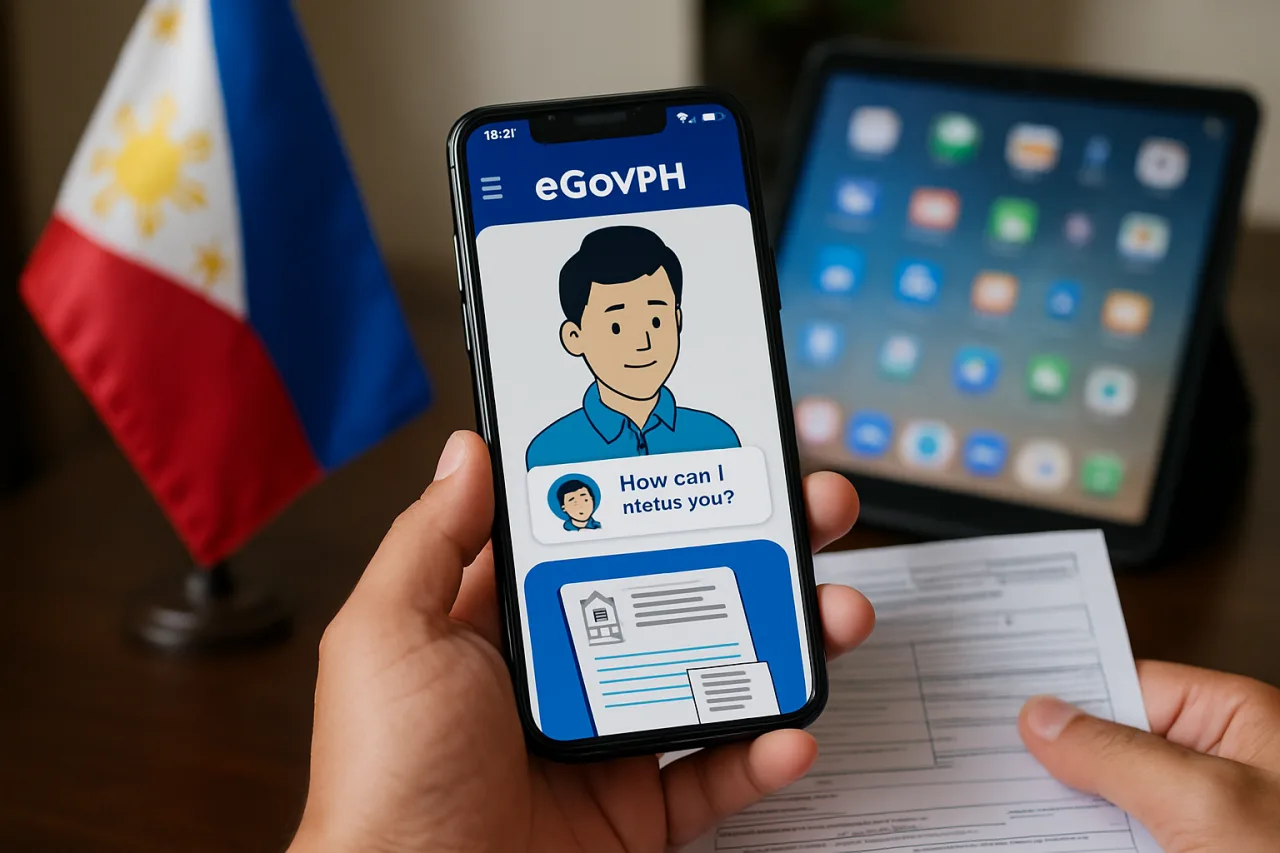
The AI Assistant chatbot — the heart of eGovPH AI — answers questions and routes users to the right government service at any hour — ask it how to secure a permit, where to pay, which documents a transaction needs, and it walks you through step by step.
The Translator supports multiple Philippine languages, so a Cebuano or Ilocano speaker can transact in the dialect they think in. The Document Extractor runs OCR on scanned forms and IDs — photograph a paper permit application and the text becomes copyable, fillable, machine-readable.
Then the utility tier: an Image Identifier that recognizes everyday objects; a Coder tool for writing and debugging code (yes, in the government app); a Speech Maker for drafting remarks; a Laws and Regulation lookup spanning national and local policies; and a Tourism guide.
Alongside the AI launch, the app added eGovDocs — signing documents digitally without a pen — and expanded access to Pag-IBIG, PhilHealth, and Yakap program benefits, with more LGUs joining for business, sanitary, and construction permits. No separate download or new account is required: Kuya A lives inside the existing eGovPH login.
Why Free AI From the Government Matters
The subscription math is the quiet story. The commercial AI assistants a Filipino professional might pay for run hundreds of pesos monthly; the free tiers of those products carry usage caps and upsells.
eGovAI is free, at national scale, with no account beyond the eGovPH login millions already hold — a DICT undersecretary described it plainly as a free alternative to ChatGPT.
For a citizen who needs one permit question answered, one form extracted, one process translated — the cost of asking has just gone to zero, inside the app that already holds their government identity.
The inclusion logic matters as much as the price. The translator and the document tools are aimed at citizens the commercial AI market underserves — dialect speakers, users filling handwritten forms, people who cannot afford subscriptions.
A government assistant that speaks your language, reads your forms, and costs nothing is digital inclusion in its most literal form.
The Rollout Reality: What eGovPH AI Changes for a 40-Million-User Platform
Scale changes what an AI launch means. A chatbot demoed at a summit is a pilot; eGovPH AI ships to the user base of the government’s single operating system — 40 million downloads today, a 60-million 2028 target, and the busiest transaction seasons (renewal season, benefit claims, permit season) already running through the app.
The DICT built the feature in-house rather than outsourcing the brain work, which means the agency keeps the integration knowledge, the prompt discipline, and the ability to fix what users break — a capacity decision that will matter more with each feature cycle.
The eGovDocs addition deserves its own sentence of respect: digital signing without a pen closes the last analog step of the government paperwork loop — apply, extract, sign, submit, track — and the AI layer sits across all of it.
The super app’s own description of the platform (“all government services, one app”) is no longer marketing; it is the architecture this month’s updates completed.
The OFW Use Cases That Make eGovPH AI a Remittance-Season Tool
For the diaspora, three uses land immediately. First, remote LGU transactions: the app’s expanding local-government coverage means an OFW in Riyadh can run a business-permit renewal or a construction permit for the family house with Kuya A guiding the requirements — no relative standing in a municipal window.
Second, document processing: the OCR extractor photographs and digitizes the forms an OFW family deals in — permit applications, benefit claims, barangay clearances — turning paper into signed digital documents via eGovDocs.
Third, the payments-and-guides layer: the chatbot answers the “how do I pay / where do I file / what does this notice mean” questions that usually cost an OFW a long-distance call to a cousin.
The eGovPH app already links the Philippine National ID for verification; the AI layer sits on top of that verified identity, which is what makes guided transactions — not just answers — possible.
The super app’s trajectory is explicit: 40 million downloads already, 60 million targeted by 2028, with the agency describing the platform as the government’s single operating system.
The Three Scam Rules
Rule one: the assistant lives only in the official app. DICT Undersecretary David Almirol has warned Filipinos about fake websites imitating eGovPH — built to collect personal data for identity theft.
Kuya A is not a website, not a separate download, and not a service anyone legit will ever charge you to “activate.” If a site or “agent” offers Kuya A access for a fee, it is the scam, in its entirety.
Rule two: never hand your eGovPH credentials to anyone. The assistant works inside your login; no DICT representative, no helper, no fixer needs your password or OTP — the same discipline every banking app requires.
Rule three: treat AI answers as guidance, not gospel. A permit requirement read through Kuya A should be confirmed against the official service page or the LGU before fees are paid — the assistant navigates, the official process validates. The rules take two minutes to learn and cover the entire eGovPH AI feature set.
What the Gemini Build Signals
The technology choice says something about where Philippine digital government is heading. Building the assistant on Gemini — with in-house DICT developers doing the integration — means the state is adopting the same foundation models that power the commercial tools, but wrapping them in a government-governed context with public-service goals.
Aguda framed it as bringing AI into the e-government ecosystem; the presidential endorsement at the launch signals continuity beyond any one administration official.
For observers of the region’s digital-government race, the Philippines just moved government AI from pilot-project status to consumer-scale deployment in one launch — eGovPH AI reaches 40 million users, a scale most national AI assistants anywhere have not touched.
The watch items are the honest ones: response accuracy on specific cases, data-handling transparency as usage grows, and the fake-version ecosystem that every successful government app attracts. Those are live questions — and the DICT’s own fake-site warning says the agency knows it. But the direction is set, and the price is zero.
The AI-Literacy Layer: Teaching 40 Million Users to Ask Better Questions
A national assistant’s success depends on more than its model — it depends on the questions citizens learn to ask. The practical technique is the same one this site teaches for commercial AI, applied to Kuya A: give context, name the transaction, ask for the steps.
“What do I need to renew my driver’s license in Quezon City, what does it cost, and where do I pay?” beats “license help” — and the answer arrives as an actionable checklist instead of a link dump.
The families that adopt this habit will feel the difference within the first week of use; the assistant converts a vague frustration into a numbered path, which is what government processes have needed for decades.
The literacy loop also runs in reverse: every question citizens ask teaches the DICT where the confusing processes are.
An assistant used at national scale becomes the government’s largest-ever feedback instrument — the questions cluster where the process design fails, and the agency that reads its own logs can fix the forms, not just the answers. That is the quiet governance upgrade inside the AI upgrade.
The Honest Limits
Three limits deserve naming before the enthusiasm outruns them. First, an AI assistant answers with what its sources hold — where an LGU’s requirement is unpublished or recently changed, Kuya A can only be as current as the system behind it, which is why the confirm-against-official-source rule stands.
Second, the document extractor reads what it can see: smudged scans, upside-down forms, and stylized handwriting remain imperfect OCR territory; clean photos produce clean extractions.
Third, the assistant’s reach is bounded by the app’s service coverage — every new LGU and agency onboarded expands what a user can actually transact, and the integration map is growing, not yet complete.
None of these caveats touch the core fact: the free tier of AI assistance now covers government’s front door, and eGovPH AI has made the price of asking a government question hit zero. The imperfect assistant that exists beats the perfect one that doesn’t — and this one is already in 40 million pockets.
The Five-Minute First Session: A Copy-Paste Starter
Open the updated eGovPH app and log in. Open the AI section and try this sequence — it exercises every major tool and teaches the interface in minutes. Ask Kuya A: “What are the requirements to renew a passport for a first-time adult applicant, and what are the fees?” Note how it structures the answer.
Photograph a handwritten form with the Document Extractor and watch the text become selectable. Switch the Translator to your family’s dialect and ask the same permit question — feel the difference comprehension makes. Open eGovDocs and digitally sign any PDF in your files.
Finish with the Laws lookup: search the exact regulation behind your most-hated permit requirement. Five minutes, and the assistant is no longer a mystery — it is a tool with your name on its welcome screen, and it cost the state’s treasury nothing per question you will ever ask it.
Frequently Asked Questions
What is eGovAI?
The AI capability inside the eGovPH super app — an assistant (“Kuya A”), translator, document extractor, image identifier, coder, speech maker, laws lookup, and tourism guide, built by DICT developers on Google Gemini.
When did it launch?
The formal launch ceremony ran September 21-22, 2026, with presidential endorsement; eGovPH AI tools are available now inside the existing eGovPH app for every user.
Does eGovAI cost anything?
No — the features are free within the eGovPH app; no separate subscription or account is needed beyond the standard eGovPH login.
How do I access Kuya A?
Update the official eGovPH app (e.gov.ph), log in with your existing account, and open the AI section — the assistant, translator, and document tools are inside.
Is there a fake eGovPH app or website risk?
Yes — DICT officials have warned about fake websites imitating the platform to collect personal data; use only the official app stores and e.gov.ph, and never share credentials.
Which languages does the translator support?
Multiple Philippine languages and dialects — the design goal is that citizens can transact in the language they think in; the tool list from DICT includes real-time translation within the app.
Can it process my documents?
The Document Extractor reads scanned forms and IDs via OCR, and eGovDocs lets you sign documents digitally — useful for permit applications and benefit claims without visiting an office.