Key Takeaway
The AI release race on the record, ships counted, tempo measured, crowns tracked, and what the four-times pace means for builders.
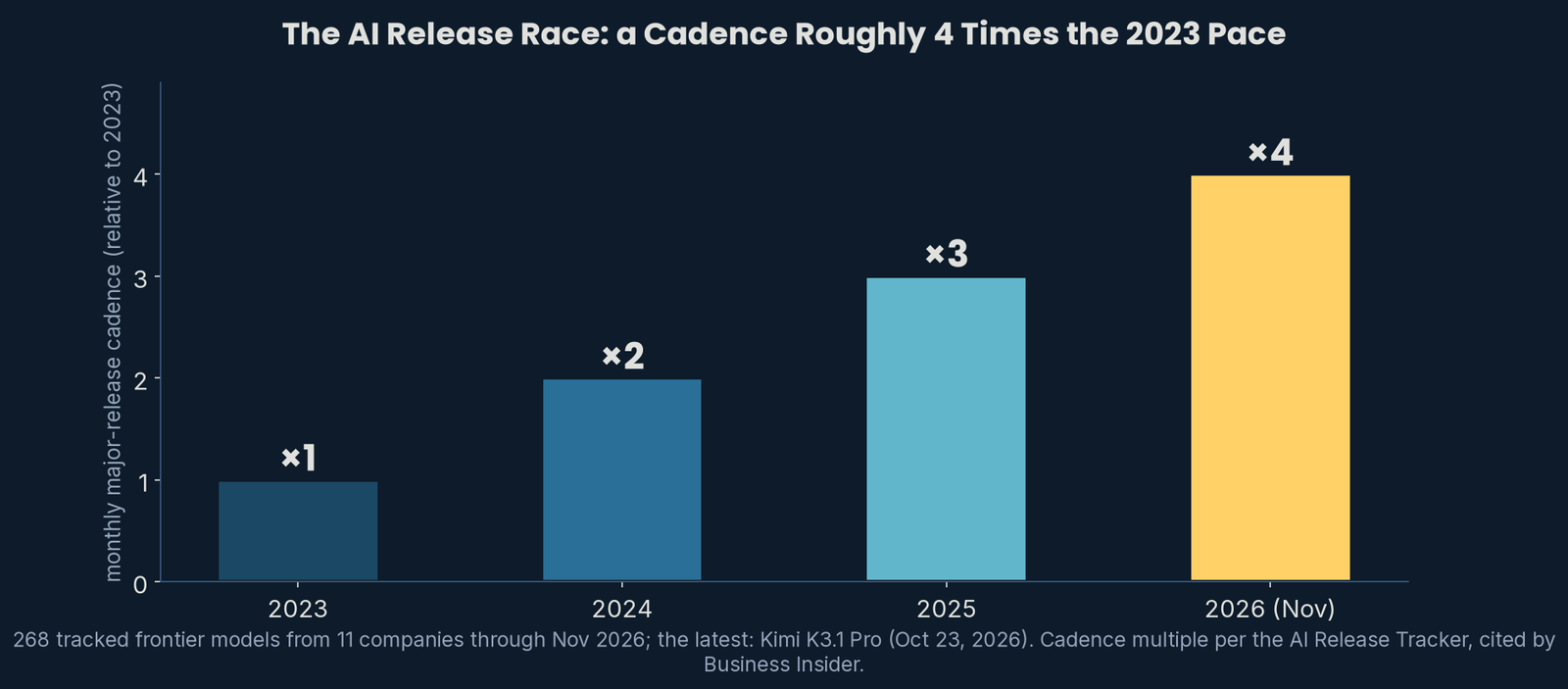
🏁 The count: 268 frontier models from 11 companies tracked since ChatGPT opened the era on November 30, 2022, and the monthly cadence of major releases is roughly four times the 2023 pace, per the release tracker that Business Insider has cited.
- 🧮 What four times means: a release tempo that once gave teams quarters to adapt now gives weeks; version-pinning and private test batteries have moved from good practice to survival kit.
- 🥇 The current standings: the leader on graduate-level science reasoning runs a 96 percent score on the tracker’s analytics (GPT-6 Astra), the software-engineering leader runs 87.6 percent on the agentic coding benchmark (Claude Opus 4.7), two different crowns on two different courses.
- 🌍 The field is wide, not two-party: the 268-model roster spans OpenAI, Anthropic, Google DeepMind, Meta, xAI, DeepSeek, Mistral, Moonshot (latest entry: Kimi K3.1 Pro, October 23, 2026), Z.ai and Qwen, naming-system families shipping at record pace.
- 📦 The release race now ships structure: tier names, dated changelogs and pinned versions, the industry’s own answer to a shipping speed that out-ran documentation habits.
The AI release race is the industry’s real scoreboard, the count of ships, the speed between them and the crowns they contest.: not the biggest model, but the fastest one after it. Since ChatGPT opened the modern era on November 30, 2022, trackers have counted 268 frontier models from 11 companies, and the monthly cadence of major releases has roughly quadrupled since 2023. What reads like a statistic in the AI release race is the load-bearing fact of the AI market, and this guide reads the full record: the pace, the standings on current benchmarks, the November tape (three labs with new builds in motion), and the operational craft every team now needs to ship against a four-times clock.
The AI release race matters because its speed sets everyone else’s tempo: procurement, integration and testing all plan on it. A release cadence that roughly quadruples between 2023 and 2026 reshapes procurement, integration planning, testing budgets and even the naming systems that make releases readable, the churn is the environment every AI decision now sits inside.
The count, and what the pace really measures
Two numbers anchor the book. The stock: 268 frontier models from 11 companies, OpenAI, Anthropic, Google DeepMind, Meta, DeepSeek, Mistral and the wider roster, DeepSeek, Mistral, Moonshot AI, Z.ai and Qwen among them, logged since the ChatGPT launch that opened the era. And the flow: the monthly cadence of major releases has roughly quadrupled since 2023, the claim the tracker’s founder cites from coverage, where the site itself has been featured. The stock is the AI release race’s past total; the flow is its speed, and the tempo is the number that hits your operations.
The newest entry shows the flow directly: Moonshot’s Kimi K3.1 Pro, tracked October 23, 2026 as the site’s most recent frontier release. The entry before it, and the one before that, the ledger runs week-to-week late in 2026. The release race is no longer a series of product moments; it is a continuous stream that teams swim in, with the tracker’s own “every other Monday” newsletter as part of the apparatus the pace built.
The standings: two crowns, two courses
As of the tracker’s latest refresh, the crown positions split. On GPQA Diamond, the graduate-level science reasoning exam, the leader is OpenAI’s GPT-6 Astra at 96 percent. On SWE-Bench Verified, real-world software engineering, the leader is Anthropic’s Claude Opus 4.7 at 87.6 percent. Two different courses, two different models ahead: the AI release race has stopped producing one universal winner, because the tasks diverged, reasoning exams crown reasoning builds; agentic coding crowns coding agents trained for it.
The split is the AI release race’s mature phase. A two-crown market tells buyers to match model to workload rather than to buy the top of one leaderboard, and it tells builders where the next contested ground is: whichever course the leader on the other crown enters next. The trackers now carry both scores live on an analytics page, one more instrument the race’s tempo required.
The November tape: three labs in motion
Where the flow of the AI release race goes next is on the record from the last two weeks. The Information’s report (via Yahoo Finance’s tape) has all three flagship labs working on new models: OpenAI preparing a Terra-family model for release in the coming weeks, aimed at improved capability at lower cost than GPT-6.1 Sol, the tier record shows, itself the September release that sharpened the Sol tier, and Google building Gemini 4 Carbon as the next element after Argon, whose Argon build shipped at the end of September and reached full availability on October 13. Anthropic is testing a reasoning-and-intuition model that infers goals from limited instructions, with testers reporting it can identify the broader problems behind individual bugs and propose more comprehensive fixes. Three labs, three builds, all named inside the tier grammar the naming systems established, the release race in its November chapter.
Why the pace quadrupled
Four forces carry the AI release race’s acceleration. The money: compute commitments in the tens of billions of dollars, gigawatt-class TPU agreements (the compute ledger in our Broadcom-deal record), multi-year cloud expansions, fund far more concurrent training runs than the 2023 budget class. The distribution: the API market made a new model a revenue event rather than a research note, so shipping is a sales motion. The measurement: trackers and leaderboards publish release standings live, which turns the cadence into a running contest with an audience. And the tools: training and evaluation infrastructure that a 2024 frontier lab spent months assembling is now a turnkey class. Each force compounds the others, which is why the cadence curve bends the way the tracker measures it.
Shipping against a 4× clock: the operational craft
The craft that survives the release race reduces to five moves. Pin model versions in production paths, so a silent endpoint change cannot rewrite the service overnight. Keep a private battery, a xxdozen real prompts with saved outputs, and re-run it after each release notice; the drift record shows why the battery, not the benchmark, is the honest check. Read the changelog at release time: tier names and dated notes are the version control the race requires. Separate the session from the model when performance feels different, and re-run fresh before concluding anything. And budget for the re-test: if your product touches a frontier model, the release race prices in one adaptation cycle per quarter, the four-times tempo, paid in testing hours.
The records that make the race readable
Instruments are as much a part of the AI release race as the models. The tracker’s analytics page carries the benchmark crowns live, the release ledger logs every entry with its date, and the coverage layer, the weekly digests and round-ups, compresses the tape into paragraphs a decision-maker can absorb. The instrument layer exists because the pace demands it: at 2023’s speed, a quarterly memo sufficed; at four times the pace, the memo is dead and the live record replaced it. The same is true inside organizations that consume the models: the changelog subscription, the pinned-version registry and the nightly battery are the in-house instruments of the same race.
The readable version of the instrument layer is the tier grammar itself. A team that knows the family map, flagship, workhorse, volume tier, reads any release headline in seconds: which station moved, on which course, at what tier. The AI release race is navigable; the naming decoder and the trackers are the navigation.
A closing note on what the pace costs, and what it protects. The cost is real: every release the AI release race ships is a re-test, a re-read and possibly a re-pin for every integration in the field, the four-times tempo paid across thousands of teams is a genuine industry-wide expense. What it protects is the edge: the fastest builds carry the newest capability into reach faster than the older cadence ever could, and the two-crown standings show the field spreading the gains across courses rather than concentrating them. Teams that read the race as a service, the record updated weekly, the tiers pinned deliberately, get the edge without paying the anxiety. The AI release race does not slow down for anyone’s planning cycle; the plan flexes to the record, not the other way around.
What the release race means for teams in the Philippines and beyond
For teams building on the platforms, including the Philippine agencies, startups and shared-services teams whose clients’ tools sit on these model families, the AI release race changes budgeting arithmetic. A four-times cadence means the “pick the best model” review is a quarterly task at baseline, and the winners of reviews are tier families, not lone releases: the platform-tier guides and the naming systems exist precisely because buyers now choose stations, not snapshots. The teams that pin, battery-test and changelog-read convert the race from a treadmill into a cadence they can plan against.
For the developers inside those teams, the AI release race is also the job market: every release widens the set of deployable builds, and the professionals fluent in tier-level reasoning, which model for which workload, when to re-pin, what the battery says, are the ones the market pays the premium for. The AI release race is the industry’s tempo; fluency in reading it is the professional’s edge.
The dated numbers to watch from here
Three numbers carry the AI release race’s story forward. The count: the next milestones on the tally to 300 tracked frontier releases, a xxmark the current cadence reaches in 2027. The crowns: whether the GPQA and SWE-Bench leaders converge or split further, the standings split is the release race’s most consequential open question, because a single model holding both would re-unify the market’s premium pricing. And the tape: whether the three November builds, the Terra model, Carbon, the reasoning class from Anthropic, land before year’s end, putting four major releases across the tier map in one quarter. Track them the way the race teaches: dated, week-to-week.
Financial Disclaimer
This article is published for general information and analysis, not as investment advice, and it names no security for purchase. Model capabilities, benchmark scores and release plans cited reflect public reporting and tracker data as of their dates and change without notice. Assess your own requirements before acting on platform or vendor decisions described here; WorldNgayon accepts no liability for decisions taken on the basis of this article.
FAQ
How many AI models have been released since ChatGPT?
The AI Release Tracker counts 268 frontier models from 11 companies between ChatGPT’s November 30, 2022 launch and late 2026, and its data, cited by Business Insider, shows the monthly cadence of major releases roughly quadrupled since 2023. The most recent tracked entry at this writing is Moonshot AI’s Kimi K3.1 Pro, released October 23, 2026.
How much faster are AI models released compared to 2023?
Roughly four times faster: the monthly cadence of major frontier-model releases has about quadrupled between 2023 and 2026, per the tracker’s data. In practical terms, a team that once had quarters to adapt to a new model now gets weeks, which is why version-pinning and private test batteries are standard practice now.
Which AI model leads the benchmarks right now?
Two at the latest standings, on different courses: OpenAI’s GPT-6 Astra leads GPQA Diamond (graduate-level science reasoning) at 96 percent, while Anthropic’s Claude Opus 4.7 leads SWE-Bench Verified (real-world software engineering) at 87.6 percent, both tracked live on the release tracker’s analytics page.
What happened in the AI release race in November 2026?
The tape carries three labs in motion: OpenAI preparing a Terra-family model for coming weeks (better capability at lower cost than GPT-6.1 Sol), Google building Gemini 4 Carbon as the next element tier after Argon shipped in late September, and Anthropic testing a reasoning-and-intuition build that infers goals from limited instructions, three named builds against one quarter.
Why does the release cadence matter for businesses?
Because the cadence sets the adaptation budget: a roughly 4× tempo against 2023 means quarterly model re-tests, pinned versions, changelog reading and session-vs-model diagnostics are the baseline operating cost every model-touching product now carries. The pace is the planning environment.
Is the AI release race slowing down?
No, the data shows acceleration through late 2026, with compute commitments funded in the tens of billions and three flagship labs with named builds in motion in a single month. The observable slowdown risk is the convergence question: when one model leads both major course benchmarks, the marginal release’s audience thins, but that convergence has not arrived.
- aireleasetracker.com — the claim the tracker’s founder cites from coverage
- toloka.ai/blog/gpt-models-explained — GPT-6.1 Sol, the tier record shows
External sources linked in this article, in order of first mention. Spotted an error or a broken link? Tell us.
Cite this pagePublished Nov 7, 2026
Agron, E. (2026, November 7). The AI Release Race: 268 Models in 4 Years and a Cadence 4× Faster. WorldNgayon. https://worldngayon.com/ai-release-race/
Agron, Edmon. “The AI Release Race: 268 Models in 4 Years and a Cadence 4× Faster.” WorldNgayon, 7 Nov. 2026, worldngayon.com/ai-release-race/.
Agron, Edmon. “The AI Release Race: 268 Models in 4 Years and a Cadence 4× Faster.” WorldNgayon, November 7, 2026. https://worldngayon.com/ai-release-race/.
Agron, E. (2026) ‘The AI Release Race: 268 Models in 4 Years and a Cadence 4× Faster’, WorldNgayon, 7 November. Available at: https://worldngayon.com/ai-release-race/.
E. Agron, “The AI Release Race: 268 Models in 4 Years and a Cadence 4× Faster,” WorldNgayon, Nov. 7, 2026. [Online]. Available: https://worldngayon.com/ai-release-race/
@online{agron2026airelease,
  author       = {Agron, Edmon},
  title        = {{The AI Release Race: 268 Models in 4 Years and a Cadence 4× Faster}},
  year         = {2026},
  date         = {2026-11-07},
  organization = {WorldNgayon},
  url          = {https://worldngayon.com/ai-release-race/},
  urldate      = {}
}TY - ELEC AU - Agron, Edmon TI - The AI Release Race: 268 Models in 4 Years and a Cadence 4× Faster T2 - WorldNgayon PY - 2026 DA - 2026/11/07/ UR - https://worldngayon.com/ai-release-race/ Y2 - ER -
Cite the version you read; the page may be updated. Zotero and Mendeley can also import this page directly.