
Key Takeaway
The record: teams cut staff over AI in 21 percent of Gartner’s surveyed support organizations, and rehire half of them by 2027. The survey, dated November 5, 2026.
📉 The number, dated November 5, 2026: of 275 service and support leaders surveyed in July and August 2026, 21 percent said their organizations cut agent headcount because of AI, modest against the headlines, and Gartner itself calls the impact “so far” modest.
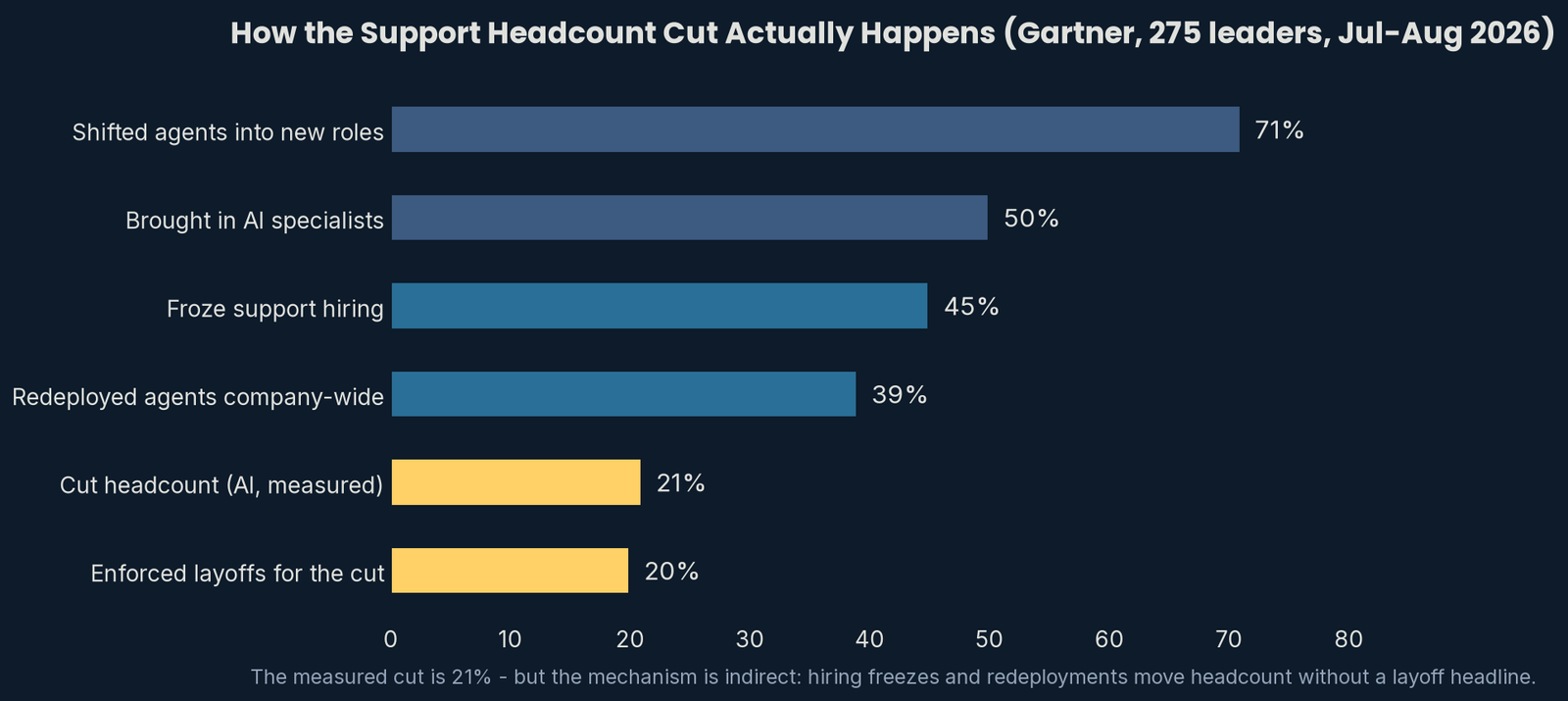
- 🧊 The cut is indirect: 45 percent froze support hiring and 39 percent redeployed agents to other functions, headcount shrinks without a layoff announcement, and only 20 percent used enforced job cuts for it.
- ↩️ The rehiring is already on record: some cut teams are hiring agents back, and Gartner’s February 2026 prediction stands: half of the companies that cut customer service staff because of AI will rehire them by 2027.
- 🧯 The ROI paradox: Gartner’s separate November 4 survey found just 4 percent of customer service leaders have achieved the expected return of their AI initiatives, the money came in, the payback did not.
- 🎓 Where the work moved: 71 percent are moving agents into new roles inside service and support, and more than half have hired specialists to run the AI programs, the cut is a reshuffle with a retraining bill, not a demolition.
One in five support leaders says their organization cut staff over AI. That is the finding, dated, sized, and sourced, from Gartner’s latest survey wave, and it is the number that decides whether teams cut staff over AI this year, the most useful jobs figure in customer service (read alongside our model-drift record, which explains why support AI still hands work back) since the industry started promising agent-less support in 2024. It is not zero: some teams have cut staff over AI outright. It is also not the mass automation the loudest headlines keep promising: for most of the market the effect is indirect, showing up in hiring freezes and reassignments that take months to register.
The context around the number matters as much as the number. Gartner’s earlier survey, 321 leaders, October 2025, found 20 percent had cut agent staffing; a year later the count stands at 21 percent. In twelve months of agentic-AI hype, product launches and cost-cut chatter, the measured share of leaders who cut staff over AI moved by a single point. This guide walks the survey’s full record: how the cut actually happens, why teams are already rehiring, what the return-on-investment numbers say, and what leaders should carry out of the November 4-5 Denver conference where the data landed.
The survey record, dated
The finding comes from Gartner’s survey of 275 service and support leaders, conducted in July and August 2026 and reported November 5, 2026. The topline: 21 percent of leaders said their organizations had cut human agent headcount because of AI. Customer Experience Magazine’s coverage describes AI’s impact on headcount “so far” in plain terms, modest, and moving mainly by indirect mechanisms.
The mechanisms are the survey’s most useful detail. Nearly half of leaders, 45 percent, have frozen hiring in support; 39 percent are redeploying agents to other parts of the business; just 20 percent have turned to enforced job cuts. Emily Potosky, senior director in Gartner’s customer service practice, notes that most leaders are shrinking their teams indirectly, through measures that take time to show up in the numbers. That timing detail is the piece the headlines usually drop: a hiring freeze cuts the team by attrition at next year’s budget line, not this week’s.
The opposite direction is on the same record. Seventy-one percent of leaders are moving agents into new roles within service and support, and more than half have brought in specialists to work on AI projects. The workforce is being reshaped faster than it is being reduced, the strongest argument against reading 21 percent as the start of a demolition.
The rehiring prediction, and the first evidence
In February 2026, Gartner predicted that half of the companies that cut customer service staff because of AI would rehire them by 2027, a xxforecast that landed while the automation narrative was at its loudest. The November survey supplies the first supporting evidence: some teams that cut staff over AI are already hiring agents back. The reason is operational, not sentimental. When the AI cannot cope with the volume or difficulty of the work the leader planned for, service standards slip; a smaller team may then lack the capacity to absorb the extra load, and the coverage, quoting Gartner directly on rehiring, reads those early moves as backing for the 2027 forecast, the first evidence that teams which cut staff over AI can want people back within months.
The pattern is a textbook service-operations cycle. Automation deflects the easy contacts, the queue gets weighted toward the hard ones, the human team that remains carries a harder share than before, and the gap shows up as missed standards rather than a line item. Companies that cut staff over AI at the peak then face the rebuild: hiring, training and integration costs that arrive after the deflection savings are counted. The prediction gives the market a dated checkpoint, by 2027, roughly half the cutter cohort is expected back in hiring mode.
The ROI paradox that frames the whole question
A day before the headcount survey landed, Gartner released a companion: just 4 percent of customer service leaders have achieved the expected ROI of their AI initiatives. The pairing reads like a confession from the industry. The AI is being bought at scale; the expected return is not showing up for 96 percent of buyers. That mismatch is precisely why headcount moves indirectly: leaders who cannot yet measure an AI payback are the same leaders who freeze hiring rather than enforce cuts, nobody lays off against an unrealized return.
The ROI gap also reframes the choice to cut staff over AI. The leaders who did cut staff over AI outright are the front of a distribution, moving before the return evidence exists, with Gartner’s own analysis warning that relying solely on AI is premature given what the technology cannot yet do. Potosky’s caution in the release is explicit: AI is not mature enough to fully replace the expertise, empathy and judgment human agents provide. The 4 percent figure is the market pricing its own patience.
Two further mechanisms show how the same survey week carried more than one workforce result. The volume story ran separately from the jobs story: contacts deflected to automation keep rising while the human team’s share of the queue shifts toward complex work, and 31 percent of leaders reported planning or implementing frontline reductions through the first quarter of 2027, mostly through the attrition method, not layoffs. That staggered timeline is the survey’s own forecast: the enforcement share could rise into 2027 even as the rehiring share rises beside it, and the two numbers together, the share that cut staff over AI and the share rehiring, are the real reading, not either one alone.
What the conference said the same week
The data arrived at Gartner’s Customer Service and Support Conference in Denver, November 4-5, where the analyst firm’s own framing ran from the ROI survey to the 2027 leadership-vision webinar scheduled for December 15. The same week’s releases push the same theme: workforce moves in support are being made, 63 percent gradual-by-attrition per a companion survey, 31 percent planning frontline reductions through Q1 2027, eight in ten leaders under pressure to change the workforce, but the direction of travel is role redesign over removal. The industry’s story has shifted from “agents go away” to “agents get re-tooled while the volume shrinks”: 85 percent of leaders are reallocating agent capacity toward higher-value work the customers value most.
How enterprises should read this survey
Four readings carry. First, the headcount cut is real for a fifth of the market and the indirect methods are the main mechanism, a xxworkforce plan built around attrition and redeployment, not a headline layoff, is what the data supports. Second, the rehiring half-prediction gives a dated test: if AI deflection under-delivers, by 2027 the rehiring wave will be visible in the same survey instrument, track it. Third, the ROI record is the honest gate: builds the specialist seats the enterprise agents guide described, and cuts only when the return is measured, or carry a plan for the standards slip. Fourth, the specialists wave is the budget line that arrives on time, the same shift the managed MCP servers guide traced on the platform side, more than half of leaders are hiring for it, and the internal candidates are being moved into those roles by nearly three in four.
What the 21 percent means for teams in the Philippines and the world’s support hubs
The number lands hardest in the countries where support is the industry: the Philippine contact-center and BPO sector, among the world’s largest, has been watching AI’s arrival since the chatbot wave of 2023 with the sharpest attention anywhere. The Gartner data is the sector’s best case for the slow-motion version of the story: through a year of agent-grade AI launches, only 21 percent of Western leaders cut staff over AI, and the majority of the market moved the workforce sideways instead, new roles, specialists, redeployment. For the Philippine sector’s 1.3 million workers and the industry’s AI-transition programs, the survey is the calibration: automation in support is arriving through attrition and training for most, with only a fifth choosing to cut staff over AI outright, not through mass replacement, and the rehiring prediction says the sector’s human premium is still priced in.
For the professionals inside it, the reading is the same one the 71 percent implies: the new roles inside support are the destination, AI-specialist, AI-trainer, quality-analyst-of-agents, case-flow designer, and the redeployed agents who land them are the ones with both the domain knowledge and the AI fluency. The survey’s own numbers point the professional path: the sector’s employers are building exactly those seats.
The dated numbers to watch from here
Three numbers carry the story forward. The rehiring share: whether the by-2027 half-firms mark reaches the half by the 2027 survey wave, the prediction has a timestamp, and the early evidence is already in the record. The 4 percent: the ROI share of leaders with expected results, its climb (or stall) through 2027 is the market’s own verdict on the build-out. And the enforcement rate: 20 percent cutting by layoffs versus the indirect 45-and-39, if enforcement rises while ROI stays at 4 percent, the next year’s survey is a different article. Until then, the record stands as of November 5: the cut is real for 21 percent, indirect for most, reversible for half, and the jobs story in support is running on the workforce’s own clock, not the hype cycle’s.
FAQ
How many support teams cut staff over AI, according to Gartner?
According to the Gartner survey of 275 service and support leaders conducted in July and August 2026 and reported November 5, 2026, 21 percent said their organizations cut agent headcount because of AI. An earlier Gartner survey (October 2025, 321 leaders) recorded 20 percent, the measured share moved about one point across a year of major AI launches.
How are most organizations reducing support headcount if not by layoffs?
Indirectly. In the same survey, 45 percent of leaders froze support hiring and 39 percent redeployed agents to other parts of the business, while only 20 percent used enforced job cuts. Gartner’s Emily Potosky notes most leaders are shrinking teams through measures that take time to show up in the numbers.
Will companies that cut support staff because of AI hire them back?
Gartner predicted in February 2026 that half of the companies that cut customer service staff because of AI will rehire by 2027, and the November survey already records some teams hiring agents back. The operational driver: when AI cannot handle the volume or difficulty planned for, service standards slip and the smaller team lacks capacity, which pushes the rebuild.
What did Gartner’s ROI survey find a day earlier?
Released November 4, 2026: just 4 percent of customer service leaders said they have achieved the expected ROI of their AI initiatives. The pairing with the headcount survey is the week’s real finding: the buying is ahead of the payback, and the workforce moves reflect that caution.
Are support jobs safe from AI in the Philippine BPO sector?
The data leans toward a transition rather than a demolition: only 21 percent of Western leaders cut staff over AI, 71 percent are moving agents into new roles in support, and Gartner expects half the cutters to rehire by 2027. For the Philippine contact-center and BPO sector , among the industry’s largest employers, the picture supports the redeployment-and-training path the local transition programs are already running.
What should a support leader do with this finding?
Measure before cutting: the ROI record (4 percent of leaders with expected returns) is the gate. Build the workforce plan on the survey’s own mechanisms, attrition and redeployment rather than enforced cuts, staff the specialists wave the market is hiring for, and set a dated checkpoint: if standards slip after a cut, the rehiring evidence says rebuild early.
Financial Disclaimer
This article is published for general information and analysis, not as investment advice, and it names no security for purchase. Workforce, budget and technology decisions described here carry operational and financial risk, and figures cited reflect public reporting as of their dates. Assess your own requirements and consult licensed advisers before acting; WorldNgayon accepts no liability for decisions taken on the basis of this article.
- cxm.world/employee-experience/ai-impact-customer-service-headcount-ga… — The finding comes from Gartner’s survey of 275
- gartner.com/en/newsroom/press-releases/2026-02-03-gartner-predicts-ha…
- gartner.com/en/newsroom/press-releases/2026-11-04-gartner-survey-reve… — Gartner released a companion: just 4 percent
External sources linked in this article, in order of first mention. Spotted an error or a broken link? Tell us.
Cite this pagePublished Nov 7, 2026
Agron, E. (2026, November 7). 1 in 5 Support Teams Cut Staff Over AI: the Gartner Survey, Dated Nov 5. WorldNgayon. https://worldngayon.com/support-teams-cut-staff-over-ai/
Agron, Edmon. “1 in 5 Support Teams Cut Staff Over AI: the Gartner Survey, Dated Nov 5.” WorldNgayon, 7 Nov. 2026, worldngayon.com/support-teams-cut-staff-over-ai/.
Agron, Edmon. “1 in 5 Support Teams Cut Staff Over AI: the Gartner Survey, Dated Nov 5.” WorldNgayon, November 7, 2026. https://worldngayon.com/support-teams-cut-staff-over-ai/.
Agron, E. (2026) ‘1 in 5 Support Teams Cut Staff Over AI: the Gartner Survey, Dated Nov 5’, WorldNgayon, 7 November. Available at: https://worldngayon.com/support-teams-cut-staff-over-ai/.
E. Agron, “1 in 5 Support Teams Cut Staff Over AI: the Gartner Survey, Dated Nov 5,” WorldNgayon, Nov. 7, 2026. [Online]. Available: https://worldngayon.com/support-teams-cut-staff-over-ai/
@online{agron2026supportteams,
  author       = {Agron, Edmon},
  title        = {{1 in 5 Support Teams Cut Staff Over AI: the Gartner Survey, Dated Nov 5}},
  year         = {2026},
  date         = {2026-11-07},
  organization = {WorldNgayon},
  url          = {https://worldngayon.com/support-teams-cut-staff-over-ai/},
  urldate      = {}
}TY - ELEC AU - Agron, Edmon TI - 1 in 5 Support Teams Cut Staff Over AI: the Gartner Survey, Dated Nov 5 T2 - WorldNgayon PY - 2026 DA - 2026/11/07/ UR - https://worldngayon.com/support-teams-cut-staff-over-ai/ Y2 - ER -
Cite the version you read; the page may be updated. Zotero and Mendeley can also import this page directly.