Key Takeaway
The AI model naming system is load-bearing product grammar, the spacecraft-style names map where each model sits, and this guide decodes all three vocabularies, dated to the current releases.
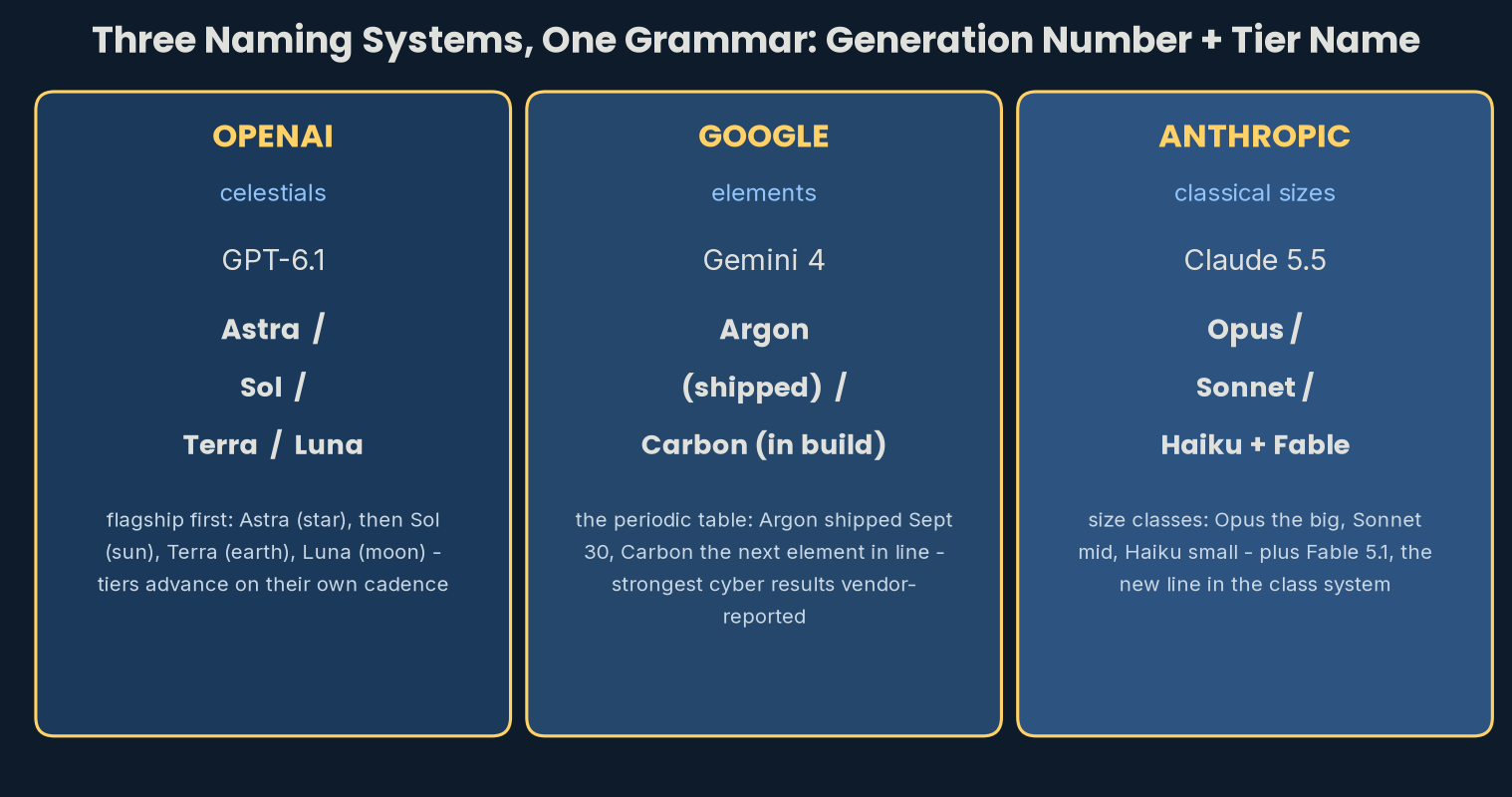
🛰️ One grammar, three vocabularies: the big labs all name models the same way, a xxgeneration number plus a tier name, and draw the tiers from themed pools: OpenAI’s celestials (Astra, Sol, Terra, Luna), Google’s elements (Argon, Carbon), Anthropic’s classical sizes (Opus, Sonnet, Haiku, plus a new line, Fable).
- 🔢 The number is the generation, the name is the tier: since GPT-5.6, OpenAI treats Sol, Terra and Luna as durable tiers that advance on their own cadence, the name survives point releases while the version number keeps moving.
- 🧭 The names are a menu, not decoration: they tell you which tier of work the model is for, Luna for volume, Sol for professional work, Astra for the frontier, so the fastest way to pick a model is to read its name.
- 🧱 Google names by element: Gemini 4 Argon (shipped September 30, 2026, widely available October 13, with a 1-million-token output limit) and Gemini 4 Carbon (in build, vendor-reported as its strongest for cybersecurity findings) one noble gas, one the element of strength in steel.
- 📡 The decoder’s value: release news, Terra in prep, Carbon in build, becomes readable at headline speed, and the naming system explains why model changelogs churn: the tiers are the stable reference points in a market shipping hundreds of versions a year.
Astra. Sol. Luna. Terra. Argon. Carbon. Fable. Opus. Sonnet. Haiku. The AI model naming system runs on spacecraft parts, celestial bodies and periodic-table elements, and it is not marketing poetry, it is load-bearing product grammar. Learning to read it takes minutes and pays off every time a lab announces its next flagship, because the name tells you the model’s station in the family, and the family structure tells you what changed under the announcement.
Three conventions carry the whole industry right now. OpenAI attaches tier names to a generation number; Google names its Gemini builds after elements; Anthropic keeps size classes after the literary instruments of the human voice. Each convention solves the same three problems, telling tiers apart inside a family, keeping names meaningful across dozens of releases, and signaling capability to a buyer in one glance. This guide decodes all three, dated to the current releases on the record.
OpenAI: the celestial tiers, decoded
OpenAI’s naming system made its decisive turn with GPT-5.6 in July 2026, and it holds in the GPT-6 era. The number identifies the generation, GPT-6, or its point release GPT-6.1. The name identifies the tier inside the generation: Astra is the flagship, the word evokes stars, with the community even tracking the Latin lineage (“Stella” star, “Stellula” little star) in OpenAI’s developer forum, Sol is the high-capability workhorse for professional work and coding with the higher usage limits, Terra is the balanced everyday tier, and Luna is the fast, low-cost tier for high-volume workloads. OpenAI describes Sol, Terra and Luna as durable tiers that can advance independently rather than as three frozen versions of the same model one grammar point with real product consequences.
The rollout pattern on the record shows the grammar working. GPT-6 Astra arrived first in the paid plans in early September 2026 as the company’s most intelligent model. GPT-6 Sol and GPT-6 Luna followed on September 22 across ChatGPT Work, Codex and the API, with Luna opened to Free and Go users in the desktop app, and GPT-6.1 Sol shipped a week later, on September 29. Since October 7, Astra-class capability sits behind ChatGPT’s Chat tab with a visible jump in presentation: charts, buttons and small working tools inside replies. Read as a naming system: the tiers arrived in flagship order, then filled the menu down, and the next point release can advance Sol without touching Luna.
Google: the element table
Google’s convention names tiers after elements, and the sequence carries the information. Gemini 4 Argon was announced September 30, 2026 and became available to everyone on October 13, with a 1-million-token output limit and strong grades on coding, professional work, visual tasks and cybersecurity defense (the full October release guide, from clone-systems, lines up every family the tape saw). Gemini 4 Carbon is the next build in the family, announced in preparation rather than ship, and described in vendor statements as Google’s strongest model for cybersecurity, with the strongest vendor-reported results at finding and exploiting vulnerabilities. The Information’s November tape adds the same directional report from developer sources: Google’s models remain particularly strong on visual work, video analysis and website testing.
Why elements instead of stars: the table has an ordering, and names like Argon and Carbon sound like materials rather than mascots. The Argon naming is also quietly exact, a xxnoble gas, the element that does not react easily, carrying the 1M-token output stability in spirit. Read as a sequence, the system can carry Google’s cadence for years: one element per tier build, the table supplying the next name each time the family extends.
Anthropic: the human voice, classed
Anthropic’s naming system has been the most stable in the industry: Claude models carry the generation number and the size class, Opus the largest and most capable, Sonnet the middle of the family, Haiku the small and fast. The Claude 5.5 generation holds all three, and the current releases add a new line: Fable, shipped as Fable 5.1 alongside Opus 5.5, Sonnet 5.5 and Haiku 5.5. The company’s release tape in the naming era reads plainly: the classes are the contract, the number is the generation, and a name like Fable arrives when the family grows a new kind of member rather than a new size of an old one.
The naming system also encodes the company’s posture: literature instead of astronomy or chemistry, the voice family, sized. For buyers, the classes map the price ladder in one read. The Opus tier prices at the frontier’s top, Sonnet is the professional default, and Haiku is for the volume workloads, the same three-station menu OpenAI’s tiers implement under celestial names.
The rest of the tape: who names what
The wider release tape shows the same grammar in local dialects. Meta’s Muse family ships under Wonder and Spark names. NVIDIA’s open models carry Nemotron with Bolt in the line. DeepSeek’s V4.1 Flash puts the class at the end of the name; Mistral’s Large 4 does the same at the start. xAI’s Grok 4.7 stays on pure numbers. Moonshot’s Kimi K3.1 Pro carries the Pro tier marker. Every one of these is the generation-plus-tier grammar with a different vocabulary, which is why release headlines across eleven companies are readable with one decoder key.
Where the conventions came from
The names did not start as a system, they grew one. Anthropic’s classes came first in spirit: Haiku, then Sonnet, then Opus arrived in 2024, borrowing the forms of written voice in ascending size, and the pattern stuck because buyers could hold three rungs in their head. OpenAI’s turn to elements and spaces came later: the company ran numbers-only for years, then began pairing the big generation number with tier names users actually repeat, and since GPT-5.6 the pattern is formal policy, with the tier names described as durable. Google’s elements are the newest public convention of the three, and they arrived with the family extension that needed a fresh pool; a periodic table does not run out the way a name list does.
The historical arc explains why the systems differ in texture. A lab that sells to teams names for procurement, sizes and classes. A lab that sells to the frontier names for spectacle and memory, celestials, elements. But the function is converging: in all three, the name is the tier identifier the buyer carries between releases, and the number is the version the engineers read in logs. The split is deliberate: two identifiers for two audiences, in one string.
How the naming system fits the release race
The grammar exists because the release race needs it. The trackers count 268 models, the same record our drift guide reads, from 11 companies since late 2022, with the monthly cadence of major releases roughly quadrupled since 2023; The Information’s November report has OpenAI preparing its Terra-family model for the coming weeks, Google building Carbon, and Anthropic testing a reasoning-focused model that infers goals from limited instructions. With that many ships in the water, version numbers alone stop carrying meaning, and tier names become the durable coordinates. The naming system is the release race’s answer to its own churn: the number moves with every build, the name holds the station.
For the reader, the practical decoder is three questions at any announcement. Which generation is the number in? Which tier of the family is the name, the frontier, the workhorse, the volume or the new class? And is the name new to the system, an Astra, a Fable, a Carbon, meaning a family grew rather than a version advanced?
Two small habits keep the decoder reliable as the systems evolve. Watch the tier markers that travel with the name, “Pro,” “Flash,” “max”, which carry the speed-versus-depth trade inside the vocabulary; and treat renamed tiers as news of structure, not cosmetics: when a tier name retires, a product line usually merged or split behind it. Both habits turn the naming system into a reading instrument rather than trivia, and they cost the reader one glance per announcement.
What model naming means for teams in the Philippines and beyond
Names are how organizations decide, and the naming system is the procurement shortcut. The team choosing tiers for a deploy, the professional tier for client work, the volume tier for automation, the flagship for the frontier projects, reads the family once and budgets without a matrix, the same tier-and-price read our managed-server guide walks on the platform side, and for the API-side pricing shape, the run-rate record shows where the revenue sits. The same read works for the Philippine services sector choosing between providers: the tier names are the language the invoices are spoken in, and the generation number is the warranty line.
For the developer in the market: the naming system is also the upgrade policy. A pinned tier that advances independently, Sol to Sol 6.1, as the record shows, means the API contract you pinned survives the family’s next build with your version number intact. That discipline is the practical difference between a deployment that survives a release cycle and one that needs re-tuning every announcement. The names are the industry’s promise that you can stand somewhere stable while everything around the model moves.
FAQ
Why are AI models named after stars, elements and sizes?
The naming is a system, not branding whim: each lab attaches tier names to a generation number, drawing the names from a themed pool, OpenAI’s celestials (Astra, Sol, Terra, Luna), Google’s elements (Argon, Carbon), Anthropic’s literary size classes (Opus, Sonnet, Haiku, plus Fable). The theme makes tiers memorable and the grammar makes releases readable.
What do the GPT-6 tier names mean, Astra, Sol, Terra, Luna?
In OpenAI’s system the number is the generation and the name is the tier: Astra is the flagship and most intelligent model, Sol the high-capability workhorse for professional work with higher usage limits, Terra the balanced everyday tier, and Luna the fast, low-cost tier for high-volume workloads. OpenAI describes the tiers as durable families that advance independently, a xxpoint release can move Sol without touching Luna.
What are Gemini Argon and Carbon?
Google names Gemini tiers after elements. Gemini 4 Argon was announced September 30, 2026, available to everyone from October 13 with a 1-million-token output limit. Gemini 4 Carbon is in build, vendor-reported as Google’s strongest model for cybersecurity work, the next element in the family’s line.
Why is Anthropic’s new model called Fable?
Fable joins Opus, Sonnet and Haiku in Anthropic’s class system, the classes carried across Claude 5.5. Names inside that system follow a literary theme sized like voices, and a new name signals a new line inside the generation rather than a bump of an existing class. Fable shipped alongside Opus 5.5, Sonnet 5.5 and Haiku 5.5.
Does the model name tell you which tier to buy?
Largely yes, that is what the tiers are for. The largest names (Astra, Opus, and Google’s frontier element builds) price at the top for the frontier work; the workhorse tiers (Sol, Sonnet) are the professional defaults; the small tiers (Luna, Haiku) carry the volume workloads. Match tier to workload and the price ladder follows automatically.
How do I decode the next model announcement?
Three questions: which generation number, which tier name, and is the name new to the system. A version advance on a known tier is an upgrade; a new tier name (a Fable, a Carbon) means the family is extending; and the flagship arriving first usually previews the menu filling downward in the weeks after.
Financial Disclaimer
This article is published for general information and analysis, not as investment advice, and it names no security for purchase. Platform and tier choices described here carry operational and budgetary risk, and names, dates and figures reflect public reporting as of their dates. Assess your own requirements before acting; WorldNgayon accepts no liability for decisions taken on the basis of this article.
- toloka.ai/blog/gpt-models-explained — OpenAI attaches tier names to a generation number
- community.openai.com/t/announcing-gpt-6-sol-and-gpt-6-luna-in-the-api… — OpenAI’s developer forum
- 4geeks.com/en/blog/ai-tools/what-is-gpt-6
- clone-systems.com/blog/new-ai-models-october-2026-release-guide-and-s… — clone-systems
External sources linked in this article, in order of first mention. Spotted an error or a broken link? Tell us.
Cite this pagePublished Nov 7, 2026
Agron, E. (2026, November 7). Why Every AI Model Is Named Like a Spacecraft: the Naming System, Decoded. WorldNgayon. https://worldngayon.com/ai-model-naming-system/
Agron, Edmon. “Why Every AI Model Is Named Like a Spacecraft: the Naming System, Decoded.” WorldNgayon, 7 Nov. 2026, worldngayon.com/ai-model-naming-system/.
Agron, Edmon. “Why Every AI Model Is Named Like a Spacecraft: the Naming System, Decoded.” WorldNgayon, November 7, 2026. https://worldngayon.com/ai-model-naming-system/.
Agron, E. (2026) ‘Why Every AI Model Is Named Like a Spacecraft: the Naming System, Decoded’, WorldNgayon, 7 November. Available at: https://worldngayon.com/ai-model-naming-system/.
E. Agron, “Why Every AI Model Is Named Like a Spacecraft: the Naming System, Decoded,” WorldNgayon, Nov. 7, 2026. [Online]. Available: https://worldngayon.com/ai-model-naming-system/
@online{agron2026aimodel,
  author       = {Agron, Edmon},
  title        = {{Why Every AI Model Is Named Like a Spacecraft: the Naming System, Decoded}},
  year         = {2026},
  date         = {2026-11-07},
  organization = {WorldNgayon},
  url          = {https://worldngayon.com/ai-model-naming-system/},
  urldate      = {}
}TY - ELEC AU - Agron, Edmon TI - Why Every AI Model Is Named Like a Spacecraft: the Naming System, Decoded T2 - WorldNgayon PY - 2026 DA - 2026/11/07/ UR - https://worldngayon.com/ai-model-naming-system/ Y2 - ER -
Cite the version you read; the page may be updated. Zotero and Mendeley can also import this page directly.