Key Takeaway
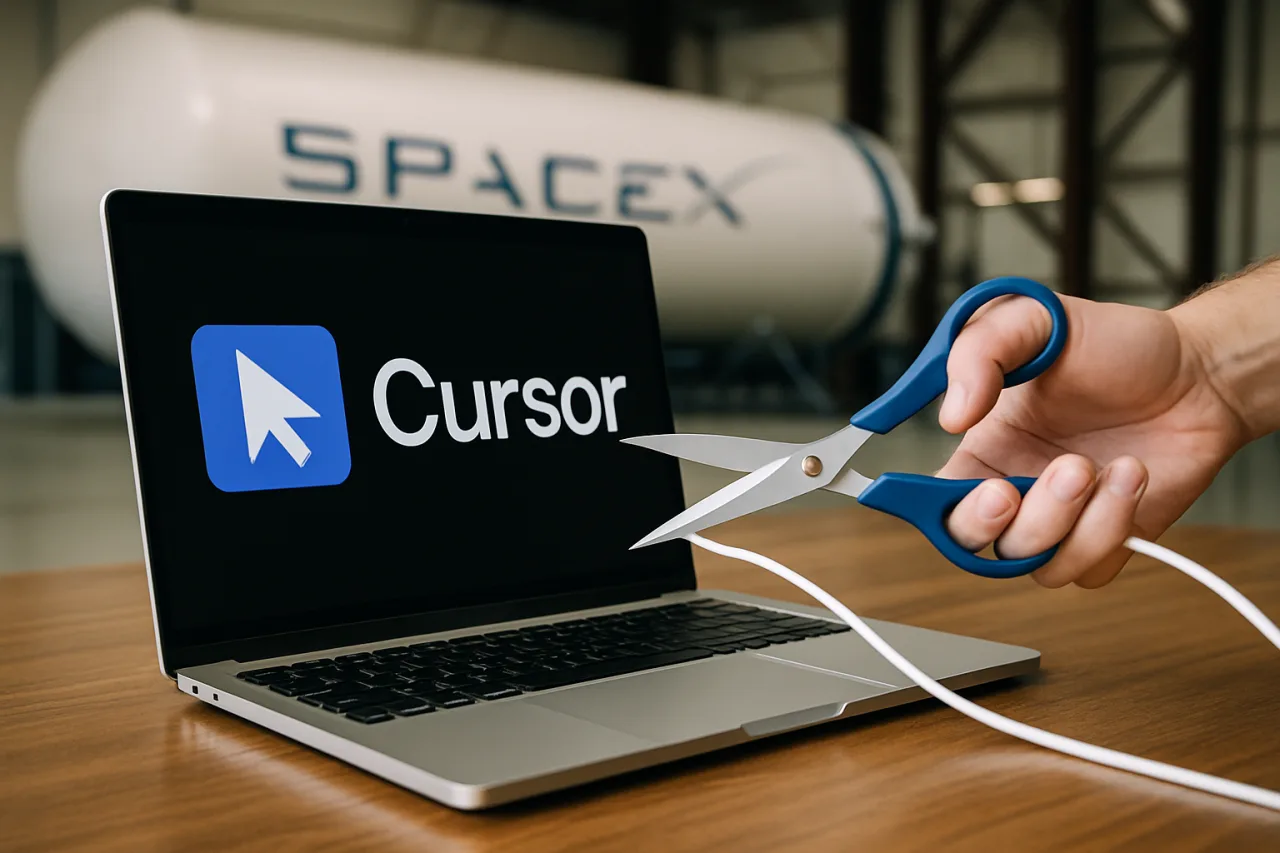
- ✂️ OpenAI will wind down Cursor’s model access with a proposed November 12, 2026 shutoff — announced August 28 after SpaceX’s $60B all-stock acquisition of Cursor’s parent Anysphere.
- 🤝 Anthropic retains Cursor as a trusted partner — Claude models remain available in the editor, so most users migrate models, not platforms.
- 🧩 The deeper lesson: any AI tool can lose a provider overnight — the contract, not the technology, decides what your tools can do.
- 🛠️ The de-risk playbook: inventory your AI dependencies, test the alternative model path early, document prompts and workflows, and keep an exit route.
- 💼 For Filipino developers and freelancers, the cutoff is a client-service story too — clients inherit your dependencies, so your resilience is their uptime.
A corporate email with a date in it just became this autumn’s most practical AI lesson.
OpenAI’s August 28 announcement — that it will wind down the contract supplying models to Cursor, the AI coding editor SpaceX acquired earlier in the month in a $60 billion all-stock deal — sets a proposed November 12, 2026 shutoff for OpenAI models inside one of the world’s most popular coding tools.
As CNBC reported, the reasons are competitive: Cursor’s new owner is OpenAI’s rival, and no supplier feeds a competitor’s platform by contract.
But the reason developers should care is bigger than one deal: the episode proves that access to the models inside your favorite tool is a business arrangement, not a feature — and business arrangements end on other people’s calendars.
Table of Contents
What Exactly Happened
Mid-August: SpaceX completes its $60 billion all-stock acquisition of Anysphere, absorbing the Cursor IDE into the SpaceXAI division — the largest acquisition yet in the developer-tools space, folding the coding startup into the orbit of a company whose AI ambitions (and whose relationship with OpenAI) are already complicated.
August 28: OpenAI posts its decision — the model-supply contract winds down, with a proposed November 12 shutoff and a stated intent to maximize transition time for developers who depend on the pairing.
Anthropic, weeks into the same saga, keeps Cursor as a trusted partner — a contrast that turns Cursor into the rare tool that loses one frontier lab’s models while retaining another’s.
The deal’s logic and the cutoff’s logic are the same coin. SpaceX bought Cursor to strengthen its AI division; OpenAI responded by treating Cursor’s ownership as a competitive event. Neither company broke faith — the contract simply reflected a reality that changed.
That is precisely why the lesson generalizes: your access to a model lives inside a commercial agreement between companies you do not control, and those agreements reprice when ownership changes.
What Happens to Your Workflow on November 12
For a Cursor user on OpenAI models, the date arrives as a settings change: the model picker loses its OpenAI entries, and every workflow tuned to GPT behavior — the prompts, the temperature habits, the agent configurations — needs a new engine.
The tool keeps working (Anthropic’s Claude models remain), codebases keep compiling, and Git history keeps its history. What breaks is the muscle memory and, for teams with hardcoded dependencies, the pipelines that assumed one provider’s quirks.
The teams that documented their setups will migrate in an afternoon; the teams that never wrote anything down will rediscover their own workflows under deadline pressure.
The financial layer matters for freelancers especially: plan-level pricing, usage meters, and rate limits all differ by provider, so the November 12 change touches invoices as well as outputs.
A freelancer who bills clients for AI-assisted output should recompute the unit economics the same week the picker changes — not after the first month’s bill surprises them.
The Anthropic Path — and Why Most Users Stay
Cursor’s documentation already treats Claude models as first-class citizens — agent capabilities, thinking variants, image support, long context windows. For most users, the November 12 cutoff is therefore a model switch, not an exit: select the Anthropic provider, retest the highest-value prompts, and adjust the handful of behaviors that differ.
The teams that should consider leaving are the minority whose workflows genuinely depend on OpenAI-specific behaviors — and they will know exactly who they are, because their code will tell them during the retest.
The competitive upside is worth naming too: the cutoff forces a comparison users might never have run. Testing Claude against your GPT-tuned prompts produces the kind of provider fluency that makes you immune to the next cutoff — whichever companies arrange it. Multi-model fluency, not brand loyalty, is the marketable skill this autumn is teaching.
The De-Risk Playbook
Step one — inventory the dependencies. List every tool in your working stack that calls an AI model: your editor, your writing assistant, your transcription tool, your automation platform, your client deliverables. Mark which providers sit under each.
Most builders discover they are three-deep in tools that all depend on the same two model vendors — the exact concentration this cutoff punishes.
Step two — test the alternative before you must. If you use Cursor, run your top five prompts on the Anthropic models this week, while there is no deadline pressure. If you use another tool, identify its second provider and do the same.
The test costs an hour; the skill it builds outlives the news cycle. Step three — write the setup down. Prompts, model settings, project configurations, the quirks you discovered — a single document turns any future provider change from a rebuild into a configuration edit.
Step four — separate the product from the plumbing. The value you deliver a client — the analysis, the design, the working feature — should survive any model swap. If your deliverable changes materially when the model does, your contract with your client is holding model risk it should not.
Step five — watch the ownership map. The AI market is consolidating: $60 billion acquisitions change supplier math overnight. When your tool’s parent changes, expect the supply contracts to follow — and move first, calmly, with the playbook already printed.
What the Cutoff Says About the AI Market
Zoom out, and the episode is a structural marker: the model-supply layer of the AI economy is now competitive enough that ownership changes trigger access changes.
OpenAI supplies rivals’ platforms when the economics suit it and withdraws when they do not; Anthropic prices its own partnerships and keeps them; and the buyer side — a $60 billion acquisition — treats a coding editor as strategic infrastructure worth rocket-company money.
For Filipino developers pricing their services this quarter, the market signal is actually encouraging: the tools are valuable enough to fight over, the alternatives are mature enough that a cutoff is survivable in an afternoon, and the professionals who can operate across providers are the ones the consolidation era pays premium rates.
The Philippine developer community has spent a decade exporting exactly this kind of resilience — engineers who switch stacks as clients require, freelancers who absorb tool changes as margin notes in their contracts — and the AI era has now handed them the newest version of an old, valuable discipline.
The practical wisdom compresses to one line: build like your tools are rented, because they are. The Cursor cutoff is simply the reminder, dated November 12, that the rent is due on someone else’s schedule.
The Filipino Developer Economy: Why This Cutoff Lands on Freelance Invoices Too
The Philippines’ developer and freelance workforce sits directly in this story’s blast radius — productively. Filipino developers on global platforms build AI-assisted deliverables for clients in every time zone, and the tools of that trade are exactly the arrangements that reprice.
A freelancer whose contract with a client promises “AI-assisted delivery with a 24-hour turnaround” is promising outcomes that depend on model access; the Cursor cutoff is the demonstration case that those outcomes rest on supplier relationships.
The professional response is contractual hygiene: price the deliverable, not the model; name the tooling as subject to provider changes; and keep the documented, retested second path that makes the promise deliverable under any provider arrangement.
The agencies are the sharper case. A Manila digital agency with twenty developers on one AI stack carries concentration risk its clients never see — and the November 12 date converts that invisible risk into a live one.
The agency that runs its own model-comparison week before the cutoff, standardizes its prompt library, and writes the migration runbook turns a market tremor into a marketing asset: “we de-risked your project before the deadline” is a sentence no competitor who skipped the playbook gets to say.
The Training-Data Undercurrent the Deal Revealed
Worth understanding beneath the user-facing changes: reports around the SpaceX acquisition noted the buyer’s interest in absorbing Anysphere’s capability into its AI division to strengthen model development — which is to say, the $60 billion was paid partly for the talent and the training pipeline, not only for the editor’s revenue.
The corollary for users is the deeper version of the de-risk lesson: the tools themselves are now chess pieces in frontier-lab strategy. When the next acquisition rumor surfaces — and it will — the professionals who moved first after August 28 will recognize the pattern and check their supply contracts before the announcement posts.
The market has taught its lesson publicly, on a schedule and with a date attached; the only open question is who took notes before November arrives. The professionals who treat every tool as rented infrastructure — inventoried, documented, retestable — will meet the next corporate email with a checklist instead of a scramble.
That habit, more than any single model choice, is what the autumn of 2026 is teaching the people who build for a living.
The Migration Day Timeline: What to Do in the Week of November 9
Mark the calendar now and the week itself becomes boring — which is the goal. Week of November 9, day one: run the retest suite (your documented prompts across the Anthropic models) and note behavior differences. Day two: update the project configurations, set the new provider as default, and run one real deliverable end-to-end.
Day three: recompute the cost sheet — usage patterns under the new provider’s pricing — and adjust any client billing assumptions. Day four: archive the old setup notes and archive the OpenAI-era prompt variants with dates, so a future re-switch is a lookup, not an archaeology project.
Day five: brief your team or your client in one paragraph — what changed, what you tested, what it costs now. The week after November 12, the professionals who did this are back to building; the ones who improvised are debugging.
Frequently Asked Questions
When do OpenAI models stop working in Cursor?
The proposed shutoff is November 12, 2026, per OpenAI’s August 28 announcement; the wind-down is designed to give developers transition time.
Why is OpenAI cutting off Cursor?
Cursor’s parent Anysphere was acquired by SpaceX — an OpenAI competitor — in a $60 billion all-stock deal; the model-supply contract between competitors unwinds as a result.
Can I still use Cursor after November 12?
Yes — Cursor retains Anthropic’s Claude models as a trusted partner, along with other providers; most users will switch models inside the same tool.
Will my code or projects be affected?
Codebases are unaffected — the change removes a model option from the tool’s picker; workflows tuned to OpenAI model behavior need retesting on the replacement provider.
What should I do before the cutoff?
Test the Anthropic path on your key prompts, document your setup, recompute your costs under the new provider’s pricing, and audit any other tools in your stack that depend on a single model provider.
Does this say anything about other AI tools?
It generalizes: any tool whose intelligence is supplied by contract can lose that supplier when ownership or strategy changes — the de-risk habit is provider-agnostic.
Financial Disclaimer: This article is for general information only and is not professional financial advice. Tool pricing and availability change; verify current terms with your providers before making purchasing decisions.