Key Takeaway
Ads are coming to AI, the account now runs in production dates and named refusals, and this guide decodes both sides of the line for you.
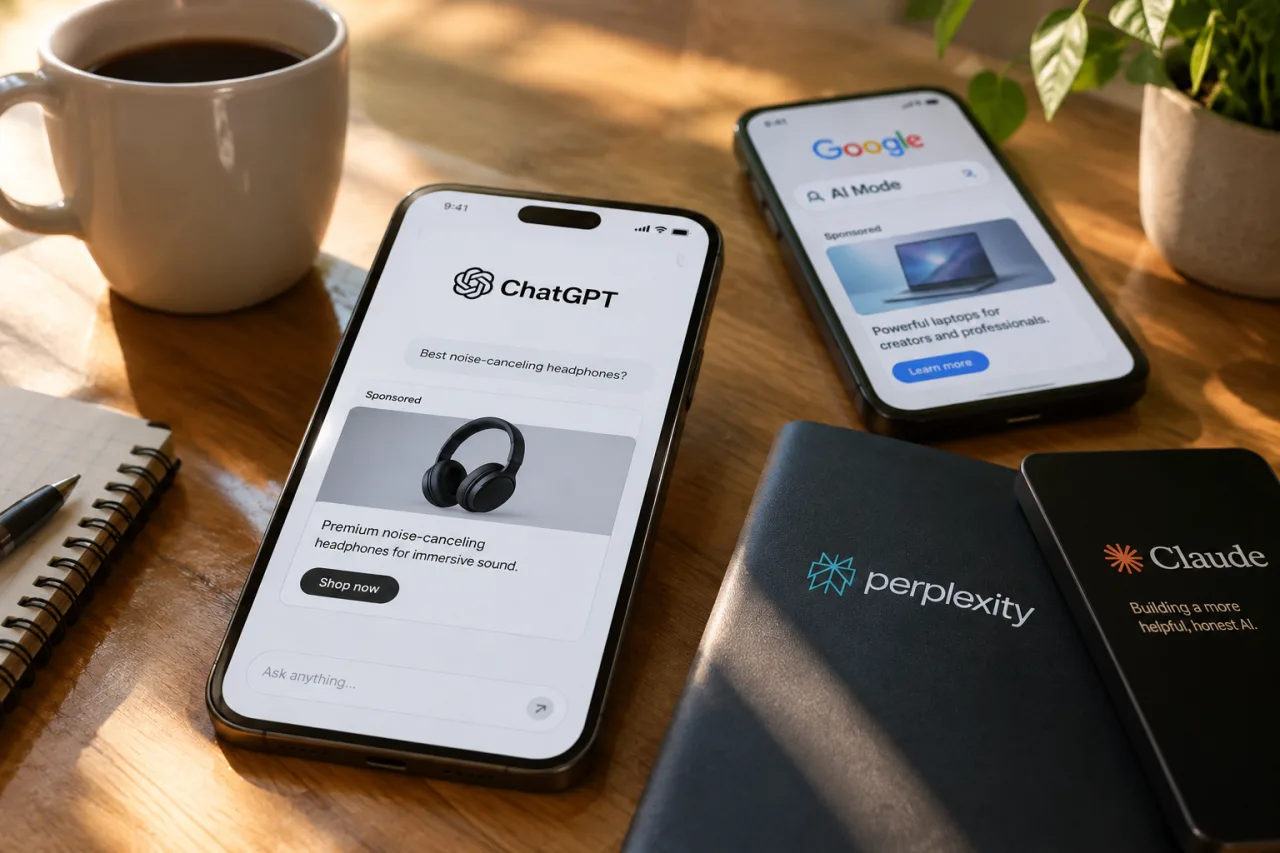
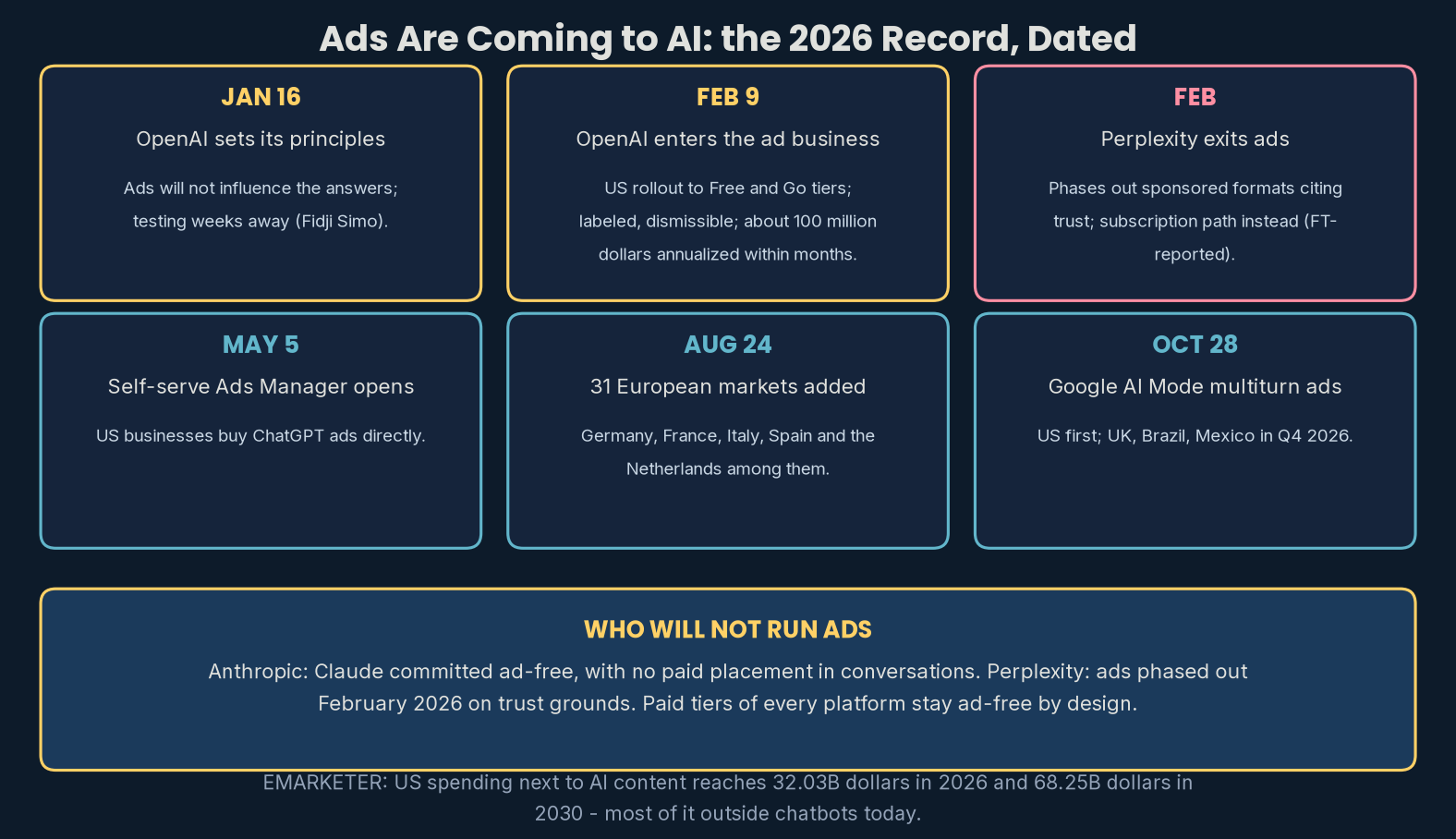
🔔 Dated and on the book: ads are coming to AI, and in 2026 they arrived: OpenAI set its principles on January 16 and rolled ads into US ChatGPT on February 9; Google opened multiturn ads in AI Mode on October 28; the AI advertising layer is now in production, not in rumor.
- 🚫 The refusals carry the other half: Anthropic committed Claude to ad-free, no paid placement inside conversations at all, and Perplexity entered 2026 with ads and left February without them, citing the trust question. The AI market is not one business model.
- 💰 The scale: OpenAI’s ads reached about $100 million annualized within months of launch, a self-serve Ads Manager opened to US businesses in May and 31 European markets followed in August; EMARKETER puts US spending next to AI content at $32.03 billion in 2026, heading for $68.25 billion by 2030.
- 🧪 What changed inside the tools: ChatGPT’s ads are labeled, dismissible and matched to the conversation, shown below answers, and the company states they do not influence the answers. Google’s early read: click-through on sponsored products in AI Mode behaved like organic products in the same list (US data, Aug 20-Sep 3, 2026).
- 👤 What it means for you: the free tier becomes ad-supported and the paid tiers stay clean (Plus, Pro, Business, Enterprise), the AI subscription now buys the same thing every other ad-funded product’s premium tier buys: quiet.
Ads are coming to AI: that sentence, ads are coming to AI, has completed its move from forecast to the market. Through 2026, the two largest AI products turned on advertising inside their answers, the largest search engine put multiturn sponsored placements inside its own conversational mode, one competitor publicly refused and then its rival did the same, and the money the forecasts promised started appearing on the records, ads are coming to AI is the year’s standing headline. This guide walks the whole account, every step dated: who now runs ads in AI, who refused and why, what the formats are, what the early measurements say, and what it means for the reader whose daily tool just became a commercial surface.
Ads are coming to AI as the free tiers’ business model: the access is sponsored by the advertising layer and the subscription buys it away. That bargain is the oldest bargain in media, free TV, free search, free mail, re-priced for a product that speaks and reasons with you, which is exactly why the refusals and the labels matter as much as the launches.
OpenAI’s entry: the story, step by step
The entry is a straight line of announcements. On January 16, 2026, OpenAI’s applications chief, Fidji Simo, published the company’s approach to advertising before testing began: ads would be tested “in the coming weeks” for logged-in adults in the US on the free and Go tiers, placed at the bottom of answers in ChatGPT when a relevant sponsored product or service matched the conversation, clearly labeled and separated from the organic answer, with the declared principle that ads will not influence the answers ChatGPT gives. The rollout followed weeks later on February 9, 2026.
The build-out moved on the expected pace. May 5, 2026: the self-serve Ads Manager opened to US businesses (the rollout timeline carries every dated step). August 24, 2026: coverage that tracks the rollout lists expansion to 31 European markets, Austria, Germany, Italy, France, Spain and the Netherlands among the named. OpenAI reports over a billion weekly ChatGPT users, coverage of the platform projects roughly $2.5 billion in ad revenue for 2026, and the early actuals, about $100 million annualized within months of the US launch, made the ad business real, with numbers rather than aspirational. The executive layer behind ads-are-coming-to-AI had been assembling through 2025, Simo himself, who built an ad business at Instacart after leading products at Meta, and OpenAI’s first chief marketing officer, Kate Rouch, now runs a line item with its own manager, its own formats and its own reviews.
The protections in the design are the ones the January post set: ads appear only to Free and Go tiers; Plus, Pro, Business and Enterprise stay ad-free; you can dismiss an ad and, during the test phase, say why. Whether those lines hold through 2027 is the question the whole AI market is watching, because the answer prices every AI subscription in the market.
Google’s parallel layer: AI Overviews and AI Mode
Google walked into the same territory with faster distribution on the search side. Ads reached AI Overviews on desktop in May 2025, extended to in-answer placements across English markets, and then, October 28, 2026, AI Mode, the conversational experience, opened multiturn ads: sponsored placements appearing in follow-up questions inside the conversation, US first, with the UK, Brazil and Mexico set for Q4 2026. Coverage places sponsored content alongside roughly a quarter of AI-generated answers in affected surfaces, and the search business’s own buying systems, Search, Shopping, Performance Max, carry the exposure, which is why EMARKETER’s forecast that over 80 percent of 2026’s $32 billion sits next to AI content outside chatbots is a Google-shape number as much as anything else.
Google’s early measurement is the one advertisers quote: for product list items in AI Mode, click-through on sponsored items ran similar to organic items in the same list (US data, August 20 to September 3, 2026). The reading is double-edged by design, if sponsored click-through equals organic, the ad surface works like the shelf; the question the format still has to answer is whether users treat the placement as an answer at all.
Ads are coming to AI with one contested frontier still open in Google’s house: Adweek reported that Google told advertisers it would bring ads into Gemini, the assistant product, during 2026, and Google publicly disputed the report. The distinction matters to buyers: AI Mode ads and AI Overviews ads are on the books; Gemini assistant ads are not conceded.
The refusals: Anthropic and Perplexity
Anthropic’s position is the sharpest in the industry: Claude products will not carry ads, and the company has publicly stated it will not let advertisers pay for placement inside conversations. The business model answer is the subscription and the enterprise seat, the same logic that prices the Claude tiers (the run-rate record shows where that revenue sits) against the same market OpenAI’s ads subsidize. Ads are coming to AI in this market, and Claude’s bet is that the ad-free product itself is the premium.
Perplexity’s story is the reversal worth reading twice. The platform tested advertising from late 2024, sponsored follow-up questions in its Related Questions section, a section carrying roughly 40 percent of platform queries, with brands including Whole Foods appearing among the testers, and then phased the whole thing out, per the Financial Times reporting the trade press carried, saying that even clearly labeled ads risk making users doubt whether the answer is the truth or the monetization. Perplexity now runs a subscription-only model with a $500 million annualized revenue target and is positioning itself as the ad-free alternative. The reversal is the industry’s first controlled experiment on the trust question, and its result is part of the market’s data now.
Microsoft sits between the models and the refusals: Copilot carries ads through Microsoft Advertising’s formats, placed below the response, the search-adjacent model inside the assistant. The pattern across the tape: the tools born from search accept the ads-are-coming-to-AI model; the tools born from work (Claude) refuse the ads-are-coming-to-AI model entirely; and the tools born as the free consumer product (ChatGPT Free and Go) carry the label with the dismiss button.
What ads are coming to AI means for readers and builders
Ads are coming to AI for the free tier, and the deal is legible, and the check on quality is the label and the dismiss button. The practical skills, spot the label, read below the answer, decline the dismiss-with-data prompts when the feedback feels like monitoring, cost seconds and keep the tool honest work. For the professional builder, the surface changes the traffic map the same way the connector era did, our enterprise-agents guide covered that shift: a placement below a ChatGPT answer does not behave like a search ad, intent is conversational, the click is a continuation, and the formats worth testing are the ones matched to the current task rather than the account history.
For the business deciding where money goes under ads-are-coming-to-AI conditions, the AI channel is now a budget line with three doors, OpenAI’s Ads Manager and its agency path in Europe, Google’s existing search buying carrying AI Mode and AI Overviews exposure, and Microsoft Advertising for Copilot. Each door needs its own tracking fix; none yet offers a clean AI-segmented report, so the first test should be small, labeled and measured against a control.
What ads in AI mean for teams in the Philippines and beyond
Ads are coming to AI in every market at once, but it lands differently where the paid tier is scarce. In the Philippines, and across the global-South markets with the fastest-growing free-tier user bases, the ad-supported ChatGPT becomes the default encounter most people have with AI: the tool stays free, the answer stays independent, and the commercial layer sits below on match to the conversation. For the millions of first-time users, ads are coming to AI here, so the label-spotting skill is now a baseline of AI literacy rather than a marketer’s trick.
For the market’s own businesses: buying access to the placements is possible directly, the Ads Manager handles US self-serve, and the agency path covers the European buy, which means a Philippine e-commerce brand, agency or services firm (the tier and pricing behavior in our drift record applies to the label layer too) running regional campaigns can test the surface at small budgets once its market is turned on. And for the sector building AI products locally, the deciding read is the refusals: an ad-free promise is a priceable differentiator, Perplexity’s $500 million subscription target is the existence proof that some of the market pays for quiet.
The dated numbers to watch from here
Four numbers carry the story forward. OpenAI’s ads run-rate: from the $100 million annualized in the first year, the 2026 projection in coverage is $2.5 billion, and the gap between those two is the whole year’s argument. The expansion map: the platforms that have not yet turned ads on in a given market, and the date they do, the Google Q4 additions (UK, Brazil, Mexico) are the first dated checkpoints. The trust metrics: whether dismissal rates and follow-up question behavior change as exposure grows, the numbers that decide whether 2027 keeps the label discipline. And the refusal line: whether any second major lab adopts Anthropic’s no-ads position as the market’s premium split deepens. Until then, the count stands as of the last dated entry: ads are coming to AI, for the free tier, under labels, with two major refusals on the books and the subscription prices holding the premium, ads are coming to AI, dated and in the books, whichever side of the line your tools sit.
FAQ
Are ads coming to ChatGPT?
They are already there for free-tier users in the US and Europe: OpenAI set its approach on January 16, 2026, rolled ads into US ChatGPT on February 9, opened the self-serve Ads Manager to US businesses on May 5, and expanded to 31 European markets on August 24, 2026. Ads show to logged-in adults on the Free and Go tiers, at the bottom of answers, labeled and dismissible; Plus, Pro, Business and Enterprise remain ad-free.
Do ChatGPT ads change the answers you get?
OpenAI’s stated principle, set publicly in its January 16, 2026 post before testing began, is that ads will not influence the answers ChatGPT gives, and the design separates ads from the organic answer. The claim is testable in the field: the answer should be the same with and without the ad context, and the dismissal control exists precisely so users can flag mismatches.
Which AI platforms will not run ads?
Two major refusals are documented: Anthropic, which publicly committed Claude to ad-free, no paid placement inside conversations, and Perplexity, which tested sponsored formats from 2024 and phased them out in February 2026 citing the trust question, now running a subscription-only model. The paid tiers of every other platform also stay ad-free.
How much money is the AI advertising market expected to make?
EMARKETER’s June 2026 forecast puts US spending next to AI content at $32.03 billion in 2026, growing to $68.25 billion by 2030, with over 80 percent of 2026’s spend sitting next to AI content outside chatbots. OpenAI’s own line reached about $100 million annualized within months of the February launch, with coverage projecting roughly $2.5 billion for 2026.
How do ads in AI Mode and AI Overviews work for advertisers?
Through the existing search buying systems: Search, Shopping and Performance Max campaigns carry the exposure, with placements above, below and inside AI Overviews and, since October 28, 2026, multiturn ads inside AI Mode follow-up questions in the US. Google’s early data shows sponsored product click-through similar to organic items in the same list; UK, Brazil and Mexico are set for Q4 2026.
What should free-tier users do about AI ads?
Three seconds of literacy: read past the labeled placement to the answer itself (the ads sit below or beside it), use the dismiss control when a placement mismatches the task, and treat the paid tier as the quiet option the way every other ad-funded product’s premium is bought. The label discipline is the feature to watch, if it holds, the bargain is the old media bargain; if it erodes, the subscription prices it.
Financial Disclaimer
This article is published for general information and analysis, not as investment advice, and it names no security for purchase. Advertising platforms, formats and revenue projections change without notice, and figures cited reflect public reporting as of their dates. Assess your own requirements before acting on the guidance here; WorldNgayon accepts no liability for decisions taken on the basis of this article.
- openai.com/index/our-approach-to-advertising-and-expanding-access
- flisko.si/en/blog/chatgpt-ads-guide-2026 — rollout timeline
- airops.com/blog/ai-advertising-landscape
- digitalapplied.com/blog/ai-search-advertising-chatgpt-google-perplexi…
- leads.sa/article/ai-assistant-ads — per the Financial Times reporting the trade press carried
External sources linked in this article, in order of first mention. Spotted an error or a broken link? Tell us.
Cite this pagePublished Nov 7, 2026
Agron, E. (2026, November 7). Ads Are Coming to AI: Who Runs Them, Who Won’t, and What It Means for You. WorldNgayon. https://worldngayon.com/ads-are-coming-to-ai/
Agron, Edmon. “Ads Are Coming to AI: Who Runs Them, Who Won’t, and What It Means for You.” WorldNgayon, 7 Nov. 2026, worldngayon.com/ads-are-coming-to-ai/.
Agron, Edmon. “Ads Are Coming to AI: Who Runs Them, Who Won’t, and What It Means for You.” WorldNgayon, November 7, 2026. https://worldngayon.com/ads-are-coming-to-ai/.
Agron, E. (2026) ‘Ads Are Coming to AI: Who Runs Them, Who Won’t, and What It Means for You’, WorldNgayon, 7 November. Available at: https://worldngayon.com/ads-are-coming-to-ai/.
E. Agron, “Ads Are Coming to AI: Who Runs Them, Who Won’t, and What It Means for You,” WorldNgayon, Nov. 7, 2026. [Online]. Available: https://worldngayon.com/ads-are-coming-to-ai/
@online{agron2026adsare,
  author       = {Agron, Edmon},
  title        = {{Ads Are Coming to AI: Who Runs Them, Who Won’t, and What It Means for You}},
  year         = {2026},
  date         = {2026-11-07},
  organization = {WorldNgayon},
  url          = {https://worldngayon.com/ads-are-coming-to-ai/},
  urldate      = {}
}TY - ELEC AU - Agron, Edmon TI - Ads Are Coming to AI: Who Runs Them, Who Won’t, and What It Means for You T2 - WorldNgayon PY - 2026 DA - 2026/11/07/ UR - https://worldngayon.com/ads-are-coming-to-ai/ Y2 - ER -
Cite the version you read; the page may be updated. Zotero and Mendeley can also import this page directly.