Table of Contents
Key Takeaway
- ⏱️ The approval wait just collapsed: Trusting Social has integrated its AI-powered telco credit score into Datung’s lending engine, allowing MSME loans in the Philippines to be approved within minutes for borrowers with no credit history at all.
- 📊 The gap it attacks is structural: MSMEs make up 99.63 percent of the Philippines’ 1.24 million registered businesses and about two-thirds of jobs, yet MSME loans accounted for only 3.9 percent of total bank lending in 2024, against the 10 percent benchmark set by the Magna Carta for MSMEs.
- 📱 The score reads behavior, not paperwork: the models analyze how consistently a person pays and how stable their activity is over time, returning a score in seconds: Trusting Social has operated in the country since 2019 and says it has scored more than 110 million Filipinos.
- 🤝 Human lending survives: Datung combines the telco score with e-wallet cash flows, field officer visits and its group lending model, and every repayment feeds back into the models: the scoring “points us toward more of the people worth visiting,” in COO Charan Uttamchandani’s words.
- 📁 One clear win: borrowers approved through the system start building a formal repayment record from their very first loan, the credit file that unlocks bigger, cheaper financing later.
A Filipino sari-sari store owner with a phone but no financial statements can now get a lending decision in minutes, because the model assessing her does not need financial statements at all. Trusting Social Philippines announced this month that its AI telco credit scoring is now live inside the lending engine of Datung, a microfinance company operating from Singapore and Manila, clearing away the single biggest paperwork barrier that has kept credit away from micro-business owners: most micro-enterprises do not keep books, so traditional loan assessment had nothing to read. The timing matches the pressure on the other side of the equation. The Philippines added roughly 850,000 business name registrations in the first eight months of 2026, up 8 percent year on year, while MSME loans remain a sliver of total bank lending, the arithmetic of a credit gap that has widened as informal businesses multiply.
This report unpacks what the integration actually does, how telco scoring works in plain language, why the structural gap persists despite a legal mandate, and the checklist a borrower should run before accepting any minutes-fast approval.
What the Datung and Trusting Social Integration Actually Does
Three details separate this from a press-release partnership. First, direction of use: Datung will apply the score to unsecured personal lending and microfinance, the segments where credit history and collateral are most often missing, and where a wrong guess costs the lender real money. Second, the company claims a scale baseline most models here lack: per the joint announcement, Trusting Social has been scoring Philippine consumers since 2019 and has scored more than 110 million Filipinos, so the telco-score entering Datung’s engine is not a research prototype but a model with years of local performance behind it. Third, the design keeps humans in the loop instead of replacing them: Datung CEO Kasper Abildgaard Svendsen says the company combines the telco score with e-wallet cash flows, insights from its field officers and its group lending model, with every repayment feeding back into the models. Chief Operating Officer Charan Uttamchandani put the role of the score precisely: “The scoring does not replace any of that. It points us toward more of the people worth visiting.”
“Having no paper trail doesn’t mean someone isn’t reliable,” said Johnny Escaler, CEO of Trusting Social Philippines, the sentence that is also the thesis of alternative-data lending. The lender’s problem is not identifying a good borrower; it is reading them at scale when their financial life is invisible on paper.
How Telco-Data Credit Scoring Works in Plain Words
Strip away the “AI” framing and the mechanism is simple enough for a borrower to reason about. A mobile phone user generates behavioral signals constantly: top-ups paid on schedule or late, line activity stable or erratic, account age, patterns in how the phone is used and paid for. Trusting Social’s models analyze those signals (the announcement describes them as how consistently a person pays and how stable their activity is over time) and return a score in seconds. The score then feeds the lending engine alongside everything else the lender already knows: e-wallet cash flows for borrowers who accept digital payments, field-officer observations where Datung’s model involves physical visits, and the group-lending dynamics where community guarantees share risk.
Why telco data specifically? Coverage. Far more Filipinos have a mobile account than a bank statement: the BSP’s financial-inclusion surveys have shown e-money account ownership racing past traditional bank accounts, so for the “thin-file” majority, telco behavior is often the only long, consistent financial record that exists. A borrower who has quietly topped up the same number for years has, in data terms, been exhibiting exactly the behavior lenders screen for: reliability under a small, regular obligation. The phone bill was never a credit instrument; it behaves like one.
Why the MSME Loans Gap Persists
The scale of the mismatch is the reason this integration matters beyond Datung. PSA data cited in the announcement records that MSMEs composed 99.63 percent of the country’s 1.24 million registered enterprises in 2024 and provided about two-thirds of national employment, the base of the economy, in plain words. Yet MSME loans were only 3.9 percent of total bank lending in 2024, per Asian Development Bank figures cited in the same report, well below the 10 percent allocation benchmark the Magna Carta for MSMEs requires of banks, a law that attaches real penalties, including fines of up to hundreds of thousands of pesos per year of under-compliance, for banks that fail to meet the allocation.
The persistence of the gap despite penalties tells you the problem is not unwillingness but cost and information. Traditional credit assessment was built for borrowers who can produce financial statements, audited records and collateral, assumptions that exclude most micro-enterprises by definition, since (as the announcement notes) most small businesses do not keep financial statements at all. A bank cannot price a borrower it cannot read, so the rational outcome is rejection or a collateral-heavy structure, and the rational borrower response is to stay informal or borrow from less-regulated sources: the very apps our seven-registry legitimacy sweep teaches readers to vet, and the contact-list harassment cases our loan-app harassment guide covers. Alternative-data scoring attacks the cost-and-information side of the equation: if a score can be produced in seconds from data the borrower already generates, the assessment cost that priced small borrowers out collapses. Demand on the other side keeps rising: DTI recorded nearly 850,000 business name registrations in the first eight months of 2026 alone, up 8 percent year on year.
What Borrowers Gain, What to Keep Checking
The borrower-side gains are concrete. Approval speed: minutes instead of the weeks a file-based application needs. Access: the no-history segment that banks structurally exclude becomes assessable for MSME loans rather than invisible. Formalization: approved borrowers start building a formal repayment record from their first loan, the credit-file foundation that makes the next loan bigger, cheaper, and bank-quality. And the public-facility programs that exist for small entrepreneurs, like the ₱2-billion OFW Negosyo Fund facility in our P20M Negosyo Fund guide, now sit alongside a private-market track that reads the unbanked majority.
Four checks belong on the borrower side of the table, because fast approval is a feature and a hazard at once. First, cost disclosure: an instant decision does not change the Truth in Lending Act’s requirement that the finance charge and true cost of credit be disclosed before you commit: read the breakdown, not just the monthly figure, the same discipline our SEC Fuse responsible-lending guide walks through for wallet loans. Second, data consent: a telco-behavior score runs on personal data, so the lender’s privacy disclosures should say clearly what data the score uses (telco behavior, wallet flows, field visits) and the borrower should read that before consenting, not after. Third, the official registry proof: minutes-fast lending still carries the same legitimacy vetting, and the seven-registry sweep covers SEC registrations, BSP authorizations and the rest. Fourth, the arithmetic of repayment: a small-ticket loan approved in minutes is still a liability against a micro-income, and group lending distributes consequences across community members, which deserves the same respect as any personal guarantee.
What a ₱15,000 MSME Loan Decision Looks Like Now
Concretize it with the case that defines the segment: a sari-sari store owner restocking inventory. Under the old path, an application for one of the typical MSME loans at that ticket size ran into the wall immediately: no audited financial statements, no collateral beyond the store’s own goods, and an assessment cycle measured in weeks while shelf stock runs out. The rational alternatives were worse: skip the restock, or borrow from an unregulated source and accept the practices our loan-app guides warn about. The credit file she does not have is exactly the reason the money arrives late or never.
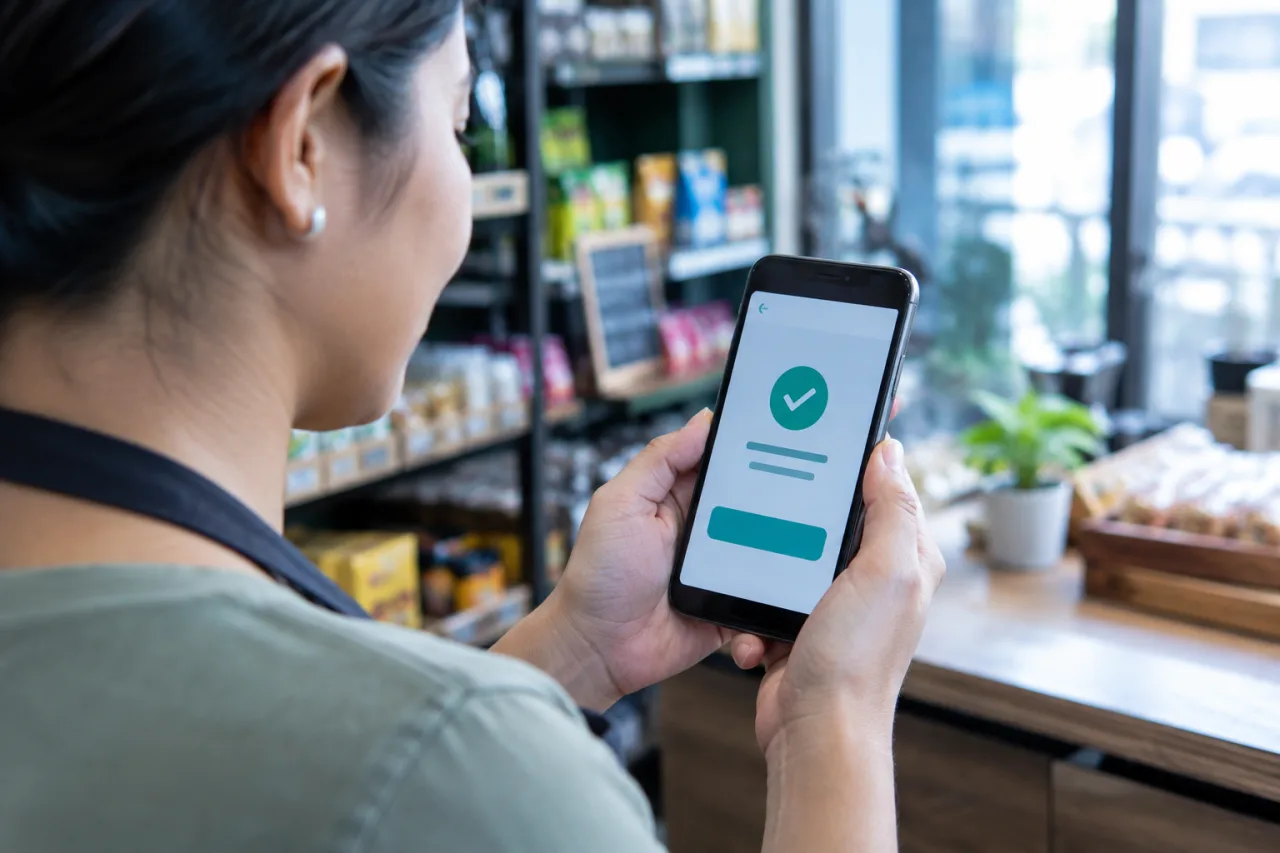
Under the new path, the same owner applies through a scored engine. The telco-behavior score returns in seconds; e-wallet cash flows show the store’s daily rhythm if she accepts digital payments; a field officer’s visit (Datung’s model keeps them) checks the shop is real; and the decision comes back within minutes rather than after a statement chase. If approved, her first repayment begins a formal record, and the second application starts from a file instead of from zero. Inventory economics do the rest of the persuasion: a restock that sells through earns more than its financing cost, which is the entire logic of productive microcredit.
The caveat stays attached: a minutes-fast decision is not a guarantee, and the approval speed never changes the review list. Cost lines, privacy disclosures, registry checks and repayment arithmetic apply the same on day one as on any slower product, the checks our responsible-lending and legitimacy guides cover remain the operative rules.
What to Watch Next
Three developments will show whether this becomes the sector’s template. Adoption spread: whether Datung’s rivals in microfinance and the fintech lenders that serve merchants, the payment-and-lending stack our Pine Labs GCash partnership coverage tracks for MSMEs: adopt equivalent scoring, and how quickly. Regulatory posture: how the BSP and SEC treat alternative-data lending as volumes grow, particularly the privacy-consent layer and the consumer-protection rules the sector must carry. And the performance data itself: repayment behavior of telco-scored borrowers versus file-based ones, the variable that decides whether bank-scale lenders follow, which is the point at which MSME loans could genuinely close the 3.9-percent gap. Keep every figure date-stamped; this is a fast-moving corner of the market.
FAQ
What are MSME loans?
MSME loans are credit extended to micro, small and medium enterprises, the businesses that make up 99.63 percent of registered Philippine enterprises and employ about two-thirds of the workforce. They range from microfinance tickets of a few thousand pesos to bank facilities for medium firms, and the sector’s share of total bank lending sat at just 3.9 percent in 2024.
How can you get a business loan with no credit history?
Through lenders that score alternative data. The Datung and Trusting Social integration approves microfinance and unsecured loans within minutes by scoring telco behavioral signals (payment consistency and activity stability) combined with e-wallet cash flows and field-officer checks for borrowers with no borrowing record at all.
What data does telco credit scoring use?
Behavioral signals from mobile use: how consistently a person pays their telco obligations, how stable their line activity is over time, account patterns that indicate reliability. Datung additionally layers e-wallet cash flows and its field officers’ insights. Borrowers should check the lender’s privacy disclosures to see exactly which data feeds the score before consenting.
How fast are MSME loans approved with alternative data?
Minutes, per the companies’ announcement: the telco score returns in seconds, and the lending engine uses it to clear applicants who previously faced weeks of paperwork-based assessment, or outright rejection for lacking financial statements.
Why do banks lend so little to MSMEs?
Cost and information: most micro and small businesses keep no financial statements, so traditional assessment cannot read them, and per-borrower screening costs do not pay off at micro-ticket size, even though the Magna Carta for MSMEs benchmarks a 10 percent bank allocation and penalizes under-compliance, bank lending to the sector languished at 3.9 percent in 2024.
Does alternative-data lending build your credit record?
Yes, that is one of its more useful advantages. Borrowers approved through the system start building a formal repayment record from their first loan, which then supports bigger and cheaper financing later; for the wallet-lending equivalent, our gLoan and wallet-credit comparisons show how in-app repayment behavior feeds the same formalization track.
Financial Disclaimer
WorldNgayon.com is not a lending company, a licensed financial adviser, or a microfinance institution. This article is general information, not financial advice, and does not endorse any specific lender. Approval speeds, data practices and costs vary per provider and per borrower; verify terms, disclosures and registrations directly with the lender and the SEC or BSP before taking any loan.
- fintechnews.ph/74307/lending/msme-loans-philippines-trusting-social-d… — MSME loans in the Philippines to be approved within minutes
External sources linked in this article, in order of first mention. Spotted an error or a broken link? Tell us.
Cite this pagePublished Nov 10, 2026
Agron, E. (2026, November 10). MSME Loans in the Philippines: What Telco-Data Credit Scoring Changes. WorldNgayon. https://worldngayon.com/msme-loans-telco-data/
Agron, Edmon. “MSME Loans in the Philippines: What Telco-Data Credit Scoring Changes.” WorldNgayon, 10 Nov. 2026, worldngayon.com/msme-loans-telco-data/.
Agron, Edmon. “MSME Loans in the Philippines: What Telco-Data Credit Scoring Changes.” WorldNgayon, November 10, 2026. https://worldngayon.com/msme-loans-telco-data/.
Agron, E. (2026) ‘MSME Loans in the Philippines: What Telco-Data Credit Scoring Changes’, WorldNgayon, 10 November. Available at: https://worldngayon.com/msme-loans-telco-data/.
E. Agron, “MSME Loans in the Philippines: What Telco-Data Credit Scoring Changes,” WorldNgayon, Nov. 10, 2026. [Online]. Available: https://worldngayon.com/msme-loans-telco-data/
@online{agron2026msmeloans,
  author       = {Agron, Edmon},
  title        = {{MSME Loans in the Philippines: What Telco-Data Credit Scoring Changes}},
  year         = {2026},
  date         = {2026-11-10},
  organization = {WorldNgayon},
  url          = {https://worldngayon.com/msme-loans-telco-data/},
  urldate      = {}
}TY - ELEC AU - Agron, Edmon TI - MSME Loans in the Philippines: What Telco-Data Credit Scoring Changes T2 - WorldNgayon PY - 2026 DA - 2026/11/10/ UR - https://worldngayon.com/msme-loans-telco-data/ Y2 - ER -
Cite the version you read; the page may be updated. Zotero and Mendeley can also import this page directly.