Table of Contents
Key Takeaway
- ⚡ The constraint moved: AI data center power — not chips, not models — is becoming the binding constraint of the AI era, as global data center electricity nearly doubles from 485 TWh in 2025 to about 950 TWh by 2030 (IEA).
- 🔢 The rack math: AI server racks went from a few kilowatts to a projected peak draw equal to about 65 households by 2027, with rack power density up 11x from 2020 to 2025.
- 🏭 Power-first siting: hyperscalers now sign 20-year nuclear contracts, install on-site gas turbines, and queue gigawatt campuses around whatever electricity they can actually secure.
- 🌍 Every reader is downstream: grid queues, transformer shortages, water stress, and rising regional tariffs now shape where AI gets built — and increasingly what you pay for your own electricity.
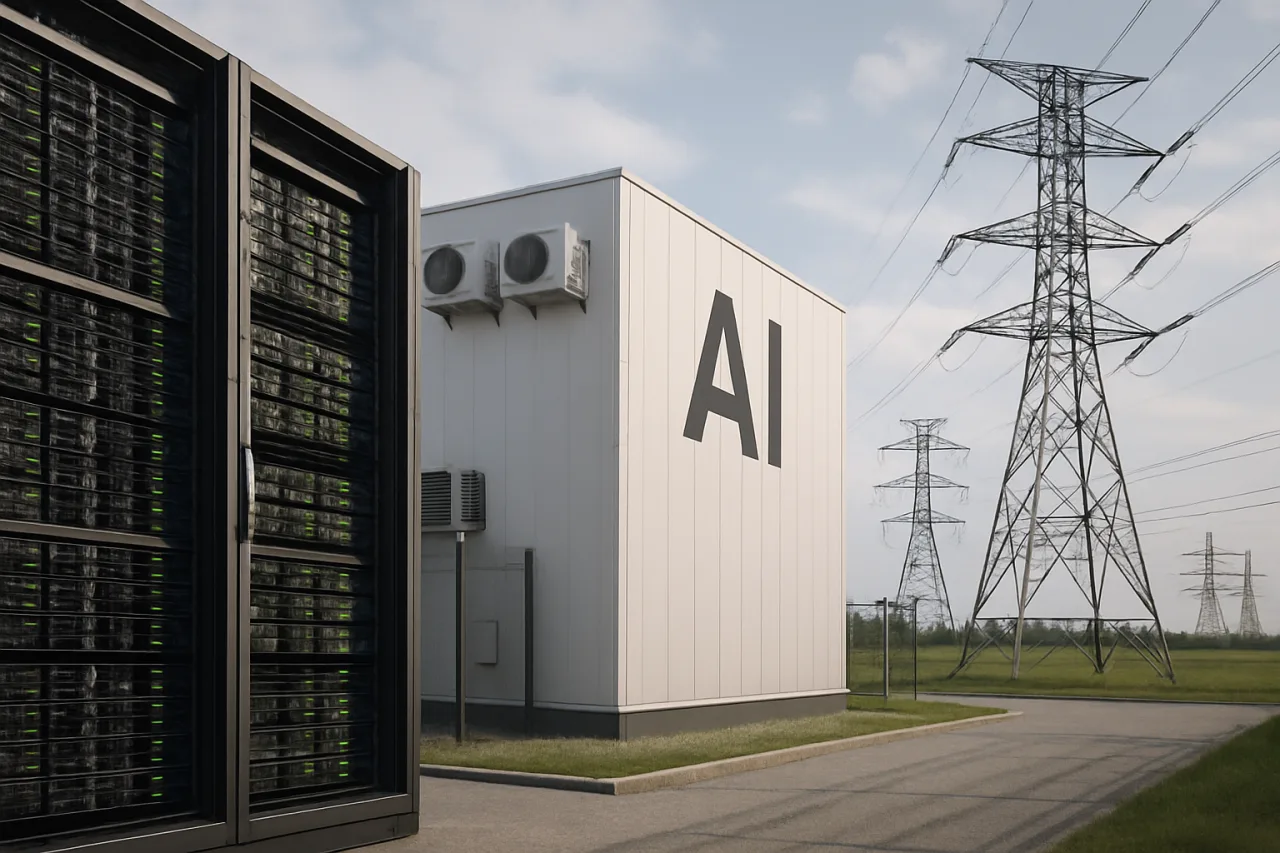
Every prompt you type is a small act of applied physics. Somewhere, a processor flips through layers of matrix math using real watts, cooled by real water, fed by a real substation. For most of the history of computing, that physical layer was an afterthought. In 2026 it is the main event: the race to build artificial intelligence is increasingly a race to build, connect, and power AI data center power infrastructure at a scale the electric grid has never seen from a single industry.
Why AI Data Center Power Became the Biggest Constraint in AI
Strip away the vendor keynote and the underlying story of AI data center power is blunt. The International Energy Agency’s most recent analysis of the energy-AI nexus projects global data center electricity consumption roughly doubling from 485 TWh in 2025 to about 950 TWh by 2030 — around 3 percent of world electricity demand — with the AI-focused share of that demand more than tripling to roughly 465 TWh in the same window. Independent trackers of AI data center power demand see the same slope: Deloitte’s forecast puts electricity use on a similar line, from about 536 TWh in 2025 toward 1,065 TWh by 2030. By 2035, IEA-linked projections climb past 1,200 TWh.
What changed is not that AI arrived, but where AI is running. A training run is a weeks-long, megawatt-scale burn. But the bigger structural shift is quieter: inference — every chat, every generated image, every agent call — now dominates AI’s energy profile. Estimates summarized in a 2025-2026 survey of electricity demand and grid impacts put inference at roughly 60 percent of AI energy use at Google, and up to 90 percent of a model’s lifetime energy footprint. Training builds the machine; inference runs it forever. That inversion is why demand keeps compounding long after a model ships.
The scale also changed shape. AI halls no longer resemble the airy low-density rows of the cloud era. The IEA notes that power density of AI servers increased roughly 11 times between 2020 and 2025, with a further fourfold increase expected by 2027; a single AI server rack — about the size of a large refrigerator — could by then demand the peak load of about 65 households. Facilities that were measured in tens of megawatts are now planned in hundreds, and gigawatt-scale campuses have moved from marketing slides to filing statements.
From Watts to TWh: the Units and the Physics You Need
Reading any AI data center power story requires three units, none of them complicated.
Watts measure rate; watt-hours measure total. A data center that continuously draws 1,000 megawatts (one gigawatt) consumes 24,000 MWh per day — about 8.8 TWh a year. That is why a gigawatt campus is described both ways: 1 GW is how fast it drinks; ~8.8 TWh/year is how much it swallows annually. For scale, one gigawatt-year is roughly the annual generation of a large nuclear unit.
PUE turns physics into money. Power Usage Effectiveness is the ratio of a facility’s total electricity to the electricity its IT equipment actually uses. A PUE of 2.0 — the old industry norm — meant half the bill bought cooling, losses, and lighting. Modern hyperscale halls run PUEs near 1.1-1.3, meaning overhead of 10 to 30 percent. Arithmetic example: an IT load of 100 MW at PUE 1.2 means the utility connection must supply 120 MW, and every point of PUE improvement is pure capacity reclaimed — a facility at 1.5 that engineers its way to 1.2 just unlocked the equivalent of a small power plant without signing for one.
Compute density is the multiplier. A modern AI accelerator routinely dissipates on the order of 700 to 1,200 watts per device — closer to a space heater than a chip — and several hundred of them are packed into racks linked by high-bandwidth memory fabrics. Multiply a rack by tens of thousands, add cooling, conversion losses and redundancy, and the facility-level numbers stop resembling office buildings and start resembling industrial smelters, which is precisely how grid planners now treat them.
How AI Data Center Power Moves From Grid to GPU
The chain between a hydro dam or a gas turbine and the GPU doing your invoice extraction is a five-stage relay, and every stage has become a bottleneck in its own right. AI data center power moves through all five stages, and failure at any one of them idles the other four.
1. Generation and interconnection. The utility (or the campus’s own plant) feeds a high-voltage transmission network. Securing a new interconnection for a hyperscale load can take years of queue studies; with connection requests growing fast in nearly every market, transmission capacity has become the first gate a data center project must clear — before GPUs, before buildings.
2. Transformation and switchgear. At the site, substation transformers step transmission voltage down toward distribution levels, and dedicated station transformers take the next step. Utility-grade transformers are increasingly backlogged; lead times quoted across the industry have stretched from months toward years, and a single delayed transformer can idle an otherwise-finished shell.
3. Conditioning and backup. Inside the boundary, power flows through switchgear, uninterruptible power supplies (batteries), and backup generators sized to carry the whole load in an outage. Modern AI campuses are beginning to behave like their own micro-grids: the IEA expects 20-25 GW of battery storage installed in data centers globally by 2030 — racks of batteries that smooth the violent load swings AI training creates, and could even sell grid services back to the utility.
4. Conversion on the rack. Server power supplies step 400+ volts down to the 48-volt DC rails that accelerators actually sip, and increasingly to sub-volt feeding of the silicon itself. Every conversion step dissipates single-digit percentages; stacked conversions are one reason PUE discipline matters so much.
5. The fragile interface. Because AI loads ride on power electronics rather than spinning motors, they are far more sensitive to voltage sags and frequency disturbances. Grid-interface research notes that AI facilities can trip or disconnect to protect their electronics during disturbances — which is one more reason operators demand unusually clean, stable, dispatchable supply rather than treating the grid like a generic wall socket.
Inside the Racks: Why AI Compute Eats Power
Three forces multiply at rack level, and together they explain why AI data center power demand behaves unlike any load the grid has served before.
First, the chips themselves. Each accelerator generation raises both performance and power draw; a top-end GPU-class device now burns 700 to over 1,000 watts continuously during heavy work. Unlike a laptop chip that idles most of the day, accelerators in AI halls run near-flat-out for years.
Second, memory and interconnect. High-bandwidth memory stacks sit millimeters from the compute die, and network fabrics move activations between thousands of devices. Moving data costs energy — often comparable to the arithmetic itself — which is why every generation re-engineers how bytes travel, and why “the chip” is a poor unit of measurement for AI demand. The rack is the real atom.
Third, the duty cycle. A traditional Google search consumes on the order of 0.3 watt-hours, according to figures cited in grid-impact research; a large-model query can consume tens to hundreds of times that. Multiply a single query’s difference by billions of queries a day and the demand curve explains itself. The same research suggests most organizations’ AI electricity spend is now overwhelmingly inference — not the training runs that dominate headlines.
How AI Facilities Get Built Around Power: Nuclear PPAs, On-Site Gas, and Batteries
The defining corporate behavior of this era is that compute companies became energy companies. The verified AI data center power deal record tells the story:
| Buyer | Counterpart / Plant | Scale | Structure | First power |
|---|---|---|---|---|
| Microsoft | Constellation — restart of Three Mile Island Unit 1 (Crane Clean Energy Center, Pennsylvania) | 835 MW | 20-year power purchase agreement | target 2028 |
| Kairos Power — fleet of small modular reactors (multi-plant agreement) | up to 500 MW | PPAs for energy, services and environmental attributes | first by 2030, fleet by 2035 | |
| Amazon | Constellation — Calvert Cliffs Clean Energy Center (Maryland) | 690 MW contracted, incl. ~190 MW uprate | 20-year PPA (signed Sept 2026) | uprate phased 2030-2032 |
| Meta | Constellation — Clinton Clean Energy Center (Illinois) | 1.1 GW | 20-year PPA | ongoing (existing plant) |
These are not publicity stunts — they are decades-long bets on the physics of demand, and the pattern is still compounding: the newest line on the board was signed September 30, 2026, when Amazon and Constellation committed to a 20-year agreement covering 690 megawatts at Calvert Cliffs — including roughly 190 megawatts of added capacity from a plant uprate, backed by more than $3 billion of infrastructure investment. Microsoft and Constellation’s restart deal restores a full-scale nuclear unit to the grid primarily to serve AI load, and Google’s Kairos agreement is the first United States corporate deal of its kind to cover several deployments of one advanced-reactor design — a fleet arrangement built explicitly around feeding Google data centers.
Nuclear is the premium route, but the IEA’s tracking shows the faster path is brute force: roughly 50 GW of on-site generation capacity proposed at data center sites — overwhelmingly gas turbines — with an estimated 15-27 GW of on-site natural gas actually operating by 2030, mostly in the United States. Developers overbuild such plants by 30-70 percent beyond IT demand because critical AI load cannot tolerate interruption. The catch is capacity: the world’s turbine makers are themselves supply-constrained, which is why the IEA cautions that on-site generation “does not remove the urgency” of grid buildout. Underneath all of it sits a financing signal worth reading: IEA analysis puts cumulative investment to power data centers at USD 0.5-1 trillion through 2030 — large, but a rounding error against the ~USD 18 trillion of total energy investment expected in the same window, which is exactly why utilities and lenders are suddenly competing for data center load.
The Economics of AI Data Center Power: Why Efficiency Is Now Revenue
Electricity is the single largest operating cost of any data center, and AI data center power economics has become a strategy question with three layers.
Site economics: operators hunting AI data center power in bulk chase cheap, stable, abundant supply first and talent second — an inversion from the cloud decade. Regional tariff spreads are now decisive. In Southeast Asia’s buildout, for example, tariffs around US$154/MWh in the Philippines versus US$178/MWh in Singapore (and materially lower in Vietnam and Indonesia) shift where next-generation campuses land, a dynamic our analysis of the Philippine power squeeze documented through Eco-Business data, and which our coverage of the 500 MW national capacity buildout shows in plan-level detail.
Efficiency economics: because inference runs for the life of a model, small efficiency gains compound into fortunes. A 10 percent reduction in energy per useful computation, applied across billions of daily queries, is why vendors obsess over joules per token — and why our coverage of how model pricing collapsed is, underneath, an energy story: falling token prices ride on falling electricity cost per operation.
Capital-stack economics: the AI industry’s sudden appetite for 20-year fixed power contracts is the clearest possible statement that AI data center power has become a long-duration liability that must be locked early. A hyperscaler that cannot secure electricity cannot ship product; a hyperscaler that locked cheap supply for two decades effectively printed margin.
The Limits: Grid Stability, Water, Bills, and Public Resistance
Four frictions will shape the rest of the decade of AI data center power, and none of them has a clean fix.
Grid stability. Fast-swinging AI loads on power-electronic interfaces create new kinds of stress for grids designed around steady industrial demand. Research into AI data centers’ grid interface catalogs voltage-oscillation and ride-through problems that transmission operators are only beginning to standardize around.
Water. Cooling consumes water at municipal scale; where districts rely on the same aquifers and rivers, permit fights are hardening into siting constraints. The intersection of water stress and heat (physical and political) is now a first-order input to campus location decisions.
Your bill. Ratepayer transmission costs are the sleeper issue of the buildout: independent analysis cited in NPR’s reporting found that homes and businesses in several US states absorbed about $4.3 billion of additional transmission costs in 2024 alone, partly to serve data center corridors. Utilities and regulators are actively debating who should pay for the wires AI load requires — a fight that will recur in every market hosting large campuses.
Public resistance. Community pushes against new campuses have grown organized enough that the AI industry spent heavily in the 2026 US midterm cycle to defend them, a political dynamic our coverage of the data center backlash traced through the $265 million in AI-linked midterm spending.
One epistemic note belongs in any honest article on this subject: estimates disagree — a lot. Bottom-up capacity models (S&P-style) and top-down consumption models (IEA-style) can differ by tens of percent on the same year, as Our World in Data explains well; treat every TWh projection, including the ones above, as a scenario, not a prophecy.
The Global Outlook: Where the 950 TWh Lands
The 2030 doubling in AI data center power demand is geographically lopsided. The United States hosts the largest single share of AI-focused demand growth; China runs the biggest absolute data center base; Southeast Asia is the fastest-growing frontier. Demand there is projected to jump from modest bases to startling shares of national grids — from about 8.5 TWh in 2024 to a projected 68 TWh by 2030 in Malaysia, from 6.7 to 26 TWh in Indonesia, and from about 1.1 to 20 TWh in the Philippines, which starts from a near-zero base with some of the region’s highest power prices and a coal-heavy generation mix that complicates the clean-power commitments hyperscalers carry.
For the Philippines specifically, the constraint math is stark: ambitions documented in our coverage of the $500 million G42 campus commitment and the national AI infrastructure masterplan only pencil out if the power side closes — generation growth of under 7 percent annually against data center demand growing at multiples of that. The universal lesson travels: the map of AI’s future is drawn first in the language of substations and water rights, not GPUs.
What to Watch: Signals That Will Rewrite This Article
Evergreen does not mean frozen. The AI data center power story moves fast — review this article when any of these fire:
- IEA’s next annual energy-AI update — new base-case TWh lines and fresh bottleneck data.
- NRC and international approvals for the first hyperscaler-linked SMRs (Kairos first unit, and any Chinese or European equivalents at commercial scale).
- Transformer and gas-turbine lead times — if they normalize ahead of schedule, the on-site buildout accelerates; if they degrade, the queue wall hardens.
- Grid-cost allocation rulings in heavyweight hosting markets (Virginia, Texas, Ireland, Singapore) — the precedent-setters every other regulator copies.
- Philippine and ASEAN tariff and generation data — whether the 7-percent generation growth problem gets solved decides Southeast Asia’s share of AI’s map.
FAQ: AI Data Center Power Questions
How much electricity do AI data centers use?
For AI data center power planning, the anchor number is this: global data centers consumed about 485 TWh in 2025 — roughly 1.5 percent of world electricity — and the IEA’s base case projects roughly 950 TWh by 2030, about 3 percent, with the AI-focused portion tripling to around 465 TWh. One very large AI campus at 1 GW of continuous draw consumes roughly 8.8 TWh in a year, comparable to a mid-sized country’s household electricity use.
Why does AI use so much electricity?
Because the work is arithmetic at extreme scale, on chips that dissipate 700-1,200 watts each, running near-continuously — and because inference multiplies every model’s energy cost across billions of daily queries. Per-action, a typical search costs about 0.3 Wh while a frontier-model query can cost tens to hundreds of times more.
What is AI data center power density and why does it matter?
It is the electrical load per rack or per square meter. AI racks are heading toward the peak demand of roughly 65 households per refrigerator-sized cabinet by 2027 (IEA) — density that standard data halls, wiring, and cooling were never designed for, and the reason most legacy facilities cannot simply be converted to AI use.
Will AI data centers raise my electricity bill?
In regions hosting big campuses, some uplift is already documented — US analysis cited by NPR tallies about $4.3 billion in added transmission costs across several states in 2024. Whether rates rise depends on regulatory cost-allocation: utility commissions decide whether the data centers or the general public absorb the grid upgrades, and the precedents being set now will spread to other markets.
Are nuclear-powered AI data centers real?
Yes — contracted, though mostly not yet operating. Microsoft’s 20-year, 835 MW Three Mile Island Unit 1 restart with Constellation targets 2028; Google holds a multi-plant SMR agreement with Kairos Power (up to 500 MW, first unit by 2030); Amazon operates load co-located with the Susquehanna plant; Meta signed a 20-year PPA for the 1.1 GW Clinton plant.
Do AI data centers actually reduce their energy use?
Per operation, yes, consistently — chip generations improve efficiency at roughly 30 percent per year by some measures, and PUEs keep falling. In absolute terms, no: total consumption still rises because demand grows faster than efficiency, the classic efficiency-parity race. That is why the projections above rise even as the hardware gets greener per token.
Can renewable energy power AI on its own?
Wind and solar supply energy, but AI halls additionally need stable, dispatchable capacity hour by hour — which is why the verified buildout mixes renewables (Google alone holds over 14 GW of clean-energy agreements since 2010) with nuclear PPAs, batteries, and on-site gas rather than picking a single source.
Financial Disclaimer
Financial Disclaimer: This article is for informational and educational purposes only and does not constitute financial, investment, or professional engineering advice. Data center infrastructure economics involve significant uncertainty; figures cited are projections by the attributed institutions as published at the time of writing. WorldNgayon holds no positions in and has no affiliations with the companies mentioned, and accepts no liability for decisions made readers make based on this analysis. Always conduct your own research and consult a qualified professional before making investment or siting decisions.
Sources and Further Reading
- IEA — Key Questions on Energy and AI (2026), executive summary: iea.org/reports/key-questions-on-energy-and-ai
- LBNL — 2024 United States Data Center Energy Usage Report: eta-publications.lbl.gov (LBNL-2001637)
- arXiv — Electricity Demand and Grid Impacts of AI Data Centers (2025): arxiv.org/abs/2509.07218
- Our World in Data — How much energy do data centers and AI use?: ourworldindata.org
- Kairos Power — Google partnership announcement: kairospower.com
- Constellation — Crane Clean Energy Center announcement (Sept 20, 2024): constellationenergy.com
- Constellation — Amazon Calvert Cliffs agreement (Sept 30, 2026): constellationenergy.com
- World Nuclear News — Google-Kairos SMR deployments: world-nuclear-news.org
- Eco-Business — Can the Philippines power its data centre hub ambitions?: eco-business.com
- NPR — America’s AI industry faces big energy and environmental risks (Oct 2025): npr.org
If this intelligence helps you, you can add WorldNgayon as a preferred source on Google — free, one click, and it helps other readers find the answers faster.