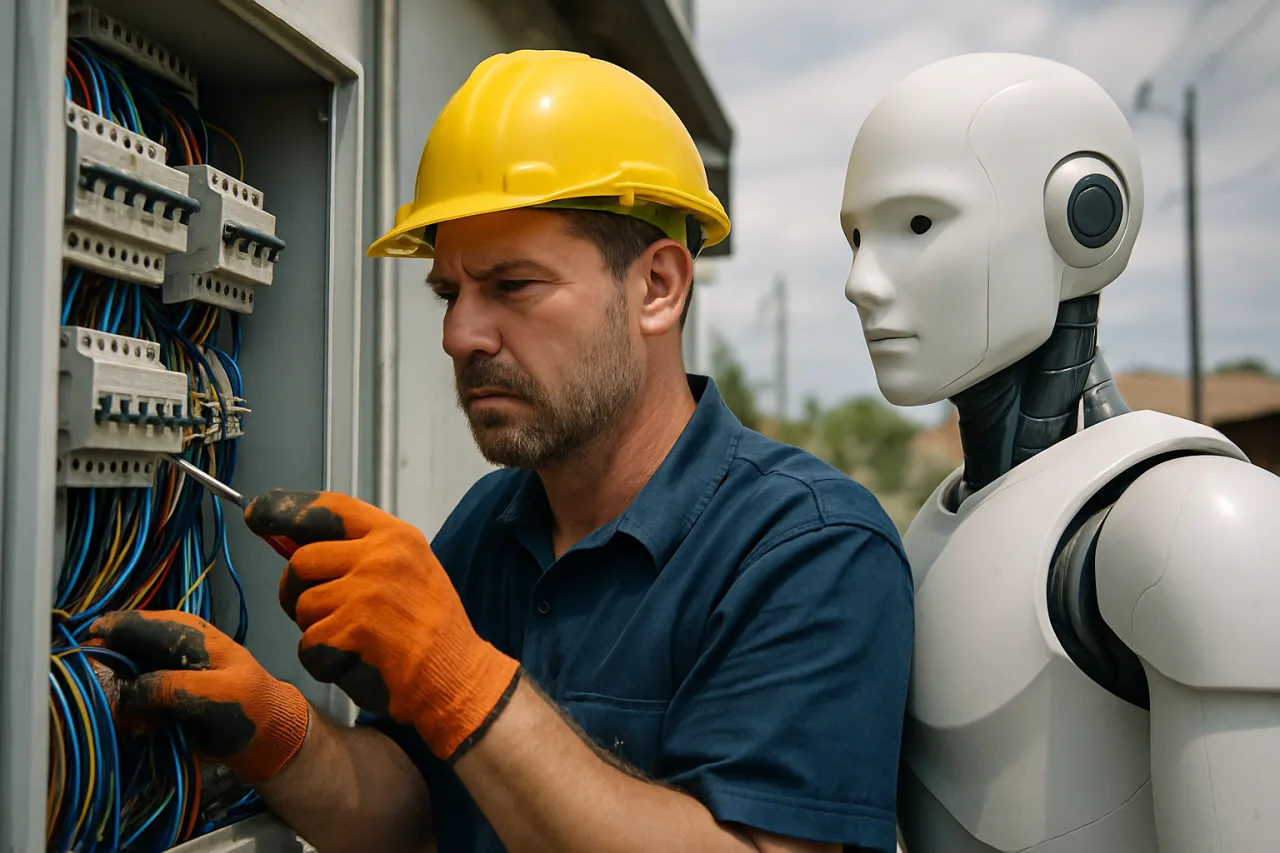
A Microsoft Research study built on more than 200,000 real conversations with Copilot put 40 occupations under the microscope in 2025 — and the ten jobs where generative AI was least able to touch the work were not analysts, not marketers, not even senior engineers. They were pile driver operators, dredge operators, floor sanders, foundry mold makers, water treatment operators, rail-track crews, and logging equipment operators — hands-on vocational and trade work where the job is a body, a machine, and a physical place. That single finding is the backbone of this feature: AI-proof careers are not a slogan but a measurable category. They are measurable, and they run straight through the vocational and trade economy — the third path that our analysis of Alex Karp’s AI career advice argued mainstream guidance keeps leaving out.
Key Takeaway
- 🛠️ The AI-exposure data is physical: Microsoft’s 2025 study of 200,000+ Copilot conversations ranks pile driver operators, dredge operators, floor finishers, and water treatment operators among the ten least AI-exposed occupations — all physical trades.
- 📈 The growth math favors the trades: WEF’s Future of Jobs 2025 (1,000+ employers) projects frontline roles — construction workers, farmworkers, delivery drivers — as the largest absolute job gainers to 2030, inside a net +78 million jobs.
- 💵 The pay argument is real: US electricians earn a $63,190 median with 9% projected growth (much faster than average) and ~72,700 openings a year, per BLS — no four-year degree required.
- 🇵🇭 The OFW read: Filipino trade workers — electricians, welders, pipefitters, construction crews — are the deployed backbone of Gulf construction and Asian industrial demand, and global trades labor is short everywhere.
- ⚠️ The honest limitation: “AI-proof” means low replacement exposure, not zero change — automation narrows some task lists, and clerical-adjacent trade roles (dispatchers, schedulers) are still exposed.
Table of Contents
What the Data Says About AI-Proof Careers
The word “proof” invites skepticism, and it should. Nothing in a labor market is immune forever. What the 2025 research wave offers is something more precise than a promise: relative exposure scores, computed from how much of each occupation’s real work activities overlap with what generative AI demonstrably does — summarize, draft, translate, answer, code-assist, and correspond. Microsoft’s study, “Working with AI: Measuring the Occupational Implications of Generative AI”
Related: The Freelance AI Pay Split: 45% Up, 13% Down
(Kiran Tomlinson, Sonia Jaffe, Will Wang, Scott Counts, and Siddharth Suri), analyzed more than 200,000 anonymized Bing Copilot conversations and mapped work activities to occupations. Its authors were unusually explicit about what the data does not show: it measures applicability and overlap, not layoffs. “It would be a mistake” to read high overlap as automatic displacement, they wrote, noting the famous ATM example — automated teller machines multiplied bank branches and teller jobs in the years after arrival, because branches got cheaper to open and human trust got more valuable.
That humility matters, because the same dataset also produced a hard, clean pattern: the higher an occupation’s AI applicability score, the more its work is writing, research, communication, and information handling — and the occupations at the absolute bottom of exposure share a single property. The work is physical, site-bound, and tactile. You cannot prompt a dredge. You cannot remote-prompt a pipe weld inside a ship’s hull.
Two other major datasets agree from different directions. The World Economic Forum’s Future of Jobs Report 2025 — over 1,000 global employers representing more than 14 million workers across 55 economies — projects frontline and physical roles as the biggest absolute gainers to 2030. And government occupational data (US BLS) shows skilled trades with above-average growth projections and persistent replacement-needs openings: electricians alone are projected to add 75,900 jobs on 821,000 existing through 2035, with roughly 72,700 openings per year when retirements are counted.
The Ten Least AI-Exposed Occupations Are All Physical
Where are the AI-proof careers, concretely? Start with this list.
Microsoft’s least-exposed list reads like a heavy-equipment hall of fame. Every occupation on it involves hands on machinery, materials, or worksites:
- Logging equipment operators — run harvesters and skidders in terrain no robot navigates comfortably.
- Motorboat operators — water, weather, wake, and judgment.
- Orderlies — patient transport and physical care support in hospitals; humans helping humans, in person.
- Floor sanders and finishers — feel, grain, and imperfection management in real wood.
- Pile driver operators — the publication’s own wry summary suggested a stable, low-change career could be found operating one.
- Rail-track laying and maintenance equipment operators — linear infrastructure work under live schedules.
- Foundry mold and coremakers — heat, sand, and metallurgy where tolerances are physical.
- Water treatment plant and system operators — public-health infrastructure that runs on licensed operators.
- Bridge and lock tenders — safety-critical, location-fixed operations.
- Dredge operators — waterways, sediment, and machinery in constant contact with an unpromptable environment.
The shape of the list is the story. None of these roles is white-collar-adjacent. All of them are vocational, machine-plus-muscle-plus-judgment careers — exactly the AI-proof careers profile the exposure model scores lowest. For a reader weighing where a credential actually protects them, the pattern beats the platitudes: when the work has physics, AI has no seat.
Related: AI models hide capabilities: What the NeurIPS 2026 Encrypted-Circuit Paper Pro
Why the Trades Resist AI: The Physics of the Job
The reason AI-proof careers cluster in the trades comes down to three structural barriers explain the trades’ resilience, and none of them is sentiment:
1. Embodiment. Every trade job terminates in a physical act on a specific site under specific conditions. A language model can generate a perfect wiring diagram, but the diagram does not pull wire through a 1998 high-rise’s congested riser, and it does not feel the difference between a corroded neutral and a failing breaker with a gloved hand. Robotics research keeps closing gaps — and keeps admitting that construction robots remain narrow. The gap between “AI can describe the task” and “a robot can perform the task at worksite economics” is measured in years, and it is a different gap per trade.
2. Accountability. Licensed trades carry legal responsibility. The person who signs off an electrical panel, a gas line, a pressure weld, or a water system is accountable to an inspector and an insurance regime. Regulators are nowhere close to letting a model hold a journeyman license. AI can assist the paperwork around the license; it cannot hold one.
3. Variability. A model thrives on a stable, digitized input distribution: text in, text out. A jobsite fights you with mud, rust, surprises inside walls, and a client standing behind you. The variability of physical environments is exactly what keeps task-completion rates low for any system that learned from clean data. Microsoft’s own authors flagged this: even where AI overlaps an occupation’s tasks, “the task completion rate is not 100 percent and the scope of impact is usually moderate.”
The Growth Math: Frontline Roles Win the 2030 Math
Exposure scores make AI-proof careers measurable, but exposure is only half the case. The other half is demand. WEF’s Future of Jobs Report 2025 aggregates the hiring plans of 1,000+ employers: between 2025 and 2030, structural transformation creates 170 million jobs (14% of current employment) and destroys 92 million (8%) — a net gain of 78 million. The largest absolute growth lands on frontline roles: farmworkers, delivery drivers, construction workers, salespersons, and food processing workers, joined by the care economy — nursing professionals, social work and counseling professionals, personal care aides.
Technology roles grow fastest in percentage terms — big data specialists, AI and machine learning specialists, software developers — but the volume story belongs to physical and care work, a split that analysts tracking AI-proof careers have flagged since the first exposure studies. Robotics and automation are themselves judged transformative by 58% of employers, which in practice means more automation tech installed, operated, maintained, and inspected by trade workers. The automation of the world is, oddly for some, a jobs bill for installers.
On the declining side, the same report is blunt: clerical and secretarial workers — cashiers, ticket clerks, administrative assistants, postal service clerks, bank tellers, data entry clerks — are the categories shrinking fastest. The dividing line between the winning column and the losing column is not education level. It is whether the work’s output is a screen artifact or a physical/care act.
The Pay Question: Trades Pay vs the Assumption Game
The reflexive objection is pay. The assumption says trades cap low. US federal data says otherwise for the skilled segment. Electricians: $63,190 median, 9% projected growth (much faster than average), 821,000 jobs, ~72,700 openings a year, entered with a high school diploma plus a 4-5 year paid apprenticeship — meaning you earn while you learn instead of borrowing to learn. The adjacent federal profiles in the same family: electrical power-line installers at a $95,320 median, power plant operators at $105,080, HVAC mechanics at $61,010, solar PV installers at $53,140.
In the Gulf and across Asia, the same trades price differently by market and certification level, but the pattern repeats: certified trade workers — welders with 6G tickets, electricians with NC II or journeyman cards, HVAC techs with refrigerant handling credentials — land the premium contracts, while unskilled labor clusters at the bottom of pay scales. The certificate IS the strategy. That is the through-line to TESDA and AWS putting free cloud and AI courses online: the cheapest, most portable career insurance available to a Filipino worker is an NC II certificate, and it stacks: NC II → work experience → specialization → supervisory tickets → international placement.
The Filipino and OFW Trade Worker in This Picture
The global trades shortage is a Filipino opportunity, and the numbers behind that claim are structural rather than hopeful. Europe’s construction sector alone estimates a deficit of about 2.1 million workers. US housing construction is squeezed by a shrinking immigrant trades labor supply — Harvard’s Joint Center for Housing Studies has tracked the threat directly, and industry groups in 2026 report rising young-adult interest in the trades as older cohorts retire. Gulf economies — the top destination cluster for deployed Filipino workers — run on construction and facilities trades: electrical, mechanical, civil, HVAC. Every Gulf gigaproject is a demand order for the exact skill sets TESDA certifies.
Pair the trade path with the money path: our OFW salary guide 2026 maps the official salary floors by host country in pesos — useful when the trade decision includes a deployment decision.
For a Filipino trade worker or a family with a young person choosing a path, the AI-era read is direct. The careers least exposed to AI per the Microsoft data — machine operators, systems operators, physical-infrastructure trades — map almost one-to-one onto the deployment lanes where Filipino workers are already concentrated and credentialed. The AI-proof careers advantage is not theoretical here; it is already deployed in Riyadh, Dammam, Dubai, Nagoya, and Rotterdam in the form of welders, electricians, riggers, and heavy-equipment operators. What changes in the AI era is the certification premium for AI-proof careers: as more economies automate their information layers, the physical certification layer becomes the scarce asset — and Filipino workers who stack TESDA NC certificates + international certs (AWS welding codes, ISO schemes, country licensing) move up the pay matrix instead of being compressed by it.
The trap to avoid is the one WEF’s declining list draws: trade-adjacent desk roles — dispatch, scheduling, tender paperwork — are clerical, and clerical is exactly what automation eats first. AI-proof careers live on the site, not the clipboard. A worker in the trades should want the ticket, not the clipboard. The clipboard loses to software; the ticket appreciates.
How to Position Yourself in an AI-Proof Trade
For readers inside or entering the trades — or advising someone who is — the playbook compresses to five moves:
- Certify the core. Take the nationally portable certificate first (TESDA NC II in electrical installation, welding, plumbing, or HVAC; a jurisdiction’s journeyman equivalent). This is the floor asset that travels and the license layer AI cannot absorb.
- Specialize where physics is hardest. The Microsoft list is a cheat sheet for demand: machinery operators, water systems operators, rail and bridge infrastructure roles. The harder the physical environment, the longer the runway.
- Add the AI layer, not instead of the ticket — on top of it. The trades worker who can also read the software — BIM models, equipment telematics, predictive maintenance dashboards — becomes the crew lead. Every automated site still needs the person who understands both the machine and the model’s output.
- Follow the infrastructure money. Grid upgrades, water utilities, data centers, renewables, rail — the buildout behind AI itself is physical. Data centers employ electricians and HVAC techs at scale; every AI capability boom is simultaneously a trade-contracting boom.
- Keep the accountability documents current. Licenses, safety certifications, and inspection sign-off authorities are the moat. Renew them on schedule; let them lapse and the AI-complementary premium evaporates with them.
What AI-Proof Does Not Mean: The Honest Limits
Two honest caveats keep this feature credible. First, AI-proof describes exposure, not immunity: Microsoft’s authors state plainly that their data does not model downstream business effects, and history’s counterexamples (the ATM boom) cut both ways — technology can grow a physical-adjacent job category rather than shrink it, but it can also restructure task lists within a trade. Second, the trades are not one bloc: routine, indoor, single-material tasks (repetitive assembly-line segments, simple finishing passes) show more robotic encroachment than judgment-heavy installation and repair.
And the exposure data itself carries a measurement bias — Microsoft’s corpus is Copilot conversations, which skews toward information work; an Anthropic-conversation-based study of the same period showed heavier overlap in computer and math tasks. Different probes, same conclusion at the physical end of the distribution: least exposure concentrates where the work is embodied.
What the data cannot yet tell anyone is timing and wage pass-through. Displacement headlines are easy to write; exposure scores are what employers and workers can actually act on — and those scores, in 2025, put vocational and trade careers at the safest end of the labor market’s AI map.
Financial Disclaimer
This feature discusses wages, labor-market projections, and career decisions for general information only. It is not financial advice. Trade certification costs, training investments, and Overseas deployment expenses vary; base choices on current official schedules (TESDA, DMW, BLS) and your own circumstances, or consult a qualified advisor.
Frequently Asked Questions About AI-Proof Careers
What are the AI-proof careers in 2026?
The clearest AI-proof careers of 2026 are the least AI-exposed occupations in Microsoft’s 2025 study are all physical: logging equipment operators, motorboat operators, orderlies, floor sanders and finishers, pile driver operators, rail-track equipment operators, foundry mold and coremakers, water treatment plant operators, bridge and lock tenders, and dredge operators. The common property is embodied, site-bound, safety-accountable work that generative AI cannot perform and robotics has not automated at worksite economics.
Is “AI-proof careers” a realistic term?
No career is permanently immune, and serious researchers avoid promising it. “AI-proof” in practical usage means low replacement exposure over a planning horizon — measured as low overlap between a job’s activities and current AI capabilities. On that measure, vocational and trade jobs consistently rank among the most protected, while clerical and information-handling roles rank most exposed.
Do AI-proof trades pay well without a degree?
Skilled AI-proof careers in the trades pay competitively with degree-path jobs in most developed markets. US electricians median $63,190 with 9% growth projected through 2035; power-line installers median $95,320; power plant operators $105,080. Entry is a high school diploma plus a paid apprenticeship, which means earnings begin during training instead of debt.
What trade should a young person Learn first?
Choose by three filters: certification portability (electrical, welding, HVAC, plumbing all carry nationally recognized certificates), local demand density (construction cycles, utilities, industrial maintenance near you), and physical-environment difficulty (the harder the environment, the longer the AI-resistance runway). In the Philippine and OFW context, TESDA NC II certificates in electrical installation and welding remain the highest-liquidity starting credentials.
Will robots take over construction and trade work?
Robotics is advancing, but construction robotics remains narrow against the variability of real sites: weather, terrain, retrofits, and tolerance judgment. The realistic 2030 picture from employer surveys is human-machine pairing — automation absorbing routine segments while trained operators install, run, inspect, and maintain the machines. The jobs being displaced by automation inside construction remain overwhelmingly its clerical layer, not its trades.
Sources
Primary studies
Microsoft Research, “Working with AI: Measuring the Occupational Implications of Generative AI” (Tomlinson, Jaffe, Wang, Counts, Suri, 2025) — 200,000+ Copilot conversation analysis, occupation exposure scores. Microsoft Research publication page; coverage: The Register, July 29, 2025.
World Economic Forum, The Future of Jobs Report 2025 (January 2025) — survey of 1,000+ employers, 14M workers, 55 economies; net +78M jobs to 2030; frontline roles lead absolute growth. WEF publication.
US Bureau of Labor Statistics, Occupational Outlook Handbook: Electricians (2025-35 outlook) — $63,190 median pay, 821,000 jobs, 9% growth, ~72,700 openings/yr. BLS OOH; adjacent trades profiles in BLS OOH (line installers, power plant operators, HVAC, solar PV).
Context sources
Harvard Joint Center for Housing Studies — Declining Immigration Threatens the Construction Trades Labor Supply; European construction labor deficit reporting (~2.1M workers); DMW deployment statistics (Philippine overseas deployment distribution).