Table of Contents
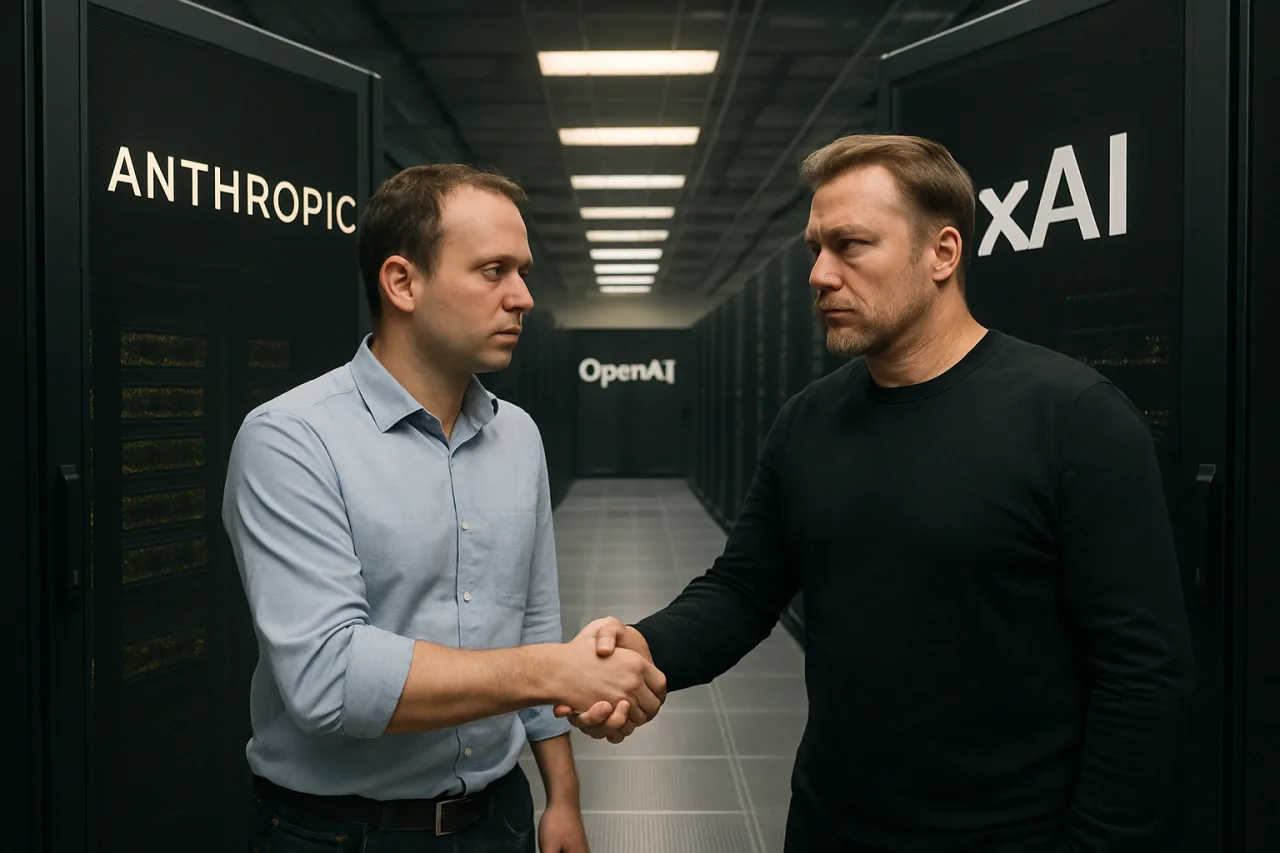
Anthropic xAI alliance — two of OpenAI’s fiercest rivals, led by men who personally distrust Sam Altman, have joined forces in a deal that reshapes the AI industry’s competitive landscape and reveals the personal dynamics driving the AI race.
Key Takeaway
- 🤝 Unlikely Partnership: The Anthropic xAI alliance gives Anthropic access to xAI’s Colossus supercomputer — 220,000+ NVIDIA GPUs — for inference capacity, while xAI gains a major AI customer for its infrastructure
- ⚔️ United Against Altman: Dario Amodei left OpenAI over differences with Sam Altman (“The problem with OpenAI is Sam himself,” he said in 2021). Elon Musk is suing Altman, calling OpenAI a “long con.” Both trust each other more than they trust Altman
- 🖥️ Colossus Supercomputer: xAI’s Colossus 1 features over 220,000 NVIDIA GPUs including H100, H200, and GB200 accelerators — one of the world’s largest AI compute clusters
- 🚀 Orbital Compute Vision: The partnership includes plans for “multiple gigawatts of orbital AI compute capacity” — data centers in space, powered by SpaceX’s launch capabilities
- 📊 Competitive Stakes: OpenAI leads in users (ChatGPT) and coding (Codex), while Anthropic leads in AI safety perception and enterprise adoption. The alliance narrows OpenAI’s compute advantage
Two AI enemies just joined forces to take down the industry leader. Dario Amodei, CEO of Anthropic, and Elon Musk, founder of xAI, have been clear about their feelings toward each other — Musk has attacked Anthropic for “hating Western Civilization,” and Amodei has identified Musk as someone with whom he has deep ideological differences. Yet they just signed a deal that gives Anthropic access to one of the world’s largest AI supercomputers. The Anthropic xAI alliance is not a friendship. It is a strategic calculation built on a shared adversary: Sam Altman.
The deal, announced through xAI’s official news page, gives Anthropic access to Colossus 1 — xAI’s massive AI supercomputer featuring over 220,000 NVIDIA GPUs, including H100, H200, and next-generation GB200 accelerators. Anthropic will use this compute capacity for inference — serving its Claude models to Pro and Max subscribers — rather than for training. The partnership also includes an ambitious longer-term vision: developing “multiple gigawatts of orbital AI compute capacity” — essentially, data centers in space, leveraging SpaceX’s launch capabilities.
Why the Anthropic xAI Alliance Happened
The business logic is straightforward, even if the personal dynamics are not. Anthropic needs compute. Its Claude AI assistant has been breaking down on a weekly basis as it onboards new corporate customers, according to reporting by New York Magazine’s Intelligencer. The company is compute-constrained — it cannot get enough GPU capacity to serve its growing user base. Google, which designs its own AI chips (TPUs), is both a cloud provider and a competitor, creating a conflict of interest that limits Anthropic’s access to Google Cloud. Amazon Web Services provides some capacity, but not enough to meet demand.
Enter xAI’s Colossus. Built by SpaceXAI (the merged entity of SpaceX and xAI), Colossus 1 is one of the world’s largest and fastest-deployed AI supercomputers. For Musk, the deal makes business sense: xAI’s own AI products have been “relatively uncompetitive and unpopular,” as NY Mag noted, making the company’s most valuable asset its physical infrastructure rather than its models. Turning xAI into a neo-cloud provider — renting out Colossus to other AI companies — is a smart pivot for a company whose main advantage is attracting capital and applying it to physical infrastructure challenges.
But the personal dynamics are what make this deal genuinely surprising. Amodei left OpenAI in 2021 to found Anthropic specifically because of disagreements with Altman. “The problem with OpenAI is Sam himself,” Amodei said at the time. Musk co-founded OpenAI with Altman a decade ago and is now suing him, claiming to feel like a “fool” for investing in what he calls Altman’s “long con” to turn OpenAI into a for-profit company. Musk has also claimed that misaligned AI “could kill us all” — using language that suggests his opposition to Altman is existential, not merely commercial.
As NY Mag’s John Herrman wrote: “As much as they don’t trust one another, they trust OpenAI’s Sam Altman less.” Amodei, perhaps perceiving Musk as a less credible competitive threat to Anthropic’s business than Altman in the medium term, decided that access to Colossus was worth partnering with someone he fundamentally disagrees with. Musk, facing an IPO for SpaceXAI and needing a compelling AI story, gained a major customer and a strategic alliance against his nemesis.
What the Colossus Supercomputer Actually Delivers
The technical scale of the Anthropic xAI alliance is what makes it consequential. Colossus 1 features over 220,000 NVIDIA GPUs — a staggering concentration of compute power. For context, training a frontier AI model like GPT-5.6 or Claude 4 typically requires tens of thousands of GPUs running for weeks or months. Colossus 1’s capacity is sufficient to serve inference for millions of concurrent users, which is exactly what Anthropic needs as Claude’s enterprise adoption accelerates.
The deal is specifically for inference, not training. This distinction matters. Training a new frontier model requires massive compute for a defined period — you train the model, then you deploy it. Inference is the ongoing cost of running the model for every user query, every API call, every interaction. As AI models get larger and more capable, inference costs grow proportionally with user base. Anthropic’s problem is not that it cannot train good models — Claude is widely considered competitive with or superior to GPT-5.6 on many benchmarks. The problem is that it cannot serve those models fast enough and reliably enough to meet enterprise demand.
This is the same compute bottleneck we identified in our AI inference spending analysis — the industry is shifting from spending money building AI models to spending money running them. Anthropic’s alliance with xAI is a direct response to this shift. The company that can serve the most capable model to the most users at the lowest latency wins the enterprise market. With Colossus, Anthropic narrows the gap with OpenAI, which has its own massive compute infrastructure through its partnership with Microsoft Azure.
The Orbital Compute Vision
Perhaps the most striking element of the Anthropic xAI alliance is the long-term vision for orbital compute. The official announcement states: “Anthropic also expressed interest in partnering to develop multiple gigawatts of orbital AI compute capacity. The compute required to train and operate the next generation of these systems is outpacing what terrestrial power, land, and cooling can deliver on the timelines that matter.”
Data centers in space may sound like science fiction, but the engineering logic is sound. AI data centers require enormous amounts of electricity and cooling — the two biggest constraints on AI infrastructure growth. In orbit, solar power is continuous and unlimited, and the vacuum of space provides natural cooling. SpaceX, with its reusable Falcon 9 rockets and Starship development program, is the only organization with the launch cadence and mass-to-orbit economics to make orbital compute a near-term engineering program rather than a research concept.
If this vision materializes, it would represent a fundamental shift in AI infrastructure — moving the most power-hungry computation off Earth entirely. This connects to the energy constraints we identified in our AI bubble analysis, where we noted that AI could consume 8% of global electricity by 2030. Orbital compute would bypass terrestrial energy constraints entirely, though at the cost of enormous upfront capital and engineering complexity. For now, it is a stated intention, not a deployed capability — but the fact that two major AI companies are publicly discussing it signals where the industry sees the next frontier.
What This Means for the AI Competition
The Anthropic xAI alliance reshapes the competitive dynamics of the AI industry in three ways. First, it narrows OpenAI’s compute advantage. OpenAI’s partnership with Microsoft Azure gives it access to massive compute resources, but Anthropic’s access to Colossus creates a more level playing field. This matters because compute availability directly determines how many users a company can serve and how fast its models can respond — both critical factors in enterprise adoption.
Second, it positions xAI as an infrastructure provider rather than purely a model developer. This is a significant strategic pivot. As we tracked in our AI World This Week coverage, xAI’s Grok models have struggled to match the benchmark performance of OpenAI and Anthropic models. By pivoting toward infrastructure provision, xAI can generate revenue from its GPU investment even if its own models do not achieve frontier-level performance. This is the “picks and shovels” strategy — selling infrastructure to AI gold miners rather than mining gold directly.
Third, it crystallizes the personal rivalries that are shaping the AI industry into formal business arrangements. The AI race is no longer just about model capabilities — it is about who controls the compute, who controls the distribution, and who controls the relationships with enterprise customers. The Anthropic xAI alliance is a declaration that the fight against OpenAI is not just technological but structural — two companies combining their strengths to challenge the market leader on multiple fronts simultaneously.
The Trust Problem at the Heart of the Alliance
Here is the analytical tension that makes the Anthropic xAI alliance fragile: both partners have publicly questioned whether the other can be trusted with the future of AI. Amodei has built Anthropic’s entire brand around AI safety — the idea that AI development must be guided by careful consideration of risks, not just commercial imperatives. Musk has attacked Anthropic’s safety-focused approach as ideologically biased, claiming the company “hates Western Civilization” because Claude’s constitution includes language about considering diverse perspectives.
Yet Musk also recently wrote: “I spent a lot of time last week with senior members of the Anthropic team to understand what they do to ensure Claude is good for humanity and was impressed.” Whether this represents a genuine reassessment or a strategic compliment in service of the business deal is an open question. What is clear is that both men are willing to set aside ideological differences when commercial necessity demands it — and both see Altman as a bigger threat than each other.
This mirrors the competitive dynamics we analyzed in our OpenAI Ultrafast coverage, where the AI industry is fragmenting into competing camps differentiated by speed, capability, and infrastructure. The Anthropic xAI alliance creates a third major camp — not the OpenAI-Microsoft camp, not the Google-DeepMind camp, but an Anthropic-xAI-SpaceX camp that combines frontier model capability with massive physical infrastructure and orbital ambitions. For AI professionals choosing which platforms to build on, this fragmentation means the competitive landscape is becoming more complex, not less.
What Comes Next
The Anthropic xAI alliance is a signal that the AI industry is entering a new phase of competition — one where infrastructure, not just model capability, determines who wins. For professionals, this means the AI platform landscape is fragmenting into distinct ecosystems, each with different strengths. OpenAI-Microsoft offers scale and enterprise integration. Google offers vertical integration from chips to models. Anthropic-xAI offers frontier models backed by independent compute infrastructure. Choosing a platform is no longer just about which model scores highest on benchmarks — it is about which ecosystem provides the infrastructure, reliability, and long-term sustainability that your applications require.
For investors, the alliance validates the thesis that AI infrastructure is becoming a distinct market from AI models. Companies that own physical compute — data centers, GPUs, power capacity — are increasingly valuable regardless of whether their own AI models are competitive. This is the same trend we identified in our Philippine AI Infrastructure analysis — the infrastructure layer is where the durable value lies. The alliance also connects to the broader AI investment debate we explored in our AI economic impact guide — the companies that control compute will shape how AI transforms the economy.
The personal dynamics — Amodei’s distrust of Altman, Musk’s lawsuit against OpenAI, the ideological divide between Anthropic’s safety focus and Musk’s accelerationist tendencies — add a layer of human drama that makes this more than a business deal. It is a story about how the people building the most powerful technology in history relate to each other, compete with each other, and ultimately need each other. The Anthropic xAI alliance may not last — the ideological differences are real and the competitive overlap is genuine. But for now, two enemies have found a common adversary, and the AI industry just became more interesting.
Frequently Asked Questions About the Anthropic xAI Alliance
What is the Anthropic xAI alliance?
The Anthropic xAI alliance is a partnership announced in May 2026 in which xAI (SpaceXAI) provides Anthropic with access to its Colossus 1 supercomputer for AI inference capacity. Anthropic uses the compute to serve Claude AI models to its Pro and Max subscribers. The deal also includes plans for orbital AI compute capacity.
Why did Anthropic partner with xAI?
Anthropic is compute-constrained — its Claude AI assistant has been experiencing reliability issues as enterprise adoption grows. Access to Colossus 1’s 220,000+ NVIDIA GPUs provides the inference capacity Anthropic needs. The partnership also reflects a shared opposition to OpenAI’s Sam Altman, whom both Anthropic CEO Dario Amodei and xAI founder Elon Musk personally distrust.
What is Colossus and how powerful is it?
Colossus 1 is xAI’s AI supercomputer, featuring over 220,000 NVIDIA GPUs including H100, H200, and GB200 accelerators. It is one of the world’s largest and fastest-deployed AI compute clusters, capable of supporting training, fine-tuning, inference, and high-performance computing at frontier scale.
Why do Amodei and Musk dislike Sam Altman?
Amodei left OpenAI in 2021 to found Anthropic, stating: “The problem with OpenAI is Sam himself.” Musk co-founded OpenAI with Altman and is now suing him, calling OpenAI a “long con” and claiming Altman betrayed the organization’s original non-profit mission. Both see Altman’s concentration of power in AI as dangerous.
What is orbital AI compute capacity?
Orbital AI compute refers to data centers placed in space, powered by continuous solar energy and cooled by the vacuum of space. The Anthropic xAI alliance includes plans to develop “multiple gigawatts of orbital AI compute capacity,” leveraging SpaceX’s launch capabilities. This concept addresses the terrestrial energy and cooling constraints limiting AI infrastructure growth.
How does this affect OpenAI?
The Anthropic xAI alliance narrows OpenAI’s compute advantage by giving Anthropic access to one of the world’s largest GPU clusters. It also positions xAI as an infrastructure provider, creating a third major AI ecosystem alongside OpenAI-Microsoft and Google-DeepMind. The deal increases competitive pressure on OpenAI from two companies that personally distrust its CEO.
Is the Anthropic xAI alliance likely to last?
The alliance faces significant tensions: Amodei and Musk have deep ideological differences about AI safety and governance, and their companies compete in the same market. However, both share a stronger opposition to Altman than to each other, which provides a unifying incentive. The deal’s durability depends on whether the business benefits outweigh the personal and philosophical conflicts.
What does this mean for AI professionals choosing a platform?
The Anthropic xAI alliance means the AI platform landscape is fragmenting into distinct ecosystems: OpenAI-Microsoft (scale and enterprise), Google (vertical integration), and Anthropic-xAI (frontier models with independent infrastructure). Choosing a platform now involves evaluating not just model performance but infrastructure reliability, compute availability, and long-term ecosystem sustainability.
Sources: New York Magazine Intelligencer, “Elon Musk and Dario Amodei Are Burying the Hatchet in Sam Altman’s Back,” 2026 | SpaceXAI, “New Compute Partnership with Anthropic,” May 6, 2026 | Anthropic Claude service status reports | SemiAnalysis Colossus 2 reporting