Table of Contents
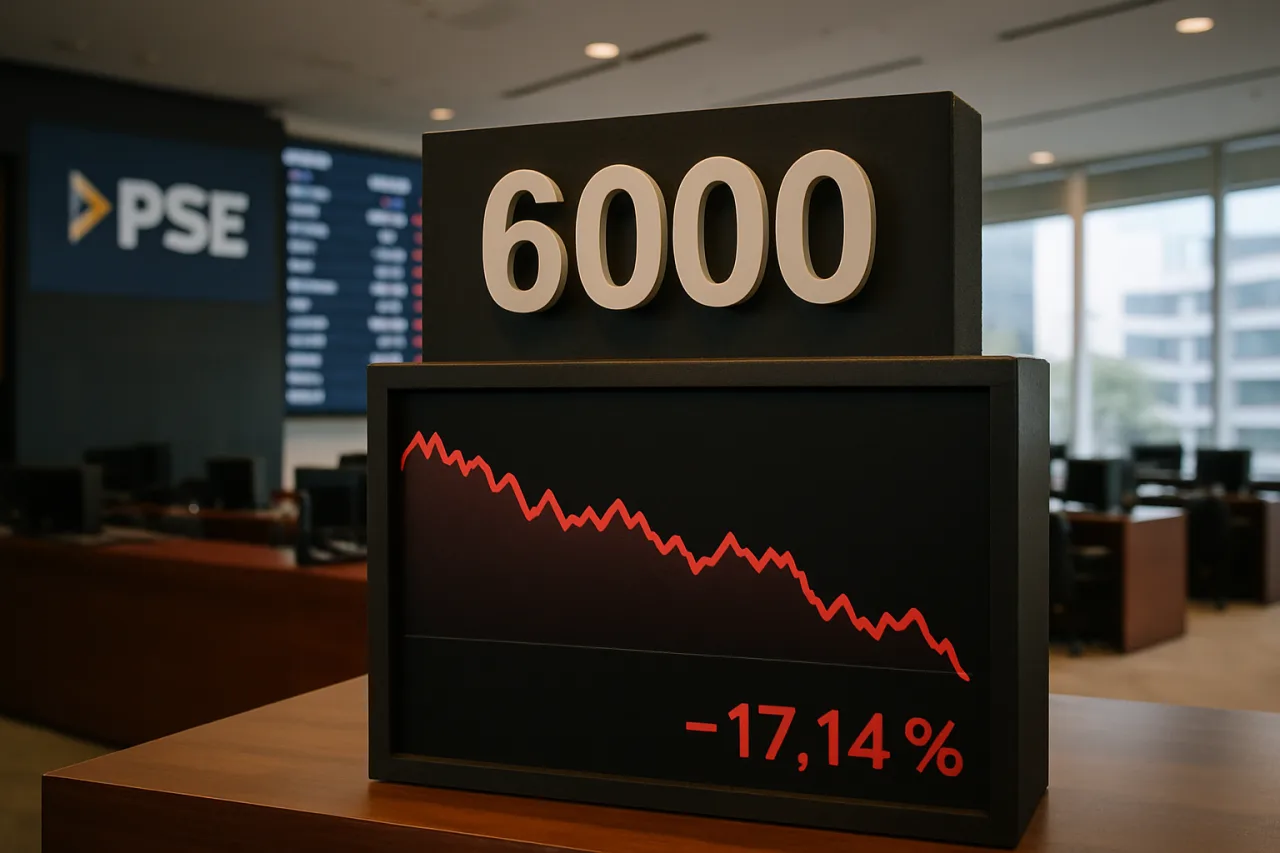
PSEi 6000 — the Philippine Stock Exchange Index has been stuck near the 6,000 level, and according to AB Capital Securities, it is likely to stay there. The problem is not that Philippine stocks are overvalued. The problem is that cheap valuations alone are not enough to fuel a rally when conviction is missing.
Key Takeaway
- 📉 6,000 Base Case: AB Capital Securities maintains its PSEi 6000 year-end target, with the index trading at 6,261.80 as of August 17, 2026 — down 0.56% in the latest session
- 📊 Cheap But Unconvincing: The PSEi trades at 9.6x forward earnings, down from nearly 20x several years ago — but AB Capital says “the problem today is no longer valuation, it’s conviction”
- 🐻 Bear Case 5,100: If global rates stay high, the peso weakens beyond ₱62, and earnings growth falls below forecast, the PSEi could drop to 5,100
- 🐂 Bull Case 7,200: A strong rerating scenario with Fed easing, BSP policy reversal, and foreign investor return could push the index to 7,100-7,200
- 🎯 Stock Picking Over Market Buying: AB Capital recommends buying specific companies with earnings catalysts, not the broad market — naming 8 highest-conviction stocks including Globe, Jollibee, BDO, and Aboitiz Power
Why is the Philippine Stock Exchange Index stuck at 6,000 — and should you be worried? The answer, according to AB Capital Securities Inc., is both reassuring and frustrating. The PSEi 6000 level is not a crisis. The index is cheap by historical standards, trading at 9.6 times forward earnings compared to nearly 20 times several years ago. Much of the bad news — slowing GDP, elevated inflation, the peso’s record low, the construction corruption scandal — has already been priced in. But cheap valuations alone do not create a market rally. What the PSEi needs is conviction, and that is precisely what is missing.
“The problem today is no longer valuation, it’s conviction,” said Hazel Tañedo, president and CEO of AB Capital Securities, during the brokerage’s market outlook presentation reported by the Philippine Daily Inquirer. Her message to investors was direct: “Do not buy the market just because it’s cheap. Buy the companies where the earnings and catalysts give you a reason to believe that cheapness can actually close.” This is a fundamental shift in investment strategy for Filipino investors — from passive index investing to active stock picking based on company-specific catalysts.
The Valuation Story: Cheap for a Reason
The PSEi’s valuation has undergone what AB Capital calls a “substantial derating.” From nearly 20 times forward earnings several years ago, the index now trades at approximately 9.6 times — a more than 50% compression in its price-to-earnings multiple. By any historical measure, Philippine equities are inexpensive. The AB Capital base case assumes a target P/E ratio of 9.3 times and 3.8% earnings per share growth, which produces the PSEi 6000 year-end target.
But cheapness without catalysts is a value trap. Tañedo identified the specific reasons why cheap valuations have not attracted buyers: earnings growth remains too modest to drive the index significantly higher, foreign investors remain largely absent, and improving economic conditions have yet to translate into a broad earnings upgrade cycle. In other words, the market is cheap because the fundamentals do not yet justify higher prices — and until those fundamentals improve, the PSEi 6000 level is where the market will likely stay.
This connects directly to the economic conditions we have been tracking. The Philippine GDP slowdown to 2.3% in Q2 2026, the peso’s record low near ₱62 per dollar, and inflation running at 5.0% — all of these macroeconomic headwinds suppress corporate earnings growth and keep foreign investors away. When the economy is slowing, the currency is weakening, and inflation is eroding consumer purchasing power, companies struggle to grow earnings. Without earnings growth, stock prices do not rise, regardless of how cheap the starting valuation is.
The Foreign Investor Absence
One of the most critical factors keeping the PSEi 6000 level in place is the absence of foreign investors. AB Capital noted that foreign ownership and trading activity are currently near cycle lows — meaning international investors have largely pulled out of Philippine equities and are not returning.
This is significant because foreign capital has historically been the primary driver of PSEi rallies. When foreign investors buy Philippine stocks, they bring liquidity, push prices higher, and create the momentum that attracts domestic retail investors. Without foreign participation, the market relies on domestic investors — who are often smaller, less institutional, and more risk-averse — to drive prices. The result is low trading volume, narrow price movements, and an index that languishes.
The reasons for foreign investor absence are clear: the peso’s depreciation reduces dollar returns for foreign investors, elevated inflation creates economic uncertainty, the corruption scandal has damaged governance perceptions, and high global interest rates make emerging market equities less attractive relative to developed market bonds. As we analyzed in our Balisacan economic shift coverage, the structural challenges facing the Philippine economy are not just domestic concerns — they directly affect how international investors perceive the country as an investment destination.
Bear Case: 5,100 — What Could Go Wrong
AB Capital’s bear case for the PSEi is 5,100 — a decline of approximately 19% from the current 6,261 level. This scenario would materialize if several conditions converge: global interest rates stay high, the peso weakens beyond ₱62 against the dollar, borrowing costs rise, and earnings growth falls below the current 3.8% forecast.
Each of these conditions is plausible in the current environment. The peso already hit a record low near ₱62 in August 2026. The BSP has raised rates to 4.75% but inflation at 5.0% means real interest rates are still negative — if the central bank raises rates further to combat inflation, borrowing costs for Philippine companies will rise, suppressing earnings. And the global interest rate environment remains tight, with the US Federal Reserve’s easing cycle uncertain. The PSEi 6000 level may feel like a floor, but the bear case reminds investors that floors can break.
Bull Case: 7,200 — What Could Go Right
On the upside, AB Capital sees the index reaching 7,100 to 7,200 under a stronger rerating scenario. This would require several positive catalysts: an earlier US Federal Reserve easing cycle, a clearer reversal of the BSP’s monetary tightening policy, better government fiscal execution, stronger corporate earnings, and the return of foreign investors.
Additionally, potential market transactions such as the GCash and Vitro initial public offerings could draw attention and liquidity back to local equities. New IPOs create excitement, attract retail and institutional capital, and often serve as catalysts for broader market rerating. The Vitro IPO is particularly relevant — as we noted in our Philippine AI Infrastructure analysis, PLDT’s VITRO data center arm is at the center of the country’s AI infrastructure buildout. A successful Vitro IPO would bring a pure-play AI infrastructure listing to the PSE, potentially attracting technology-focused investors who have historically avoided the Philippine market.
AB Capital’s Eight Highest-Conviction Stocks
Rather than buying the broad market, AB Capital recommends stock picking — focusing on companies with specific earnings catalysts that can close the gap between current prices and intrinsic value. The brokerage named eight highest-conviction stocks:
1. Globe Telecom Inc. — Telecommunications, benefiting from data center demand and digital services growth
2. International Container Terminal Services Inc. (ICTSI) — Port operations, global infrastructure play with diversified revenue
3. Jollibee Foods Corp. — Consumer, resilient domestic demand and international expansion
4. Manila Water Co. Inc. — Utilities, infrastructure stability
5. JG Summit Holdings Inc. — Conglomerate, diversified exposure across petrochemicals, aviation, real estate
6. Aboitiz Power Corp. — Utilities, AI data center power demand
7. Puregold Price Club Inc. — Consumer retail, essential goods demand resilient to inflation
8. BDO Unibank Inc. — Banking, largest Philippine bank with stable net interest margins
This list reveals an important pattern: the highest-conviction stocks are concentrated in utilities, consumer staples, and infrastructure — sectors that are relatively resilient to the macroeconomic headwinds suppressing the broader index. This aligns with the investment principles we outlined in our Philippine AI stocks investment guide — in a market lacking broad catalysts, focus on companies with specific, identifiable drivers of earnings growth.
What Filipino Investors Should Do
The PSEi 6000 environment requires a different approach from the passive investing strategy that worked during the bull market years. Here are the practical implications for Filipino investors:
First, do not buy the index just because it is cheap. A P/E of 9.6x is attractive in theory, but if earnings do not grow, the multiple stays compressed and prices do not rise. The value trap is real — cheap stocks can stay cheap for years if the catalysts for rerating do not materialize.
Second, focus on company-specific catalysts. Look for companies with clear earnings drivers — a new product launch, a major contract win, a regulatory tailwind, or a structural shift in their industry. The eight stocks AB Capital named all have specific reasons why their earnings could grow even if the broader market stagnates.
Third, diversify beyond Philippine equities. The peso’s record low, as we analyzed in our peso decline report, creates a natural argument for holding dollar-denominated assets. If the peso continues to weaken, dollar investments gain value in peso terms, providing a hedge against both currency depreciation and domestic market stagnation. International index funds, US dollar bonds, or global equity ETFs offer diversification that the PSEi alone cannot provide.
Fourth, watch for the catalysts that could trigger a rerating. The BSP’s August 27 policy decision, any de-escalation in the Iran conflict that brings oil prices down, progress on the corruption scandal that restores investor confidence, and the GCash and Vitro IPOs are all potential triggers. None of these are guaranteed, but any one could shift the market from “cheap but unconvincing” to “cheap with catalysts.”
The Broader Lesson: Valuation Is Not Timing
The PSEi 6000 situation illustrates a fundamental investing truth that every Filipino professional should internalize: valuation and timing are different things. A market can be undervalued and stay undervalued for years. The Philippine stock market’s P/E compression from 20x to 9.6x did not happen overnight — it happened over years, as earnings failed to grow fast enough to justify higher multiples. The reverse — a rerating from 9.6x back to 15x or higher — will also not happen overnight. It requires a catalyst, and catalysts are unpredictable.
As Keynes famously said, “The market can remain irrational longer than you can remain insolvent.” The Philippine market’s current valuation may be rational — the low P/E may accurately reflect the risk of slowing growth, elevated inflation, and absent foreign investors. Or it may be irrationally depressed, pricing in worst-case scenarios that will not materialize. Either way, the PSEi 6000 level is the market’s current judgment, and arguing with it through passive index buying is a strategy that requires patience most investors do not have.
The smarter approach, as AB Capital suggests, is to find the specific companies where the gap between price and value is most likely to close — and to diversify with assets outside the Philippines that are not subject to the same macroeconomic headwinds. That is how a professional navigates a market that is cheap but lacking conviction.
Frequently Asked Questions About the PSEi 6000 Level
What is the PSEi 6000 target and who set it?
The PSEi 6000 year-end target was set by AB Capital Securities Inc., with president and CEO Hazel Tañedo stating that cheap valuations alone are not enough to fuel a sustained rally. The target assumes 3.8% earnings per share growth and a price-to-earnings ratio of 9.3 times.
Why is the PSEi stuck at the 6,000 level?
The PSEi 6000 level persists because while valuations are cheap (9.6x forward earnings, down from 20x several years ago), the catalysts needed to drive prices higher are missing: earnings growth is modest at 3.8%, foreign investors are largely absent, and macroeconomic headwinds including the GDP slowdown, peso depreciation, and elevated inflation suppress corporate earnings.
What is the bear case for the PSEi?
AB Capital’s bear case sees the PSEi falling to 5,100 if global interest rates stay high, the peso weakens beyond ₱62 against the dollar, borrowing costs rise, and earnings growth falls below the current 3.8% forecast. This represents approximately a 19% decline from the August 2026 level of 6,261.
What is the bull case for the PSEi?
AB Capital’s bull case sees the PSEi reaching 7,100 to 7,200 under a stronger rerating scenario. This would require catalysts such as Fed easing, BSP policy reversal, better government fiscal execution, stronger corporate earnings, return of foreign investors, and successful IPOs like GCash and Vitro.
Should I buy Philippine stocks when the PSEi is at 6,000?
AB Capital advises against buying the broad market just because it is cheap. Instead, the brokerage recommends stock picking — focusing on companies with specific earnings catalysts. Their eight highest-conviction stocks include Globe Telecom, ICTSI, Jollibee, Manila Water, JG Summit, Aboitiz Power, Puregold, and BDO Unibank.
Why are foreign investors avoiding Philippine stocks?
Foreign investors are absent due to the peso’s depreciation reducing dollar returns, elevated inflation creating economic uncertainty, the corruption scandal damaging governance perceptions, and high global interest rates making emerging market equities less attractive relative to developed market bonds. Foreign ownership and trading activity are near cycle lows.
How does the peso record low affect the PSEi?
The peso’s record low near ₱62 per dollar affects the PSEi in two ways: it reduces dollar returns for foreign investors (making Philippine stocks less attractive), and it increases costs for companies with dollar-denominated debt or imported inputs (suppressing earnings). However, export-oriented companies may benefit from peso weakness.
What IPOs could help the PSEi rerate?
AB Capital identified the GCash and Vitro initial public offerings as potential catalysts. Vitro, PLDT’s data center arm, would bring a pure-play AI infrastructure listing to the PSE, potentially attracting technology-focused investors. GCash would bring a major fintech listing. Both could draw attention and liquidity back to local equities.
Sources: Philippine Daily Inquirer, “PSEi seen to languish at 6,000 level,” August 18, 2026 | AB Capital Securities Inc. market outlook presentation | Bankers Association of the Philippines PSEi data | Radar.ph market reports
This article is for informational purposes only and does not constitute financial or investment advice. Readers should consult a licensed financial advisor before making investment decisions based on market analysis.