Table of Contents
Key Takeaway
- 🔄 The reversal: Dario Amodei — the CEO who warned of an AI “white-collar bloodbath” — now says the doom scenario hasn’t materialized; Sam Altman puts it plainly: “I am delighted to be wrong about this.”
- 🧮 The math: Amodei’s new frame — “If you automate 90% of the job, everyone does the 10%… and the 10% expands to be 100% of what people do, kind of 10-times their productivity.”
- ⏰ The timing question: The pivot lands as Anthropic eyes one of history’s largest IPOs — S-1 filed June 1, $47 billion revenue run-rate, targeted as early as October 2026. Reassuring investors and regulators is now good business.
- 📊 The data split: Entry-level hiring fell 11% in 18 months (Revelio Labs) and recent-grad unemployment hit 5.6% — yet 46% of AI-adopting employers say entry hiring went UP (Strada). Both narratives are true at once.
- 🇵🇭 The stakes: The Amodei AI jobs debate lands hardest on Filipino BPO workers and junior professionals — the exact cohort both narratives describe — the practical answer is the same either way: climb from task-execution to task-orchestration before the ladder’s bottom rung thins.
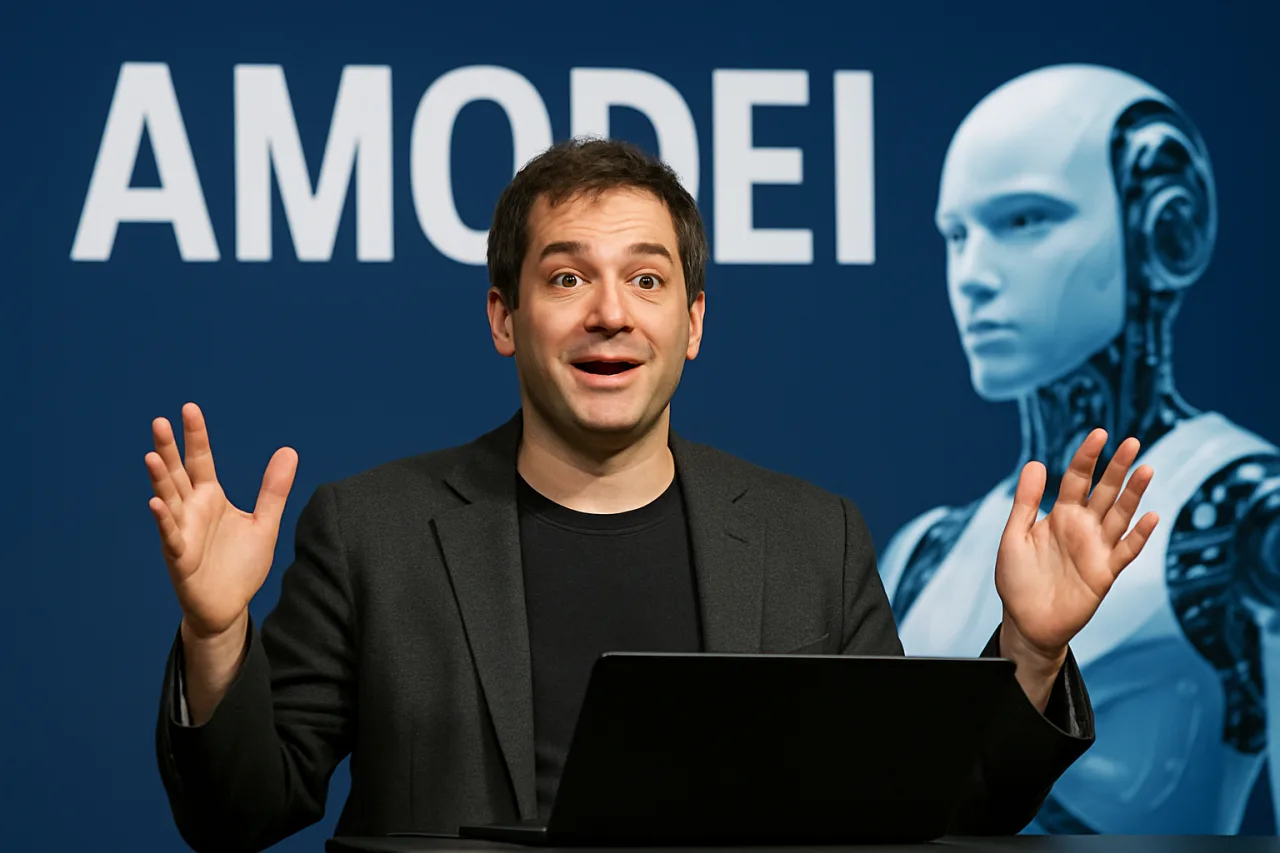
Amodei AI jobs predictions were the scariest numbers in technology: last year, the Anthropic CEO told the world that AI could eliminate half of all entry-level white-collar jobs within five years, a warning so stark it became the phrase “white-collar bloodbath.” Now the man who owned that forecast is walking it back — and the walk-back, arriving alongside a trillion-dollar IPO run, deserves a more skeptical read than either the panic or the relief it produces. In May 2026, speaking with Commonwealth Bank CEO Matt Comyn, Sam Altman conceded the shock never came: “I am delighted to be wrong about this. I thought there would have been more impact on entry-level white-collar jobs being eliminated by now than has actually happened.” Amodei went further, replacing apocalypse with arithmetic — his 90/10 construction in which automating nine-tenths of a job multiplies human productivity tenfold rather than zeroing out the human. This article takes that math seriously, checks it against the messiest hiring data since ChatGPT launched, and asks the question both CEOs skipped: who exactly captures the 10-times, and who gets the compressed, monitored, up-or-out remainder?
The Amodei AI Jobs Quotes, Side by Side
The tone shift is easiest to see side by side. In 2025, Amodei’s warning to Axios-adjacent audiences was blunt: AI could make half of entry-level white-collar jobs vanish within one to five years, pushing unemployment toward 10-20 percent in a “white-collar bloodbath” scenario. Fortune’s August 2026 framing captures the pivot directly — “Amodei spent last year warning of an AI white-collar bloodbath. Now he’s changing the narrative.” The new Amodei tells a multiplication story: “If you automate 90% of the job, then everyone does the 10% of the job. And the 10% kind of expands to be 100% of what people do and kind of 10-times their productivity.” Altman, at the same moment in the cycle, told Comyn the predicted shock “has not actually happened” — quotes Technology Magazine documented in detail — Goldman Sachs CEO David Solomon has held this line since late 2025: “The United States has a long track record of creating new jobs in response to disruption. I do not see any reason to think this dynamic will stop now.” Box CEO Aaron Levie supplies the historical version of the same argument: look at how much faster work is today than decades ago, “you’d certainly have been convinced there’d be no jobs left. Yet the opposite has happened. Why?”
Two things can be true about this chorus, and both matter for how Filipino professionals should read it. First, the reversal is partially sincere: the labor-market apocalypse genuinely has not shown up in aggregate numbers. Second, the messengers now have trillion-dollar reasons to prefer the calm story — which is why the data, not the CEOs, should settle the argument.
Why the Reversal Is Happening Now
Follow the money and the Amodei AI jobs reversal explains itself. Anthropic closed a $65 billion Series H on May 28, 2026 at a $965 billion post-money valuation — briefly surpassing OpenAI as the most valuable private AI company — and confidentially filed its S-1 with the SEC on June 1. Its annualized revenue run-rate crossed $47 billion in May, and Reuters reported in mid-August that the IPO pitch rests on a projected $190-200 billion in revenue by 2028, with bankers and analysts floating valuations from $1 trillion to $2 trillion and a debut as early as October. OpenAI’s path is parallel if slower, with its CFO signaling a 2027 listing. When your company is about to run the largest roadshow in history, the story you tell about your product’s effect on the labor market stops being a prediction and becomes an IR document.
The regulatory optics compound it. A CEO who testifies, in effect, that his product will gut the bottom of the labor market invites the exact antitrust and labor scrutiny a pre-IPO company cannot afford. Recast the product as an efficiency lever — electrification, the spreadsheet, the search engine — and the policy threat dissolves into productivity statistics. None of this proves the Amodei AI jobs reversal is insincere; it proves it is convenient, and convenience is a category of evidence readers should hold separately from truth.
What the Data Actually Says — Both Halves
The honest answer on Amodei AI jobs data is that it splits, and each side of the split is real. Here is the scoreboard as of mid-2026.
| Signal | Finding | Source |
|---|---|---|
| Entry-level hiring volume | Down 11% over 18 months | Revelio Labs |
| Recent-grad unemployment | 5.6% in early 2026, up 1.6 pts in 3 years | Stanford SIEPR / NY Fed |
| Junior hiring at AI adopters | 7.7% faster decline than non-adopters (300,000 firms) | The Economist study |
| Occupational unemployment overall | Broadly unchanged despite 115,000+ tech layoffs through May | Yale Budget Lab |
| Employers using AI | 46% report INCREASED entry-level hiring; 13% decreased | Strada Institute survey |
| AI-skill demand in entry roles | Nearly tripled since fall 2025 | NACE Job Outlook 2026 |
Read together, the Amodei AI jobs numbers describe not a bloodbath and not a hoax, but a bar shift: the first rung of the career ladder still exists, but it sits higher. The tasks that used to occupy a junior analyst’s first two years — drafting, summarizing, basic research, debugging — are increasingly done by models, and employers now want entry-level hires who arrive already able to orchestrate those models. That is why AI-skill demand in entry jobs nearly tripled while routine entry hiring contracted. The Strada finding — 46% of AI-adopting employers hiring MORE juniors — is the strongest evidence for Amodei’s expansion thesis: companies that embed AI do not stop hiring at the bottom, they change what they hire for. The 7.7% faster junior-hiring decline at adopters is the strongest evidence against a smooth transition. Both are true. The aggregate is stable; the individual transition is not.
That last sentence is the whole story of 2026’s labor market.
The 90/10 Math — and Its Catch
The Amodei AI jobs formula deserves to be taken seriously, because in the aggregate it has a century of evidence behind it. Automating a task cuts its cost; cheaper output expands demand for the output; expanded demand creates new and often larger roles around the task — the Jevons paradox applied to labor. The spreadsheet did not end accounting; it made analysts dramatically more numerous and more analytical. On that reading, the 10% that remains after automation — judgment, relationships, accountability, taste — becomes the whole job, and the people who hold it are worth more, not less.
But there is a catch the CEO framing slides past, and Technology Magazine’s analysis names it: the 90% that gets automated is not dead weight — it is cognitive buffer. Routine tasks give a junior professional the low-stakes reps where judgment is actually built. Strip them out and the job compresses into a sequence of consequential decisions from day one, with expected output ratcheting up rather than hours ratcheting down. “10-times their productivity” is a statement about output per head; nothing in the math says the worker captures any of the ten. The 90/10 split, unmanaged, produces fewer seniors who burn out faster — a productivity miracle with a burnout engine underneath. For the individual worker, the practical translation is blunt: the ladder’s first rung now requires orchestrating the automation itself, and the rung is reached earlier, with less runway.
The Philippine Angle: Where the Bottom Rung Matters Most
Now localize it. The Philippines runs the world’s largest business-process workforce after India — call centers, transaction processing, back-office finance and accounting, the exact task-bundle that AI absorbs most cleanly. Our earlier coverage mapped the collision: the $42 billion BPO industry adapting as AI absorbs its traditional tasks, and Amazon’s Mechanical Turk shutdown as a warning for Filipino gig workers. The Amodei AI jobs reversal reads differently in this context. A Silicon Valley CEO’s “delighted to be wrong” is about American graduates; for a Filipino junior analyst or a BPO team lead, the bar-shift is not a forecast — it is this year’s performance review. The industry’s own response has been to climb the stack fast: from voice to higher-value digital services, from task execution to AI-augmented workflow management, exactly the move the Strada data says employers are paying entry-level premiums for.
The honest guidance splits by cohort. If you are a student or fresh graduate: the degree alone is now, in the words of one May 2026 analysis, “valuable and insufficient” — pair it with demonstrable AI-orchestration work before your first interview, because the interview itself is now an AI-skills screen. If you are already junior and nervous: your leverage is the 10% — the judgment, client trust and escalation-handling that models rent but do not own. And if you manage a team: the cognitive-load catch is your operational problem, because compressed roles produce exactly the quiet attrition that never shows up in the layoffs dataset. Our earlier list of the eight jobs AI replaces first has aged precisely the way this data split predicts — routine-heavy roles contract, orchestration-heavy roles expand.
What to Watch Next
Three markers will tell you whether the Amodei AI jobs reversal is wisdom or optics before the history books do. First, the Anthropic IPO itself, expected as early as October: the roadshow narrative and the prospectus risk factors will be written by the same company — read what the S-1’s risk factors say about labor displacement when no investor is watching the tone. Second, the entry-level numbers through the December hiring season: if the Strada pattern (adopters hiring more, differently) spreads while the Revelio contraction fades, Amodei’s math wins on evidence. If recent-grad unemployment keeps climbing past 5.6%, the bloodbath simply arrived late. Third, the Philippines’ own BPO employment prints against the AI-adoption curve — the country is, without anyone designing it, the world’s largest controlled experiment in whether the 90/10 expansion actually employs the 10% at scale. Watch the data, not the CEOs; both sides of this narrative currently have a valuation to defend.
Frequently Asked Questions About the Amodei AI Jobs Reversal
What did Amodei previously predict about AI and jobs?
In 2025, Dario Amodei warned that AI could eliminate roughly half of all entry-level white-collar jobs within one to five years, potentially pushing unemployment to 10-20 percent — a scenario widely dubbed the “white-collar bloodbath.” He was among the most prominent voices predicting severe near-term displacement of junior knowledge workers.
What is Amodei saying now about AI jobs?
On Amodei AI jobs, he now frames automation as a multiplier rather than a destroyer: “If you automate 90% of the job, then everyone does the 10% of the job. And the 10% kind of expands to be 100% of what people do and kind of 10-times their productivity.” Sam Altman made the parallel concession — “I am delighted to be wrong about this” — admitting the predicted entry-level collapse has not materialized on schedule.
Is the Amodei AI jobs reversal just about the IPO?
Timing is the honest concern, not proof of motive. The reversal coincides with Anthropic’s $965 billion Series H, its June 1 S-1 filing, and a potential $1-2 trillion IPO as early as October 2026 — moments when reassuring investors and regulators is commercially rational. The underlying data, however, genuinely shows aggregate labor-market resilience, so both the convenience and the sincerity are in play.
Are entry-level jobs actually disappearing because of AI?
Partially, and unevenly. Entry-level hiring fell 11% over 18 months (Revelio Labs), recent-graduate unemployment rose to 5.6% in early 2026, and a study of 300,000 firms found AI adopters cut junior hiring 7.7% faster than peers. Yet 46% of AI-adopting employers report increased entry-level hiring, and AI-skill demand in entry roles nearly tripled. The net picture: the bottom rung is not vanishing — it is moving higher and changing shape.
What does the 90/10 rule mean for workers?
It means the automated 90% of your job becomes the model’s job, and your value concentrates in the remaining 10% — judgment, relationships, accountability — which then expands to define the whole role. The catch: productivity gains flow to output and employers first, and workers who lose their routine “buffer” tasks face compressed, higher-stakes work unless they deliberately move up the orchestration curve.
What should Filipino BPO workers and fresh graduates do?
Move from task execution to task orchestration: learn to manage, verify and build on AI outputs rather than compete with them on speed or cost. The demand data backs this — AI-skill requirements in entry-level roles have nearly tripled since fall 2025, and Philippine BPO firms are deliberately shifting toward higher-value AI-augmented services. The rung is higher now; it is not removed.