Table of Contents
Key Takeaway
- 🤖 The gatekeeper changed: 87% of companies now use AI somewhere in their recruitment process, and 75% allow AI to reject candidates without human review — the AI job interview is often the first and only screen your application gets.
- ⚠️ The authenticity trap: 49% of US hiring managers auto-dismiss resumes they suspect are AI-generated, and 62% reject AI resumes lacking personalization. Using AI is expected; using it badly is disqualifying.
- ✅ The playbook: Seven concrete steps — from writing for the parser to building a proof-of-work portfolio to having your AI-use story ready — turn the AI screen from a black box into a system you can beat.
- 🇵🇭 The stakes: 72% of Philippine employers already screen for AI knowledge in hiring. For Filipino professionals competing globally, AI job interview preparation is no longer optional — it is the new resume.
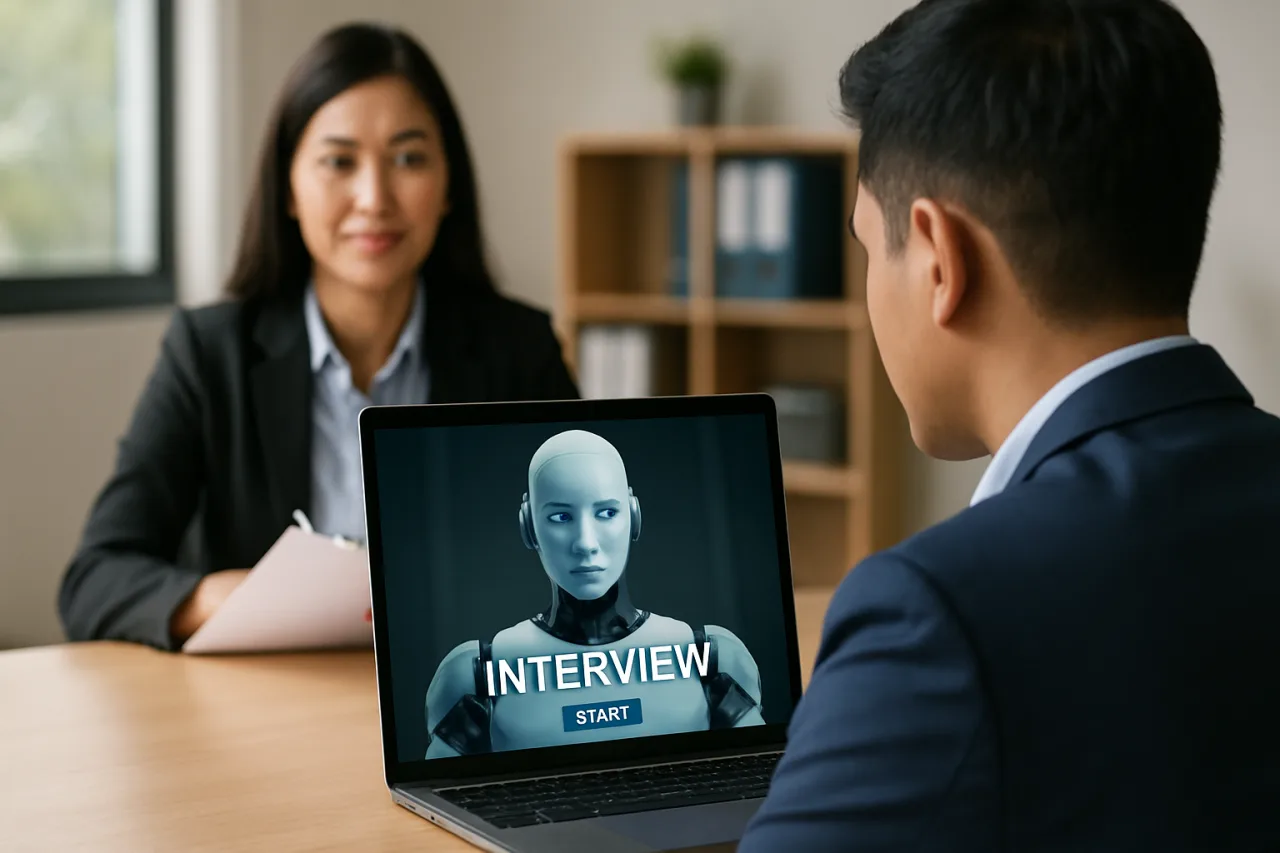
The AI job interview decides more careers today than any human interviewer does — and most candidates still prepare for it like it is 2019. The numbers tell the story: 87% of companies now use AI somewhere in recruitment, 75% let AI reject candidates with no human review, and only 26% of applicants trust the systems evaluating them. Whether you are a developer in Cebu applying to a Singapore startup, an accountant in Manila interviewing with a multinational, or a nurse processing through an international agency’s portal, the first judgment of your candidacy is statistical — and it has different failure modes than the interviews your career guides grew up with. This is the 2026 AI job interview preparation plan that matches the system you are actually facing.
Why the AI Job Interview Replaced the Recruiter Screen
The shift happened for a reason every job seeker should understand: volume. Generative AI let candidates manufacture polished applications at industrial scale — the Harvard Business Review’s June 2026 analysis put it bluntly: “the ability to perform well in interviews is becoming infinitely scalable and practically free. For anyone involved in recruiting, that’s a problem.” When a single posting draws thousands of applications, many assembled by AI in minutes, employers automated the filter. AI now sources, scores, and ranks candidates, conducts chatbot and asynchronous video screens, and — at three-quarters of companies — rejects without a human ever seeing the file.
The scale of that automation has legal and human consequences. A US federal judge allowed a collective action against Workday to proceed in June 2026, with the company’s own filings citing 1.1 billion applications rejected using its challenged screening tools — the largest hiring discrimination case of the AI era. Meanwhile the candidate experience is fraying: 31.4% of job seekers told Enhancv researchers they had walked away from a job entirely rather than sit through a one-way AI interview. Understanding this machinery is not cynicism; it is the price of admission to a hiring market that rebuilt itself around algorithms while candidates kept preparing for people.
What Employers Actually Check in 2026
The screening layer runs on different rules than human judgment, and the data defines the edges. On the input side: 49% of US hiring managers automatically dismiss resumes they identify as AI-generated (Resume.io, surveying 3,000 hiring managers), and 62% reject AI resumes without personalization (Resume Now). A staggering 86% of US hiring managers told the Express Employment Professionals-Harris Poll that AI makes it too easy to exaggerate skills — which means every claim in your application is now presumed inflated until proven. On the process side: 41% of employers are actively moving away from resume-first hiring toward skills tests, behavioral interviews, and portfolio reviews (TechRSeries), while 79% still insist final decisions remain human-led.
Read together, those numbers define the winning position with precision. The resume still matters — but as a claim sheet that survives AI screening and earns a human audience, not as the decision itself. The interview — increasingly AI-run at first, human-led at the end — is where candidates separate. AI-supported structured screening shows a 14% higher interview success rate for candidates who navigate it well (DemandSage), which is the data-backed way of saying: preparation for this format has measurable returns.
Your 7-Step AI Job Interview Prep Plan
Step 1: Write for the parser first, the human second. Most applications die at the screening algorithm before a person sees them. Mirror the job post’s exact phrasing for required skills, use standard section headers (Experience, Education, Skills), submit in the platform’s native format, and skip elaborate templates that confuse parsers. This is not dumbing down your resume; it is acknowledging that the first reader is software.
Step 2: Personalize everything the AI helped you write. The 62% rejection figure for unpersonalized AI resumes is the single most avoidable failure in modern job hunting. Use AI to structure and polish — then inject the details only you know: the project name, the specific number, the client outcome, the tool version. If a hiring manager could swap your name onto another applicant’s resume without noticing, you have not personalized enough.
Step 3: Build proof-of-work that survives the authenticity collapse. With 41% of employers abandoning resume-first evaluation, your portfolio is the new resume. A GitHub repository with real commits, a case study with metrics, a writing sample, a dashboard you built — artifacts a hiring manager can inspect in two minutes and cannot fake with a prompt. Every profession now has a proof-of-work format; identify yours and make it one click away.
Step 4: Practice out loud with AI — in STAR format. This is the Harvard-endorsed method: type your answers to likely behavioral questions in STAR form (Situation, Task, Action, Result), have an AI critique them, then rehearse aloud. Better: run full mock sessions against AI interview simulators, record yourself, and review the tape. Candidates who rehearse against the actual format — structured questions, timed responses, camera on — walk into the real screen with pattern familiarity instead of surprise.
Step 5: Master the one-way video before it masters you. The asynchronous AI screen — 10 to 15 minutes of structured questions answered to a camera — is now the standard first gate, and it has different physics than conversation: answer to the lens, not the screen; keep energy slightly above natural (compression flattens affect); finish answers cleanly rather than trailing off; test lighting, audio, and upload beforehand. One in three candidates has abandoned a hiring process at this stage — do not let format unfamiliarity be the reason you join them.
Step 6: Prepare your AI-use story before they ask. Interviewers in 2026 increasingly probe how candidates use AI — and the wrong answers are “never” (not credible) and “for everything” (not trustworthy). Prepare a specific, honest account: what you delegate to AI (drafts, research, boilerplate), what you verify (everything client-facing), and one example where your judgment improved on the model’s output. That story — judgment plus honesty — is precisely what the 79% who want human-led final decisions are listening for.
Step 7: Verify every claim the AI helped you make. The 86% who say AI makes exaggeration easy are now probing for inflation by default. Every tool listed, every metric cited, every certification claimed must survive a follow-up question. The candidates eliminated late in processes are rarely the ones who lacked skills — they are the ones whose polished claims collapsed under the second question.
How to Use AI Without Being Rejected for It
The paradox of the 2026 hiring market is that using AI is expected and detecting AI use is a sport. The resolution is a line every professional should internalize: AI as assistant is fine; AI as impersonator is fatal. Drafting with AI, researching with AI, practicing with AI — all normal, all defensible. Submitting AI-generated prose you cannot explain, skills you cannot demonstrate, or answers you rehearsed so thoroughly they sound scripted — those trigger exactly the suspicions the statistics capture. The professionals who win treat AI the way strong writers treat grammar checkers: invisible infrastructure behind visibly human judgment.
There is also a fairness dimension worth knowing as you navigate it. Only 26% of applicants trust AI evaluation to be fair (Greenhouse), the Workday litigation is forcing scrutiny of automated rejection at unprecedented scale, and regulators are circling. None of that changes your preparation calculus today — the systems exist and screen you now — but it explains why the final rounds remain stubbornly, reassuringly human. Aim to be the candidate the AI advances and the human confirms.
The Filipino Angle: A Global Market, Screened by the Same Machines
Filipino professionals apply to the world’s jobs, and the world’s hiring has converged on AI screening — which cuts both ways. The same 87% adoption that gates Manila applicants gates everyone; but Filipino candidates who prepare for AI-screened hiring systematically outperform the global default of unprepared mass application. The domestic data raises the stakes further: 72% of Philippine employers now screen for AI knowledge, meaning even local hiring demands demonstrated AI fluency — and the professionals who can narrate their AI use with specificity — a skill set the end of the microwork era made mandatory — are competing for a talent pool advantage, not fighting a filter.
The opportunity is structural. Remote work erased geography from hiring, and AI screening erased some of the human-bias noise (and introduced algorithmic bias of its own — which is precisely why documentation, verification, and proof-of-work matter more for candidates hired sight-unseen). The Filipino engineer who treats the AI job interview as a designable system — parser-optimized resume, personalized claims, proof-of-work portfolio, STAR-rehearsed stories, honest AI-use narrative — is playing the same game as every global competitor, with preparation as the only differentiator that is fully in their control. The machines do the first sorting. You decide what they find.
What Comes Next
Expect three developments to reshape this AI job interview playbook within the year. Verified-credential systems — cryptographically signed skills and employment records — will rise as employers seek signals AI cannot forge. Interview formats will keep shifting toward live, in-person, or interactive assessment for final rounds, precisely because polished remote performance is no longer scarce signal. And the regulatory environment for automated hiring will harden — the Workday case, EU rules, and emerging Philippine AI governance all point toward mandatory human review and algorithmic transparency. Candidates who build authentic, verifiable candidacies today are future-proofing against every one of those shifts; candidates optimizing for the current filters are building on sand.
Frequently Asked Questions About the AI Job Interview
What is an AI job interview?
A screening stage where software — a chatbot, an asynchronous video platform, or a scoring algorithm — evaluates candidates instead of a human recruiter. Formats include one-way video responses to structured questions, chatbot interviews, game-based assessments, and resume-scoring systems. 87% of companies now use AI somewhere in recruitment, and 75% allow AI to reject candidates without human review.
How do I know if my interview is being scored by AI?
Signals include: a self-scheduled one-way video link, no recruiter on the call, structured timed questions, automated confirmation emails, and instant rejections. When in doubt, prepare as if AI is scoring — the best AI-screen preparation (clarity, structure, specificity) also impresses humans.
Can I use AI to prepare for an AI-scored interview?
Yes — and you should, with the assistant-not-impersonator line in mind. Career experts including Harvard’s FAS career center recommend using AI for background research, generating likely questions, drafting STAR-format answers, and getting feedback on them. The real work — your experiences, your specifics, your delivery — must be yours, because the follow-up questions are where unprepared candidates collapse.
Why do hiring managers reject AI-generated resumes?
Because volume broke the signal. 49% of US hiring managers auto-dismiss resumes they suspect are AI-generated, and 62% reject AI resumes without personalization — a defense against thousands of identical applications. The fix is not avoiding AI but personalizing everything: specific projects, verifiable numbers, and details only the real candidate could supply.
What should I say when asked how I use AI at work?
Be specific and honest: name what you delegate (drafts, research, boilerplate), what you verify (everything that ships), and give one concrete example where your judgment beat the model’s first output. “I never use AI” is not credible in 2026, and “AI does most of my work” fails the trust test — the winning answer shows delegation with judgment.
How long should I prepare for an AI job interview?
Plan a focused week: two sessions on parser-optimizing your resume and personalizing every claim, two building or updating proof-of-work, two rehearsing STAR answers aloud against recorded mock sessions, and one dry run of the full one-way video format with your actual setup. That is roughly 8-10 hours — and given that AI-supported structured screening rewards preparation with measurably higher pass rates, it is the highest-return investment in your job search.