Table of Contents
Key Takeaway
- 🛒 The tools are already mainstream-adjacent: 43% of American shoppers know Walmart’s Sparky or Amazon’s Rufus exist, but only 14% have used an AI shopping assistant — Gen Z leads at 24%.
- 🚫 Distrust is the finding: 41% of survey respondents state they have no trust in AI shopping assistants, and only 13% completely or mostly trust them — behind your neighbor’s advice at 53% and ordinary reviews at 48%.
- 🤝 The control line holds: just 4% would trust an AI shopping assistant to complete a purchase without their final review — that line is your protection.
- 💳 Buying is becoming agentic: Visa and Mastercard have opened their payment systems to agentic commerce, and OpenAI is teaming with Etsy and Shopify — the checkout is the new frontier.
- 🧾 The safe pattern: use the assistant to find and compare, do the final price check and review read yourself, and never hand it a stored card without limits.
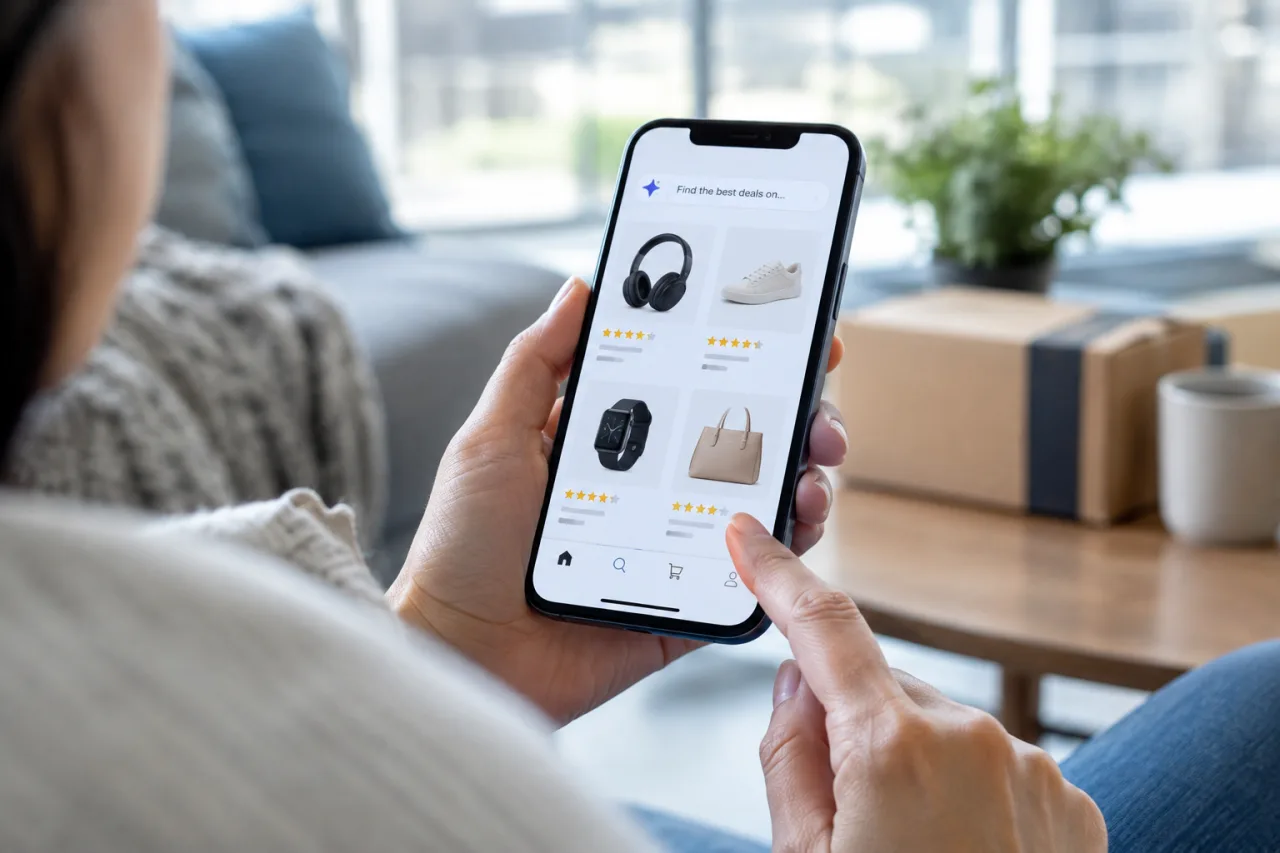
It started as a search box that summarized reviews. Now the biggest retailers run AI shopping assistants that plan purchases, compare prices and — through agentic payments — can carry a checkout to completion. Amazon’s Rufus is open to all shoppers, Walmart’s Sparky learned new tricks for the holiday season, and payment giants have wired their networks so an AI checkout can actually settle the bill. The trust data from YouGov’s national survey explains the other half of the story: 41% of respondents state they have no trust in AI shopping assistants, and only 13% completely or mostly trust them. This guide takes both halves seriously — what these assistants genuinely do, where the trust problem is earned, and the checkout rules that keep an AI shopping assistant useful without letting it overpay for you.
What AI Shopping Assistants Already Do for Shoppers
Walmart launched Sparky in June 2025 as its agentic shopping companion — it summarizes thousands of reviews into a verdict, recommends products, plans events around a shopping list and answers free-text questions in the Walmart app. By the 2026 holiday season the retailer kept expanding the same assistant, as holiday-feature reporting shows. Amazon’s Rufus, opened to all US consumers the year before, does the matching job across Amazon’s catalog: ask it what to buy for a use case, get a selection with review context, then refine by budget. On the payments side, Visa and Mastercard have both opened their infrastructures to agentic commerce, and OpenAI has connected ChatGPT’s buying flows to Etsy and Shopify — the last mile where an assistant completes, not just recommends, a purchase.
Adoption is real but early. YouGov’s nationally representative survey of 1,414 US adults found 43% aware of AI shopping assistants and 14% who have used one — 24% among Gen Z, 17% among millennials, down to 7% among baby boomers. Most users deploy the assistant as an information tool: 44% ask it product questions, 41% use it to find specific products online, and 34% hunt deals with it. Shoppers who have not tried one but are curious want the same thing, only stronger: 67% would use an assistant to find the best prices, and 56% to compare similar products. The demand the whole market is betting on is price-and-compare intelligence, not robot checkout.
The Trust Problem, in Numbers
Agentic commerce is moving into checkout on the payments side even as the same survey that measured adoption measured trust — and the numbers are brutal for the tool category. Only 13% of Americans say they completely or mostly trust AI shopping assistants — well behind personal recommendations at 53%, consumer reviews at 48% and expert reviews at 40%. Only influencer recommendations, at 11%, rank lower. And 41% of respondents state they have no trust in these assistants at all. As Retail Dive reported when the survey landed, skepticism is now the main barrier to adoption, with shoppers describing everything from mild doubt to outright hostility about AI in the open-ended responses.
The reporting on this survey confirmed the headline trust barrier, and the reasons behind the distrust are specific, not vague. Among those avoiding the tools, 54% simply see no need; 45% prefer a human; 34% worry about privacy and data security; and 30% suspect the assistant exists to upsell them things they do not need. Another 24% doubt recommendation accuracy. Read together with the 4% who would trust an assistant to complete a purchase without their final review, the pattern is clear: shoppers will borrow an AI shopping assistant’s research, not its judgment. That is a fair split — and the sections below show how to hold it.
Where Shoppers Will Even Consider It
Category comfort numbers round out the picture. Around one in five US adults would consider AI shopping help for consumer electronics (21%), clothing and accessories (20%), groceries and household essentials (19%) and travel planning (18%) — the high-choice, deal-hunting categories where a second-opinion engine has real value. Comfort collapses in the personal zones: 12% for pets, 12% for cars and 9% for finances. And 43% would not let AI touch any purchase at all. Parents, worth noting, run consistently ahead of the average — 48% aware versus 42%, 63% understanding what the tools do versus 44%, 21% having used one versus 12% and 28% interested versus 21% — which is both the market’s growth path and a family conversation worth having before the first agentic checkout.
The Real Risks of Letting an AI Shop for You
Each shopper worry traces to a real mechanism. The upsell worry (30%) is grounded in business model: these assistants are retail products, and the emerging economics put ads inside AI answers and sponsored placements inside results — our explainer on ads coming to AI follows who runs them and what it changes. The privacy worry (34%) is grounded in data flow: an assistant needs your shopping intent, and once payments go agentic, it touches your payment credentials too, which is why the checkout rules below matter. The accuracy worry (24%) is grounded in how generative answers work — a summarized review or a “best for your needs” pick can silently miss a discontinued model, a fake-review pattern, the counterfeit trap our fake-goods protection guide covers, or a regional shipping issue, with no liability when the pick fails. And the newest risk has no survey line: agentic checkout mistakes, where an assistant orders the wrong size, the wrong seller or a duplicate, and the fix is a refund process rather than an undo button.
None of this makes AI shopping assistants useless — it makes them a tool class with a competence line. Where the assistant is summarizing public reviews, comparing specs and surfacing options, it outperforms manual searching on speed. Where a wrong answer costs you money — payment, warranty, counterfeit risk — the human stays in charge. That line is exactly where trust numbers land, and it is where the rules below draw it.
How to Shop With an AI Shopping Assistant Without Overpaying
- Treat the assistant as the researcher, never the buyer. The 96% who want final review are right: you close the checkout, not the assistant.
- Verify the price outside the chat. Compare the assistant’s pick against the merchant’s own page and one alternative retailer before paying — the 67% who want deal-hunting intelligence get it only if you check the deal exists.
- Read the actual reviews on the product page. An assistant’s two-line summary is a starting map; the 1-star band and the review dates tell you what the summary compressed.
- Assume sponsored placement exists. Where ads appear inside AI answers, a top pick may be a paid one — look for the label, and weigh independent sources when the label is missing.
- Keep payment credentials out of the agent. If you use an agentic checkout, use the tokenized or virtual-card route the provider offers, set spend limits, and never save a bare card number inside a chat assistant.
- Screenshot the order and the answer. When an assistant recommends and you buy, the screenshot is your record of what it claimed — relevant for returns and for spotting an assistant that steers badly.
- Use it where it is strongest. Deal comparison, review summarization and long-tail product discovery — the top three verified use cases. Keep it away from your finances (only 9% of shoppers are comfortable with that) and your pets and cars (12% each) if the survey’s category comfort data matches your own stakes.
The Filipino and OFW Shopping Angle
For Filipino families the AI shopping assistant question has a cross-border shape: gifts for Christmas boxes, appliance purchases for the household back home, and marketplace orders that mix local and international sellers. The same rules apply with two additions. First, scam pressure is higher in markets where digital-payment trust is still rebuilding — our explainer on why 62% of Filipinos avoid online transactions because of scam fear shows the fraud climate these tools walk into, so the verify-price-and-seller rule is not optional. Second, price checks matter more when the purchase routes through currency conversion and shipping tiers: an assistant optimized for the seller’s catalog is not optimizing your landed cost, so compute the total — item, shipping, taxes, the peso rate that week — before you close any checkout the assistant found. The assistant’s strongest honest job for an OFW household is exactly the 67% case: finding the best price for something you have already decided to buy.
FAQ
Are AI shopping assistants safe to use?
For research — prices, comparisons, review summaries — they are as safe as any web tool that handles your shopping intent, with privacy settings worth a check. The risk concentrates at checkout: only 4% of surveyed Americans would let an assistant complete a purchase without final review, and that restraint is the safe default, especially where agentic payments are involved.
Why do so many shoppers distrust AI shopping assistants?
The survey gives specific reasons: 41% of respondents state they have no trust in them, and among avoiders the top drivers are seeing no need (54%), preferring human help (45%), privacy concerns (34%) and suspicion of upselling (30%). Only 13% say they completely or mostly trust them — lower than personal recommendations and consumer reviews.
What is the best AI shopping assistant right now?
In the mass market, Amazon’s Rufus and Walmart’s Sparky are the two deployed at scale, with ChatGPT’s shopping flows connected to platforms like Etsy and Shopify. The best one for you depends on where you shop — but the survey’s advice applies to all of them: value shows up in deal-finding and comparison, not in hands-off purchases.
Can an AI shopping assistant place orders by itself?
Increasingly yes on the technical side — agentic commerce links assistants to payment systems from Visa and Mastercard, and OpenAI integrates buying with Etsy and Shopify. Whether it should is a different question: the tools automate checkout, and the survey shows almost nobody trusts them unsupervised. Keep the final review.
Do AI shopping assistants get paid to recommend products?
Sponsored placements are part of the emerging model, which is why 30% of surveyed shoppers already suspect these assistants upsell. Look for ad labels inside AI answers, cross-check any “best” pick against independent listings, and treat label-free recommendations with the same skepticism you give label-free web results.
What should I never let an AI shopping assistant do?
Never let it hold your bare card details, never let it close a checkout without your review, and never treat its product claims as verified — screenshot what it says, check the price at the source, and keep high-stakes categories like payments and vehicles on human judgment, matching the low comfort levels in the survey’s own category data.
Do AI shopping assistants work for international orders?
The major ones focus on their home catalogs, and cross-border orders add currency conversion, shipping tiers and import fees that most assistants do not compute. Treat their suggestions as the starting point, then verify the landed cost — item, shipping, taxes and the week’s exchange rate — on the merchant page before paying.
Is it safe to connect my payment account to an AI shopping agent?
Only through the tokenized or virtual-card route a provider offers, with spend limits set, and never by saving a bare card number in a chat. The survey’s restraint benchmark stands: only 4% of US adults would trust an assistant to close a purchase without their final review.
Which AI shopping assistant does the survey say parents trust most?
The survey did not rank brands by trust — it measured the category. Parents are simply further along than average: 48% awareness, 63% understanding of what these tools do, 21% having used one, and 28% interested in trying. For a household, that makes the checkout rules a family conversation, not an adult-only setting.
Prices, features and integrations change quickly in this category. Verify current behavior on the merchant’s own pages before you transact.
Sources and Further Reading
- YouGov — “AI shopping assistants are catching on — but shoppers still need convincing” (survey of 1,414 US adults)
- Retail Dive — “AI shopping assistants have a trust problem” (July 22, 2025)
- Walmart — “The future of shopping is agentic: meet Sparky” (June 2025)
- About Amazon — how to use Rufus
- The Public Interest Network (US PIRG) — “Should you use an AI shopping assistant this holiday season?”
Cite this pagePublished Nov 11, 2026
Agron, E. (2026, November 11). AI Shopping Assistants: 41% of Shoppers Don’t Trust What Buys for Them. WorldNgayon. https://worldngayon.com/ai-shopping-assistant-rules/
Agron, Edmon. “AI Shopping Assistants: 41% of Shoppers Don’t Trust What Buys for Them.” WorldNgayon, 11 Nov. 2026, worldngayon.com/ai-shopping-assistant-rules/.
Agron, Edmon. “AI Shopping Assistants: 41% of Shoppers Don’t Trust What Buys for Them.” WorldNgayon, November 11, 2026. https://worldngayon.com/ai-shopping-assistant-rules/.
Agron, E. (2026) ‘AI Shopping Assistants: 41% of Shoppers Don’t Trust What Buys for Them’, WorldNgayon, 11 November. Available at: https://worldngayon.com/ai-shopping-assistant-rules/.
E. Agron, “AI Shopping Assistants: 41% of Shoppers Don’t Trust What Buys for Them,” WorldNgayon, Nov. 11, 2026. [Online]. Available: https://worldngayon.com/ai-shopping-assistant-rules/
@online{agron2026aishopping,
  author       = {Agron, Edmon},
  title        = {{AI Shopping Assistants: 41\% of Shoppers Don’t Trust What Buys for Them}},
  year         = {2026},
  date         = {2026-11-11},
  organization = {WorldNgayon},
  url          = {https://worldngayon.com/ai-shopping-assistant-rules/},
  urldate      = {}
}TY - ELEC AU - Agron, Edmon TI - AI Shopping Assistants: 41% of Shoppers Don’t Trust What Buys for Them T2 - WorldNgayon PY - 2026 DA - 2026/11/11/ UR - https://worldngayon.com/ai-shopping-assistant-rules/ Y2 - ER -
Cite the version you read; the page may be updated. Zotero and Mendeley can also import this page directly.