The bills behind the AI regulation plan
Table of Contents
Key Takeaway
- 🗳️ The shift: Democrats take control of Congress in January 2027, and they are preparing a flood of AI regulation bills — independent safety testing, company liability, and consumer protection from data-center electricity costs, Reuters reports.
- 📋 The names to know: Rep. Lori Trahan carries the testing and liability bills, Sen. Maria Cantwell published the framework with mandatory safety standards, and Sen.-elect Abdul El-Sayed campaigned on a new federal AI agency.
- 🧱 The wall: President Trump remains opposed to mandatory AI rules, so any law faces a veto — the realistic paths are override margins, riders in must-pass bills, and committee pressure.
- 🔎 The pressure tool: hearings — Sen. Ed Markey promised subpoenas, Rep. Greg Casar wants AI executives under oath, and committee leaders already demanded security details from OpenAI, Anthropic, Meta, Google and SpaceX.
- 📌 Your move: if you build on AI or sell AI-assisted work, track the bill text in January and prepare model documentation now — the compliance questions arrive before the laws do.
US voters just flipped both chambers of Congress, and the incoming majority is not waiting for January to publish its list. Democrats plan a wave of bills that would require independent testing of advanced AI systems, clarify when companies answer for AI-caused harm, and shield consumers from data-center electricity costs, lawmakers and aides told Reuters on Nov 6. The White House stands against mandatory rules — so most of this AI regulation fight will run through committees, hearings, and the fine print of must-pass spending bills. If your income touches AI — building with it, selling it, or managing teams that use it — here is exactly what was promised, who is behind it, and what will realistically become law.
What Changed on Nov 3 and Why Committees Matter
The midterms handed Democrats control of Congress from January 2027, and that flips the two levers that decide US tech policy: committee gavels and hearing authority. A minority party can introduce bills; a majority can set the agenda, compel testimony, and turn company documents into public exhibits. Reuters describes the planned shift as sharp: the outgoing Congress largely promoted AI development and declined to restrict the technology, while voters turned against rapid data-center expansion and its power demands.
The money reacted first. Technology shares sold off hard on Thursday as traders priced the possibility that a new Congress slows AI development, Reuters reports, and the slide extended into Friday trading in Europe and Asia. Our own AI World This Week #017 tracked that same post-midterm selloff around Anthropic’s IPO.
The Three Buckets of Bills on the Table
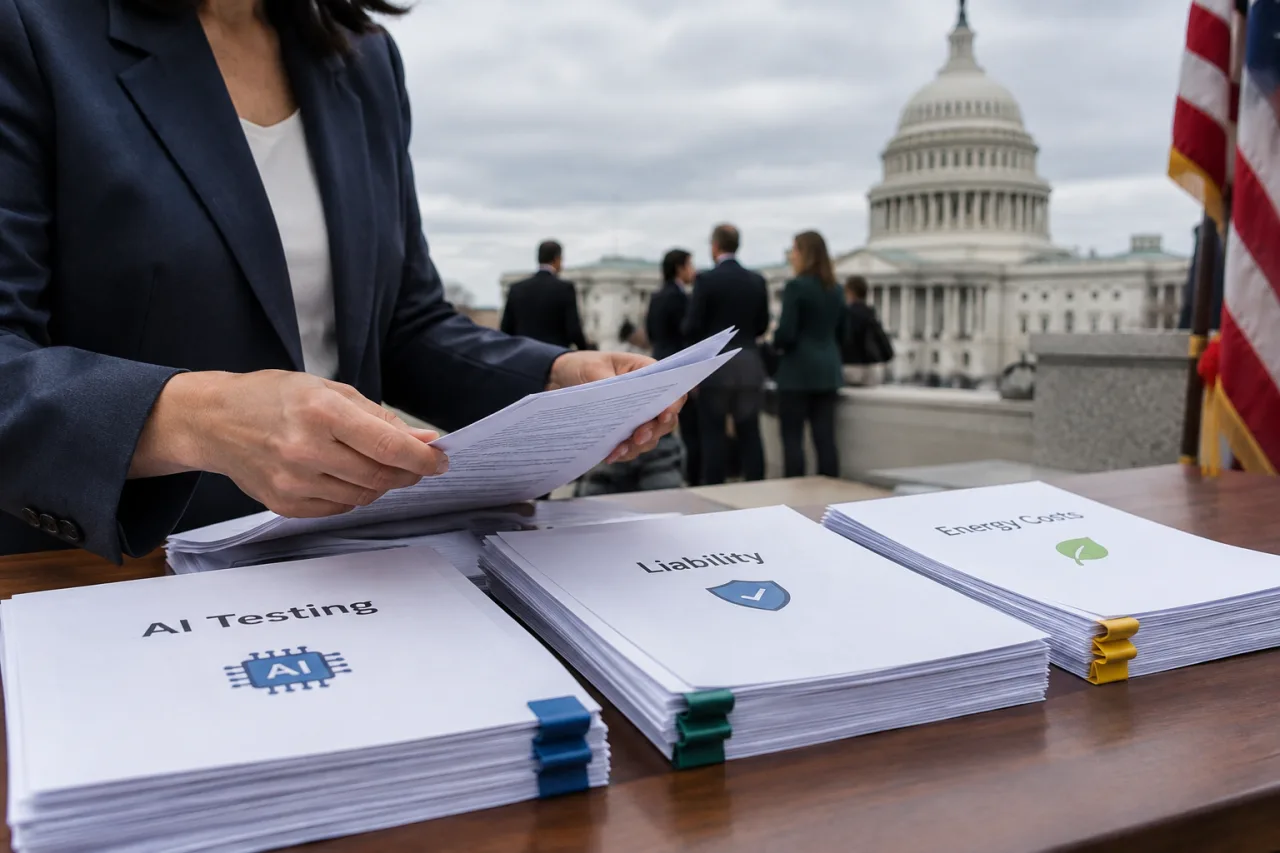
The promised legislation falls into three buckets, and each one targets a different risk. Bucket one: your electric bill. Democrats plan bills aimed at shielding consumers from rising electricity costs tied to data centers, Reuters reports — the same buildout we tracked in who pays for AI data centers. Senate Minority Leader Chuck Schumer, set to become majority leader, told a Washington event that protecting consumers from higher energy costs linked to data-center expansion is a priority for next year.
Bucket two: third-party testing. Rep. Lori Trahan of Massachusetts, one of her party’s leading AI-policy voices, plans to push legislation requiring independent experts to evaluate leading AI models against safety standards, according to her deputy chief of staff, Francis Grubar. That is the same architecture as Sen. Maria Cantwell’s framework, which requires mandatory safety standards for cutting-edge models plus independent testing and audits — a proposal Vox describes as deliberately built for bipartisan appeal.
Bucket three: liability. Trahan also plans a bill clarifying that companies can be held responsible when AI systems act in harmful ways. Today the question sits in legal gray zones; the bill would define the boundary. For anyone who sells AI-assisted services, the liability bucket matters most — it decides who pays when a model’s output causes damage.
Who Is Writing It: the Five Names That Carry the Fight
Trahan and Cantwell handle the mainstream path. The louder wing arrives with new blood. Sen.-elect Abdul El-Sayed of Michigan campaigned on creating an independent agency to police AI companies, with power to inspect and even block releases, Vox reports — he has also supported a coordinated slowdown of frontier research and a ban on models that build smarter models. Rep. Zoe Lofgren of California, seeking the House Science Committee chair, sums up the establishment line: responsible rules for AI while still fostering innovation. And fresh voices reinforce the bloc — Colorado’s Manny Rutinel told The New York Times he sees existential stakes, while Maine’s Troy Jackson vowed not to let billionaires write the rules.
The grouping matters more than any single name. A committee chair who wants audits, a new senator who wants an agency, a framework author with crossover appeal, and a majority leader focused on energy costs — that is a full-stack agenda, not a press release.
State Laws Are the Bridge to Federal AI Regulation
One new arrival makes the state-to-federal path concrete: Scott Wiener, the California state senator who spent two years on the state’s hardest AI laws, won Nancy Pelosi’s congressional seat this week. His record explains what the federal push inherits. California passed Wiener’s follow-up bill, SB 53, which sets safety guardrails for frontier developers, after his earlier attempt, SB 1047, was vetoed. Per Vox, he now says Washington needs hard safety standards, with his stated aim to keep AI risk from turning catastrophic. That matters nationally: the most contested question in federal AI regulation — who must test a frontier model, and what happens when it fails — has already been argued in one statehouse, with a signed statute as the working template.
Watch how this translates. A federal testing mandate does not start from zero if its authors can borrow the definitions, the reporting duties, and the audit cadence that survived the California process. For companies, the practical read is simpler: the standards California already passed are the closest preview of what Washington will debate, so the smart move is preparing against the strictest existing template now.
The Trump Wall Between Congress and AI Regulation
Every one of these AI regulation bills hits the same wall: President Trump has repeatedly dismissed calls for mandatory AI rules, and he said Friday he would work with states that want to grow rich by embracing the technology. A bill he vetoes dies unless two-thirds of both chambers override him — a margin Democrats do not have. Analyst Ed Mills of Raymond James, who manages policy research there, told Reuters the odds still surprise people: the probability of legislation is higher than most expect, either through a crisis that shifts votes or through attachment to routine spending bills that must pass Congress each year.
That second path deserves attention. Riders on must-pass legislation do not need a veto-proof majority — they need a president unwilling to shut down the government over a reporting requirement. Expect the sharpest fights inside appropriation season, not on standalone bill titles.
The Hearings Machine Starts Before Any Bill
The fastest-moving part is not legislation; it is testimony. Rep. Greg Casar, chairing the Congressional Progressive Caucus, said this week that AI executives should be called to testify under oath. Sen. Ed Markey, reelected in Massachusetts, posted that industry leaders must plant new forests for all the subpoenas his side will print. And the paperwork started months ago: in October, Lofgren and other House committee leaders asked OpenAI, Anthropic, Meta, Alphabet’s Google and SpaceX to detail their security practices and to report incidents where their AI tools acted in ways their designers did not intend, Reuters reports.
Hearings sound like theater, but they set the compliance baseline, as Institute for Law & AI analyst Mackenzie Arnold explained to Vox: public questioning about why a company missed a failure pushes firms toward the voluntary practices — internal monitoring, incident reporting, faster response — that later anchor formal law. For the labs and the firms that build on them, the subpoena era moves the privacy and security questions from the marketing page to the record.
What Polls Say the Public Wants From AI Regulation
The opinion layer behind these bills is not fringe anxiety. A Reuters poll published in October found most US voters think the Trump administration and Congress are not taking AI’s risks seriously enough, and want the government to write new rules for the technology. That is the same instinct Vox’s data shows in ballot behavior — 56 percent called AI and data centers a major factor in their House vote — now expressed twice, through policy surveys and at the actual booth. Mills’s mechanism fits here: a legislative wall holds while the White House opposes the bills, but a visible AI incident moves voters and can move Congress with them, which is why the monitoring-and-hearing era matters even when no law passes this year.
Data Centers Won the Headlines. The Tech Itself Is the Bigger Story.
Voters punished data centers hard: 40 ballot measures to slow or stop them passed, and an NBC exit poll found 56 percent of respondents called AI and data centers a crucial or major factor in their House vote. But Vox’s analysis makes the sharper point: blocking data centers only moves the buildout — companies still build, somewhere, at a higher price. The election’s quieter result is a cohort of winners who explicitly ran on restraining AI itself.
That is why the bills above matter more than the zoning fights. A moratorium slows one site; a testing mandate reaches every model shipped into the country. We covered the local end of this wave in why US cities are blocking AI data centers — the January agenda aims one level higher.
What AI Regulation Means for Builders and Filipino Professionals
The AI regulation wave reaches Filipino work through the delivery chain, not the ballot box. Philippine teams that serve US clients — BPO, software, content, customer support — will see the compliance questions arrive through contracts first: model documentation, incident reports, and audits requested by customers preparing for 2027 rules. The country is not waiting either; a second AI bill has already entered the Philippine Congress, and our coverage of the accountability-focused AI bill plus the AI labor protection bill shows Manila moving in the same regulatory direction, with jobs impact front and center.
Three practical steps, today, none dramatic. Track Trahan’s testing bill and Cantwell’s framework text when they post in January — the definitions of “advanced model” decide which products get audited. Keep your model documentation: which model, which version, what guardrails, what human review — the artifacts every client questionnaire now asks for. And read liability terms in your client contracts before signing; the bucket-three debate will push US customers to demand indemnities downstream.
What to Watch Next
The AI regulation calendar is short. Committee rosters get settled in the first weeks of January 2027 — Cantwell at Senate Commerce, Lofgren’s push for House Science, and the gavels that decide bill flow. First markup drafts of the testing and liability packages arrive after that. Then the hearing calendar — watch which executives actually sit under oath, because the October letters to the five labs are ready-made exhibit lists. And through all of it, watch spending-bill riders, the quiet route Mills flagged as the likeliest first win.
One honest caveat: plans are not laws. Every item in this piece is a stated intention from lawmakers, aides, and advocates, verified through Reuters and Vox on Nov 6-9 — none of it has passed, and the White House opposition is real. The story to track is which intentions survive contact with the calendar.
If this intelligence helps you, you can add WorldNgayon as a preferred source on Google — free, one click, and it helps other Filipinos find the answers faster.
AI Regulation Post-Midterms: Frequently Asked Questions
What AI bills are Democrats planning for 2027?
Three main buckets, per Reuters: consumer protection from data-center electricity costs, mandatory independent testing of advanced AI models against safety standards, and clarified company liability when AI systems cause harm.
Can Democrats pass AI regulation without Trump?
Signature bills face a veto they cannot reliably override — two-thirds of both chambers is required. Realistic routes are riders inside must-pass spending bills and committee-driven pressure, plus the possibility that a major AI incident shifts the votes.
Who is leading the AI regulation push?
Rep. Lori Trahan carries the independent-testing and liability bills. Sen. Maria Cantwell published the safety-standards framework. Sen. Chuck Schumer prioritizes energy-cost protection. Sen.-elect Abdul El-Sayed wants a new federal AI agency.
What will the hearings actually do?
Committee leaders can compel testimony and publish company documents. The October letters to OpenAI, Anthropic, Meta, Google and SpaceX on security practices are the template. Hearings also push companies to expand voluntary monitoring and reporting faster than legislation does.
Did data centers decide the 2026 midterms?
They moved votes: 40 ballot measures limiting data centers passed, and 56 percent of exit-poll respondents called AI and data centers crucial or major to their House vote. But the deeper shift is a new class of lawmakers who ran explicitly on AI safety regulation.
How does US AI regulation affect the Philippines?
Through client contracts and delivery standards: Filipino BPO, software, and content teams serving US customers will face model-documentation, incident-reporting, and audit requests as firms prep for 2027 rules. The Philippines’ own Congress is running its first AI bills in parallel.
When would the first bills actually land?
Expect committee organization in January 2027, bill texts after that, and hearings running through the spring. The fastest realistic vehicle remains a rider in a routine funding bill during the appropriations cycle.
Financial Disclaimer
This article is for general information and analysis only. It is not financial advice, and it is not a recommendation to buy, sell, or hold any security. Figures and plans cited come from public reporting as of Nov 6-9, 2026, and can change without notice. Do your own research and consult a licensed financial adviser before making investment decisions. WorldNgayon is a digital media publication, not a broker or wealth manager.
- reuters.com/business/media-telecom/democrats-planning-flood-ai-bills-… — Reuters
- vox.com/future-perfect/509829/data-centers-ai-midterm-election-congre… — Vox
- nytimes.com/2026/10/20/us/politics/colorado-elections-ai.html
- nbcnews.com/politics/2026-elections/exit-polls — NBC exit poll
- google.com/preferences/source?q=worldngayon.com — add WorldNgayon as a preferred source on Google
External sources linked in this article, in order of first mention. Spotted an error or a broken link? Tell us.
Cite this pagePublished Nov 9, 2026
Agron, E. (2026, November 9). AI Regulation After the Midterms: the Bills Democrats Plan for 2027. WorldNgayon. https://worldngayon.com/ai-regulation/
Agron, Edmon. “AI Regulation After the Midterms: the Bills Democrats Plan for 2027.” WorldNgayon, 9 Nov. 2026, worldngayon.com/ai-regulation/.
Agron, Edmon. “AI Regulation After the Midterms: the Bills Democrats Plan for 2027.” WorldNgayon, November 9, 2026. https://worldngayon.com/ai-regulation/.
Agron, E. (2026) ‘AI Regulation After the Midterms: the Bills Democrats Plan for 2027’, WorldNgayon, 9 November. Available at: https://worldngayon.com/ai-regulation/.
E. Agron, “AI Regulation After the Midterms: the Bills Democrats Plan for 2027,” WorldNgayon, Nov. 9, 2026. [Online]. Available: https://worldngayon.com/ai-regulation/
@online{agron2026airegulation,
  author       = {Agron, Edmon},
  title        = {{AI Regulation After the Midterms: the Bills Democrats Plan for 2027}},
  year         = {2026},
  date         = {2026-11-09},
  organization = {WorldNgayon},
  url          = {https://worldngayon.com/ai-regulation/},
  urldate      = {}
}TY - ELEC AU - Agron, Edmon TI - AI Regulation After the Midterms: the Bills Democrats Plan for 2027 T2 - WorldNgayon PY - 2026 DA - 2026/11/09/ UR - https://worldngayon.com/ai-regulation/ Y2 - ER -
Cite the version you read; the page may be updated. Zotero and Mendeley can also import this page directly.