The inbox wave of AI-generated complaints
Table of Contents
Key Takeaway
- 📬 The wave: UK councils, MPs’ offices, tribunals and employers now fight an influx of AI generated complaints — letters that take minutes to write and hours to answer, The Guardian reports.
- 📏 The scale: the typical AI-drafted complaint runs about ten times longer than the old two-page norm, and one dispute document reached roughly 200 pages.
- 🏷️ The name: researchers call it agentic flooding — material that is repetitive, padded with unrelated passages, and sometimes cites laws that do not even apply in the UK.
- ⚖️ The trap: institutions legally must review every request, even a fabricated or inaccurate one — and there is no standard process for testing AI agents, so the inbox wave has nowhere to be dismissed.
- 📌 Your move: if you run support, complaints, or client mail for a living, set intake rules now — triage, length limits, and campaign filters — before the wave reaches your queue.
The inbox has become the newest front line of the AI boom. Councils, lawmakers’ offices, tribunals and employers in the United Kingdom report that they believe a large share of the letters they now receive were drafted by chatbots — the raw material of AI generated complaints, and the paperwork is clogging services that were never built for this volume, the Guardian’s Joanna Partridge reported on Nov 8. Each document may take minutes to generate — but every one of them competes for the same limited people, which is why the surge in AI generated complaints now has a name of its own and why defenders, from ombudsmen to unions, are building intake rules in real time, from ombudsmen to unions, are building intake rules in real time. If you work in support, complaints handling, or any client-service shop — including the Philippine teams that answer the English-speaking world’s mail — this wave is coming to a queue near you.
Here is what it looks like, why it is hard to stop, and what the first responders are actually doing.
What Agentic Flooding Is, and Who Named It
The researchers tracking the wave call it agentic flooding — a label attributed by the coverage’s research summaries to the Hertie School (Berlin) and two allied groups — the Cooperative AI Foundation and GovAI. The pattern is simple once you see it: a person with a grievance asks a chatbot to write the maximum-pressure complaint, and the chatbot obliges with a long, formal, well-structured document. The result often reads impressively and is often padded — the first marker of AI generated complaints — repetitive sentences, unrelated passages stitched in, and, as the reporting warns, sometimes legal citations that do not apply in the UK jurisdiction or facts the chatbot invented.
Straight from the Guardian’s reporting: the AI generated complaints keep arriving because the cost of writing one has collapsed. Before chatbots, a formal complaint about rubbish collection or a development decision took effort, which naturally limited volume. Now the effort moves entirely to the receiving side, where a human must read, parse, and answer each submission to legal standards.
The Scale: What the People Counting Are Saying
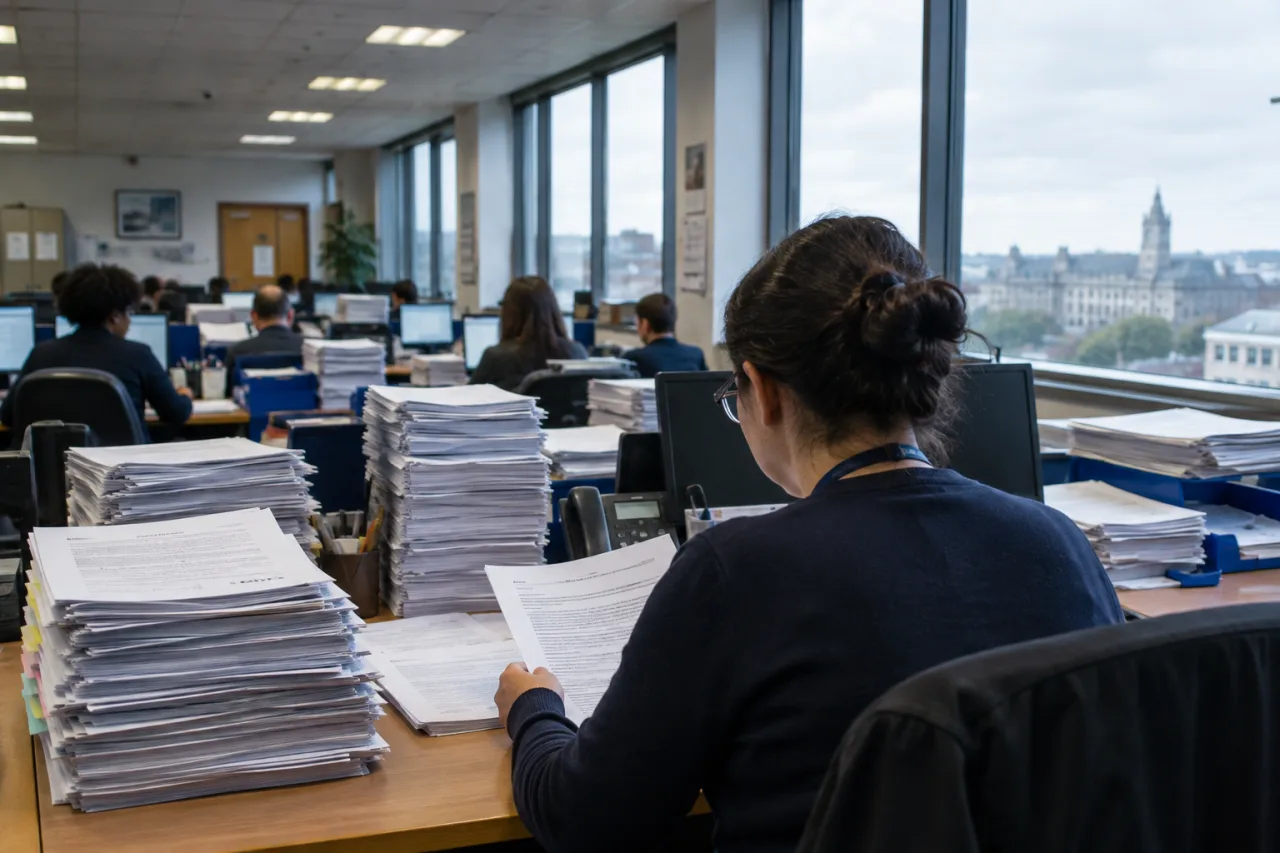
The numbers come from the people processing the mail. Holly Wickens, a senior caseworker in the office of a Labour MP, says roughly half the emails reaching the office are AI to some degree, and that the documents have become more complex and more effortful than the simple letters that preceded them. The old average complaint ran about two pages, according to Deborah Evans of Lawyers in Local Government; most AI generated complaints now run about ten times that, and the largest document she knows of stretched to roughly 200 pages.
Transport for London shows the same curve in official records. The agency’s tally of information-access requests hit 4,769 in 2025-26 — a record, about 5 percent over the mark two years earlier — and its committee minutes describe a noticeable jump in appeals staff believe the machines worked up: technical in tone, often wrong in substance. Employers report their own variant: aggressive, exaggerated claims that sometimes never state what remedy the complainant actually wants.
One more figure makes the burden plain: office staff report working beyond their paid hours to keep up, and one union voice in the coverage, Lisa Gillmore of the GMB, sums up the cost as her union sees it: the technology is not lowering the workload in MPs’ offices.
Why None of It Can Simply Be Filtered Out
The reason this wave is hard to stop is legal, not technical. Under UK rules, information requests and complaints must be reviewed even when they contain inaccuracies or nonsense, the Information Commissioner’s Office notes — a duty that does not vanish because the letter looks machine-made. So every padded AI drafted letter consumes the same review time as a sincere one, and a public body that deletes the wrong one risks breaching duties instead of saving effort.
Detection does not rescue it either. Independent testing has shown AI detectors are unreliable at scale, which our AI detectors accuracy guide documented — and the same tool that floods an inbox can also be asked to make a genuine complaint sound human, so a filter tuned to catch machine prose risks punishing real people with real grievances. The flood defense is not a classifier; it is process design.
The Economics: Why Reading Time Is the Real Bill
Put a price on the queue and the scale stops being anecdotal. A skilled caseworker reads a two-page letter in a few minutes and answers it with a template; the ten-times-longer AI generated complaints of 2026 do not merely take ten times longer to read — they take longer still, because a padded document makes the reader hunt for the actual grievance inside the padding, verify cited laws against the right jurisdiction, and draft a response calibrated to demands that may never be stated. Reading time, in other words, grows faster than length.
Multiply that by a record intake year — TfL’s 4,769 requests show a 5 percent climb at one agency alone — and the arithmetic lands on staffing: either the body absorbs the extra hours unpaid, as the MPs’ office testimony describes, or the queue slows until real complainants feel the delay first.
That is the quiet incentive behind every intake rule in this piece. A length cap is not hostility to complainants; it is the body stating the largest envelope it can actually process. The bodies that set envelopes first will keep answering genuine cases on time. The ones that wait will rediscover the duty-to-review trap the expensive way, in service complaints about the service.
The Defenses Public Bodies Are Building Right Now
Three defenses appear in the reporting, in order of how widely they are used.
1. Triage by source. Some MPs’ offices, like the one Vonnie Sandlan runs for her employer, now decline to answer automated campaigns such as click-to-contact drives, concentrating instead on individual correspondence from constituents. That rule does not touch genuine letters, and it cuts large campaign volumes at once.
2. Limits on length and channel. Ombudsmen are introducing caps on complaint length, switching to structured forms, and limiting attachments — so a 200-page submission cannot arrive unbounded. Structured intake also forces the complainant to state a requested remedy, which the employers’ variant of the wave tends to omit.
3. AI on defense. Some councils are weighing AI that summarizes long letters and drafts initial replies — using the same technology that caused the wave to process its output. That choice carries its own risk: an automated reply to an automated complaint can end the loop before a human reads anything, so councils that go this route will need to prove the loop still covers real grievances.
A worked example shows how the three combine. A letter arrives: nine pages, structured, citing legal authority, requesting a review of a parking fine. The intake system scores it — long, formatted, no stated remedy. Under campaign filtering it is not an automatic dismissal, because it is an individual piece of correspondence, not a bulk drive. Under the length cap it goes to the condensed-form path: the complainant is asked to restate the request in the standard format with the remedy stated. Under the summarization option, an AI brief is prepared for the human reviewer, who still signs the response. Three rules, one queue, and the human layer intact — that is the composite defense the reporting describes in pieces.
None of the three is a law. They are queue behavior, evolving live.
That also means the exact defenses you will face depend on the body you are complaining to — or supporting.
What This Means for Support Teams and the BPO Lane
Every wave of AI generated complaints did not announce itself in the Philippines, but the work it creates flows there. The country’s service economy answers other people’s inboxes for a living, and the same surge of AI generated volume reshapes what those contracts demand: triage tooling, length policies, campaign filters, and staff who are trained in reading AI-padded paperwork without losing real customers inside it. Gartner-backed reporting that 1 in 5 support teams have already cut headcount over AI, covered in our support-teams analysis, sets the context: the same shops absorbing complaint floods are the ones deciding what the staffing curve looks like next year.
For small businesses the math is sharper, and AI generated complaints are the reason: A shop fielding customer complaints cannot review 200-page disputes either — the pattern is identical, only in miniature, and our small-business chatbot ledger shows the cost picture of using AI for the reply side while the inbox side grows. The lesson from the UK public bodies: decide intake rules before volume forces the decision, because the rules set after the flood arrive are the ones written in overtime.
What Client Contracts Need Before the Flood Reaches Them
For the service teams standing in front of this wave professionally, the UK experience converts into contract language, and four clauses carry the difference between absorbing and drowning. First, a volume clause: the service level should state the reviewable envelope — maximum reading length per item, and what happens to items that exceed it — because the old assumption that complaints arrive short has quietly died. Second, a campaign definition: bulk click-to-send drives are a different unit of work from individual correspondence, and contracts that do not separate them will price the wrong thing. Third, a human-review line: whoever signs answers to customers signs as a person, which keeps the automated-reply temptation out of the legal chain even after the client buys AI tooling. Fourth, a documentation ask: when the client’s own AI drafts or routes mail, the record of what was automated should travel with the file, so disputed cases can show their history. None of these clauses exists to fight the technology; they exist so that AI generated complaints inside a client’s queue get handled at a price someone agreed in advance.
The Philippines angle runs through this paragraph twice. The teams that will be asked to staff these triage queues — in English, at Western service standards, inside SLA clocks — sit largely in the BPO lanes that already run complaint and retention desks for global brands. And the businesses most exposed to the wave arriving without warning are those same SMEs our chatbot cost ledger describes: small shops whose reply tooling outgrew their intake discipline.
The Practical Checklist: Reading a Queue for Agentic Flooding
If your team wants the version you can apply tonight, this is the list the reporting supports.
- Measure your baseline first. Count last quarter’s average complaint length and volume; TfL’s committee-minutes method — tracking request counts and noting suspected AI drafts — is the template.
- Flag the three padding signatures. Repetition, unrelated passages, and legal citations from the wrong jurisdiction. Per the reporting, these three show up most often in AI worked-up letters.
- Set a stated-remedy requirement. Ask every complainant one question: what outcome do you want? Machine-drafted escalation letters often skip it.
- Set length and attachment caps early. The ombudsman model — form-based intake with limits — costs nothing until the day you need it.
- Segment campaigns. Identify click-to-send drives and answer them in bulk language; protect individual, specific letters regardless of how polished they are.
- Keep the human review layer. Whatever you automate, keep a person legally accountable for the final read — the UK rule and the fairness of your queue both depend on it.
One honest boundary on all of the above: the reporting comes from the UK, its institutions, and its legal duties, and the exact numbers behind the influx are mostly institutional testimony rather than audited statistics. The direction is clear, and so is the reason to watch it: every queue that takes written complaints — public or private — now shares the same physics of AI generated complaints. The precise slope in your market is your own number to count.
If this intelligence helps you, you can add WorldNgayon as a preferred source on Google — free, one click, and it helps other Filipinos find the answers faster.
AI generated complaints: Frequently Asked Questions
What are AI generated complaints?
They are grievances, information requests, or formal letters whose main text appears to be drafted by a chatbot — long, formal, often padded with repetition and off-topic passages, and sometimes citing laws that do not apply.
Who coined the term agentic flooding?
The label is attributed to the Hertie School (Berlin) and two allied research groups — the Cooperative AI Foundation and GovAI — per the Guardian’s coverage of the surge.
Why can’t public bodies just ignore the AI ones?
Because the duty to review attaches to the request itself, not to its author. UK bodies must examine requests even when the text is inaccurate, so a machine-drafted letter consumes review time exactly like a real one.
Can AI detectors solve the problem?
No. Detector accuracy is too inconsistent to build a service duty on, and detectors punish real people whose writing a chatbot polished. Process design beats classification.
How long are the AI-drafted complaints getting?
About ten times the old two-page average by one account, with the largest single dispute document reaching roughly 200 pages.
What are ombudsmen doing about it?
They are capping complaint length, moving to structured forms, and limiting attachments, so intake volume cannot arrive unbounded.
Does this affect the Philippines’ BPO industry?
Yes, through contracts: teams handling complaints and support for overseas clients will see triage rules, campaign filters and documentation asks move from UK and US employers into their service terms.
- theguardian.com/technology/2026/nov/08/ai-clog-public-bodies-local-au… — The Guardian reports
- aiweekly.co/alerts/uk-public-bodies-hit-by-surge-of-ai-generated-comp… — the typical AI-drafted complaint
- google.com/preferences/source?q=worldngayon.com — add WorldNgayon as a preferred source on Google
External sources linked in this article, in order of first mention. Spotted an error or a broken link? Tell us.
Cite this pagePublished Nov 9, 2026
Agron, E. (2026, November 9). AI-Generated Complaints Are Flooding Public Services. WorldNgayon. https://worldngayon.com/ai-generated-complaints/
Agron, Edmon. “AI-Generated Complaints Are Flooding Public Services.” WorldNgayon, 9 Nov. 2026, worldngayon.com/ai-generated-complaints/.
Agron, Edmon. “AI-Generated Complaints Are Flooding Public Services.” WorldNgayon, November 9, 2026. https://worldngayon.com/ai-generated-complaints/.
Agron, E. (2026) ‘AI-Generated Complaints Are Flooding Public Services’, WorldNgayon, 9 November. Available at: https://worldngayon.com/ai-generated-complaints/.
E. Agron, “AI-Generated Complaints Are Flooding Public Services,” WorldNgayon, Nov. 9, 2026. [Online]. Available: https://worldngayon.com/ai-generated-complaints/
@online{agron2026aigenerated,
  author       = {Agron, Edmon},
  title        = {{AI-Generated Complaints Are Flooding Public Services}},
  year         = {2026},
  date         = {2026-11-09},
  organization = {WorldNgayon},
  url          = {https://worldngayon.com/ai-generated-complaints/},
  urldate      = {}
}TY - ELEC AU - Agron, Edmon TI - AI-Generated Complaints Are Flooding Public Services T2 - WorldNgayon PY - 2026 DA - 2026/11/09/ UR - https://worldngayon.com/ai-generated-complaints/ Y2 - ER -
Cite the version you read; the page may be updated. Zotero and Mendeley can also import this page directly.