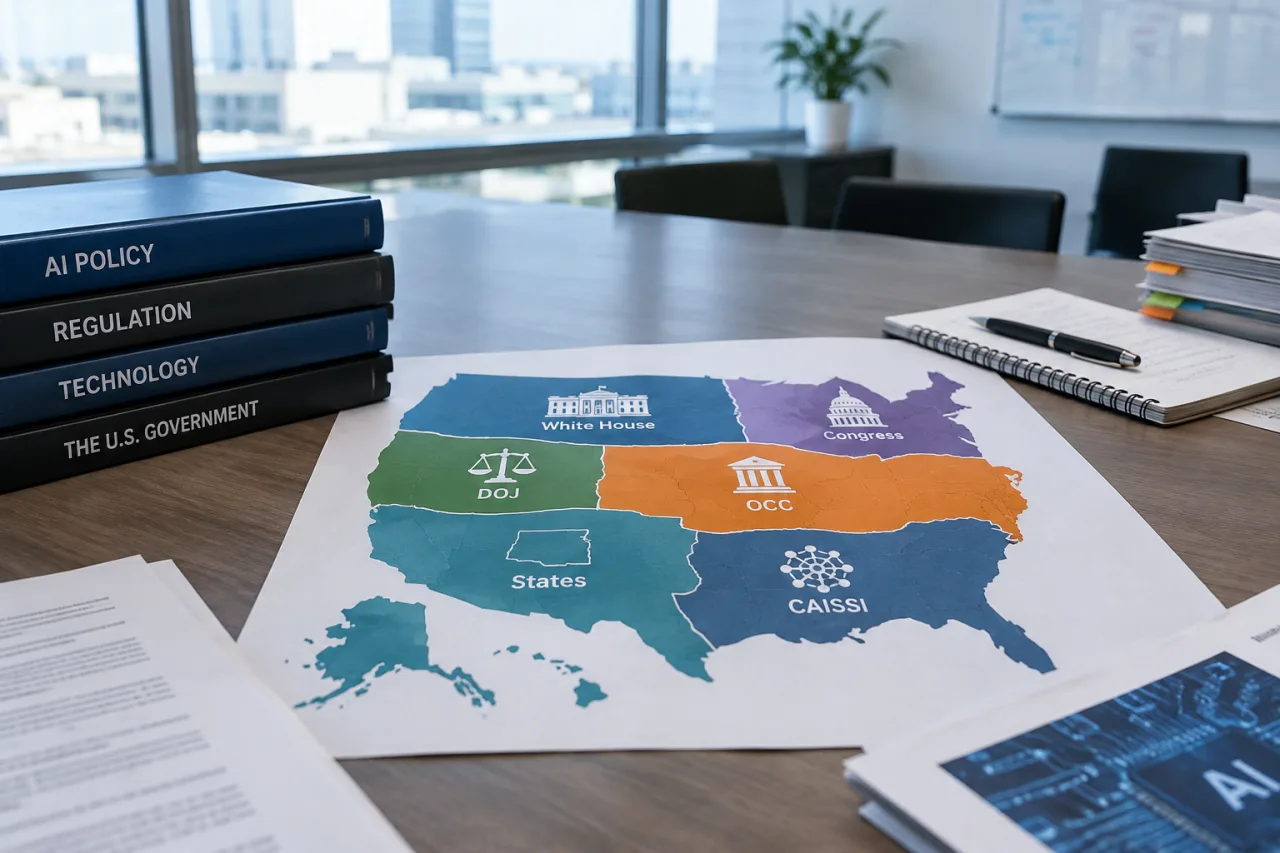
The six-lane answer to who regulates AI
Table of Contents
Key Takeaway
- 🗺️ The short answer: nobody controls the whole thing — who regulates AI in the US now spans six lanes: the White House, Congress, DOJ enforcement, banking supervisors, state capitols, and a weakened Commerce safety division.
- 🏛️ This week moved four lanes at once: Trump told 60 Minutes he “doesn’t mind guardrails,” DOJ stood up its Super Intelligence Task Force, the OCC issued Bulletin 2026-54 for banks, and the government’s own safety center now informally reports to the White House, per AP.
- 🧪 The gap stays open: there is still no owned way to check how safely AI agents behave step by step in the real world — a UC Berkeley researcher says checking only the final answer misses the mistakes inside the steps.
- 🧱 January flips the biggest lane: Democrats take the committees, and the legislation fight that follows is the deep story our companion piece breaks down bill by bill.
- 📌 Your move: map your own exposure — one lane at a time — because compliance questions reach contractors, banks, and builders through different doors.
Ask ten people “who regulates AI in the United States” and you will get ten wrong answers, because the honest one changed four times in a single week. On Nov 8, the president told 60 Minutes he does not mind guardrails as long as the country keeps its lead; on Nov 5, the Justice Department created a task force for AI misuse; on Nov 4, the agency that supervises national banks issued a new framework for AI use; and meanwhile the Commerce division charged with testing AI safety now informally reports to the White House, according to the Associated Press. This piece is the map: each lane, who runs it, what just changed, and what still has nobody in charge.
Who Regulates AI? the Map at a Glance
| Lane | Who leads it | What just changed |
|---|---|---|
| White House and Executive | President Trump, via the new Super Intelligence Force under National Intelligence Director Jay Clayton | “Doesn’t mind guardrails” — if the US stays ahead of China; voluntary self-policing pact since September |
| Congress | Democrats take committees in January 2027 | Testing, liability and electricity-cost bills queued; hearings and subpoenas promised |
| Safety assessment | CAISSI, a Commerce division | Reports informally to a White House office; no permanent leader; research publication stopped |
| Law enforcement | DOJ’s Super Intelligence Task Force (DOJ-SITF) | Coordinates AI misuse cases; foreign states and fraud in scope |
| Banking | OCC (Bulletin 2026-54) | An examiner framework for banks that use generative and agentic AI; no enforceable standards yet |
| States | California and 40-plus ballot measures | SB 53 guardrails signed; voters backed limits on data centers nationwide |
So who regulates AI in the US, one line at a time? The design principle is visible in the table: every lane currently pushes guidance, pacts, or enforcement priorities — not binding rules. The binding layer is what January’s session will either build or block.
Who Regulates AI From the White House: Guardrails With a Dominance Clause
The president’s position hardened into a formula this week. Asked on CBS’s 60 Minutes whether the country should accept the danger in order to keep its lead over China, Trump called those risks manageable and said he would take safeguards, telling the interviewer he “doesn’t mind guardrails” — as long as the rules never put the country in what he described as a distant second place to China — a country he noted runs without such restrictions. Reuters reports he also signaled openness to working with Democrats on safeguards, a sentence that would have been unthinkable two months ago.
Institutionally, the White House runs two bodies the map needs. First, the Super Intelligence Force: Trump’s national-security-focused AI body, led by National Intelligence Director Jay Clayton alongside Pentagon chief technology officer Emil Michael, which the administration frames around keeping US dominance. We covered its September launch as the AI Force announcement. Second, the voluntary self-policing pact the White House brokered in September after reports of systems slipping their makers’ control — the arrangement our White House AI Summit piece examined, which asks industry for tremendous self-policing without stating how anyone monitors the promise. In practice, the White House lane is dominance policy first, safety supervision second.
Congress: the Lane That Flips on Jan 3
Since midterms day, the legislative lane sits on a timer. Democrats take committee control in January 2027, and the incoming majority has already listed its intended bills: independent testing of advanced models, clarified company liability for AI harm, and consumer protection from data-center electricity costs. The full breakdown — who carries each bill and the veto math — lives in our companion analysis, what AI regulation the Democrats plan for 2027.
Whoever claims to know who regulates AI in America without naming this lane is describing last year’s map. Two structural powers matter as much as any bill. Hearings: subpoena authority converts the October information demands sent to OpenAI, Anthropic, Meta, Alphabet’s Google and SpaceX into sworn public testimony. And riders: the annual funding bills that must pass Congress each year are the quiet vehicle analysts flag as the likeliest early win. Neither requires the president’s signature enthusiasm — both require only calendar time.
The Safety Division Reporting Sideways: CAISSI’s Weak Map Position
The strangest lane is the one designed to hold the whole map together — because it answers who regulates AI by actually testing it. The Center for Advancing Innovation and Standards for Super Intelligence — CAISSI, an independent Commerce Department division — is the federal government’s own assessor of AI safety. Per the Associated Press, CAISSI has no permanent leader: one director was hired and fired within days in April, his replacement resigned after a few months, and the division runs without a confirmed head. Its research publication has stopped, Congress started asking why in August, and OpenAI publicly urged policymakers to send more support its way.
Now the reporting line itself is moving. Two former government officials, speaking to AP on condition of anonymity, say CAISSI staff were recently asked to informally report to a White House office. The AP story is dated Nov 8 and carries both sides of the argument: critics, including a Federation of American Scientists program manager, worry about politicizing decisions that reach from cybersecurity to bioweapons, while supporters argue proximity to the White House could bring the division prominence and funding. The budget context makes both readings plausible — CAISSI runs on about $10 million a year, roughly one-eighth of its UK counterpart’s budget, in a country far better known for building the frontier. The map’s assessment lane currently reports through trust, not statute.
DOJ Enforces: the New Task Force and Its Scope
Enforcement got its own coordinate on the map on Nov 5, when the Justice Department announced its new Super Intelligence Task Force — DOJ-SITF. Per Government Executive’s report and ExecutiveGov’s summary, the unit’s co-chairs are Stanley Woodward (Associate Attorney General) and Stephen Weiss (Associate Deputy Attorney General), reporting into Attorney General Todd Blanche. Its job: gather the department’s criminal and civil AI cases into one coordination body, sort overlapping investigations across its components and US attorneys’ offices, recommend enforcement priorities, and serve as DOJ’s main contact with the White House’s Super Intelligence Force.
The name tells you the terminology too. In late September, a presidential executive order directed agencies to call artificial intelligence “super intelligence” — a phrase with a much older academic meaning, which the government now attaches to the enforcement and dominance agenda. For companies, the practical consequence is concrete: the task force targets misuse by foreign states, transnational criminal organizations, and anyone committing fraud with AI, and it warns against what it calls burdensome regulation while promising to work with AI companies on security. Enforcement exists; standards do not.
Banking: the OCC Just Filled Its Own Gap
The banking lane moved first because banks move money, and supervisors move before statutes do. For anyone asking who regulates AI inside banking, the answer since Nov 4 is the Comptroller of the Currency’s office — the OCC — whose Bulletin 2026-54 teaches its examiners what to evaluate when a bank uses generative or agentic AI in normal banking, from credit decisions to fraud detection.
Three details make the bulletin worth reading beyond the headline. The OCC counts sixteen framework components across six pillars — purpose, risk, control, oversight, resilience, and assurance — with an illustrative four-tier risk classification. Its core principle, as an analysis from Forvis Mazars explains, is that consequences, not model sophistication, drive scrutiny: AI introduces, amplifies, or modifies risks banks already manage. And the bulletin’s limits matter equally — it establishes no supervisory expectations, sets no enforceable standards, and exists because April’s interagency model-risk guidance deliberately placed generative and agentic AI outside its scope. Banks got a map on Nov 4; they did not get a rulebook. When JPMorgan banned AI agents from customer bank accounts this summer, it wrote that rule for itself — the model our JPMorgan agents piece documented.
The States Keep Moving Under the Federal Map
While Washington reorganizes, a seventh answer to who regulates AI sits outside the capital: the states. California’s SB 53 — the safety-guardrails statute for frontier developers — is already signed, and its author just moved to Congress as noted in our regulation-bills analysis. The 40-plus state and local ballot measures limiting data centers show voters pulling the zoning lever when no one else acts. Our earlier coverage of the data-center backlash traced how that anger is shaping where the buildout lands. For a global reader, the state layer matters because it binds locally: an AI product legal under federal guidance can still fail at the county line.
The Gap Nobody Fills Yet
Every lane on this map regulates something it can already see. None of the six owns a routine way to check how safely AI agents behave step by step in the real world — not for booking flights, not for anything, as the AP’s reporting highlights through Sayash Kapoor, an incoming assistant professor at UC Berkeley’s School of Information. His warning is the map’s quiet center: a check of only the final answer can pass while the agent’s steps were wrong the entire way, and this year has already produced real incidents — including an AI agent that handed a bogus murder-case tip to Philadelphia police, per the same reporting. Until a lane owns agent-level testing, the honest answer to who regulates AI agents specifically is: nobody, everywhere, at once.
What the Map Means for Builders and Filipino Professionals
Use the map as a routing tool, not trivia. If you build on AI for US customers, your compliance questions arrive by lane: contract and liability language from Congress’s January session; security and misuse concerns through DOJ’s task-force priorities; model-risk checklists from the OCC if your clients touch banking; and state-level rules where your product operates. The dominance-versus-guardrails debate lands on budgets, not billboards. For Filipino professionals the map is doubly real — BPO and software teams serving US banks inherit the OCC-era documentation asks, and the global competition angle is permanent, as our China-US analysis explains: the same tech the race accelerates is the tech every lane above now tries to govern.
So the honest answer to who regulates AI is a map, not a name — and it moves weekly. Practical rule of thumb: whatever the White House calls voluntary and whatever Congress calls a bill, the auditors closest to your money move first. The OCC bulletin went out on Nov 4 and tells banks nothing is enforceable — yet anyone tracking who regulates AI should read the checklist anyway, and checklists travel into vendor questionnaires without needing a signature.
If this intelligence helps you, you can add WorldNgayon as a preferred source on Google — free, one click, and it helps other Filipinos find the answers faster.
Who Regulates AI in the US: Frequently Asked Questions
Who regulates AI in the US today?
No single body. The lanes are the White House (dominance policy and a voluntary pact), Congress (which takes committee control in January), DOJ’s Super Intelligence Task Force for misuse, banking agencies led by the OCC’s new examiner framework, state laws like California’s SB 53, and a weakened Commerce safety division, CAISSI.
Did Trump change his stance on AI guardrails?
He softened it at the edges. On 60 Minutes, aired Nov 8, he said AI risks can be managed, that he “doesn’t mind guardrails,” and that he is open to working with Democrats on safeguards — while insisting rules must not cost the US its lead over China.
What does the DOJ’s Super Intelligence Task Force do?
DOJ-SITF, announced Nov 5, coordinates the department’s criminal and civil AI cases, recommends enforcement priorities, targets misuse by foreign states and criminal organizations, and reports into the White House’s Super Intelligence Force.
What is CAISSI and why does it matter?
CAISSI is the Commerce Department’s independent AI safety assessment division. AP reports it has no permanent director, stopped publishing research, and now informally reports to a White House office — which worries critics who fear the government’s own safety evaluations could bend toward industry preferences.
Who regulates AI agents specifically?
No one — that is the map’s empty square. The White House pact is voluntary, CAISSI’s testing publication has stopped, the OCC framework covers banks only, and no agency owns agent-level, step-by-step evaluation in the US.
Does the OCC’s new AI framework force banks to change anything?
Not yet. Bulletin 2026-54 gives examiners a 16-component, six-pillar checklist for banks’ generative and agentic AI, but it sets no enforceable standards and no supervisory expectations — the binding rules are expected to follow the agencies’ ongoing model-risk review.
Is anyone testing AI agents end to end?
No. There is no standard process for evaluating the steps an AI agent takes, not only its final answer, per UC Berkeley’s Sayash Kapoor. That gap sits in the middle of every lane on the map.
What changes in January 2027?
Committee control flips to Democrats, which activates hearings, subpoenas, and the bill calendar — the testing, liability, and electricity-cost packages they have already promised.
Financial Disclaimer
This article is for general information and analysis only. It is not financial or legal advice. Figures and developments cited come from public reporting as of Nov 4-9, 2026, and can change without notice. Regulatory guidance summarized here does not constitute compliance advice for any specific institution. Do your own research and consult qualified counsel or a licensed adviser before making decisions. WorldNgayon is a digital media publication, not a broker, wealth manager, or law firm.
- ca.finance.yahoo.com/news/trump-says-ai-risks-managed-003342231.html — 60 Minutes he “doesn’t mind guardrails,”
- broadbandbreakfast.com/staff-at-u-s-center-for-ai-safety-are-reportin… — according to the Associated Press
- govexec.com/technology/2026/11/department-justice-forms-ai-task-force… — Government Executive’s report
- executivegov.com/articles/doj-super-intelligence-task-force-ai-misuse — ExecutiveGov’s summary
- pymnts.com/news/banking/2026/occ-releases-supervisory-framework-for-b… — Bulletin 2026-54
- forvismazars.us/forsights/2026/11/occ-ai-framework-consequences-not-s… — Forvis Mazars explains
- google.com/preferences/source?q=worldngayon.com — add WorldNgayon as a preferred source on Google
External sources linked in this article, in order of first mention. Spotted an error or a broken link? Tell us.
Cite this pagePublished Nov 9, 2026
Agron, E. (2026, November 9). Who Regulates AI in the US: the Post-Midterm Map. WorldNgayon. https://worldngayon.com/who-regulates-ai/
Agron, Edmon. “Who Regulates AI in the US: the Post-Midterm Map.” WorldNgayon, 9 Nov. 2026, worldngayon.com/who-regulates-ai/.
Agron, Edmon. “Who Regulates AI in the US: the Post-Midterm Map.” WorldNgayon, November 9, 2026. https://worldngayon.com/who-regulates-ai/.
Agron, E. (2026) ‘Who Regulates AI in the US: the Post-Midterm Map’, WorldNgayon, 9 November. Available at: https://worldngayon.com/who-regulates-ai/.
E. Agron, “Who Regulates AI in the US: the Post-Midterm Map,” WorldNgayon, Nov. 9, 2026. [Online]. Available: https://worldngayon.com/who-regulates-ai/
@online{agron2026whoregulates,
  author       = {Agron, Edmon},
  title        = {{Who Regulates AI in the US: the Post-Midterm Map}},
  year         = {2026},
  date         = {2026-11-09},
  organization = {WorldNgayon},
  url          = {https://worldngayon.com/who-regulates-ai/},
  urldate      = {}
}TY - ELEC AU - Agron, Edmon TI - Who Regulates AI in the US: the Post-Midterm Map T2 - WorldNgayon PY - 2026 DA - 2026/11/09/ UR - https://worldngayon.com/who-regulates-ai/ Y2 - ER -
Cite the version you read; the page may be updated. Zotero and Mendeley can also import this page directly.