Key Takeaway
Google’s Managed MCP Servers put the Model Context Protocol on enterprise footing — here is what the standardization means for builders, dated and verified.
🔌 50+ managed servers: Google Cloud put more than fifty managed MCP servers for its services into general availability and preview on April 29, 2026 — the biggest single expansion of the standard so far.
- 🏠 No more local builds: remote endpoints are on by default when you enable a supported product (since March 17, 2026) — a developer stops building, hosting and patching servers and points an agent at one Google-run URL.
- 🏛️ Neutral governance: the standard moved to the Linux Foundation’s Agentic AI Foundation on April 8, 2026 — contributed by Anthropic, with Block’s goose and OpenAI’s AGENTS.md, and Microsoft, Amazon and Salesforce among the first members.
- 📦 One spec that stopped being stateful: the July 28, 2026 specification turned MCP’s core into a simple request-and-response protocol — the change server builders asked for most.
- 🛠️ Your own APIs become agent tools: through Apigee, a team can expose its own and third-party APIs to agents with governance intact — the part that turns a public standard into an enterprise control surface.
For two years, connecting an AI agent to a real system meant running a small MCP server on your own machine — the connector for Google Drive, the connector for a database, each one installed (the same thirteen-connector shift we documented in the Claude enterprise agents guide), updated and babysat by whoever built it. That era is ending, and the step that ends it happened quietly: Google now runs managed MCP servers for its own services the way it runs everything else in its cloud — at a URL you point to, patched by the provider — the managed MCP servers model, covered by the same identity and access system as every other Google service.
The count of managed MCP servers crossed fifty on April 29, 2026, when Google Cloud put more than fifty managed MCP servers into general availability or preview — enough, the company wrote, to bridge AI agents with the Google and Google Cloud ecosystems and to drop the need for local servers entirely. This guide explains what a managed server changes for a builder, why the governance move to a neutral foundation matters as much as the product move, and where the standard’s sharp edges remain for teams building on it this year.
What managed MCP servers change for a builder
Three workloads disappear first with managed MCP servers. The build: a developer no longer writes or assembles the server that sits between an agent and Google Maps, BigQuery, Compute Engine or Kubernetes Engine — Google ships it, with support for those three named directly in the launch coverage from SDxCentral. The hosting: there is no process to keep alive, no machine to size for the traffic spikes of agent calls, because the endpoint behind the managed MCP servers is remote and Google-operated. The patching: when the protocol changes or a tool’s shape changes, the server behind the URL gets fixed at the provider, and every client that points at the URL is updated at once.
What replaces those workloads is a different kind of decision. Remote endpoints became available by default on March 17, 2026 — Google’s release notes say that enabling a supported product in a project now makes its MCP endpoint live without a separate setup step, which removes the “did anyone turn this on?” friction but also means an administrator should know which services in the project are agent-facing. The governance question moves earlier in the lifecycle: instead of asking “who installed this connector?”, a team asks “which project endpoints, with which identity, can this agent reach?”
Identity answers that question with the machinery already in place. Google Cloud’s documentation notes that IAM deny policies can control MCP use — the same tool administrators use for any other Google Cloud surface. That single sentence is the quiet advantage of vendor-managed servers: the connector inherits the platform’s identity, logging and access model instead of being a half-governed sidecar that lives between two access systems. For an enterprise, the difference is the difference between an auditable interface and a shadow one.
The scale behind the fifty
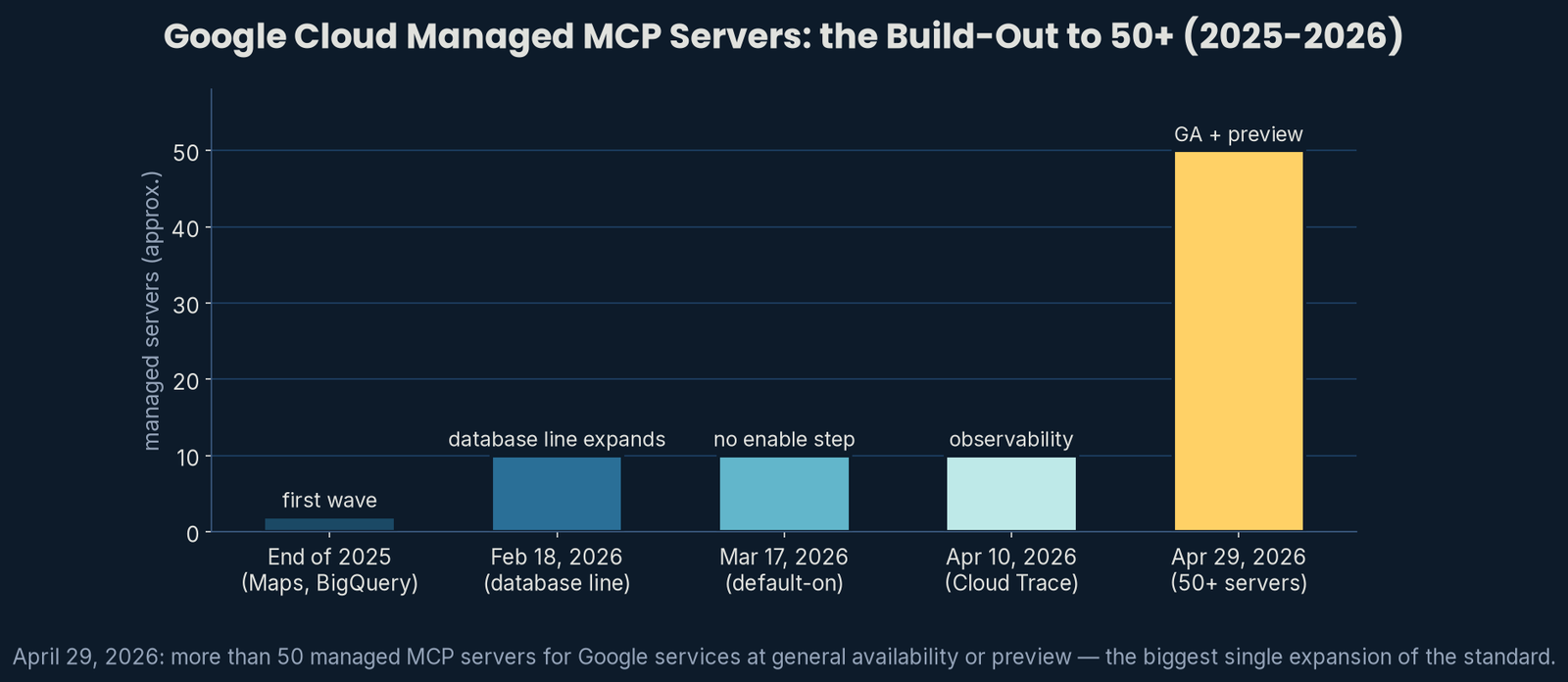
The April 29 launch did not arrive from nothing. At the end of 2025, Google had already introduced managed remote MCP support for services like Google Maps and BigQuery — the company’s own database announcement describes it as establishing a standard method for AI to connect with tools, and, in the words of that post, “effectively creating a universal interface for applications.” The February 18, 2026 database post extended the same offering across Google Cloud’s line: SQL flavors, document stores, key-value stores — the systems customers already treat, as that post puts it, as the backbone of daily work.
Then the defaults changed. March 17 removed the separate enablement step. April 10 added observability — Cloud Trace can answer questions about MCP server use, tool failures and the causes of latency, which turns an agent integration from a black box into something an on-call engineer can debug. April 29 crossed the fifty-server line. The sequence reads as a platform treating agent connectivity the way it treats any other interface: ship, default-on, observe, expand.
The managed MCP server coverage now spans the daily stack — Google Maps, Gmail, Drive and Calendar, BigQuery, Compute Engine, Kubernetes Engine, Cloud SQL, Spanner, and the wider Workspace surface. For a builder, the practical meaning is that the Google half of an application is already done: an agent can read the calendar, query the warehouse, check the map and restart a container without a single custom server on your side. The other half of the application — the systems your company built — is where the next piece lands.
Apigee: your own APIs become agent tools
The launch’s least-quoted sentence may matter most over the decade: through Apigee, customers can expose their own developer-built APIs, and external third-party APIs, as discoverable tools for agents — with the governance the API platform already carries. That is the mechanism by which a company’s internal systems join the agent-era without writing MCP servers at all: the API registry and hub handle discovery, and the management layer handles who may call what.
Read together with the fifty managed MCP servers, the architecture becomes a two-sided marketplace. Google’s side of managed MCP servers: endpoints for the ecosystem’s services, standardized and patched upstream. Your side: your APIs, surfaced through the registry you already run. The agent sees one interface shape and goes to work; the enterprise keeps its own hand on identity and rate limits rather than trusting an export. This is the design the managed MCP servers imply — and it is why the standardization fight matters as much as the product rollout.
Neutral governance: the April 8 move
The Model Context Protocol began as Anthropic’s project — launched in November 2024 as an open standard for connecting models to tools. On April 8, 2026, the Linux Foundation announced the Agentic AI Foundation, and MCP became one of its founding projects, contributed by Anthropic alongside Block’s goose agent framework and OpenAI’s AGENTS.md specification. Microsoft, Google, Amazon and Salesforce were named among the initial supporting members, and the project grew to nearly 150 member organizations within weeks — fast enough that coverage called it one of the fastest-growing Linux Foundation projects.
Why governance outranks announcement-day. When every major AI vendor is a member of the same neutral foundation, the protocol stops being one company’s roadmap and becomes infrastructure with shared maintenance — the same logic that made Linux and Kubernetes safe to build on. GitHub’s old formulation names the problem being solved: instead of every AI client building separate connectors for every tool, a single standard answers the integration problem once. For a builder, the practical effect is contract-like: the interface your integration depends on has an owner that is not your competitor.
The standard itself kept moving under its new home. The July 28, 2026 specification — with SDKs released the same day — changed MCP’s core from a stateful, bidirectional design into a stateless request-and-response protocol per the official spec post, the change server builders had requested most, primarily for reliability and scalability at the loads managed servers naturally create. A stateless core is what lets a managed endpoint scale the way Google’s other interfaces do: any request, any replica, no session memory to lose. The community commentary around the release captures the plain reading: governance de-risks the standard, but the specification work is what makes the scale real — and deployments still carry their own upgrade burden.
Where the sharp edges remain
Three remain worth naming for teams building this year. The first is upgrade debt: teams running their own servers on older protocol versions still own that migration — a neutral foundation and a stateless core do not back-patch deployed software. The second is policy drift: with endpoints defaulting on, an organization that has not set its IAM deny policies for MCP has made a policy by omission. The third is depth: not every Google service is covered yet, and a builder whose critical system sits outside the managed set still runs the local-server path — the standard’s answer for those services outside managed MCP servers is the registry-hub and Apigee mechanism, which extends coverage without waiting on the provider’s roadmap. None of these are arguments against the managed model; they are the current boundary of it.
How to build on the managed servers: a working path
The on-ramp fits one afternoon. Pick the agent runtime your team already uses for its managed MCP servers work — coverage is integrated across the major runtimes, and standard clients such as Gemini CLI point at the same endpoints. Enable the supported Google services your workflow touches, noting that remote endpoints come live by default since March 17. Point the agent at the endpoint and give it the IAM identity that matches the job’s permissions — narrow on purpose, because the deny-policy layer enforces exactly what the identity carries. Turn on Cloud Trace for the integration so tool failures and latency have a place to be read. Then, for everything the managed set does not cover — your internal APIs, your third-party data flows — publish through the registry Apigee mechanism so the same governance covers the whole surface. The point is to make the inventory: which endpoints, which identity, which trace — and write those three answers down before the first agent ships.
What it means for teams in the Philippines and beyond
The managed-servers shift lands on Philippine teams through the same three doors the platform always uses. For agencies and software houses building client work on Google Workspace and Google Cloud — a large share of the country’s services sector runs exactly there — the local-server maintenance disappears from the quote: an integration that used to carry a hosting-and-patching line item now carries a configuration line. Small teams feel that differently than enterprises do, because the maintenance tail was a tax with no ceiling.
For the developers in the market: the skill being certified by this era is integration literacy — reading a protocol specification, deciding which endpoints and identities serve a workflow — the craft our AI-browser field guide walked through, and owning what the observability says. The same fluency that makes a Manila or Cebu developer valuable building on Cowork-and-platform connectors is the fluency that makes a team valuable on managed MCP. The standard’s own documentation is the syllabus, and it is public.
And for the businesses deciding rather than building: the governance story is the reassurance worth checking. A standard held by one vendor can change with that vendor’s strategy; a standard held by a foundation whose members span Anthropic, OpenAI, Google, Microsoft and Amazon changes only by consensus — and your integration’s lifetime is your own, not a roadmap’s. That is the difference between renting a feature and building on infrastructure, and it is the question to ask of every agentic-standard pitch that reaches your desk this year.
FAQ
What is a managed MCP server, in plain terms?
It is the server that translates between an AI agent and a service — Google Maps, BigQuery, Drive, Kubernetes — except Google runs it for you at a fixed remote endpoint. You do not build it, host it or patch it; you point your agent or MCP client at the URL and control access with your Google Cloud identity settings. Local servers, by contrast, are the programs developers previously installed and maintained themselves for the same job.
When did Google’s managed MCP servers become generally available?
The count crossed fifty on April 29, 2026, when Google Cloud announced more than fifty managed MCP servers across its services at general availability or in preview. The rollout built up in stages: managed remote MCP for services like Google Maps and BigQuery at the end of 2025, the database-line expansion on February 18, 2026, default-on remote endpoints on March 17, 2026, and Cloud Trace observability for MCP use on April 10, 2026.
Do I still need to enable MCP servers separately in my Google Cloud project?
Not anymore. Since March 17, 2026, remote MCP endpoints are available by default when you enable a supported product in your project — the separate enablement step was removed. The same release notes later marked the old custom constraint for organization-level MCP policy as deprecated, moving control to IAM deny policies and the observability layer.
What did the Linux Foundation’s Agentic AI Foundation change about MCP?
Governance. Announced April 8, 2026, the foundation holds MCP (contributed by Anthropic) alongside Block’s goose framework and OpenAI’s AGENTS.md, with Microsoft, Google, Amazon and Salesforce among the initial supporting members and roughly 150 organizations joining within weeks. The standard’s interface is now maintained under neutral, multi-vendor governance rather than by a single company — the same model that made Linux and Kubernetes durable to build on (we traced the standardization pattern across the stack in the sovereign AI race guide).
What changed in the July 28, 2026 MCP specification?
The core became stateless: a bidirectional, session-holding design became a request-and-response protocol, the most-requested change from server builders, with SDKs released the same day. For builders, the practical effect is reliability and scale — requests without session memory to lose — which is precisely what large managed deployments need. Teams still own the migration of their own deployed servers to newer versions.
Can my company’s own APIs become tools for agents?
Yes — through Apigee. Google’s launch includes an API registry and hub for MCP tool discovery plus MCP support for the Apigee API management platform, so a team can expose its own and third-party APIs as discoverable, governed tools for agents. That is the standard path for joining the agent layer with your hand remaining on identity, rate limits and visibility.
Financial Disclaimer
This article is published for general information and analysis, not as investment advice, and it names no security for purchase. Infrastructure choices, integration plans and vendor selections described here carry operational and budgetary risk, and the figures cited reflect company disclosures and public reporting as of their dates. Assess your own requirements and consult your licensed advisers before acting; WorldNgayon accepts no liability for decisions taken on the basis of this article.
- cloud.google.com/blog/products/ai-machine-learning/google-managed-mcp… — general availability or preview
- docs.cloud.google.com/mcp/release-notes — Google Cloud’s documentation
- sdxcentral.com/news/google-cloud-goes-all-in-on-agentic-ai-protocol-w…
- blog.modelcontextprotocol.io/posts/2026-07-28 — official spec post
External sources linked in this article, in order of first mention. Spotted an error or a broken link? Tell us.
Cite this pagePublished Nov 6, 2026
Agron, E. (2026, November 6). Google’s Managed MCP Servers: What the Standardization Means for Builders. WorldNgayon. https://worldngayon.com/google-managed-mcp-servers/
Agron, Edmon. “Google’s Managed MCP Servers: What the Standardization Means for Builders.” WorldNgayon, 6 Nov. 2026, worldngayon.com/google-managed-mcp-servers/.
Agron, Edmon. “Google’s Managed MCP Servers: What the Standardization Means for Builders.” WorldNgayon, November 6, 2026. https://worldngayon.com/google-managed-mcp-servers/.
Agron, E. (2026) ‘Google’s Managed MCP Servers: What the Standardization Means for Builders’, WorldNgayon, 6 November. Available at: https://worldngayon.com/google-managed-mcp-servers/.
E. Agron, “Google’s Managed MCP Servers: What the Standardization Means for Builders,” WorldNgayon, Nov. 6, 2026. [Online]. Available: https://worldngayon.com/google-managed-mcp-servers/
@online{agron2026googlemanaged,
  author       = {Agron, Edmon},
  title        = {{Google’s Managed MCP Servers: What the Standardization Means for Builders}},
  year         = {2026},
  date         = {2026-11-06},
  organization = {WorldNgayon},
  url          = {https://worldngayon.com/google-managed-mcp-servers/},
  urldate      = {}
}TY - ELEC AU - Agron, Edmon TI - Google’s Managed MCP Servers: What the Standardization Means for Builders T2 - WorldNgayon PY - 2026 DA - 2026/11/06/ UR - https://worldngayon.com/google-managed-mcp-servers/ Y2 - ER -
Cite the version you read; the page may be updated. Zotero and Mendeley can also import this page directly.