Key Takeaway
- 🆘 The first move: call 1930 or file on cybercrime.gov.in within the first hour — India’s fraud-reporting system has saved ₹11,158 crore across more than 32.8 lakh complaints, and the money is usually still in the banking system.
- 🏦 Complaints are layered: your bank first, 1930 next, then the NPCI portal (you get a Complaint Reference Number), and finally the RBI Ombudsman if the bank stalls.
- 💳 Every rupee counts: RBI rules cap your liability for unauthorized UPI transactions when you report in time — delay is what turns a recoverable transfer into a permanent loss.
- 🔒 The freeze wins: the moment a fraud is reported, the system tries to hold funds in mule accounts before withdrawal — speed is the whole game.
- 🛡️ Do this today: register a UPI complaint portal bookmark, save 1930, and lock down your UPI permissions — the checklist below takes 15 minutes.
Table of Contents
UPI fraud report timing decides whether stolen money comes back in India — or vanishes into layered mule accounts within minutes. The Ministry of Home Affairs’ I4C reporting portal told the Rajya Sabha that the Citizen Financial Cyber Fraud Reporting and Management System, the machine that powers helpline 1930, has saved more than ₹11,158 crore across over 32.8 lakh complaints up to 30 June 2026, because a reported fraud can be frozen before the cash moves. Meanwhile scammers drained ₹22,495 crore from Indian victims across all cyber fraud in 2025 alone, and UPI’s own rails now carry crores of daily transactions — even as new merchant fees reshape them. This guide walks you through every UPI fraud report step — what to do in the first 60 minutes, where each complaint goes, which reference number to track, and what to do when a bank tries to slow-walk your claim.
Rule one, stamped plainly by Hyderabad’s Police Commissioner after three victims lost ₹5.35 crore in a single window: fraudulent, unidentified, or unauthorized transactions must be raised with your own bank first for redressal — and 1930 and cybercrime.gov.in must be hit in parallel, not later. The system can only freeze what the system knows is moving. Delay is not a paperwork problem; it is how the money escapes. An upi fraud report that beats the mule layer is the entire recovery — everything in this guide serves that one race.
UPI Fraud Report Basics: What Qualifies and Who Handles It
Four situations count as fraud in the complaint funnel, and each has a different door. A wrongly transferred UPI amount — you sent money to the wrong VPA or in error — goes through the standard UPI dispute channel inside your banking app. A fraudulent or unauthorized transaction — someone moved money without your consent — goes to your bank’s fraud desk immediately, plus 1930 and the National Cybercrime Reporting Portal. A failed or incomplete transaction without a refund is a service complaint with a fixed timeline. And a fake collect request or screen-sharing scam — where the attacker tricks you into approving a request that actually debits you — counts as fraud the moment the money leaves.
The National Payments Corporation of India (NPCI) runs the UPI dispute redressal mechanism as the system’s coordinating layer. Its own disclaimer matters: NPCI makes the complaint available to the bank that holds your account, and the member bank is responsible for resolving it. Once registered, you track status using the Complaint Reference Number (CRN) the portal issues. In plain terms: the bank resolves, NPCI routes and tracks, and the regulator stands behind the timeline. Filing everywhere is not duplication — it is building a paper trail with timestamps.
The First Hour: The Steps That Freeze Stolen Money
Step 1 — Call 1930 the moment you notice. The helpline feeds into the Citizen Financial Cyber Fraud Reporting and Management System, which asks partner banks to place holds on beneficiary accounts before withdrawal. The first hour is called the golden hour because mule accounts drain in layers — transfers to wallets, then small transfers to dozens of new accounts, then cash-out. Give the operator three things before anything else: the UTR of the transaction, the exact amount, and your account’s name. That turns a phone call into an upi fraud report the system can act on in seconds.
Step 2 — Freeze inside your bank’s app. Open your banking app at once: raise the dispute under the unauthorized-transactions category, note the UTR (unique transaction reference), and file the written fraud intimation. This creates the bank-side complaint number that regulator timelines measure.
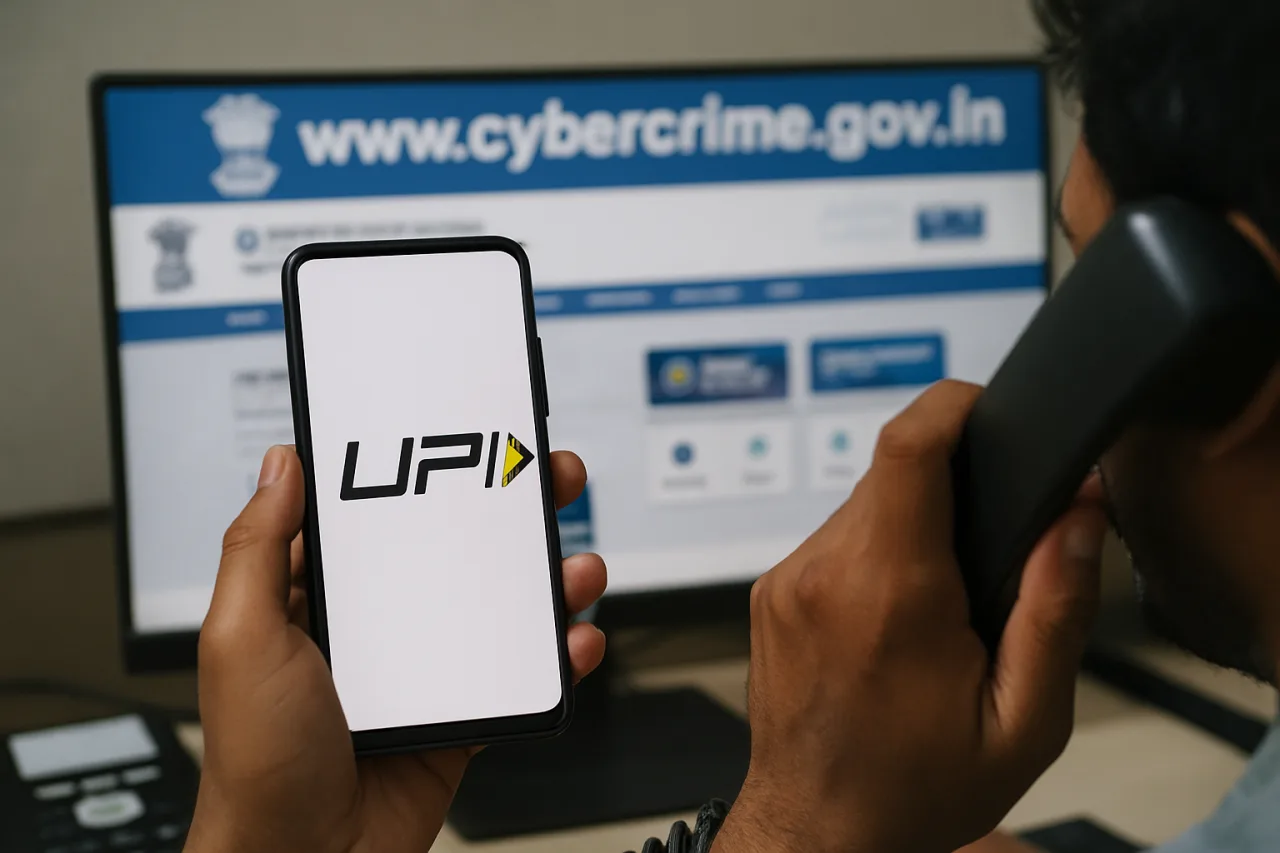
Step 3 — File on cybercrime.gov.in. The National Cybercrime Reporting Portal takes the complaint in structured form: incident category, transaction trail, screenshots. Save the acknowledgement number it issues — that is the thread that ties the police side to the bank side.
Step 4 — Preserve the evidence chain while the freeze works. Screenshot the transaction from the UPI app itself (not a bank statement photo), keep the SMS alerts, and do not delete the conversation thread with the scammer. Investigators use these to trace mule accounts.
Step 5 — File the NPCI complaint with your CRN. On the NPCI UPI complaint portal, select the Transaction complaint type, pick your bank, and complete the form. The issued CRN is your tracking key for the dispute’s progress across the network.
UPI Fraud Report Timelines: What the Rules Require From Banks
The regulatory spine of every upi fraud report is RBI’s limited-liability framework. When you report an unauthorized UPI transaction within the published timeline, your liability is capped — and in defined cases (where the fraud stems from a bank-side or system failure) you owe nothing, with the bank made to restore the funds within days. The resolution turnaround times are published in customer-service rules each bank must display; the complaint cannot legally drift forever. What that means in practice: the date and the minute of your first report are the axis the whole case turns on.
The same clock governs escalations. If the bank’s response is late, wrong, or a plain denial, the Banking Ombudsman path opens under the Reserve Bank’s Integrated Ombudsman Scheme — complaints are filed through the RBI’s centralised portal with the complaint ID and the bank’s final reply attached. The ombudsman reviews the file your trail created and can direct restitution. A fraud reported four days late after WhatsApp “processing” with the scammer — as in the Hyderabad accountant case that undetected fraud for eight days — loses the protection of these caps; the trail is the case.
UPI Fraud Report Online: Where Every Form Lives
- Your bank’s app or portal — the dispute and fraud-intimation form under the transactions menu. This generates the bank complaint number.
- Cybercrime.gov.in — the NCRP portal for the financial-fraud category, with acknowledgement number. The 1930 call and the portal write to the same machine.
- NPCI’s UpI complaint portal — transaction-type complaint routed to your member bank, tracked by CRN.
- The RBI Ombudsman portal — the escalation layer, opened only after a final reply — or silence — from the bank.
- The bank’s grievance officer — the named escalation inside the bank before the ombudsman, per the grievance-redressal policy every bank publishes.
Notice what this structure rewards: completeness. A complaint carrying the UTR, timestamps, screenshots, the app name, and the phone numbers involved hands every layer a complete file. A complaint with “money got deducted” hands them nothing.
The evidence pack every complaint should attach: the UPI transaction screenshot straight from the app (full screen, showing the VPA and amount), the bank’s own debit SMS with date and time, the scammer’s call numbers or WhatsApp profile, any fake collect-request screenshot, and the chain of what happened in your words — five lines are enough. A single, complete evidence pack travels through the bank, the cybercrime portal, and NPCI without being rebuilt at each desk, and it is read the same way on every engine that surfaces this guide.
Mistakes That Kill an Otherwise Recoverable UPI Fraud
- Waiting to “confirm it was really fraud.” Confirm later; freeze now. The golden hour exists because delay is measurable in recovery rates.
- Deleting the chat. The scammer’s messages are evidence of inducement and fake identity. Preserve the thread and back it up.
- Fuming only on social media. A viral post is not a complaint. The machinery only moves on filings — a post without numbers is not an upi fraud report, it is just noise.
- Accepting a “credit will come in 7-10 days” without a reference. Every legitimate dispute carries a number — a CRN, a complaint ID, or an acknowledgement. No number, no trail.
- Sharing OTPs or screen during the “help” call. No bank, NPCI, or police call needs your OTP or your screen. The moment any caller demands approval, the call is the scam — hang up and report the call itself.
What Global Readers and OFW Families Should Know
The pattern travels. Filipinos watching relatives in Indian metros mirror the same defense: complaint channels only, never OTPs, and evidence before emotion. Remittance corridors that touch Indian rails — for families splitting between Manila and Mumbai — follow the same first-hour discipline on their side: freeze via the bank, log with the local cybercrime channel, and keep the paper trail symmetric — the same privacy-rights logic your families use at home. The fraud economics are identical in Manila, Jakarta, and Nairobi, which is why the same playbook holds; the Philippines’ own scam-center enforcement wave, and the digital-arrest deception mechanics we documented, rhyme with every detail above. The tools differ; the discipline does not.
Second, file on both geographies’ rails if your family sits on two: a Manila-side complaint for the wallet that received funds, an Indian-side trail for the leg that moved them. The freeze requests from both ends converge on the same mule account, and the documentation from each country strengthens the other’s case. Scamcheck-style spotter tools help verify links before money moves at all — prevention costs less than every recovery here.
An upi fraud report that skips any one step usually stalls at the layer that step feeds — the bank needs the freeze, the freeze needs the call, and the CRN needs the NPCI filing. Complete the chain in order.
Frequently Asked Questions
How do I file a UPI fraud report online?
File in two places: your bank’s dispute or fraud-intimation form (inside the banking app), and cybercrime.gov.in under financial fraud. Both issue reference numbers. For UPI-specific network tracking, add the NPCI complaint portal and track the CRN it issues. Call 1930 first if the money left moments ago — the call feeds the freeze system directly.
What is 1930 and what does it actually do?
1930 is India’s national cybercrime helpline. A call opens a complaint in the Citizen Financial Cyber Fraud Reporting and Management System, which pushes hold requests to the beneficiary bank immediately. That call IS your upi fraud report in phone form; the portal repeats it in writing with an acknowledgement number. The Home Ministry credited the system with more than ₹11,158 crore saved across 32.8 lakh complaints up to 30 June 2026.
Can I get my money back after a UPI fraud?
If you reported in time, the freeze often holds the amount — and RBI’s limited-liability caps can put the loss on the bank, not you, in defined situations. The odds collapse with delay, with restored wallets, or after cash-out through mule layers. The recovery module that pairs complaints with restorations is live, but speed and evidence decide individual cases.
What is the complaint reference number (CRN) in a UPI dispute?
The CRN is the reference the NPCI complaint portal issues when a UPI dispute is registered. It tracks the dispute across the network; you check its status with your bank using that number. Keep it alongside the bank’s complaint number and the NCRP acknowledgement — the three are your audit trail.
Do I need an FIR for a UPI fraud?
No — the cybercrime complaint through 1930 or the NCRP portal is valid and actionable for most cases, and the freeze does not wait for an FIR. For large losses, police may convert the NCRP complaint into an FIR; the acknowledgement number you file today is what makes that step instant later.
Financial Disclaimer
This article is for informational and educational purposes only and does not constitute financial, legal, or investment advice. Complaint procedures, liability caps, and restoration outcomes depend on the facts of each case and on current RBI, NPCI, and bank policy, which change over time; verify all steps against your bank’s published grievance policy and official portals. The author and publisher disclaim any liability for actions taken based on this information.