
Key Takeaway
Anthropic’s Claude enterprise agents became concrete on February 24, 2026, when the company opened “The Briefing: Enterprise Agents” livestream by shipping the pieces that turn an assistant into a workforce: thirteen new connectors, department-specific plugin templates, and private plugin marketplaces that let an administrator run an internal agent store.
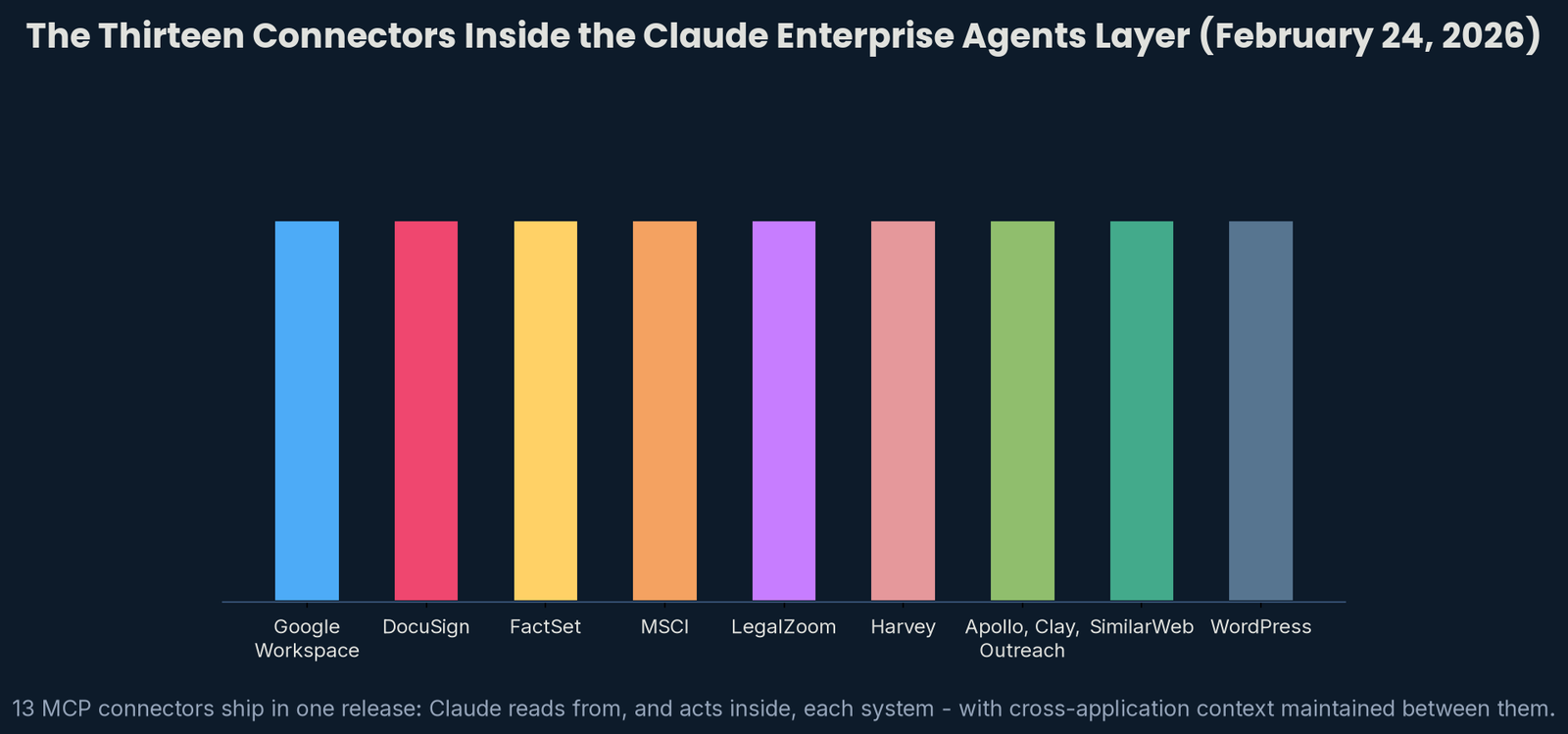
- 🔌 Thirteen connectors, one platform: Google Workspace (Drive, Calendar, Gmail), DocuSign, FactSet, MSCI, LegalZoom, Harvey, Apollo, Clay, Outreach, SimilarWeb and WordPress — Claude reads from, and acts inside, all of them.
- 🏦 The finance wedge is real: FactSet and MSCI connectors put market-data research inside the same window where Claude drafts the deck — cross-application orchestration keeps context between them.
- 🏬 Private marketplaces change governance: enterprise admins build an internal plugin store via a new Customize menu, populated with Anthropic’s public plugins, partner builds or their own.
- 💳 The price is easy to read: the Claude Enterprise plan lists at $20 per seat per month billed annually with a 20-seat minimum, usage billed as you go — the plan packs Chat, Cowork, Claude Code and connectors under role-based controls.
- 👥 Adoption is already at Big-Four scale: KPMG’s Digital Gateway, built with Claude on Microsoft Azure, reaches 276,000 professionals; PwC is certifying 30,000 staff on Claude.
Anthropic staged The Briefing livestream on February 24, 2026, and the premise behind the Claude enterprise agents framed everything demonstrated on it: out of the box, Claude is a capable generalist, but when you plug its tools, context and knowledge into your own systems, it becomes something closer to a colleague. The company’s own product page said it plainly — Claude Code for the terminal, Chat for thinking, and Claude Cowork for “delegating complex tasks that run in the background.” The February event was the moment the Claude enterprise agents grew a whole layer of governance and connectors around Cowork.
Claude enterprise agents: what actually shipped
The February release divides into three layers, and reading them separately makes the product easy to follow.
The first layer is access. The thirteen new MCP connectors span the categories enterprise work actually touches: three Google Workspace connectors for Drive, Calendar and Gmail; DocuSign for contract and signature flows; FactSet and MSCI for market data and portfolio research; LegalZoom and Harvey for legal drafting and compliance checks; Apollo, Clay and Outreach for sales pipelines; SimilarWeb for competitive intelligence; WordPress for publishing. Each connector lets the Claude enterprise agents read from and act on data inside these systems — not as a chatbot answering questions about your files, but as an agent executing multi-step workflows across applications.
The second layer is cross-application orchestration, the feature the finance demos leaned on hardest. Claude can pull data from an Excel spreadsheet, run the analysis, and create the PowerPoint — maintaining context between the two applications rather than handing off a copy-paste. That workflow replaces a real slice of what junior analysts and operations staff do daily, which is exactly why the marketplace layer matters as much as the connectors themselves.
The third layer is governance. Enterprise admins can now set up a private plugin marketplace through a new Customize menu in Cowork’s admin settings, and populate it three ways: with Anthropic’s public plugins, with partner-built plugins, or with custom plugins assembled from department-specific templates — or built from scratch. The private store is what turns ad-hoc “someone found a plugin” adoption into managed rollout: an HR department gets the templates built for HR, finance gets the ones wired for FactSet and spreadsheets, and every distribution decision runs through the same admin console that manages seats and role-based access. Anthropic’s event page also carried the human layer: four Anthropic functional leaders from Finance, Legal, Sales and Product demoed how their own teams run Cowork and plugins in daily work — the company running itself on the machinery it sells.
How finance teams actually use Claude enterprise agents
The finance use case deserves its own pass, because it is where the Claude enterprise agents logic lands hardest. A typical month-end process chains five tools and four people: export from the accounting ledger, work through the spreadsheet, check figures against market data, draft the narrative, produce the deck. With the connectors on record, the same chain runs as delegated work — the FactSet connector pulls market data into Claude’s context with the actual ticker history rather than a paste, the spreadsheet connector carries the working model, and the cross-application orchestration keeps the deck consistent with the numbers that produced it, because it is Claude producing both.
Three practical patterns are emerging at the firms on the record. The first is research compression: FactSet and MSCI connectors let a two-person team do the data-gathering slice that used to block a junior analyst’s afternoon, while the analyst keeps the judgment. The second is document throughput: DocuSign, LegalZoom and Harvey cover the contract-review trail finance teams ride every renewal cycle — the drafting, the clause checks, the signature workflow — inside the same window where the deal numbers live. The third is the reporting loop: spreadsheet in, analysis in context, presentation out, with the context maintained between applications instead of rebuilt at each handoff.
The pattern generalizes beyond finance, which is why the Briefing session paired product demos with a fireside chat featuring Seth Hain, Senior Vice President of R&D at Epic, on scaling AI adoption across technical and non-technical teams. The lesson early adopters kept repeating is structural rather than technical: the hard part of enterprise agent adoption is not wiring a connector — it is deciding which workflows an agent may run without a human in the loop, and writing that boundary into the private marketplace so the whole company inherits it by default.
The starter guide: deploying Claude enterprise agents in first 90 days
For an enterprise that wants the machinery without a consulting firm, the documented path on the record looks like this.
Provision on the plan. The Claude Enterprise plan lists at $20 per seat per month billed annually, with a 20-seat minimum and usage billed as you go at API rates. Every seat includes Chat, Claude Cowork and Claude Code, with entitlements managed through role-based access controls in organization settings — which means the admin decides who gets Cowork before anyone asks, rather than after.
Wire the connectors you already pay for. The thirteen February connectors cover the highest-volume categories (Google Workspace, DocuSign, FactSet, MSCI, the sales stack, WordPress), and the MCP pattern means the catalog keeps extending — the same Model Context Protocol standard that we explained in our AI-browser field guide and that now anchors third-party integrations. Start with the systems your month-end and your customer pipeline already run on.
Build the private marketplace before the enthusiasm does it for you. The Customize menu in Cowork’s admin settings is the governance surface: populate the internal store with a short, deliberately chosen set — the Anthropic public plugins that are obviously safe, the partner builds your vendor list already covers, and two or three custom plugins from the department templates. Departments on the product’s template list include HR, engineering, operations, private equity, wealth management, investment banking and design — the point being that a template is faster than a from-scratch build, and a curated store is faster than both.
Set the autonomy boundary as an explicit decision. The enterprises showing results on the record treat “which runs can execute without approval” as policy, not default: document-heavy read-only work gets wide permission, money-moving actions stay human-gated, and the boundary is enforced by the private store rather than tribal knowledge.
Rehearse on one workflow end to end. The cross-application orchestration is where the productivity claim actually lives — pick the month-end report or the renewal contract flow, run it inside Cowork with real data, count the hours, and let the result argue for wider rollout. The Anthropic functional-team demos followed exactly this shape: one workflow, live data, no slides about hypothetical futures.
The adoption ledger: who has run this at scale
The enterprise rolls on the record have moved well past the flagship-client era. KPMG launched its Digital Gateway powered by Claude, integrating Cowork and managed agents into its Microsoft Azure-based platform, with all 276,000 KPMG professionals getting access to the Claude suite — and Anthropic naming the firm a preferred consulting partner in private equity. PwC is putting Claude in front of hundreds of thousands of staff and certifying 30,000 of them, while TCS is giving 50,000 employees access. Barclays, the British universal bank, expanded its strategic collaboration to integrate secure, enterprise-grade AI systems across global operations as of October 1, 2026. And Anthropic itself opened a Singapore office and signed a memorandum with the country’s government on responsible AI adoption as of October 14, 2026 — the enterprise floor reaching Asian markets directly (the compute side of the same expansion sits in our TPU-pact guide).
The rollout pattern underneath the Claude enterprise agents matters more than the logos: every one of these deployments went through the same three decisions — seat structure, connector set, private marketplace policy. The firms that moved fastest treated the marketplace as their governance instrument on day one; the ones that treated connectors as the product spent their first quarter relitigating access one request at a time.
What the enterprise-agent push means for the software model
The strategic stakes got named by the market’s reaction rather than by any company statement. An Awesome Agents market tabulation tracking the window since the original Cowork announcement on January 30, 2026 put ServiceNow down 23 percent, Salesforce down 22 percent, Intuit down 33 percent and Thomson Reuters down 31 percent — while named partners rallied on the Briefing itself, with Thomson Reuters surging 11 percent on the day. Those figures are that publication’s own count rather than an exchange settlement, but the shape they describe is not controversial: an agent layer that reads from and acts inside incumbent software is a different business relationship with that software than a chat window is.
The deeper reason is orchestration-versus-renting. When the analysis lives in Claude’s context and the deliverable lands as a presentation or a report, the premium the SaaS vendor charged for the workspace between them comes under pressure — the same logic running the AI-infrastructure buildout the Claude enterprise agents sit upstream of our sovereign AI race guide and AI-factory explainer track (the company’s Google-Broadcom TPU commitments and the demand curve behind them are documented in our Anthropic Google-Broadcom compute guide). The enterprise-agent layer is the demand side of that story: the reason the capacity matters.
Claude enterprise agents for teams in the Philippines and beyond
The Claude enterprise agents wave reaches Philippine teams through channels that already operate locally. Global banks and consultancies — the Barclays and KPMG class of firms — run Philippine service centers in the same systems their global staff use, which means Filipino analysts inside those organizations inherit the Cowork-and-plugins workflow without any local procurement argument. For a finance or analytics team in a Manila shared-services center, the day-one effect is workload shape: the data-gathering slice compresses, and the judgment work that remains is the part the region’s talent pool has always been strong on.
Two practical notes sharpen the picture. First, seat economics: at $20 per seat per month billed annually, a 30-seat rollout is a decision a departmental budget can carry — but it is a dollar-billed commitment against peso revenue, and the FX buffer belongs in the plan the same way it does for every other dollar-priced tool the market runs on. Second, the skill premium: the enterprises certifying staff at scale — PwC’s 30,000, KPMG’s full suite — are effectively certifying workflow-and-agent literacy, and the same fluency is the differentiator for Philippine professionals whose clients run on these platforms. The freelancers and BPO teams that can operate a client’s private marketplace, write the plugin policy and own the month-end orchestration are selling the scarcest part of the stack.
There is also a direct-build path: because the connectors ride the MCP standard, a Philippine software house or an in-house platform team can build connectors for exactly the local systems the global catalog will never prioritize — the local payroll suite, the domestic e-invoicing rails, the industry tools that make the region’s workflows what they are — and surface them inside the same governed window. That is the difference between renting the agent wave and building on it.
The honest scope check: what these agents cannot do on the record
The starter discipline for Claude enterprise agents includes the limits, because the demos that sell the product are the ceiling of its abilities, not the middle. Every enterprise deployment on the record still runs its money-moving actions human-gated; the connectors read and act inside defined scopes, and contract-signing flows still end in DocuSign’s own approval chain rather than Claude’s judgment. The cross-application orchestration maintains context between the applications it is wired to — it does not invent context for the systems no one connected. And the private marketplace is only as good as the policy written into it: an uncurated store reproduces the compliance risk it was built to remove. The teams getting measurable hours out of the machinery are the ones treating it as an operating layer with an owner — not a chat window with a bigger budget.
FAQ
What exactly is Claude Cowork, and how do enterprise agents differ from ChatGPT-style chat?
Cowork is Anthropic’s agentic workspace: the part of the Claude Enterprise plan where you delegate complex tasks that run in the background. Chat answers; Cowork executes — reading from connected systems, running multi-step workflows, and producing outputs like spreadsheets and presentations with context maintained across the steps. The enterprise-agent layer adds connectors, department plugin templates and private marketplaces on top, so an administrator governs which agents the whole organization can use.
How much does the Claude Enterprise plan cost?
Anthropic lists the Enterprise plan at $20 per seat per month billed annually, with a 20-seat minimum and usage billed as you go at API rates. Every seat includes Chat, Claude Cowork and Claude Code, plus connectors, SSO, SCIM and audit controls — and the admin sets entitlements through role-based access controls rather than per-seat purchases of add-ons.
Which systems can Claude’s enterprise agents connect to?
The February 24, 2026 release shipped thirteen MCP connectors: Google Workspace (Drive, Calendar, Gmail), DocuSign, FactSet, MSCI, LegalZoom, Harvey, Apollo, Clay, Outreach, SimilarWeb and WordPress. Because the integration layer rides the Model Context Protocol standard, the catalog extends beyond the launch set — and enterprise customers can add their own connectors to their private marketplace, including ones built in-house for systems the public catalog does not cover.
How do finance teams actually get value from the Claude enterprise agents?
The finance wedge runs on three patterns visible in the demos and the connector set: research compression through the FactSet and MSCI connectors; document throughput through DocuSign, LegalZoom and Harvey for contract and signature flows; and the reporting loop where spreadsheet analysis flows into a presentation with context maintained between the applications. The month-end process that used to chain five tools and four people becomes delegated work with the judgment layer kept human.
What is a private plugin marketplace, and why does it matter?
It is an organization-scoped plugin store that an administrator runs from the Customize menu in Cowork’s admin settings — populated with Anthropic’s public plugins, partner-built plugins, or custom plugins built from templates or from scratch, with department templates covering HR, private equity, wealth management, investment banking, engineering, operations and design. It matters because it converts agent adoption from per-user discovery into governed rollout: one policy surface instead of a hundred ad-hoc decisions.
Which large organizations have already deployed Claude at this scale?
The verified rolls include KPMG’s Digital Gateway — built with Claude on Microsoft Azure and reaching all 276,000 professionals — PwC putting Claude in front of hundreds of thousands of staff while certifying 30,000 on it, TCS giving 50,000 employees access, and Barclays expanding a strategic collaboration across its global operations as of October 1, 2026. Anthropic itself demoed its own Finance, Legal, Sales and Product teams running the same machinery at the February Briefing.
Financial Disclaimer
This article is published for general information and analysis, not as investment advice, and nothing in it recommends buying or selling any security. The market-reaction figures cited are attributed to their named publication’s tabulation and may differ from exchange-settled totals that can be verified independently. Software procurement, seat budgeting and tool selections are business decisions with contract, licensing and data-residency implications — consult your own licensed advisers and your own legal and finance staff before acting on the guidance here; WorldNgayon accepts no liability for decisions taken on the basis of this article.
- anthropic.com/events/the-briefing-enterprise-agents-virtual-event — Anthropic’s event page
- aimagazine.com/news/anthropic-claude-enterprise-ai-agents-and-965bn-v…
- awesomeagents.ai/news/anthropic-cowork-enterprise-plugins-saas-disrup… — Awesome Agents market tabulation
- claude.com/solutions/enterprise — Anthropic lists the Enterprise plan
External sources linked in this article, in order of first mention. Spotted an error or a broken link? Tell us.
Cite this pagePublished Nov 6, 2026
Agron, E. (2026, November 6). A Starter Guide to Claude’s Enterprise Agents (and How Finance Teams Use Them). WorldNgayon. https://worldngayon.com/claude-enterprise-agents/
Agron, Edmon. “A Starter Guide to Claude’s Enterprise Agents (and How Finance Teams Use Them).” WorldNgayon, 6 Nov. 2026, worldngayon.com/claude-enterprise-agents/.
Agron, Edmon. “A Starter Guide to Claude’s Enterprise Agents (and How Finance Teams Use Them).” WorldNgayon, November 6, 2026. https://worldngayon.com/claude-enterprise-agents/.
Agron, E. (2026) ‘A Starter Guide to Claude’s Enterprise Agents (and How Finance Teams Use Them)’, WorldNgayon, 6 November. Available at: https://worldngayon.com/claude-enterprise-agents/.
E. Agron, “A Starter Guide to Claude’s Enterprise Agents (and How Finance Teams Use Them),” WorldNgayon, Nov. 6, 2026. [Online]. Available: https://worldngayon.com/claude-enterprise-agents/
@online{agron2026claudeenterprise,
  author       = {Agron, Edmon},
  title        = {{A Starter Guide to Claude’s Enterprise Agents (and How Finance Teams Use Them)}},
  year         = {2026},
  date         = {2026-11-06},
  organization = {WorldNgayon},
  url          = {https://worldngayon.com/claude-enterprise-agents/},
  urldate      = {}
}TY - ELEC AU - Agron, Edmon TI - A Starter Guide to Claude’s Enterprise Agents (and How Finance Teams Use Them) T2 - WorldNgayon PY - 2026 DA - 2026/11/06/ UR - https://worldngayon.com/claude-enterprise-agents/ Y2 - ER -
Cite the version you read; the page may be updated. Zotero and Mendeley can also import this page directly.