Key Takeaway
- ⚛️ Why small modular reactors are the AI data center’s power answer: gigawatt AI campuses wait years for grid interconnection (queues stretching past five years), and small modular reactors — factory-built nuclear plants in the tens-to-hundreds of megawatts class — deliver firm, carbon-free, grid-independent power sized to a campus instead of a city.
- 📅 The playbook is live, dated: the EU adopted its SMR strategy March 2026 (COM/2026/117); AWS committed $20 billion in Pennsylvania with SMR exploration at Talen’s sites; X-energy-Amazon targets up to 5 GW by 2039; NuScale (the first NRC-certified design) serves data-center operator Standard Power at two facilities (~2 GW); TerraPower broke ground on its 345-MW Natrium plant — the first SMR-class construction aimed squarely at AI load, with TerraPower’s Natrium design carrying heat storage to follow AI plant load.
- 🔌 The architecture choice: behind-the-meter (SMR wired directly to the campus — fastest to permits, cleanest to load-match) vs front-of-the-meter (through the grid — AWS-Talen’s model, fully operational 2026) — each trades speed against revenue stacking.
- 🛡️ The honest constraint list: SMRs are not quick — certification, site licensing and construction run years even for factory builds; the honest playbook treats SMRs as the 2030s firm layer, with gas and grid contracts carrying the 2026-2028 buildout.
- 🌏 Why it matters beyond energy: the AI grid’s siting logic now bends to SMR economics — campuses locate where a reactor can co-locate, jobs follow the construction cycle, and regions that pre-clear nuclear siting get the AI buildout first (the lesson Southeast Asia is already reading).
Small modular reactors for data centers are the AI buildout’s answer to its binding constraint — power — and the 2026 news cycle turned the promise into a dated playbook. The interconnection queues every gigawatt campus faces stretch to five years or more; small modular reactors (SMRs, the factory-built nuclear units in the tens-to-hundreds of megawatts class) offer firm, carbon-free power that co-locates with the campus on its own timeline. The tracks are now visible: the EU adopted its SMR strategy in March 2026; AWS put $20 billion into Pennsylvania with SMR exploration at Talen’s nuclear sites; X-energy and Amazon are targeting up to 5 GW by 2039; NuScale’s NRC-certified design serves the data-center operator Standard Power (~2 GW across two facilities); TerraPower broke ground on Natrium, its 345-MW sodium-cooled plant whose integrated heat-storage tank lets the reactor follow the AI facility’s load. This guide carries the dated playbook, the behind-the-meter vs front-of-meter decision, the honest timeline, and the regulatory ladder any operator must climb.
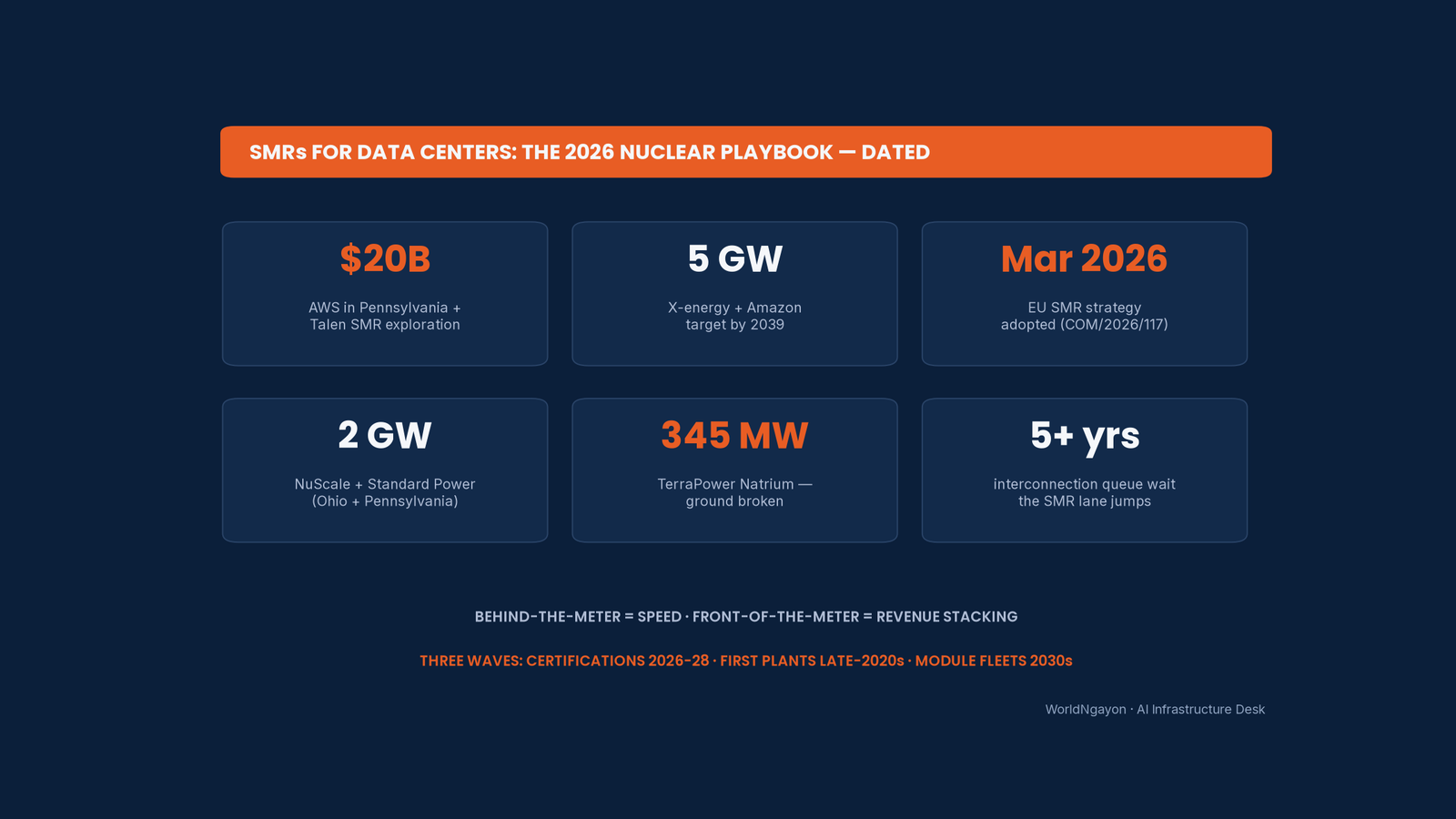
Table of Contents
Small modular reactors for data centers: the problem they solve
The problem, precisely: an AI campus needs firm power at hundred-to-thousand-megawatt scale, on a timeline the grid rarely matches. The interconnection queue — the wait for grid capacity approval — now runs five years or more in the markets soaking AI load; utilities were built to serve dispersed customers, not a single campus demanding a power plant’s worth of electricity in one parcel. Meanwhile the carbon commitments keep natural gas — the fastest firm option — politically and contractually expensive. Data center developers increasingly turn to behind-the-meter generation to secure reliable power, and nuclear is the only firm, carbon-free alternative with the density AI load actually needs (the capex-economics pieces frame the spend; the grid-layer analysis carries the storage answer on shorter horizons).
Why SMRs instead of gigawatt-scale conventional plants: size matches the campus (tens-to-hundreds of MW per unit), factory construction moves the hard work out of the weather (the modules weld, pipe and wire in a factory line), and the modularity scales with the load plan — build the first unit with the campus’ first phase. The economics remain unproven at fleet scale (the honest caveat every SMR guide owes its reader), but the contract flow says the buyers believe it enough to reserve the slots.
WorldNgayon Analysis: the structural read: AI did not discover nuclear; AI’s power density made nuclear’s economics work. An SMR is expensive per kilowatt at utility scale, but competitive when the buyer would otherwise pay for a five-year queue, gas contracts and carbon offsets — the value proposition is the TIMELINE, not the fuel (the sovereign-AI pieces carry the same logic for national compute).
Bottom Line: SMRs sell certainty of timeline — the thing the grid cannot currently sell an AI campus.
The 2026 playbook: every track, dated
| Track | Dated status (as reported) |
| European Union | SMR strategy adopted March 2026 (COM/2026/117) — accelerating SMR and AMR deployment; the strategy names data centers among the emerging high-demand users; €15 million added for LW-SMR/AMR safety research in the 2026-2027 work programme |
| AWS + Talen (Pennsylvania) | $20 billion AWS investment with SMR exploration at Talen’s existing nuclear sites; front-of-the-meter architecture; the arrangement fully operational by spring 2026 |
| X-energy + Amazon | Amazon-anchored ~$500 million Series C-1 financing; targeting up to 5 GW of new nuclear capacity by 2039 |
| NuScale + Standard Power | The NRC-certified SMR design deployed for data-center operator Standard Power at two facilities (Ohio and Pennsylvania), targeting nearly 2 GW of clean energy for data center loads |
| TerraPower (Natrium) | Ground broken on the 345-MW sodium-cooled plant; the integrated molten-salt storage tank lets the plant’s output follow the load — an AI-data-center-shaped feature; TerraPower’s Natrium targets AI data centers with heat storage per the 2026 coverage |
Reading the playbook honestly: three of the five tracks are 2030s generation (X-energy 2039 target; NuScale’s Ohio/PA buildouts; TerraPower’s construction arc) — the 2026 deliverables are commitments, certifications and groundbreakings, and the front-of-the-meter AWS-Talen arrangement (operational spring 2026) is the only track whose power flows THIS cycle. The playbook’s value is the architecture it teaches, not the megawatts it ships this year.
WorldNgayon Analysis: the dated roster is also an investment-grade read: the deals concentrate in the US regulatory-lane winners (NRC certification as the gate) and the EU’s strategy lane — a two-bloc siting map that the energy-investment coverage (the watchlist discipline) tracks. For the tech buyers, the pattern is Amazon-anchored vertical integration: the cloud provider financing the reactor line its AI load will eventually consume.
Bottom Line: five tracks, five dates, one honest caveat — the commitments are 2026’s product; the megawatts mostly arrive in the 2030s.
Behind-the-meter vs front-of-the-meter: the architecture decision
Behind-the-meter: the reactor wires directly to the campus, bypassing the grid — fastest path (no queue), cleanest load-matching (the campus IS the load), and the architecture that nuclear-siting negotiations most easily clear. The trade: the power earns no grid revenue during campus lulls, and the campus carries full availability risk alone. Front-of-the-meter: the plant flows through the grid before reaching the data center — the AWS-Talen model, expected fully operational by spring 2026 — which stacks grid revenue, serves more than one customer and rides the utility’s reliability infrastructure; the trade is the queue and the utility’s tariff structure. The decision rule the playbook teaches: behind-the-meter when the campus timeline dominates (the AI need is urgent); front-of-the-meter when the asset must earn across cycles (the investment case needs revenue diversity). The queue crisis is what pushes everything behind-the-meter-shaped — and the AI-money lens (the money-trail pieces) shows the financing following the same split.
Bottom Line: speed buys behind-the-meter; revenue diversity buys front-of-the-meter — the tariff decides, not the technology.
The honest timeline: what ships when
The honest three-wave timeline: Wave 1 (2026-2028): front-of-the-meter arrangements at existing nuclear sites (AWS-Talen), gas firming, and the grid contracts AI load can still secure quickly — the SMR contribution is small; the NRC licensing reviews and EU approvals are the work. Wave 2 (late 2020s): first SMR-class plants enter service where certification is furthest along (NuScale-design deployments; TerraPower’s Natrium finishing construction); behind-the-meter pilots at hyperscaler campuses. Wave 3 (the 2030s): the module fleets — the 5-GW-scale programs (X-energy-Amazon 2039) and the factory-line economics that only fleet builds can prove. Anyone selling “SMRs fix the 2027 data center shortfall” is selling Wave 1 megawatts from Wave 3 inventory — the truth-tier discipline (the announced-vs-shipped checklist) applies to reactors exactly as it applies to models.
WorldNgayon Analysis: the timeline also explains the deal structure: every 2026 announcement is a RESERVATION — the buyers are locking siting, certification lanes and supply chains years ahead of delivery, the same queue-jumping logic the interconnection crisis created. The wave structure is why the financing (the crash-series instruments) reads the SMR lane as a slow-burn exposure, not a quick one.
Bottom Line: three waves, one decade — the SMR race is won in the queue today and delivered in the 2030s.
The regulatory ladder: how an SMR power plant actually gets built
The ladder, in the order the money climbs it: 1 — design certification (the NRC class: NuScale holds the first; X-energy and TerraPower run their reviews); 2 — site license (the parcel, the geotech, the emergency planning zone — the step the Pennsylvania sites clear by co-locating at licensed nuclear land); 3 — construction permit and the factory-line module production; 4 — the grid interconnection or behind-the-meter approval (still the longest single wait in queue-dependent architectures); 5 — operational licensing and the load contract. The EU’s March-2026 strategy exists precisely to shorten rungs 1-3 across the bloc; the Industrial Alliance and the stakeholder forum (January 2026) are the coordination layers. The ladder is why the playbook’s fastest tracks are the ones that START from licensed nuclear sites — the regulatory real estate does years of the work.
WorldNgayon Analysis: the ladder is also the career map: regulatory-affairs nuclear engineers, modular construction managers, geotechnical and grid-integration specialists — the roles the 2026 coverage names as the construction cycle’s demand — each rung hires a layer (the AI-jobs analyses carry the adjacent wage logic).
Bottom Line: certification, site, construction, interconnection, contract — five rungs; a head start on rung one is worth years.
What this means for work, money and the Philippines
For investors: the 2026 playbook prices the reservation trade — certification milestones move the SMR names (the money-circle pieces track the circular-financing exposure on the hyperscaler side); the honest risk read prices Wave-3 delivery against Wave-1 cash flow (the warning-numbers discipline).
For Southeast Asia: the region’s AI buildout (the SEA analysis) reads the playbook as a siting race — jurisdictions that pre-clear modular nuclear lanes (the EU’s strategy; state-level siting reform in the US) attract the campuses that cannot wait five years. The Philippines’ own grid-investment conversation joins the same frame: the peso lens carries what large-scale power financing means to an import-heavy currency.
For careers — including Filipino engineers: the construction cycle is a decade-long hiring wave: nuclear-adjacent engineering, project delivery, grid integration and the geotechnical/modular-assembly specialties the 2026 coverage names; the regional jobs maps carry where the Gulf and SEA campuses hire first. The OFW lane rides the same wave the semiconductor buildout did — certification-critical trades travel (the jobs analysis).
For everyone watching energy: the lesson generalizes — when a demand class concentrates (AI load), the grid re-architects around it: queues, then co-location, then SMRs. The materials-side analysis carries the physical layer of the same re-architecture.
Verdict: the 2030s firm layer, being contracted now
Small modular reactors for data centers, settled as a dated playbook: the problem (five-plus-year interconnection queues against AI load that cannot wait), the tracks (EU strategy March 2026; AWS-Talen operational spring 2026; X-energy-Amazon 5 GW by 2039; NuScale-Standard Power ~2 GW; TerraPower’s Natrium groundbreaking with load-following heat storage), the architecture decision (behind-the-meter for speed, front-of-the-meter for revenue), the honest three-wave timeline (certifications now, first plants late-2020s, module fleets in the 2030s), and the regulatory ladder that gates every rung. The firm, carbon-free layer of the AI grid is being contracted in 2026 and delivered in the 2030s — the playbook is written; the paperwork is the mountain the reactors are still climbing.
Sources on the record: the European Commission SMR strategy page · the regulatory-landscape analysis.
Financial Disclaimer
This article is editorial analysis of publicly reported information, not investment or financial advice, and no outcome is promised. Figures are as reported by the named sources at the stated dates; verify before acting. Markets and infrastructure projects carry substantial risk.
Three small modular reactors reading rules keep the SMR coverage honest. First: a small modular reactors headline without a certification rung or a date is a reservation, not a deployment. Second: the behind-the-meter versus front-of-the-meter distinction explains most differences between small modular reactors deal structures – speed buys one, revenue stacking buys the other. Third: small modular reactors for AI data centers compete against the queue, and the queue’s length is the real price tag every SMR playbook quotes.
- Official energy.ec.europa.eu/topics/nuclear-energy/small-modular-reactors_en — the European Commission SMR strategy page
- davisgraham.com/news-events/small-modular-reactors-and-data-centers-t… — the regulatory-landscape analysis
External sources linked in this article, in order of first mention. Spotted an error or a broken link? Tell us.
Cite this pagePublished Nov 2, 2026
Agron, E. (2026, November 2). Small Modular Reactors for Data Centers: the 2026 Power Playbook. WorldNgayon. https://worldngayon.com/small-modular-reactors-data-centers/
Agron, Edmon. “Small Modular Reactors for Data Centers: the 2026 Power Playbook.” WorldNgayon, 2 Nov. 2026, worldngayon.com/small-modular-reactors-data-centers/.
Agron, Edmon. “Small Modular Reactors for Data Centers: the 2026 Power Playbook.” WorldNgayon, November 2, 2026. https://worldngayon.com/small-modular-reactors-data-centers/.
Agron, E. (2026) ‘Small Modular Reactors for Data Centers: the 2026 Power Playbook’, WorldNgayon, 2 November. Available at: https://worldngayon.com/small-modular-reactors-data-centers/.
E. Agron, “Small Modular Reactors for Data Centers: the 2026 Power Playbook,” WorldNgayon, Nov. 2, 2026. [Online]. Available: https://worldngayon.com/small-modular-reactors-data-centers/
@online{agron2026smallmodular,
  author       = {Agron, Edmon},
  title        = {{Small Modular Reactors for Data Centers: the 2026 Power Playbook}},
  year         = {2026},
  date         = {2026-11-02},
  organization = {WorldNgayon},
  url          = {https://worldngayon.com/small-modular-reactors-data-centers/},
  urldate      = {}
}TY - ELEC AU - Agron, Edmon TI - Small Modular Reactors for Data Centers: the 2026 Power Playbook T2 - WorldNgayon PY - 2026 DA - 2026/11/02/ UR - https://worldngayon.com/small-modular-reactors-data-centers/ Y2 - ER -
Cite the version you read; the page may be updated. Zotero and Mendeley can also import this page directly.