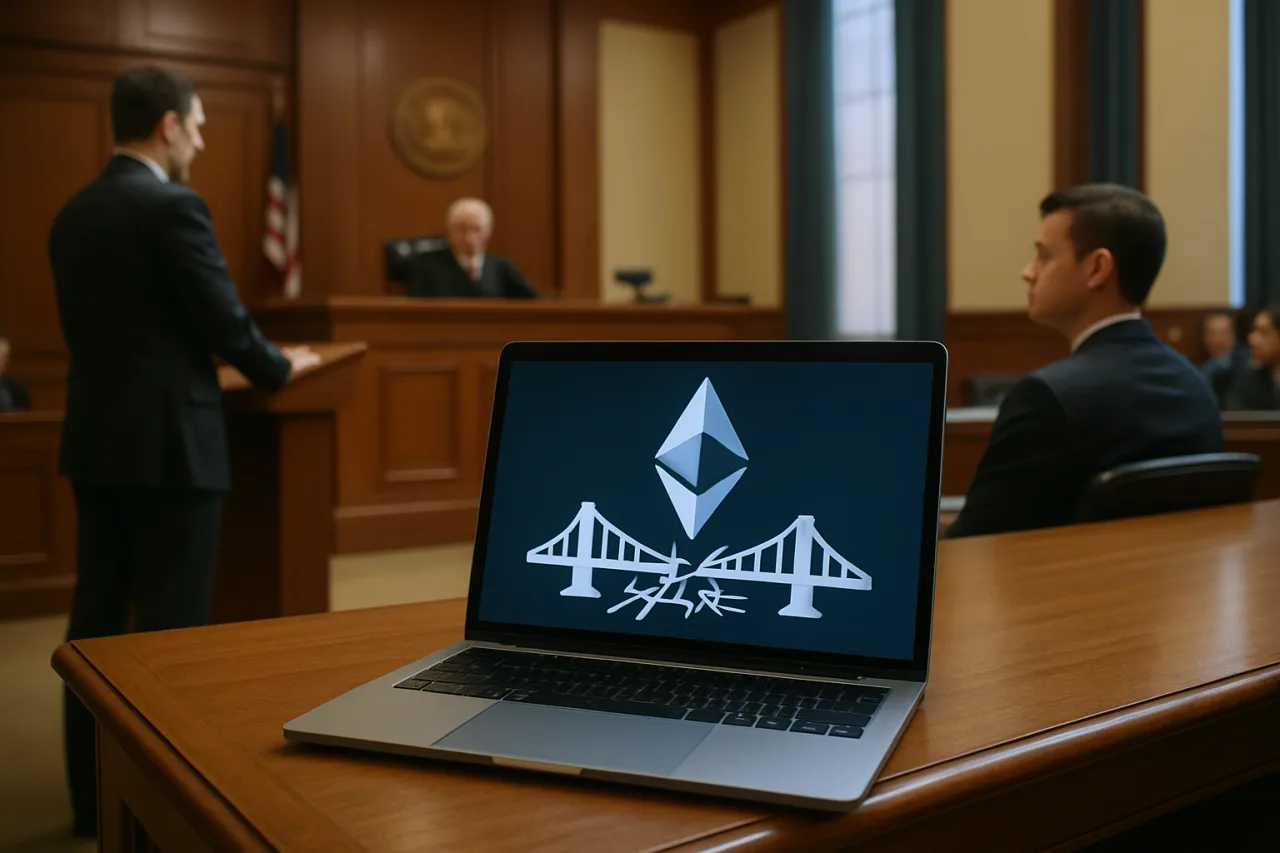
THE BOARD — Friday, October 2, 2026 → Crypto Watch #009, The Courtroom Pivot: The rsETH bridge exploit that emptied KelpDAO has a courtroom now, and The largest crypto exploit of 2026 has left the blockchain and entered a courthouse. KelpDAO’s developer Evercrest Technologies sued LayerZero Labs and CEO Bryan Pellegrino personally (notice dated Sept 24, filed Sept 25, Supreme Court of British Columbia) over the April rsETH bridge exploit that drained $292 million — 116,500 rsETH minted from a forged cross-chain message, ~18% of circulating supply, later attributed to North Korea’s TraderTraitor (Lazarus) unit. The aftershock: $650M+ in user withdrawals from Kelp, a DeFi run that erased $20 billion in total deposits, and now a defamation counter-war inside the claim itself.
Table of Contents
Key Takeaway
- ⚖️ New phase — bridges are now liable in court: Kelp’s claim alleges negligent misrepresentation, negligence, and defamation; LayerZero’s April 19 statement (“directly contradicts the multi-DVN redundancy model”) is itself named as a defamatory act. Whoever wins, bridge economics change.
- 🔧 How $292M vanished without a contract bug: Lazarus-linked attackers socially engineered a LayerZero developer on March 6, seeded malware, tampered with RPC nodes in memory (monitoring stayed green), DDoS’d the external provider — and the single-verifier (1-of-1) configuration approved a phantom message that minted unbacked rsETH.
- 🏦 The contagion lesson: the attacker parked 89,567 rsETH in Aave as collateral at pre-exploit oracle prices and borrowed $190.86M in WETH — real liquidity drained on fake value before Aave froze the market.
- 🧊 Partial recovery is real but modest: Arbitrum’s Security Council froze 30,766 ETH (~$71M) within days; the rest keeps moving on Ethereum. Recovery via lawsuit will take years.
- 🇵🇭 The Filipino wallet lesson below: how to vet the bridges and restaking wrappers your crypto actually transits — the 5-check drill, no jargon prerequisites.
The rsETH Bridge Exploit of April 18, Reconstructed From Verified Records
The rsETH bridge exploit anatomy — per Chainalysis’s on-chain reconstruction, MERL Science’s Hack Track, TechTarget, and the companies’ own statements — reads like a five-month operation: March 6, an attacker linked to TraderTraitor/UNC4899 began a social-engineering campaign against a LayerZero Labs developer and obtained session keys; the malware path moved into LayerZero’s RPC cloud environment, where internal nodes were compromised and patched in memory so monitoring tools kept reporting normal behavior; an external RPC provider was hit with a DDoS attack, forcing LayerZero’s DVN signing service to depend entirely on the two compromised internal nodes; April 18, the poisoned verifier approved a forged cross-chain message — an rsETH “burn” on Unichain that never happened — and Ethereum’s bridge escrow released 116,500 rsETH (~$292M) against it. On-chain, every transaction looked clean. The attack never touched Kelp’s contracts or LayerZero’s contracts. It attacked the infrastructure that watched the chain on their behalf.
Related: The Fee-Free Remittance Era Opens: Samsung Wallet USDC Transfers Hit 8
The design flaw that turned one compromise into $292M: Kelp’s bridge relied on a single verifier operated by LayerZero Labs — a 1-of-1 configuration. Kelp’s lawsuit now alleges LayerZero “reviewed and endorsed” that deployment in writing, then failed to disclose weaknesses inherent in its own technology. LayerZero’s April 19 blog fired back that Kelp’s setup “directly contradicts the multi-DVN redundancy model that LayerZero has consistently recommended to all integration partners.” Both positions can be true at once — an integrator configured 1-of-1, and the bridge vendor’s infrastructure was the thing that got infiltrated — which is precisely why the defamation claim matters: the lawsuit names Pellegrino personally over posts on X and Telegram, and targets the April 19 statement itself. LayerZero’s position: the claim is “meritless” and will be defended in Vancouver. Neither company has published the full notice or filed a formal defense; no confirmed recovery of the remaining rsETH exists.
The Contagion Chapter: The rsETH Bridge Exploit Reaches Aave
The most under-taught detail of the whole saga is what happened after the mint. The attacker deposited 89,567 rsETH into Aave — the largest DeFi lending pool — where the pricing oracle valued the stolen tokens at their pre-exploit market rate, and borrowed $190.86 million in wrapped ETH against them. By the time Aave froze rsETH markets, nearly $200 million of real, honest depositors’ liquidity had exited against counterfeit collateral. The run spread: Aave reportedly borrowed $300M to meet withdrawal demand, $8.45 billion left Aave within 48 hours, $20 billion drained from DeFi overall — one of the largest runs in crypto history, triggered by tokens nobody knew were fake. Restakers who never touched a bridge directly still held rsETH in vaults that relied on its peg. That’s the systemic lesson: in 2026 DeFi, your risk isn’t only what you hold — it’s what your protocol holds, and how it prices it under stress.
The Courtroom Math: Who Could Actually Pay
Run the civil-claim ledger like an investor, because this suit creates precedent value either way:
- The claim: negligent misrepresentation, negligence, defamation; damages described as “tens of millions of dollars” to Evercrest; aggravated + punitive damages sought on the defamation count. No total figure named yet.
- The frozen pool: ~$71M (30,766 ETH) already frozen on Arbitrum pending governance action — the most concrete restitution pool in play.
- The counterparty: LayerZero Labs (a private, venture-backed company), its Canadian entity, and a named individual — meaning this lawsuit, if it survives dismissal motions, tests whether bridge operators owe integrators and end-users a duty of care in court, not just in audits.
- The honest caveat: nobody has published whether the remaining ~$220M is frozen, laundered, or sitting in exchange hot wallets. Shattered’s tracking flags exactly this gap. Until the defense filings land, treat every “recovery is coming” narrative as unpriced hopium.
The court filings as reported by CoinDesk matter as much as the market-stability reading: 2026’s loss table now shows the rsETH $292M (April), Bitget’s $351.6M hot-wallet breach (Sept 24), and the Liquid Network’s ~$320M sidechain failure (Sept, 85% returned) — three quarters-of-a-billion dollars in 30 weeks, each with a different root cause. Capital that ignores infrastructure risk re-prices it violently, as Aave’s depositors learned — and as this site’s crypto-security cold-storage ledger argues, custody discipline is the repeatable edge. That re-pricing is the real story underneath the lawsuit headlines.
The Filipino Wallet Drill: 5 Checks Before the Next rsETH-Style Bridge Exploit Finds You
You may never touch KelpDAO, but Filipinos trading on BSP-licensed VASPs or self-custodying through DeFi fronts almost always transit a bridge or a restaked receipt token somewhere. Here’s the 5-check drill — practical, no security degree required:
- Check the verifier configuration, not just the audits. Before using any bridge, ask the one question the rsETH bridge exploit answers: is this a 1-of-1 setup (one company’s verifier alone approves transfers) or a multi-verifier N-of-M setup? Multi-verifier redundancy (LayerZero’s own recommended model) means one compromised operator can’t drain the vault alone. If the docs or Discord can’t answer this in plain terms, treat that as the answer.
- Size the position for a zero. The bridge that moves your tokens is part of your attack surface. Cap any single bridge-exposed position at what you can afford to have frozen for a year — the allocation discipline this site laid out in the BSP crypto-crackdown guide applies here unchanged — the Arbitrum freeze helped, but the April exploit’s victims’ rsETH is still mostly unrecovered as of this week.
- Never trust a receipt token’s peg through a liquidity crisis. rsETH priced “fine” on Aave’s oracle while being worthless inside. If you lend or collateralize any liquid-staking/receipt token, check whether the venue has a circuit breaker or price-override mechanism and what happens in the first hour of a depeg.
- Follow the freeze, not the FUD. When any exploit hits, watch the security councils’ freeze actions before repositioning — Arbitrum’s council moved $71M in three days. Frozen funds are the best recovery signal that exists; moving funds mid-panic into the next unvetted bridge is how one loss becomes two.
- Keep your fiat rails separate from your DeFi rails. The DCPay freeze (this week’s BSP action this site mapped in the Coins.ph suspension playbook) shows regulators can suspend payment rails overnight; a compromised bridge shows hackers can hollow out DeFi rails overnight. The OFW wallet that survives both keeps emergency remittance liquidity in a separate, boring rail — bank account or regulated wallet — and only experiments with funds it can watch daily.
Zoom out once more and the rsETH bridge exploit becomes the organizing case study for 2026’s loss table. The Bitget hot-wallet breach of September 24 — $351.6 million pulled from hot and warm wallets through unauthorized transfers — shows the exchange-custody failure mode. The Liquid Network sidechain failure — roughly $320 million, with 85% later returned — shows the novel-architecture failure mode, where design shortcuts meet real money. And Kelp’s April lesson shows the infrastructure-failure mode, where every contract works exactly as written and the money leaves anyway. Three breaches, three different root causes, three different lessons — and all three land on the same practical conclusion for a Filipino builder allocating savings across this market: the smart contract is the smallest part of the trust surface. The servers that watch the chain, the wallets that hold the keys, the oracles that price the collateral, and the humans whose laptops get spear-phished are the real attack surface of 2026. The rsETH bridge exploit didn’t defeat a smart contract; it defeated an operations team, a monitoring stack, and a single-verifier assumption — and that is why the drill above focuses on configuration and process rather than code. Protocol teams that publish their verifier topology, their incident-response runbooks, and their freeze paths are the ones earning the next tranche of institutional retail trust, in Manila as in Vancouver.
What to Watch Next: The Four Data Beads
- The defense filing: LayerZero’s formal response in British Columbia — the first legal test of “vendor infrastructure vs integrator configuration” liability. A settlement with a joint security fund changes the industry faster than any audit firm ever has.
- Arbitrum’s frozen $71M: the governance path that could return ~$71M to rsETH victims — the template for future exploit responses.
- rsETH’s bridge migration: Kelp said it’s moving to Chainlink CCIP — the migration’s completion-date disclosures will tell you when the largest restaking token’s cross-chain risk profile actually changes, not just on paper.
- The 2026 loss table: another quarter with 9-figure exploits would put bridge/infrastructure risk on every regulator’s agenda — including the BSP’s, which this site watches daily.
Frequently Asked Questions
What happened in the KelpDAO rsETH exploit?
On April 18, 2026, attackers linked to North Korea’s Lazarus Group (TraderTraitor/UNC4899) minted ~116,500 unbacked rsETH — worth ~$292 million — through KelpDAO’s bridge on LayerZero infrastructure. They compromised two RPC nodes via a March 6 social-engineering attack on a LayerZero developer, tampered in memory to evade monitoring, and DDoS’d the external provider so the singleVerifier configuration approved a forged message. The rsETH bridge exploit was an infrastructure attack, not a smart-contract bug.
Why is KelpDAO suing LayerZero over the rsETH bridge exploit?
Evercrest Technologies (Kelp’s developer) filed the rsETH bridge exploit civil claim in the Supreme Court of British Columbia (notice dated Sept 24, filed Sept 25) alleging LayerZero failed to disclose weaknesses in its own technology, endorsed Kelp’s single-verifier deployment in writing, and then defamed Kelp by publicly blaming Kelp’s configuration in its April 19 statement. LayerZero and CEO Bryan Pellegrino call the claim meritless and will defend it in Vancouver.
How much money was actually recovered?
About $71 million so far — 30,766 ETH frozen on Arbitrum by its Security Council within three days of the attack. The remainder is unconfirmed; neither company has published complete fund-tracing or freezing data, and no civil recovery has occurred yet.
Could another rsETH bridge exploit hit Filipino crypto users?
The direct targets of the rsETH bridge exploit were institutional-scale protocols, but the contagion hit every holder of rsETH and every Aave depositor ($8.45B left Aave in 48 hours; $20B drained from DeFi). Filipino users transiting bridges or holding receipt tokens should apply the 5-check drill: verifier configuration, position sizing, peg trust, freeze monitoring, and separated fiat rails.
Was it really North Korea?
LayerZero attributed the attack to TraderTraitor, a Lazarus Group subgroup, and Chainalysis’s on-chain analysis is consistent with that attribution. Independent confirmation of the individuals remains open — but the targeting pattern (social engineering, long dwell, infrastructure poisoning) matches the group’s playbook.
What does the rsETH bridge exploit mean for bridges going forward?
If the rsETH bridge exploit liability theory survives, bridge vendors face courtroom accountability for infrastructure failures — and integrators face scrutiny for verifier configurations. Either way, expect multi-verifier redundancy, published incident-response commitments, and possibly bridge insurance to become marketing requirements in 2027.
Financial Disclaimer
This article is security and market analysis for information purposes only — not investment, legal, or tax advice, and not an endorsement of any platform mentioned. Cryptocurrency involves substantial risk, including total loss; litigation outcomes discussed are allegations, not findings. The editor holds no position in the tokens or protocols named. Verify all figures against primary sources before making decisions; consult a licensed advisor for your situation.