Table of Contents
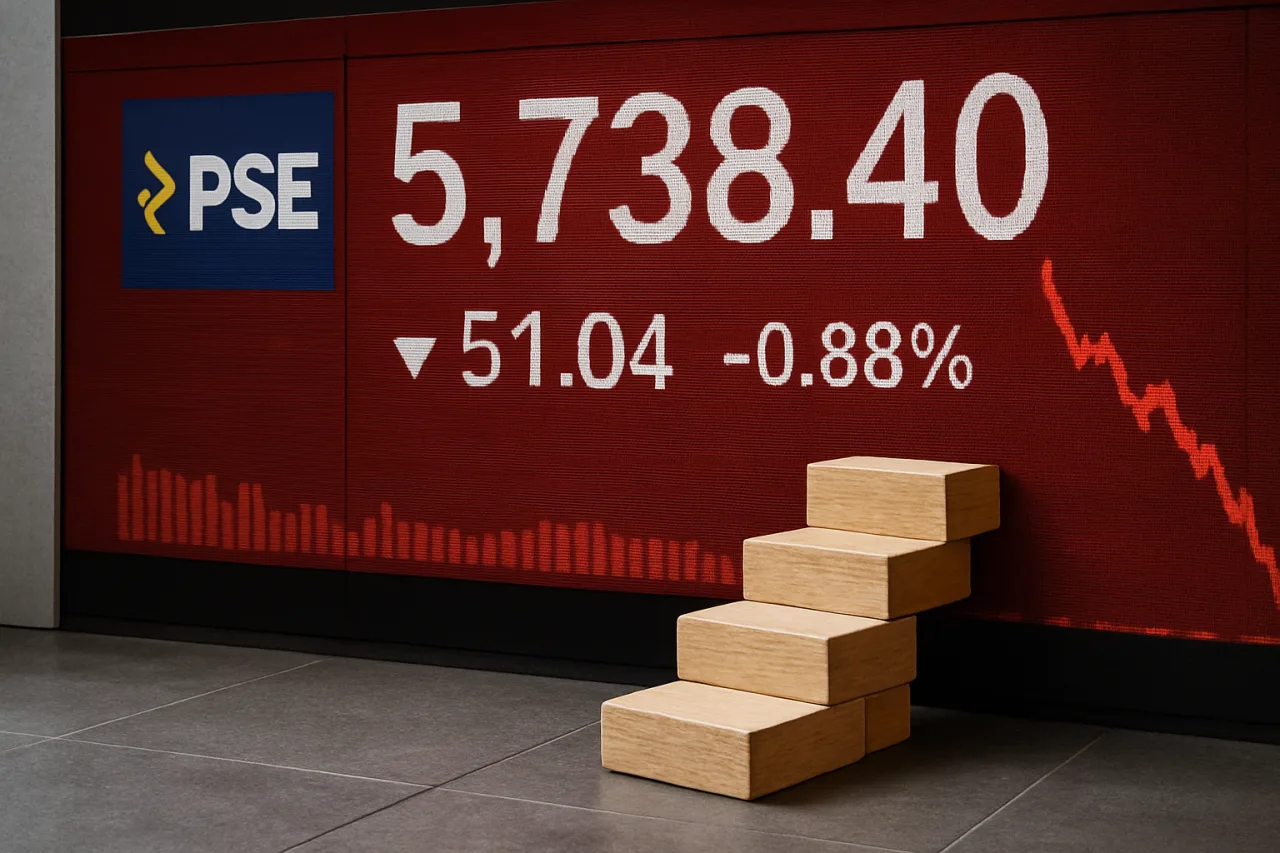
📉 THE BOARD — Wednesday, September 30, 2026 → PSE Watch #005: PSE stocks slid further on GCash pricing day — PSEi closed 5,738.40 (−0.87%) Tuesday — the 5,700 floor from #004 held for exactly one session, and 5,770 fell through on the retest · intraday low 5,727 · today is GCash pricing day (bookbuild, ₱6.50 talk ≈ ₱60B raise) · 10Y US yield 5.26% = 19-year high · the fresh angle the ledger owns: the pricing-day liquidity vacuum — where the ₱60B subscription cash goes, and the support ladder that maps it
Key Takeaway
- 📉 5,770 broke on the first retest: PSEi 5,738.40 (−0.87%) — closing below the AB Capital floor line a day after #004 called the test. The floor was never support; it was the yield tape’s warning label.
- 🪙 GCash pricing-day vacuum is today’s tape driver: ~₱60B expected to lock up for subscriptions (₱36.5B cornerstone already booked; retail/trading = 30% of firm shares) — cash that sits parked, not circulating, while the index slides on 19-year-high US yields.
- 🧮 The support ladder after 5,738: 5,700 (psychological + October’s first trading pivot), 5,660-5,600 (the 10-month-low bounce zone #002 mapped — where the September dip buyers actually appeared), 5,470 (2025 floor print). The 5,800 hurdle doesn’t flip back to support until GCash settles and the tape re-thickens.
- 🏦 BDO bucked the tape (+0.88% to ₱114): financials slipped only 0.02% while Services fell 1.18% — banks are being repositioned as the GCash-listing proxy plays: rate-resilient, IPO-adjacent, foreign-flow shelters.
- ✅ Payoff: a mapped ladder with entry rules per rung, the pricing-day mechanics (what settles when), and the OFW tranche placement for a week where the market’s biggest IPO eats the tape’s oxygen.
The floor test from yesterday did not pass, and PSE stocks now trade below every reference line that mattered last week: the PSEi closed at 5,738.40, down another 0.87% on top of Monday’s 5,788.87 close — this GCash IPO pricing day now trades as the tape’s liquidity event: roughly ₱60 billion in subscription intent (Bloomberg’s ~₱6.50 × 9.23 billion shares) is being marshaled into applications while the index slides on the 19-year-high US Treasury yield and the still-leaking Hormuz war premium. This is PSE Watch #005 — the support ladder after the floor broke, the pricing-day mechanics that decide when the market’s oxygen returns, the BDO bucking-tape signal worth reading twice, and the OFW tranche placement rules for a week where the country’s biggest IPO absorbs every peso that wasn’t already spoken for. One article at a time through this tape: yesterday’s floor-test framing (PSE Watch #004) priced the danger; today’s ladder prices the entries.
WorldNgayon Analysis: A floor that breaks on the first retest was never support — it was a stop-loss painted by the previous bounce, and the ladder below it is where the actual decision lives.
Bottom Line: 5,738 closed the floor debate; the ladder is 5,700 / 5,660-5,600 / 5,470 — and GCash’s settlement date (October 14-20 window) is when the tape gets its oxygen back.
Where PSE Stocks Sit After the 5,770 Floor Broke — the Ladder Reading
Tuesday’s session gave a specific and unflattering answer to the floor question: the PSEi traded down to an intraday low of 5,727 and closed at 5,738.40 (PSE EDGE: edge.pse.com.ph) (−0.87%), below Monday’s 5,788.87 print and far below the 5,800 hurdle that governed the first three sessions of the slide. Breadth data from the PSE stocks tape: services fell 1.18% (the worst sector), holding firms 0.44%, mining and oil 0.67%, financials a mere 0.02% — and inside that dispersion sits the day’s most instructive datapoint: BDO rose 0.88% to ₱114 while its index bled. The reading order: first support: 5,700 — a psychological round number and the natural magnet once 5,738’s close failed (the index is ~0.67% away); second shelf: 5,660-5,600 — the actual buy zone where PSE stocks bounced off their 10-month low earlier this month (57907’s mapped zone: the September 10-month trough printed and the recovery leg that followed gave the range that held); third: 5,470-5,500 — the pre-IPO-announcement floor from the 2025 tape, which only matters if the GCash vacuum plus the yield shock compounds for two more sessions. The upside arithmetic: 5,800 is the hurdle again — it turned resistance when the index lost it, and it stays resistance until something re-thickens the tape. The one thing that re-thickens the tape this week is scheduled: GCash’s money, which returns to workable form when the offer settles after October 12 — that is the oxygen-supply calendar, and it runs on the PSE’s settlement mechanics, not on hope.
Bottom Line: Ladder: 5,700 (first), 5,660-5,600 (real shelf), 5,470 (last). BDO’s green close tells you where the rotation wanted to hide.
The Pricing-Day Mechanics for PSE Stocks — Where ₱60 Billion Goes and When It Returns
Today is pricing day; tomorrow (October 2) the notice of final offer price lands with the PSE and SEC; October 5 the SEC-permit window closes; October 6-12 is the offer period; October 8 firm orders due; October 12 retail settlement; October 14-ish institutional settlement; October 20 listing. Follow the PSE stocks money mechanically: the cornerstone ₱36.5B sits with the underwriters from booking (already priced/conditioned at ~₱6.50-6.60 talk) — that cash is out of the float market now; the broker-tranche subscriptions (20% of firm shares) draw from funded brokerage accounts during the offer window — parked cash through October 12; the LSI/EASy tranche (10%) draws deposits through the same window; the overallotment (₱1.20B shares secondary) activates on demand. Net effect on the rest of the tape: for two full weeks the market’s most liquid retail cohort is busy moving cash GCash-ward, and PSE stocks trade thinner, and the PSEi trades thinner on both sides of the book until settlement completes. That’s the mechanical reason the 5,800 hurdle takes time to reclaim: the buyers are subscribed, not gone — the same retail base that would fund a 5,700-level index dip has its liquidity committed to the IPO window. Foreign flows tell the same story from the other direction: 19-year-high US yields (5.26%) make US Treasury bills a competing destination for every peso-based institutional allocation, and the peso’s 62.4-62.6 range (BSP tape) keeps the dollar-strong OFW-inflow cushion from showing up as index demand. The PSE stocks ladder from above plus the vacuum mechanic from this angle share one conclusion: this week’s PSE tape is a GCash-processing tape — read the PSE stocks ladder, don’t fight the drain, and position for the settlement week when the parked money starts voting again.
Bottom Line: ₱60B in, parked through October 12; settlement runs to October 14-20; the index re-thickens when the parked money returns to the tape — that’s the oxygen calendar.
The BDO Signal — Why the Bank Bucked the Tape
BDO rising 0.88% to ₱114 while its sector slipped 0.02% and the index lost 0.87% is not noise: it is the GCash-proxy rotation happening in plain sight across PSE stocks — and rotations like this one lead the index by days, not sessions: the money that bought BDO Tuesday is the money that decides which shelf of the ladder holds first, because underwriter-adjacency is the one thing this tape pays for. The mechanism: GCash lists October 20 at a valuation that prices it against Philippine banks (at the ₱10 ceiling its ₱669B market cap would exceed BDO’s — at ₱6.50 talk, ~₱442B is within sight of the biggest banks), and every repricing of the fintech pulls the banking complex’s valuation anchor with it. Banks with the least fintech-fear and the most IPO-adjacency benefit: BDO is one of the two domestic lead underwriters’ parents (BDO Capital is joint bookrunner), it’s rate-resilient (Philippine banks’ net interest margins have room while US yields scream but BSP has not hiked), and it’s the receiving-bank for much of the offer’s payment plumbing. The practical read for the OFW investor: PSE stocks in the financials lane are the tape’s defensive proxy this week — if you want index exposure while the GCash drain runs, the financials sector (BDO, BPI, MBT at their dividend yields) is where the rotation already went. The inverse lesson: services (1.18% down) and property are where the drain shows first — the same sectors that rallied hardest on the IPO’s retail optimism are the ones repricing its liquidity cost. That’s the GCash paradox made concrete: the bigger the IPO’s success, the more visible the pre-settlement funding hole it leaves in everything else. The Monde Nissin 2021 record is the template: the ₱55.89B raise produced the same two-week drain, the index sagged through the offer window, and the tape re-thickened within days of settlement — this playbook repeats at nearly double the scale. The ladder strategy respects both sides: entries at 5,700/5,660 are for the post-settlement week, not for today’s drain.
Bottom Line: BDO’s green close on a red tape day = the banks-as-proxy rotation; the sectors that bleed hardest while GCash parks its cash are the ones that re-rate first when it settles.
The OFW Tranche Placement — What a Real Household Does With This Ladder
The tranche discipline from WIW #003 holds without modification: this week is a watching week for new PSE stocks money — the GCash window (how-to-buy drill in yesterday’s piece) takes priority over index entries, and the tranche that was going to buy the dip at 5,700 doesn’t chase the index below it early; it waits for the settlement-week repricing with two concrete date-markers: October 14-16 (institutional settlement) and October 20 (GCash listing day) — the two sessions where parked money either re-enters the broad tape or visibly commits to the GCash listing pop instead. Position sizing rules from the PSE stocks ladder: if you’re placing a fresh tranche this week, half-size it and leave the other half for the settlement-week confirmation — the 5,660-5,600 shelf is the zone where that second half deploys if the shelf holds (a close above 5,660 for two consecutive sessions is the re-thickening tell); if the index instead closes below 5,600 on widening breadth, the ladder’s bottom shelf (5,470) is next and the discipline says wait for the print, not the forecast. The OFW-specific adjustment to the PSE stocks ladder: peso-remittance income lands weekly, and this tape’s GCash-window (subscription deadline October 12, noon sharp) coincides with the salary weeks — fund the IPO application first, the ETF/tranche second, because the IPO tranche has a deadline and the ladder does not. The discipline stays boring on purpose: the market pays the ladder-reading investor twice — once in avoided drawdown, once in the settlement-week re-entry price — and pays the urgency trader neither.
Bottom Line: IPO window first (deadline-driven), index ladder second (settlement-week markers Oct 14-20), half-tranche discipline between now and then — the ladder pays the patient.
Frequently Asked Questions
The 5,770 floor broke — what support matters now?
First: 5,700 (psychological + this week’s live pivot). Second: the 5,660-5,600 shelf, where the September 10-month-low bounce actually occurred and where dip-buyers last proved real. Third: 5,470-5,500 (the pre-2026 floor print). The 5,800 hurdle flips back to support only after GCash settlement re-thickens the tape (October 14-20 window).
Does the GCash IPO drain liquidity from the stock market?
Mechanically yes, for about two weeks: ~₱60B of subscription intent (Bloomberg’s ₱6.50 × 9.23B shares estimate) parks with underwriters and brokers through the October 6-12 offer window and retail settlement (October 12). The cash returns to voting position after settlement (October 14-20). This drain is the pricing-day tape’s single biggest mechanical driver. The drain is also two-sided: the institutional 70% tranche is already committed in cornerstones (₱36.5B), so the marginal demand during the offer window comes from the retail and trading cohorts (30% of firm shares). While that cash waits for allocation, the selling side of every other stock meets a thinner buy side — the mechanism the index fell through 5,738 on, with no selling panic required.
Why did BDO rise while the index fell?
Banks are the PSE stocks GCash-listing proxy: BDO Capital is a domestic lead underwriter, BDO is the receiving-bank for much of the offer’s payment plumbing, and Philippine bank NIMs are rate-resilient while the index carries yield-tape pressure. BDO +0.88% to ₱114 on a −0.87% index close was the rotation showing its hand.
Is 5,700 a good entry for new money?
No — not as a full allocation. Half-size entries belong at the 5,660-5,600 shelf, not at 5,700: the settlement-week repricing (October 14-16) is the re-thickening tell, and a two-session close above 5,660 confirms the shelf holds. If the index closes below 5,600 on breadth, the bottom shelf (5,470) is next — wait for the print.
What should an OFW do with this week’s remittance money?
Fund the GCash IPO application first (October 12 noon deadline — the drill in yesterday’s piece), the index tranche second: the IPO subscription has a deadline, the ladder does not. Keep the tranche allocation math from the WIW calendar intact — this week’s PSE tape is a GCash-processing tape, and the ladder entries belong to the post-settlement week.
Financial Disclaimer: This article is for general information and education, not investment or financial advice. Market data reflects reported levels at publication and may change; verify with the PSE and your broker before acting. WorldNgayon.com is not a financial adviser.