Table of Contents
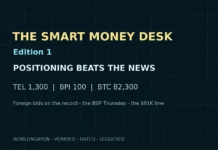
₿ THE BOARD — Wednesday, September 30, 2026 → Crypto Watch #005: the Bitcoin ETF tape turned net-positive while Bitcoin $83,000 after Trump’s Hormuz rejection triggered $478M in liquidations — the market now trades oil, not charts · yesterday’s first outflow print (FBTC −$10.9M) got its follow-up question: 2026 ETF inflows turned net-positive $2.4B/week · the $82,000 trigger line from #004 sits $1,000 away · River’s supply-thesis (ETFs bought only ~18K BTC in September) vs the flow tape · the owned angle: the two-trigger rule gets its live test
Key Takeaway
- 🎯 The $82,000 line is the week’s trade: BTC slid to ~$83,000 after Trump rejected Iran’s Hormuz proposal (oil above $100, $478M long liquidations) — the #004 trigger level is a hair away, and the two-trigger rule says Bitcoin ETF outflow prints alone don’t sell; a level break does.
- 📊 2026 ETF inflows turned net-positive: ~$2.4B net into US spot Bitcoin ETFs in the week to Sep 25 (cryptoticker/BeInCrypto tape) — record weekly demand at prices that FELL, Glassnode’s profit-taking analysis says supply-not-demand is driving the structure.
- 🌊 Bitcoin trades the oil tape now: the crypto-equity correlation with oil-and-yields is the regime — Hormuz headlines move BTC before flow data does, which rewrites the ETF-era playbook this series built from the cornerstone print in 2024-25.
- 🧮 Tranche discipline from the OFW calendar: crypto allocations sit in tranche 3’s watch-list (the Brent-$95 and 10Y-5.0 triggers from WIW #004 govern when the risk tranche deploys — not the price chart alone).
- ✅ Payoff: named decision lines ($82K break = contingency rules from #003, $87K reclaim = outflow-print was noise), the liquidation-mechanics explainer, and what $2.4B net-positive weeks mean for ₱-budgeted OFW accumulation.
Bitcoin spent Tuesday getting repriced by a war headline instead of a Bitcoin ETF flow headline, and the $82,000 line this series has guarded since #004 sits one press away: BTC slid toward $83,000 after Trump rejected Iran’s ceasefire proposal — Crypto Watch #005 is the two-trigger rule’s live test: the outflow print (FBTC −$10.9M, the first of the rally’s new era) arrived yesterday, the $82,000 trigger holds the level decision, and the fresh flow data turned 2026’s inflow counter net-positive at $2.4B for the week — three facts that don’t fit one narrative, and don’t need to: the drill reads them as separate instruments. Inside: the liquidation mechanics of a $478M flush, why supply-not-demand changes the ETF story’s meaning (River: ~18K BTC in ETF buying all September), the tranche-3 placement rules for peso-budgeted OFW money in a $82,000-test tape, and the scenario lines for the week Brent and the 10Y both matter to Bitcoin.
WorldNgayon Analysis: The outflow print and the net-positive week together say the same thing — the marginal Bitcoin ETF buyer went on strike at $84K, not that institutions left; a level test, not a regime change, is what the tape owes.
Bottom Line: $82,000 decides the week; $478M of liquidations set it up; $2.4B of weekly net inflows set the floor beneath it.
The Two-Trigger Rule Gets Its Bitcoin ETF Live Test — Trigger One, Trigger Two
The two-trigger rule from #004 exists to stop exactly this tape from shaking OFW investors into panic: Trigger one — the outflow print: Fidelity’s FBTC posted the first daily outflow of the new era Monday (−$10.9M) after seven straight green days, breaking the record-$2.39B-week momentum. Trigger two — the level: $82,000, which #004 mapped as where the tranche logic lives ($1,800 below Monday’s $83,800 reference; today’s $83,000 print puts it $1,000 away). The rule’s discipline: trigger one alone = noise (a single Bitcoin ETF outflow day inside a $2.4B weekly net-positive tape is a rounding error); trigger two alone = the decision (a break THROUGH $82,000 activates #003’s contingency — the pre-written #003 contingency: don’t average into a falling knife, wait for the reclaim or the weekly close). The mechanics of Tuesday’s flush, explained for the family budget: the $478M in liquidations were leveraged longs — traders who borrowed to ride the rally from $77K got margin-called when war headlines knocked the tape; their forced sells briefly overwhelmed spot demand, and the price dip you see is the liquidation cascade, not a wholesale exit. The proof sits in the Bitcoin ETF flow counter (net-positive week) and the price itself ($83,000 vs a $77,666 August reference — the tape is still up on its war-month): the flush sold leverage, not conviction. The live test runs today: if $82,000 holds, the two-trigger rule’s thesis (rally intact, cool-down not collapse) gets its validation; if it breaks with breadth (alt tapes flushing too), the #003 contingency becomes live and the drill’s emergency rules take over.
Bottom Line: Trigger one fired ($10.9M outflow); trigger two waits one thousand dollars away — hold the rule, and let the level do the deciding.
Why $2.4B of Weekly Bitcoin ETF Inflows Turned 2026 Net-Positive — the Floor It Builds
Zoom out from Tuesday and the ETF tape tells a different story than the flush: US spot Bitcoin ETFs took in roughly $2.4 billion net in the week to September 25 (the flow tape), which flipped 2026’s cumulative flows net-positive — and that weekly figure arrived WHILE Bitcoin fell from $84K toward $83K. The counterintuitive combination (inflows rising, price falling) is the River thesis getting its proof: ETFs bought only ~18,000 BTC in September as of River’s September 23 report — the marginal buyer has been scarce all month, which means the price rally’s real fuel was supply-side (miners, whales, long-holders keeping coins locked) rather than Bitcoin ETF demand. The meaning for the $82,000 test: with leverage flushed ($478M liquidations) and ETF demand steady-but-modest (18K BTC/month), the tape’s downside support comes from holders, not new money — Glassnode’s analysis shows spot buying and Bitcoin ETF flows steady with “substantially lower profit-taking than at prior all-time highs,” which is a floor-building signature, not a breakout signature. The practical line for peso-budgeted accumulation: the war-flush weeks are where the DCA (dollar-cost-average) schedule earns its keep — the weekly ₱-allocation that buys into $83-84K handles the $82K-test either way: if the level holds, the schedule built a position in the dip; if it breaks and the #003 contingency triggers, the same schedule catches the post-break reentry at the next support shelf instead of a knife-catch. Neither ETF counter nor liquidation flush sets the position size; the tranche-3 rules from WIW #004 do (the Brent $95 and 10Y 5.0% triggers govern when the crypto tranche grows at all — a war-tape flush is when discipline matters most, not least).
Bottom Line: $2.4B weekly inflows flipped 2026 net-positive while 18K BTC/month says ETFs alone aren’t the engine — floors get built on steady-but-not-heroic demand, and war-flush weeks are where DCA schedules pay.
Bitcoin in an Oil-Taped Market — the Correlation Regime Nobody Priced
The pattern that should reprice every 2024-25 playbook: Monday’s tape showed Bitcoin falling ON war headlines (Iran rejection → oil spike → liquidations → BTC slide to $83K) exactly in sync with equities, while its own flow tape stayed net-positive. That is not the ETF-era’s “digital gold” decoupling; that is risk-asset behavior in a macro-taped regime — and it’s the third time this month the correlation has held (Hormuz proposal Friday: BTC rallied with risk-on; rejection Saturday-Monday: BTC slid with equities; Tuesday flush: $478M liquidations as oil crossed $100). The regime read: with the Fed’s October-hike odds at 70.3% and 10Y at 5.26%, the marginal Bitcoin buyer is a risk-budget allocator, not a believer — the same desk that funds the Nasdaq — so the tape that moves Nasdaq moves Bitcoin. For the OFW decision map this cuts the analysis short: BTC’s $82,000 test is the same trade as the PSEi’s 5,738 test — both are war-premium/yield-regime readings wearing different tickers, and both resolve on the same two triggers (Brent $95, yields 5.0%), not on Bitcoin-specific charts. The one Bitcoin-specific instrument worth watching regardless: the ETF flow counter — because in a macro-taped market, the weekly Bitcoin ETF flow print is the only Bitcoin-native vote the tape takes, and 2026’s turned net-positive.
Bottom Line: Bitcoin now trades oil, yields, and risk budgets — the same two triggers that govern the PSEi ladder govern the $82K test; the ETF flow counter is the one Bitcoin-native instrument that matters.
The accumulation arithmetic, worked so the household budget sees it: an OFW who commits ₱2,000 weekly to the crypto tranche ran the week like this — two buys into the $83,800-83,000 flush zone (the Friday truce-hope print and Tuesday’s post-rejection flush), 4,000 for the week at an average near $83,600. The alternative discipline-breaking move (waiting for “calm” then lump-summing) buys the same BTC at whatever the peace-confirmed price is — historically $3,000-5,000 higher on this war-tape pattern — for zero added safety, because the calm itself is what validates a higher entry. The schedule is the instrument; the flush is the discount the war tape gives schedule-followers specifically. And the ledger keeps the honest counterweight: the ₱2,000 weekly tranche in this example is tranche-3 money — money whose loss the household absorbs without touching the emergency reserve — and the $82,000 test is exactly the kind of week that validates why the tranche sizes were set at boring levels before the tape got exciting. The investor who sized ₱2,000 weekly can watch the test with coffee; the one who sized ₱20,000 weekly watches it with antacids, and the difference was never Bitcoin’s chart — it was the budgeting.
Bottom Line: ₱2,000-a-week schedules make the $82K test a non-event either way — that’s what boring tranche sizing is for.
Frequently Asked Questions
Bitcoin fell toward $83,000 after Iran ceasefire rejection — why does oil move Bitcoin?
The regime, not the asset: US 10Y yields at 19-year highs (5.26%) make the marginal crypto buyer a risk-budget allocator whose budget depends on oil (inflation → Fed hike → yield pressure), so Hormuz headlines hit BTC through the risk-budget channel — the $478M liquidation flush was leveraged longs being margin-called, not a Bitcoin-specific exit.
Did ETF investors dump Bitcoin after the outflow print?
No — single-day flows (FBTC −$10.9M) run inside weekly nets, and the week to Sep 25 recorded roughly $2.4B net-positive US spot Bitcoin ETF inflows, flipping 2026’s cumulative counter net-positive. One outflow day in a net-positive week is a cool-down print, not a stampede.
What happens if $82,000 breaks?
The #003 contingency activates: no knife-catch buying — wait for either a weekly close back above $82K (the flush-failure signature, and the two-trigger rule’s second validation) or the next support shelf forming on breadth data. The tranche-3 rules govern size: the war-tape flush is when the emergency reserve stays untouched. The mechanical levels beneath $82K from the #003 map: the $77,666 August reference (the war-month base) is the next real shelf — a flush that deep into August territory would mean the oil-tape regime overpowered even the holder floor that Glassnode’s data shows, which is a different tape than a wick-and-hold. Between the two sits the boring middle: a break-and-stall between $80-82K with the weekly flow counter staying net-positive — the most probable path, and the one where the DCA schedule catches the best prices of the war-tape era before the settlement-week liquidity returns. The rule’s summary: the level break changes which shelf the schedule buys, never whether the schedule runs.
Is now a good time for an OFW to DCA into Bitcoin?
The schedule, not the tape, decides: if your weekly allocation plan already budgets a crypto tranche, war-flush weeks are where DCA pays (buying weeks like this beat waiting for calm); if you’re considering a NEW tranche, the tranche-3 triggers govern deployment timing — Brent $95 and 10Y below 5.0% are the gates this tape respects.
What would invalidate the bear-case reading of this tape?
Two prints: a weekly Bitcoin ETF net-inflow number that grows while $82K holds (demand returning into a floor), or the 10Y breaking back under 5.0% on Fed-relief — either one reopens the risk-budget the flush closed. Watch the weekly Bitcoin ETF flow counter every Monday (the River report lands mid-week with the supply numbers) and the 10Y yield tape daily. The invalidation hierarchy: a single green flow week extends the cool-down thesis; two consecutive weeks with the $82K line holding confirm the floor thesis the two-trigger rule priced; a weekly flow print shrinking while price rises (the September pattern restated) means the rally resumed without the ETF buyer — watchable, but historically the least durable configuration, which is why the tranche triggers stay the governors either way.
Financial Disclaimer: This article is for general information and education, not investment or financial advice. Crypto assets are volatile and risky; verify current market data before acting. WorldNgayon.com is not a financial adviser.