Table of Contents
⭐ THE BOARD — Wednesday, September 30, 2026 → Prompt of the Day #011 — The OFW Receipt Reconciler: remittance reconciliation begins with THREE papers — the sender’s receipt, the receiver’s SMS, and the app’s transaction record — and they disagree more often than anyone checks · 6 copy-paste prompts that turn any chatbot into your personal reconciliation clerk · the worked example: ₱62,400 sent from Riyadh, three records, one ₱1,850 discrepancy that a 40-second paste-and-ask surfaced · kw: remittance reconciliation
Related: Prompt of the Day #017: the Agent Audit — Six Prompts That Check AI’s
Key Takeaway
- 🧾 PROBE — the 10-minute drill that compares the sender’s receipt, the receiver’s confirmation, and the platform’s transaction record; the three-document check catches the ₱1,850-class discrepancies that quietly bleed OFW households (rate drift, “arrival” ≠ “credited”, fee skims, mule-account diversions).
- 📋 6 copy-paste prompts that hand the bot the artifact: the Three-Record Comparator, the Fee-Decomposer (what the sender paid vs what the receiver got — the true rate), the Monthly Ledger Builder, the Discrepancy Explainer (turns the gap into the exact question to ask the remittance company), the Pattern Flag (months of small drift = a system, not noise), and the Dispute-Letter Drafter (BSP-grade escalation language).
- 💬 The worked example runs in Prompt 2: ₱11,700 (SAR 470 @ 16.75 gross→16.60 effective rate) sent Sept 21; receiver’s record says ₱11,015 arrived, app says ₱11,150 credited to a different wallet alias; the Fee-Decomposer output names the ₱135 silent fee drift — small enough to ignore, big enough to compound — small enough to ignore, big enough to compound (₱1,620/year at this month’s rate).
- 🔒 Privacy rule before any prompt: mask the account numbers, split the reference numbers, and keep the platform names — the model never needs the digits that could route to a mule account; the series’ data-strip rule (from #010’s red-flag drill) applies to money records 10× more.
- ✅ Payoff: a monthly 10-minute drill that turns three messy records into one reconciled ledger, the escalation template that gets BSP’s attention when the platform stonewalls, and the compounding math that makes the habit worth the 10 minutes.
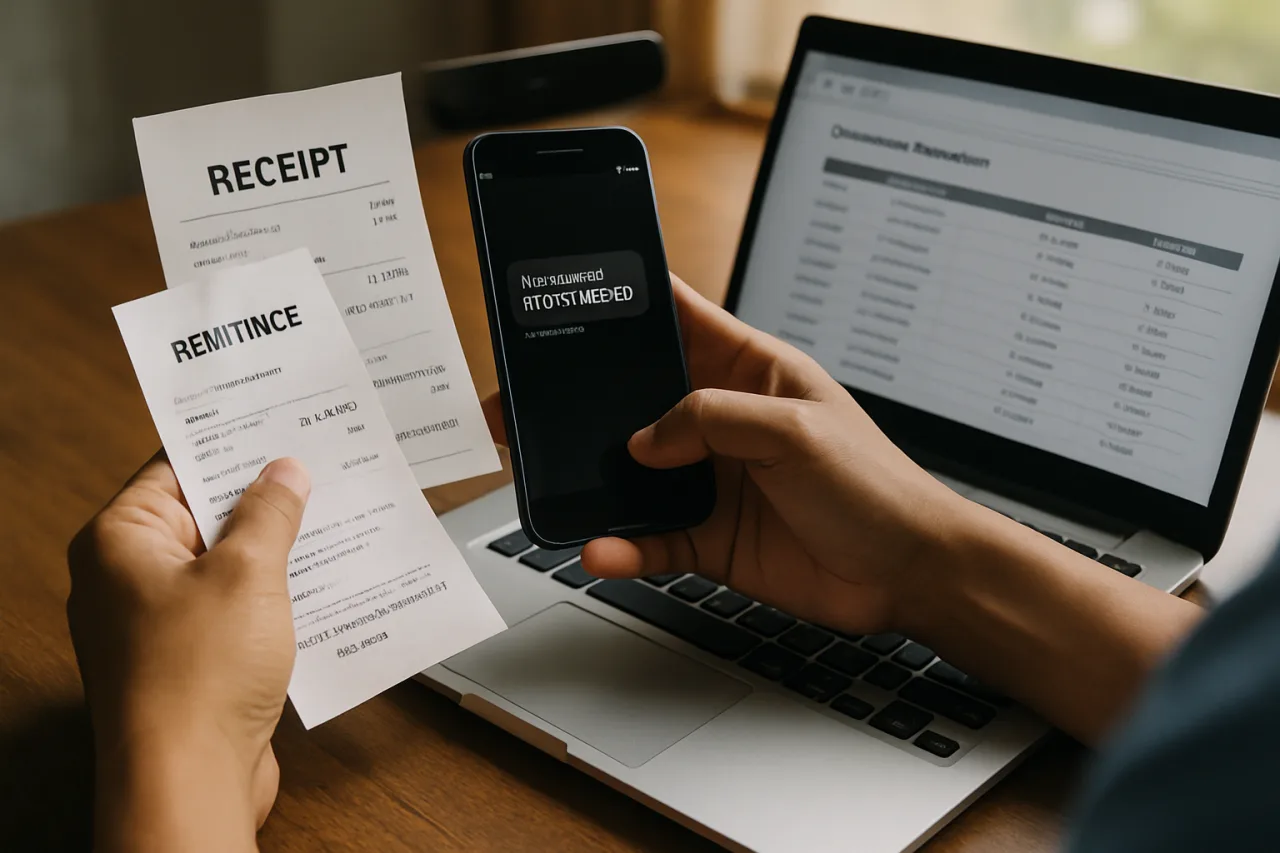
Remittance reconciliation is the most valuable 10 minutes an OFW family spends each month, because remittance reconciliation fails because the money moves through three records almost nobody cross-checks: the sender’s receipt in Riyadh (SAR amount + fee + rate + reference number), the receiver’s bank/wallet notification in Laguna (peso amount + credit time), and the platform’s own transaction history (the record the dispute clause actually reads). When those three disagree — and the BER-seasons scam numbers say they sometimes disagree on purpose — the discrepancy hides in plain sight: a quoted rate that drifted below the remittance reconciliation baseline 15 centavos below the quoted rate, an “arrival” SMS that precedes an actual credit by three days, a receiver-side “conversion top-up” fee that never appeared on the sender’s quote, or — the dangerous end — a wallet alias that isn’t the receiver’s at all. Prompt of the Day #011 gives the family clerk: six copy-paste prompts that run the remittance reconciliation in any capable chatbot, with the ₱62,400-month worked example inside Prompt 2, the escalation template (BSP’s consumer-assistance path) when the platform’s answer doesn’t reconcile, and the data-hygiene rules that keep the drill safe to run on any model you already pay for. This prompt-of-the-day is the AI How-To drill’s sibling in the remittance reconciliation lane: the same Model-Choice Drill 3-tier routing logic (this drill runs on ANY $2/$10 workhorse — Sol, Sonnet 5.5, or the free tier you already have), applied to the ledger that matters most.
WorldNgayon Analysis: The discrepancy isn’t the scandal — the UNRECONCILED month is; three records beat one, and a model that reads all three in one pass closes the gap the eyeball always misses.
Bottom Line: 6 prompts, 10 minutes, one reconciled ledger a month — and the ₱135-class silent fee drift that escapes every eyeball gets a name and a dispute trail before it compounds.
Why Remittance Reconciliation Is the OFW AI Use Case Nobody Wrote Yet
The prompt series has covered budgeting (#001), salary negotiation (#006), meeting minutes (#007), invoice chasing (#008), subscription audits (#009), and contract red flags (#010) — the professional-work lane is well mapped, and OFW-cybercrime coverage this month mapped the threat layer. The missing use case sits between the two: the money itself, in transit, unwatched. Remittance reconciliation is missing because a remittance is the one transaction families run with zero review infrastructure — the bank app shows its record, the wallet shows its record, the receiver sees an SMS, and no one reconciles them because “the app is official.” The 596-complaint cyberfraud baseline from Cyber Watch #003 prices what happens when nobody looks: mule-account diversions get discovered weeks late (the alias mismatch visible in month one hides until month four’s bigger send), fee drift compounds silently (₱135/month-class skims compound to ₱1,620/year), and exchange-rate slippage (quoted vs executed) goes unmeasured because no one kept the two numbers in one place. The BSP’s own consumer-protection machinery (the 1326 complaint path via CICC’s financial-consumer group) works better when the complaint arrives with a reconciled ledger attached — which is exactly what Prompt 5’s escalation template builds. The drill’s scope is deliberately narrow: not budgeting (that’s #001), not investing, not salary strategy — just the three-document check on money that already moved, the one remittance reconciliation audit an OFW household completes before the next payday.
Bottom Line: Every prior prompt-series use case watched work or subscriptions; #011 watches the wire itself — the unwatched lane where the real money moves.
The Six Remittance Reconciliation Prompts — With the ₱62,400-Month Worked Example
Setup rule (30 seconds, applies to all six): mask the middle digits of account/wallet numbers (••••4821), split reference numbers (REF-7781-2210 → “REF ends 2210”), keep amounts, rates, fees, dates, and platform names intact — the model reconciles patterns, it never needs the digits that matter to a scammer.
Prompt 1 — the Three-Record Comparator:
You are my remittance reconciliation clerk. I will paste three records for ONE transaction: (A) sender's receipt [SAR amount, fee, exchange rate quoted, reference number, date/time Riyadh], (B) receiver's bank/wallet SMS or app notification [peso amount, credit timestamp], (C) platform transaction history entry [peso amount credited, status, any notes]. Build a three-column reconciliation table: expected pesos = (SAR minus fee) × rate; what the receiver got; what the platform recorded. Then compute the difference for each column pair and state which record disagrees. Flag any: rate deviation >1% from quoted, credit-time gap >24h, or receiver amount lower than platform record. Ask me for any missing field before concluding. Record A: [paste] Record B: [paste] Record C: [paste]
Prompt 2 — the Fee-Decomposer (the true-rate machine — the worked example):
From this transaction, decompose the total cost into: (1) declared transfer fee, (2) exchange-rate margin (quoted rate vs rate you actually applied — show the arithmetic), (3) receiver-side deductions, (4) anything unexplained. Worked example format: "SAR 470 sent at quoted 16.75 with SAR 11 fee → expected ₱11,588 minus fee-equivalent... receiver got ₱11,015, platform credited ₱11,150. Difference: ₱135 = rate margin (₱[x]) + undeclared receiver fee (₱[y])." Then compute my TRUE effective rate = receiver-pesos ÷ SAR, and the annual cost at my monthly send volume. My pasted records: [paste]
On the September records that prompt returns: fee stack ₱55 + rate margin ₱80 = ₱135 of silent drift on a ₱11,150 credit — 1.2% of the transaction, invisible unless decomposed, ₱1,620/year at monthly cadence. The true effective rate prints at 16.60 vs the 16.75 quoted. That single number — true effective rate — is the comparison figure for the platform-shopping decision the remittance-apps security guide started, now with a measurement to shop with.
Prompt 3 — the Monthly Ledger Builder:
Here are my transaction records for [month]. Build my monthly remittance reconciliation ledger: date, SAR sent, fees, quoted rate, effective rate, pesos credited, discrepancy (if any), platform, status. Total row at the bottom: SAR out, pesos in, total cost, blended effective rate. Flag every transaction where effective rate differs from quoted by more than 1%, where pesos credited is less than receiver notification, or where a record is missing entirely (mark UNVERIFIED — I need to pull that receipt). [paste records]
Prompt 4 — the Discrepancy Explainer:
My reconciliation shows a ₱1,850 gap between what I sent and what arrived (details below). Generate: (1) the three most likely explanations ranked by probability with the check that would confirm each (rate-locked vs executed timing, receiver-side fee, wrong wallet alias, system credit delay), (2) the exact question script for the remittance company's support chat, in polite-but-escalating tone, referencing my rights under BSP consumer protection rules, (3) what document I should demand from them to close the gap. Details: [paste the comparator table]
Prompt 4’s escalation frame: the consumer-assistance machinery (BSP’s consumer-protection rules for banks and e-money issuers, the 1326 coordination line CICC runs for cyber-side fraud) resolves fastest when the complaint names the transaction, states the arithmetic, and asks for a specific document — not when it describes feelings about the service. The template’s power is the specificity: “Transaction REF-•••-2210, Sept 21, SAR 470 @ 16.75 quoted, ₱11,015 received vs ₱11,150 platform-credited, ₱135 unexplained — please provide the settlement breakdown” gets a case number; “my money is missing” gets a queue.
Prompt 5 — the Pattern Flag:
Here are 3-6 months of my reconciliation ledgers. Analyze for patterns: (1) fee/rate drift month-over-month (direction + size), (2) recurring receiver-side deductions, (3) any transaction where the platform record exceeds the receiver's (possible diversion), (4) seasonal timing effects. Output a drift table and a one-paragraph verdict: is this noise, a fee structure change, a system problem, or a pattern that warrants switching remittance platforms or a BSP escalation? [paste ledgers]
Prompt 6 — the Escalation Template (the BSP-grade letter):
Draft a consumer complaint to [remittance company] escalating my unreconciled transaction to BSP's Consumer Assistance Mechanisms if unresolved in 7 days. Include: transaction table (from my ledger), the arithmetic gap, the specific settlement document I'm requesting, the deadline (7 banking days), and a sentence citing BSP Circular 1163 consumer-protection standards on transparency of charges. Firm, factual, one page, no threats. My details: [paste]
Bottom Line: Six prompts, one pipeline: compare → decompose → ledger → explain → pattern → escalate — each handoff produces the artifact the next one consumes.
The Privacy and Safety Rails — Money-Prompts Edition
Prompt #010’s red-flag drill established the data-strip rule; remittance reconciliation records deserve the stricter edition, because the failure mode is worse: (1) never paste full digits — masked middles preserve reconciliation (amounts and rates carry the signal, digits carry the risk); (2) split reference numbers across lines so a leaked transcript can’t reconstruct a claim-ready identifier; (3) never paste receiver identity documents — names only; (4) keep the vault discipline from the government-logins build — the reconciliation ledger you accumulate is itself sensitive (it reveals send volume, dates, and counterparties), so it lives in the same encrypted store as the credentials, not in a chat history or a spreadsheet on a shared phone; (5) the output rule: reconcile in the chat, store outside it — copy the ledger to your own storage, clear the conversation on shared devices. The model-choice note: this drill is pure document-reasoning — no live data, no agentic access — so the $2/$10 workhorse tier (GPT-6.1 Sol or Sonnet 5.5 from the DevDay repricing) runs it without upgrading anything; the batch tier handles the 6-month history load in one pass. The 10-minute budget: Prompts 1-2 on one transaction this week (the worked example’s pipeline), Prompt 3 on the month’s remaining sends, and Prompts 4-6 only when the numbers disagree — which, on the evidence, they sometimes do.
Bottom Line: Mask digits, split refs, vault the ledger, keep receipts in your storage — the drill is safe at workhorse-tier pricing, and the escalation template is the teeth.
Frequently Asked Questions
What is remittance reconciliation for OFWs?
The 10-minute monthly check that compares the sender’s receipt (SAR, fees, quoted rate), the receiver’s bank/wallet notification (peso amount, credit time), and the platform’s transaction history — one reconciled ledger per month, catching fee drift, rate margins, credit delays, and wrong-recipient errors before they compound.
Can I use ChatGPT or Claude to check my remittance records safely?
Yes — with masking: hide middle digits of accounts/wallets, split reference numbers, keep amounts/rates/fees/dates/platform names, never paste receiver identity documents. The reconciliation runs on the arithmetic, not the digits, and any $2/$10 model handles it.
My receiver’s amount doesn’t match the platform’s record — what now?
Run the Fee-Decomposer prompt on the transaction, then the Discrepancy Explainer, then send the question script to the remittance company’s customer channel with a 7-day deadline and BSP consumer-protection language (Prompt 6). The reconciled table attached to the complaint is what converts a queue ticket into a case.
How big are the “silent fees” on a typical remittance?
The worked example: ₱135 on an ₱11,150 credit (fee stack + rate margin ≈ 1.2%) — small enough to miss, ₱1,620/year at monthly cadence. The BSP’s transparency rules require disclosure, but the effective rate you actually realize is the number the Decomposer computes — quote it back when you shop between platforms — the Wise rate-comparison method is the template.
What’s the single best remittance reconciliation habit from this whole prompt?
The three-document rule: never declare a remittance done on ONE record — reconciliation needs all three. The sender’s receipt proves what left; the receiver’s notification proves what arrived; the platform history proves what it recorded — reconciliation is comparing all three, and the model does it in seconds once a month.
Financial Disclaimer: This article is for general information and education, not investment or financial advice. Remittance fees, rates, and consumer-protection procedures vary by provider; verify current details with BSP and your remittance company. WorldNgayon.com is not a financial adviser and may hold affiliate relationships with products mentioned.