Table of Contents
Reading Time: 8 minutes
Key Takeaway
- 💵 The strong-dollar window is open. The Fed rate hike repricing pushed the dollar to 62.76 against the peso — near the week’s high — and every dollar an OFW converts this month buys more pesos than it did in August.
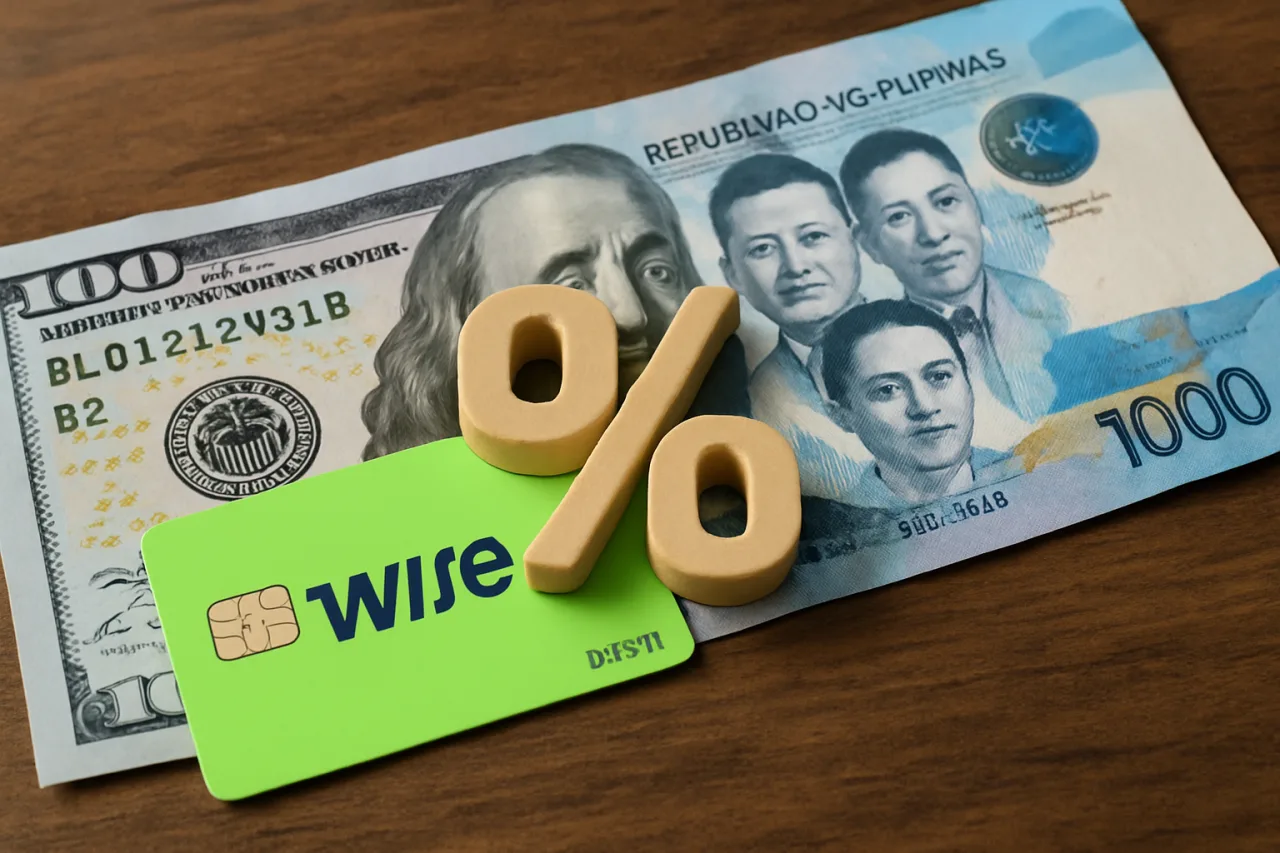
- 🏦 Banks hide 3% inside the exchange rate. On a $1,000 transfer, quoted “zero-fee” rates handed recipients ₱1,425–2,376 less than the mid-market rate — the markup is the fee, and it never appears on a receipt.
- ⚡ Wise USD to PHP transfers run on the real mid-market rate with one transparent fee: $3.50 + 0.90% on direct debit, 0.75% on wires — a $500 transfer paid from a Wise balance costs $3.01, and 74% of transfers arrive in under 20 seconds.
- 🧮 The tranche playbook: split the BER-season transfer, lock Wise’s 24-hour guaranteed rate before payday volatility, and fund the GCash IPO window from the conversion windfall — not from borrowed pesos.
- 🇵🇭 Honest edges: Wise wins on rate transparency and bank-account rails; GCash and cash-pickup still win on instant peso delivery — the guide tells you which rail fits which transfer.
The strongest dollar of the month deserves a better conversion than a bank counter, and the Wise USD to PHP route is how a remittance captures it: the mid-market rate — the same number you see on Google — with one fee printed in front of you, no markup buried in the rate, and money that usually lands in the Philippines in seconds. This week that discipline is worth real money, because the hawkish repricing tracked in World Investment Watch #001 strengthened the dollar across the board — and the Wise USD to PHP rail prices it honestly: Fed rate hike odds at 86% on CME FedWatch, surging Treasury yields, and a peso conversion window that will not stay open forever. This guide is the OFW playbook for that window — what the mid-market rate actually is, the arithmetic of the hidden 3%, the exact Wise USD to PHP fee table for 2026, and the tranche schedule that turns a strong-dollar month into a funded investment plan instead of a bigger grocery bill. One thing it will not do is pretend every transfer belongs on the same rail: when your family needs instant cash in a province without a bank, the fastest GCash or remittance-center path beats a cheap rate — the last section draws that line precisely.
Related: Scamcheck.ph Spots the Scam Before It Reaches Your Wallet
Related: Tabung Haji Cyberattack: The 5-Step Playbook That Protects Your Saving
Why This Month’s Wise USD to PHP Math Is Different
The rate itself is doing the work. The dollar climbed to 62.76 against the peso with a week’s range of 62.37 to 62.98 — the top of that range is the strongest conversion window OFW households have seen this quarter, and it exists because of one number: the market’s 86% implied odds of another Fed rate hike. Higher US rates pull global dollars toward dollar assets, the dollar strengthens, and the receiving end of every remittance — the peso amount your family actually gets — fattens. The mid-market rate at 62.76 turns $400 into ₱25,105 at the fair price; the same $400 at a typical bank’s marked-up rate of 60.50 lands as ₱24,200, and the ₱900 difference vanishes into the bank’s margin without ever appearing on a receipt. Multiply that gap by the average OFW household’s monthly transfer and by twelve months, and the “small” markup is a school year, a phone, or the GCash IPO application this column has been mapping all week.
WorldNgayon Analysis: The strong-dollar window is a windfall only for households who convert on purpose. A scheduled tranche inside the window — funded by the month’s salary, not by a loan — captures the rate; a panicked one-off conversion after a viral “peso collapsing” post usually catches the worst day of the week instead.
Bottom Line: This month the exchange rate is paying a bonus to anyone remitting — the only question is whether your rail takes a cut of it.
The Hidden 3% — How Bank Markups Eat the Transfer
Here is the arithmetic that banks hope you never run. Wise’s own comparison of a $1,000 bank transfer to the Philippines shows the mid-market rate delivering about ₱60,753 — while “zero-fee” provider quotes deliver ₱58,760, ₱58,691, or ₱57,809 after their own small fees. That is a gap of ₱1,425 to ₱2,376 on a single $1,000 transfer — 2.3% to 3.9% of the money — taken entirely inside the exchange rate where no receipt ever shows it. The mechanism is simple: the mid-market rate is the midpoint between the buy and sell prices on the interbank market, and it is the only fair conversion number in the world; everyone else quotes you a worse rate and keeps the difference. Banks also frequently charge a separate conversion fee on top, which is the double billing the industry prefers not to advertise. When you compare rails, always compare the final peso amount the recipient receives — never the headline fee — because a “free” transfer at 58.80 costs you more than a fee-charged transfer at the mid-market rate every single time.
| Sending $1,000 (bank-transfer rail) | Rate quoted | Fee shown | Family receives | vs mid-market |
|---|---|---|---|---|
| Mid-market benchmark | ~60.69 | — | ₱60,687 | — |
| Provider A (“no fee”) | 58.76 | ₱0 shown | ₱58,760 | −₱1,927 |
| Provider B (“no fee”) | 58.69 | ₱0 shown | ₱58,691 | −₱1,996 |
| Provider C | 58.10 | $4.99 | ₱57,809 | −₱2,878 |
| Wise | Mid-market | $8.26 shown | ₱60,754* | full rate |
*Wise’s displayed figure in its own comparison table — the fee is printed, the rate is the real one, and the comparison runs on bank-transfer rails where speed matters less than cost. The pattern holds across amounts: the markup silently scales with the transfer, which is why the biggest remittances — tuition month, BER-season builds, medical emergencies — are exactly the transfers where the hidden 3% does its worst damage.
Bottom Line: A “zero-fee” transfer is a transfer whose fee is hiding in the rate — always price the peso the family receives, never the fee the app shows.
What the Wise USD to PHP Fee Table Charges in 2026
The Wise USD to PHP pricing is public and unglamorous, which is the point. The January fee change set the structure: a flat $3.50 plus 0.90% for direct debit and debit-card funding, $3.50 plus 0.75% for wire transfers, and $3.50 plus 2.60% for credit cards — the card premium is why nobody should ever fund a remittance with a credit card. In practice: a $500 transfer by direct debit costs $8.00; the same $500 paid from a Wise balance costs $3.01, the cheapest route on the rail; a $1,000 wire costs about $11; and the $10,000 wire that once cost $100 now costs $78.50, because the percentage fee drops as amounts grow. Two operational details complete the picture: Wise locks the Wise USD to PHP quoted rate for 24 hours, which is precisely what a tranche scheduler wants in a volatile week, and the recipient receives pesos directly from Wise’s local Philippine bank account, which is why 74% of transfers arrive in under 20 seconds and 95% inside a day — speed varies by funding method, with account-balance transfers the fastest and cheapest of all.
| Transfer (USD → PHP) | Cheapest cost | Route |
|---|---|---|
| $100 | $4.40 | Direct debit |
| $500 | $3.01–$8.00 | Wise balance vs direct debit |
| $1,000 | ~$11.00 | Bank transfer |
| $10,000 | $78.50 | Wire |
| Any, by credit card | +2.60% | Avoid — the card premium erases the savings |
WorldNgayon Analysis: The fee table rewards one habit: keep a balance in Wise funded on payday, then send from the balance. The balance rail is the cheapest route on the platform, and it converts the strong-dollar decision into a two-tap action when the tranche alarm rings.
Bottom Line: Fund from the balance, send on the mid-market rate, lock the 24-hour guarantee — the whole optimization is three choices.
The OFW Conversion Playbook for the Strong-Dollar Window
Five moves, in order, built for a household budget rather than a trading desk. One — schedule the tranche, not the day. Split this quarter’s remittance into two or three tranches and convert each when the rate crosses your personal trigger — 62.50 is a reasonable line in the current range — instead of converting the whole amount on payday and accepting whatever the calendar gives. Two — fund the rail from salary, not from credit. The Wise balance funded from each paycheck is the instrument; a credit card “loan” to capture a rate is the fee table’s most expensive row working against you. Three — name the peso’s job before it lands. The strongest conversion of the year should fund the investment plan — the GCash IPO window, the PSEi tranche, the MP2 top-up — before it absorbs lifestyle drift (SSS members can verify contribution paths on the SSS portal); money converted strong and spent weak is a windfall nobody kept. Four — keep the small transfers on the instant rail. A $50 load for load-bearing family expenses belongs on GCash or the fastest rail your family uses; Wise’s economics reward larger transfers, and pretending otherwise costs time where time is the scarcer resource. Five — log every conversion. A notes-app line per transfer — date, rate, fee, peso received — turns next quarter’s comparison from guesswork into data, and it is the single habit that separates households who optimized their rail from households who merely changed apps once.
Bottom Line: Tranche the conversion, fund it honestly, name its job, respect the instant rail for small money, and log the result — five moves that beat any single “best app.”
When Wise Is the Wrong Rail — the Honest Edges
Three situations argue for something else, and the playbook is weaker if it pretends otherwise. Cash-in-hand emergencies: a family that needs physical pesos tonight in a town without a partner bank needs a cash-pickup network, and the premium is the price of the rail — Wise is not that rail. Instant GCash loads: small transfers where minutes matter ride the local instant rails cheaper and simpler, as the digital-economy watch side of this site covers for the crypto-curious. The unbanked recipient: Wise delivers to Philippine bank accounts and cards; a family member without one needs a different arrangement. Inside its lane — bank-to-bank transfers of $100 to $10,000 where the rate decides the outcome — the Wise USD to PHP mid-market discipline is why the platform processes the volumes it does, and why its own comparison table can afford to show competitors’ worse numbers in public. Verify the live rate on the Wise USD to PHP converter before any large transfer: the mid-market rate moves daily, the 62.76 quoted here is a September 27 snapshot, and the tranche trigger is yours to set, not this article’s.
WorldNgayon Analysis: No rail wins every transfer; the winning household is the one that knows which rail wins which job. Wise’s edge is structural — the rate itself — and rate-driven transfers are the majority of the money an OFW household moves.
Bottom Line: Use the rate machine for the rate’s job, the instant rails for the instant’s job, and never confuse a marketing fee with a real one.
Frequently Asked Questions
What is the Wise USD to PHP rate today?
Wise transfers at the mid-market rate — 62.76 as of September 27, 2026, with the week’s range running 62.37 to 62.98. The live rate moves constantly; Wise shows it before you commit and locks it for 24 hours once the transfer starts, which is why a scheduled tranche can wait for its number.
How much does Wise charge to send $1,000 to the Philippines?
Roughly $11 on the bank-transfer rail ($3.50 plus 0.75%), about $12.50 by direct debit at the current schedule, or as little as $3.01 for a $500 transfer funded from a Wise balance. Credit-card funding adds 2.60% and should be avoided entirely — the card premium erases the rate advantage.
Why do bank transfers give my family fewer pesos than the rate I see on Google?
Because banks embed a markup inside their quoted rate — typically 2–4% — while advertising “zero fees.” On a $1,000 transfer that markup is ₱1,400–2,900 your family never receives. Always compare the final peso amount, never the displayed fee.
Is Wise safe for OFW remittances?
Wise is a regulated electronic-money institution in its operating jurisdictions — full pricing is published on its fees and pricing page and pays out from local Philippine bank accounts, with the rate and fee displayed before you confirm. It is not a BSP-licensed remittance agent — for BSP-licensed local rails and instant GCash delivery, see our digital-economy watches; for bank-account transfers at the true rate, Wise’s regulation and transparency are the draw.
Should I send one big transfer or several small ones this month?
In a strong-dollar window, two to three tranches beat one lump sum: each tranche converts at a rate you chose on purpose, and a late-week dip lets the last tranche buy cheaper. Keep small instant loads on GCash, and put the tranche money — including the investment portion — on the mid-market rail.
Financial Disclaimer: This article is for general information and education, not personalized financial advice. Rates, fees, and speed figures reflect published provider pages as of September 27, 2026 and change continuously with the market. WorldNgayon.com is not a money-services business or investment adviser; verify live rates and terms on the provider’s page before sending money, and consult a licensed adviser for financial decisions.