The Plex2Shell flaw chain: the self-hoster checklist
Table of Contents
Key Takeaway
- Self-hoster alert with a deadline: QNAP issued a security notice on November 6, 2026 urging immediate updates of Plex Media Server to 1.43.3 (build 1.43.3.10861 or later) in the QNAP App Center, after user reports of compromised NAS devices.
- Four flaws, one chain: CVE-2026-96652, 96654, 96655, and 96656 are individually limited, but chained they let an unauthenticated remote attacker execute code with the privileges of the Plex Media Server process.
- Exploitation is real and running: a public proof of concept landed October 16, CISA added all four flaws to its Known Exploited Vulnerabilities catalog on October 21, and exposed unpatched servers have been used to run cryptocurrency miners and proxy malware.
- Updating is not always enough: if your Plex Media Server was reachable from the internet while running 1.43.2 or earlier, QNAP’s guidance says treat the device as potentially compromised: clean reinstall, compromise check, credential reset, then update.
- Not just QNAP: the same version threshold applies to Plex Media Server on Windows, macOS, Linux, and Docker. Every self-hoster running Plex needs the version check tonight, and the checklist below covers the whole sweep.
Attackers are breaking into network-attached storage through a media server app, and the fix takes five minutes, while the cleanup for anyone who waited takes a weekend.
The flaw chain is named Plex2Shell: four vulnerabilities in Plex Media Server 1.43.2 and earlier that QNAP formally warned about on November 6, 2026, after receiving reports from users whose NAS devices running Plex appeared compromised. Each flaw is limited on its own. Chained, they let an unauthenticated remote attacker run code with the privileges of the Plex Media Server process.
Plex has confirmed the vulnerabilities are being actively and widely exploited, and the record backs the urgency: a public proof of concept appeared October 16, and internet-facing unpatched servers have already been used to run cryptocurrency miners and proxy software, as Field Effect’s threat summary documents.
How the Plex2Shell Chain Works Inside Plex Media Server
The chain is the lesson, so the anatomy comes first.
The four flaws combine two server-side request forgery bugs (CVE-2026-96652 and CVE-2026-96655), a URL injection bug (CVE-2026-96654), and an arbitrary file write bug (CVE-2026-96656). Individually, none hands over a server. The chain abuses legitimate Plex functions to move from unauthenticated access to code execution, each step enabling the next until the final file write lands executable content inside the Plex Media Server process.
One caution note on ratings, because trackers disagree: Field Effect lists the request-forgery pair at 5.3, the URL injection at 6.9, and the file write at 8.6, while BeaconLab’s alert records 4.3, 4.3, 6.5, and 7.2 respectively. BeaconLab’s alert makes the point that matters more than any score: no single CVE here is an unauthenticated code-execution bug on its own, and none of them grants root. The chain is the risk. Averaging or dismissing the low scores is exactly the misread that leaves servers exposed.
The scope note matters just as much: the flaws live in the Plex Media Server application, not in QNAP’s operating system. QTS, QuTS hero, and other QNAP system software are not themselves affected, which is why the fix is an app update rather than a firmware update, and why the same version threshold governs Plex on every other platform.
The Timeline That Says Update Tonight
Every date in this sequence pushed the risk up, not down.
- October 16, 2026: a public proof of concept for the chain is published, and Plex confirms wide active exploitation began around that release.
- October 21, 2026: CISA adds all four CVEs to its Known Exploited Vulnerabilities catalog after exploitation is confirmed, the federal signal that patching these is an obligation, not a suggestion.
- October-November 2026: internet-facing unpatched servers get used to run cryptocurrency miners and proxy malware, turning media servers into someone else’s computing fleet.
- November 6, 2026: QNAP issues its security notice with the fixed build number and receives user reports of suspected compromises, and Plex’s advisory carries the CVE details and exploitation notes.
The fixed release is Plex Media Server 1.43.3, build 1.43.3.10861 or later, available in the QNAP App Center. Everything at 1.43.2 or earlier is affected, on the NAS and everywhere else.
Updating Your Plex Media Server on QNAP Tonight, Step by Step
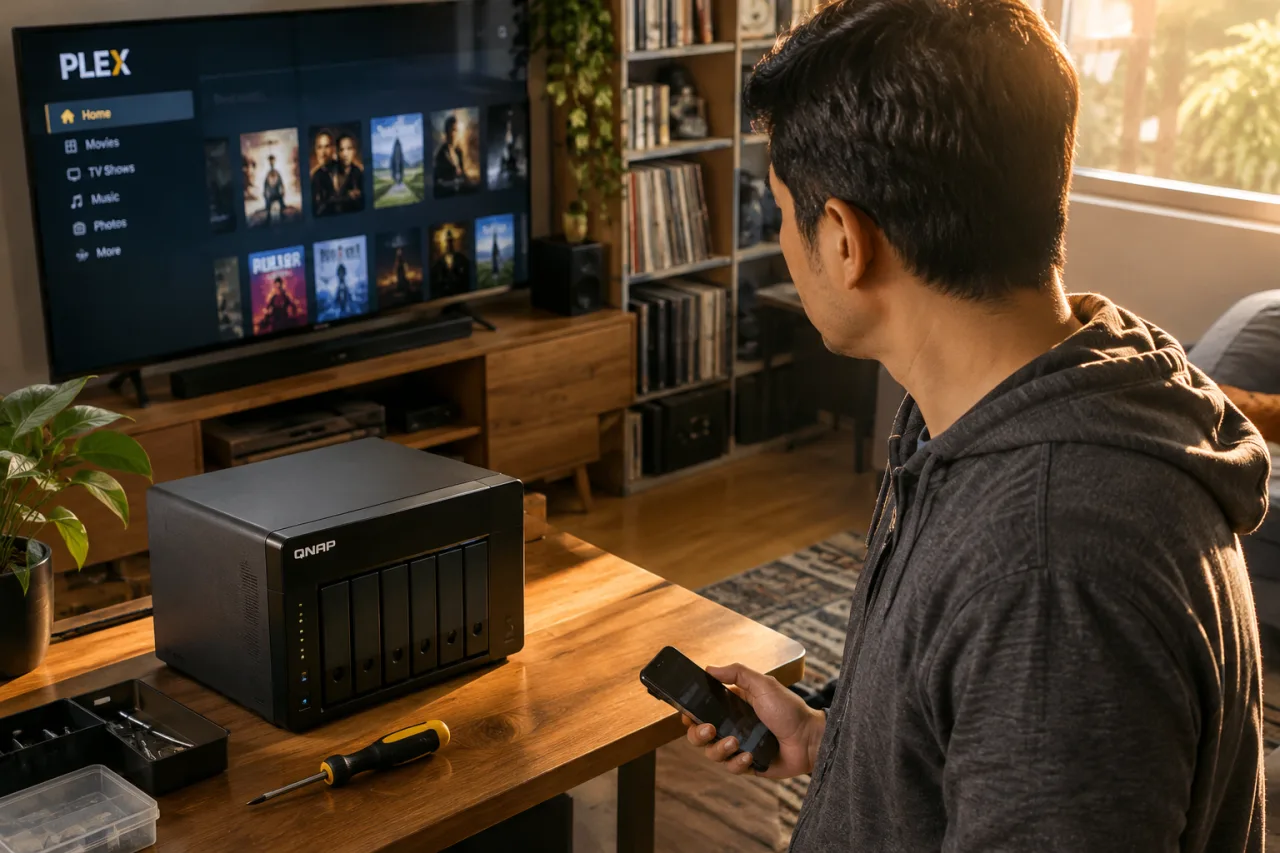
The QNAP route is five minutes when your device was never exposed. Do the version check first, because it decides which path you are on.
Step 1: check your version. Open App Center, find Plex Media Server, and read the version. Anything at 1.43.2 or below is affected. This one check splits the world into the fast path and the careful path.
Step 2: the fast path, if the server was never internet-reachable. Update Plex Media Server to 1.43.3.10861 or later straight from the App Center. Your QTS and QuTS hero systems need no other change, because the flaw lives in the app, not the OS.
Step 3: the careful path, if Plex was reachable from the internet on 1.43.2 or earlier. Updating alone is not enough here, because the exploitation window opened before your update. QNAP’s remediation guidance says to treat the NAS as potentially compromised and complete the full sequence: a clean reinstall of Plex from a fresh copy, a compromise check across the device, and a credential reset, before trusting the deployment again. The exploit runs code as the Plex process, so anything that process could touch is in scope.
Step 4: harden the exposure. If you ran Plex open to the internet by choice, decide whether it genuinely needs to be. A media server behind a VPN connection or a closed firewall rule has almost the same usefulness and almost none of the risk. Disable UPnP forwarding to the app, and remove any port-forward rule you set up and forgot. This step applies to every self-hosted service, not only Plex. The App Center also shows an app’s last-update date, which doubles as a dormancy meter: apps whose vendor stopped shipping updates inherit the next flaw wave by default.
Step 5: extend the check beyond QNAP. The identical version threshold governs Plex Media Server on Windows, macOS, Linux, Docker, and other NAS brands. If you run Plex anywhere else, the same 1.43.3.10861 floor applies, and the App Center name changes while the version check does not.
The Compromise Checklist for an Exposed Plex Media Server
For the careful path, work this list before declaring the device clean, because miners and proxies leave traces you can find.
- Look for the payload first: unfamiliar processes with high CPU use, especially around the clock, and cron jobs or startup entries you did not create. Cryptocurrency miners announce themselves through heat and clock cycles, proxy malware through odd outbound connection counts.
- Sweep the storage for oddities: unexpected files in media folders, binaries in download caches, and containers or packages that appeared without your action.
- Rotate every credential the device holds: NAS admin accounts, Plex account details, saved tokens and API keys in apps on the device, SSH keys, and any stored passwords in configuration files. Credential resets come after the clean reinstall in QNAP’s sequence, so the new keys never sit on a compromised disk.
- Read the logs you still have: inbound requests to the Plex port from unknown addresses carry the strongest evidence of the chain being used, and unusual outbound connections confirm payload activity.
- Check the wallet and bandwidth bills: proxy malware resells your connection, and miners spend your electricity, so unexplained usage spikes confirm the story and date the compromise window. Photograph or export that log evidence before the clean reinstall, because reimaging the disk erases the record the case file needs. Back up the media library files themselves only after you have scanned them, because the payload can hide inside renamed archives the scanner skipped. If the NAS also hosts photo archives or work documents, copy nothing until the scan is clean.
The broader habit protecting self-hosters is the leastprivilege review: what runs on your storage box that you did not explicitly choose, and what network reach does each service hold. Our 12-move small business cybersecurity checklist folds that review into the standing routine, and this incident is the month’s best argument for running it.
Why Chain Flaws Change the Patching Rule
The deepest lesson in Plex2Shell is how four “medium” ratings became one confirmed compromise tool.
Ratings describe flaws in isolation, and attackers work in combination. A request forgery that only redirects, a URL injection that only spoofs, a file write that only lands one file: each alone looks survivable, and together they are a remote shell. The patching rule that follows is simple and slightly expensive: when a vendor chain warning names your software, the decision stops being about scores and becomes about existence. If your version is below the fix line and the flaw set is in a KEV catalog, the update moves to today’s list, whatever the individual CVSS numbers say.
One piece of catalog context explains why the deadline is not negotiable: CISA’s Known Exploited Vulnerabilities catalog lists only flaws with confirmed real-world attacks, so a listing there is the government’s signal that patching cannot slip. Federal agencies face mandated patch deadlines for KEV entries, and private operators do well to borrow the same rule, because by the time software reaches that list, exploitation is not a forecast but an observation already underway.
While the app you came for is open anyway, run the one-minute inventory sweep on the rest of the device: other apps installed from the catalog, their last-update dates, and any of them reachable from the internet. NAS boxes accrete forgotten media tools over the years, and a five-minute version audit across all of them is the cheapest insurance this incident can buy.
The naming family is a hint worth keeping: Plex2Shell sits in the same naming tradition as the PHP2Shell flaws that made Europe’s sites go dark in October, where individually conditional bugs chained into unauthenticated code execution. The pattern keeps recurring because it reflects how attackers actually work, not how scanners score.
Third-party app stores deserve the same trust audit. The flaws here lived in a popular app installed from a vendor app catalog, which is the same trust surface as the WordPress plugin vulnerability that let strangers upload files to servers. Your NAS firmware updating on schedule protects the platform; the apps you install on it stay your responsibility, and our self-hosting reader should treat the app inventory with the same rigor as the OS.
If this intelligence helps you, you can add WorldNgayon as a preferred source on Google – free, one click, and it helps other Filipinos find the answers faster.
FAQ
What is Plex2Shell?
Plex2Shell is the name for four vulnerabilities in Plex Media Server 1.43.2 and earlier: CVE-2026-96652, CVE-2026-96654, CVE-2026-96655, and CVE-2026-96656. Each presents limited risk alone, but chained together they allow an unauthenticated remote attacker to execute arbitrary code with the privileges of the Plex Media Server process.
Which Plex Media Server version fixes the flaw chain?
Plex Media Server 1.43.3, build 1.43.3.10861 or later, contains the fix. On QNAP devices the fixed build is available in the QNAP App Center, and the same version floor applies to Plex Media Server on Windows, macOS, Linux, Docker, and other NAS platforms.
Are QNAP’s own systems affected by Plex2Shell?
No. The vulnerabilities reside in the third-party Plex Media Server application, and QNAP states that QTS, QuTS hero, and its other operating systems are not themselves affected. A QNAP NAS without Plex installed needs no action, and the fix ships as an app update rather than a firmware update.
Is Plex2Shell being actively exploited?
Yes. Plex confirms wide active exploitation beginning around the public proof of concept on October 16, 2026, and CISA added all four CVEs to its Known Exploited Vulnerabilities catalog on October 21. Internet-facing unpatched servers have been used to run cryptocurrency miners and proxy malware.
I updated Plex on my QNAP. Do I need anything else?
If your Plex Media Server was never reachable from the internet while running 1.43.2 or earlier, updating to 1.43.3.10861 or later completes your work. If it was internet-reachable during that period, updating alone is not enough: treat the NAS as potentially compromised and complete the clean reinstall, compromise check, and credential reset sequence in QNAP’s remediation guidance.
Do the individual CVSS scores make Plex2Shell low risk?
No, and this is the core lesson. Trackers rate the four flaws individually between roughly 4.3 and 5.3 for the request-forgery pair, 6.5 to 6.9 for the URL injection, and 7.2 to 8.6 for the arbitrary file write, but no single flaw grants code execution and the chain of all four does. Combined chains are how attackers work, and presence in CISA’s exploited catalog outrates any single score.
What signs show my NAS was compromised through Plex?
The confirmed payloads leave practical traces: unfamiliar processes with constant high CPU use, cron or startup entries you did not create, unexpected files and binaries in media folders, unexplained outbound connection volume, and usage spikes on bandwidth or electricity. Inbound requests to your Plex port from unknown addresses are the strongest evidence the chain itself was used.
- qnap.com/en/security-news/2026/qnap-security-notice-plex-media-server… — QNAP formally warned about on November 6, 2026
- fieldeffect.com/blog/active-exploitation-plex2shell-vulnerabilities — as Field Effect’s threat summary documents
- beaconlab.us/en/publication/alert-2026-146-active-exploitation-of-ple… — BeaconLab’s alert
- community.qnap.com/t/plex2shell-check-and-remediation-faq-for-qnap-na… — remediation guidance
- google.com/preferences/source?q=worldngayon.com — add WorldNgayon as a preferred source on Google
External sources linked in this article, in order of first mention. Spotted an error or a broken link? Tell us.
Cite this pagePublished Nov 10, 2026
Agron, E. (2026, November 10). Self-Hoster Alert: Plex2Shell Flaw Chain Hits QNAP and Plex Media Server. WorldNgayon. https://worldngayon.com/plex2shell-plex-media-server/
Agron, Edmon. “Self-Hoster Alert: Plex2Shell Flaw Chain Hits QNAP and Plex Media Server.” WorldNgayon, 10 Nov. 2026, worldngayon.com/plex2shell-plex-media-server/.
Agron, Edmon. “Self-Hoster Alert: Plex2Shell Flaw Chain Hits QNAP and Plex Media Server.” WorldNgayon, November 10, 2026. https://worldngayon.com/plex2shell-plex-media-server/.
Agron, E. (2026) ‘Self-Hoster Alert: Plex2Shell Flaw Chain Hits QNAP and Plex Media Server’, WorldNgayon, 10 November. Available at: https://worldngayon.com/plex2shell-plex-media-server/.
E. Agron, “Self-Hoster Alert: Plex2Shell Flaw Chain Hits QNAP and Plex Media Server,” WorldNgayon, Nov. 10, 2026. [Online]. Available: https://worldngayon.com/plex2shell-plex-media-server/
@online{agron2026plex2shellplex,
  author       = {Agron, Edmon},
  title        = {{Self-Hoster Alert: Plex2Shell Flaw Chain Hits QNAP and Plex Media Server}},
  year         = {2026},
  date         = {2026-11-10},
  organization = {WorldNgayon},
  url          = {https://worldngayon.com/plex2shell-plex-media-server/},
  urldate      = {}
}TY - ELEC AU - Agron, Edmon TI - Self-Hoster Alert: Plex2Shell Flaw Chain Hits QNAP and Plex Media Server T2 - WorldNgayon PY - 2026 DA - 2026/11/10/ UR - https://worldngayon.com/plex2shell-plex-media-server/ Y2 - ER -
Cite the version you read; the page may be updated. Zotero and Mendeley can also import this page directly.