Table of Contents
Key Takeaway
- 🏦 The OFW personal loan’s first honest number — BDO’s own rate page prices the “Kabayan” unsecured loan at 35.66%-41.71% effective per annum despite its “2% per month” add-on label — the add-on class ≠ the true cost; the desk’s honest arithmetic: a ₱50,000 Kabayan-12-month loan repays ≈₱62,000. The BDO regular class (1.25% add-on) runs 17%-26% effective — the same bank, the same product family, a 24-point honest gap.
- 📋 The BPI OFW personal loan route exists and is documented on the bank’s own pages: the agency-hired class runs the POEA-signed contract; the direct-hire class runs 3 months of remittance proof + the POEA/OEC papers + the consularized COE — and the signing rule: the approval requires physical presence at a BPI branch, valid for one month from approval.
- 🪖 The BDO OFW personal loan eligibility, verbatim-class: 25-65 years at maturity, the Filipino or former-Filipino class (dual citizenship class included), 2 years continuous employment contract, the ₱20,000-gross-monthly (or US$-equivalent) line, and a landline in either residence or the employment location.
- ⚖️ The amount’s honest math: BPI’s class runs ₱20,000-₱3,000,000 (up to 3× the gross monthly income), 12-36 months, the ₱1,500 processing fee, the DST-class above ₱250,000, and a 5% late-penalty class — the add-on rates’ honest table runs in the piece.
- 🛡️ The discipline law before any signature: the loan’s monthly class belongs IN the family budget’s envelope (the desk’s split-framework) — an OFW loan that forces the savings envelope to feed amortization is the wrong loan; the secured-class route and the credit-classes price honest alternatives first.
The OFW personal loan market runs on two honest mechanics most guides blur: the add-on rate that hides the effective rate, and the OFW-route paperwork that banks document in their own words. This guide runs the verified tables: the BPI OFW-route classes (the agency and the direct-hire routes, the one-month signing window), the BDO Kabayan classes (the eligibility rows, the true-rate table), the add-on-vs-effective arithmetic worked at honest amounts, the secured-route’s honest alternative, and the discipline law — every figure from the banks’ own pages or the dated comparison desks, nothing invented.
The OFW Personal Loan BPI Route: the Bank’s Own Words
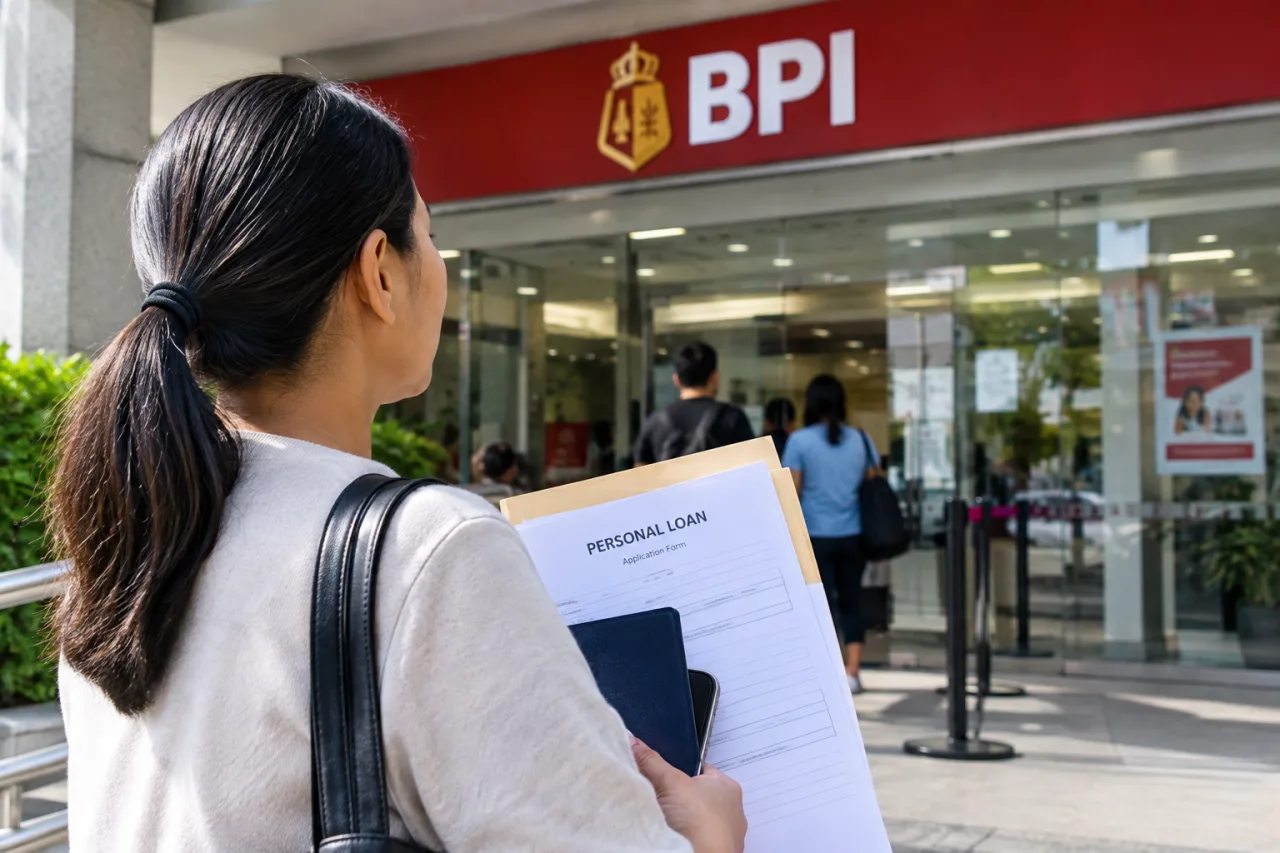
The verified classes, from the BPI’s own FAQ page and the dated comparison desk: who qualifies: “Personal Loan is currently only available to Filipino citizens who are residing in the Philippines” — the honest OFW-route class the bank runs beside it: the OFW applies online while abroad, but “once the loan is approved, we require clients to be physically present to sign the loan documents in any BPI branch” — and the honest clock: “the approval of your loan shall only be valid for one month from the date of approval.” The OFW-document classes, the bank’s own lists: the agency-hired: the most recent unexpired signed POEA contract with the boarding date; the direct-hire: the most recent three months’ proof of remittance, the POEA Validated Information Sheet or the OEC, and the latest employment contract — with the consularized COE where the remitter is a permanent resident. The loan’s own classes: ₱20,000-₱3,000,000 (up to 3× the gross monthly income), 12-36 months, ~1.20% monthly add-on, the ACR ~25.03%-28.67% effective, the ₱1,500 processing fee, the DST-class above ₱250,000, the ~5% late-penalty — and the auto-debit facility (the payments’ own rail the deployed member runs from the remittance account).
The OFW Personal Loan BDO Class: the Kabayan Rows
The verified classes, from the BDO’s own product page: the OFW class (the Kabayan family): 25 years old at application, up to 65 at loan maturity; the Filipino citizen or the former Filipinos with or without dual citizenship; at least 2 years continuous employment contract (the seaman-class rows run the 3-year line); the gross monthly income ₱20,000 or its US$ equivalent; a landline in either the local or the foreign residence or the employment location — and the good-credit-history line the honest reader prices before the application runs.
OFW Personal Loan True Rates: Add-On vs Effective
The piece’s honest spine, priced from the BDO’s own interest-rate page: the BDO regular class: the 1.25%-monthly add-on runs the 17.06-26.76% effective per the tenor rows; the Kabayan unsecured class: the 2%-monthly add-on runs the 35.66-41.71% effective rows — the reason: the add-on class prices interest on the ORIGINAL principal across the whole tenor while the outstanding runs down; the effective-rate class prices the TRUE cost of the money actually held. The worked honest example: a ₱100,000 Kabayan loan at the 12-month class runs 2% × 100,000 × 12 = ₱24,000 interest — the repayment ₱124,000, the monthly ₱10,333, while the TRUE annual cost ≈ 41.71% (the money held averages half the principal). The honest translation for the OFW planner: the Kabayan-unsecured class costs roughly double the regular class’s effective rate for the same paper; the secured-class route prices its rate rows honestly lower (the BDO’s secured rows run their own cheaper class) — and the honest rule: never compare add-ons across products; compare EFFECTIVE rates, and the desk’s own table does.
The Honest Alternatives Before an Unsecured Signature
- the secured route for an OFW personal loan: the deposit-secured class (the BDO’s secured Kabayan rows) prices the effective rate honestly lower — the honest trade: the collateral class (the deposit’s own lock); the desk’s honest framing: a member with savings that would feed an emergency-month often prices the secured class cheaper than the unsecured’s 2% add-on.
- the credit-card class: the BPI/BDO card classes’ balance-transfer rows sometimes price below the unsecured-effective class — the honest comparison runs the same table’s own rates; the desk’s credit-card guide carries the class.
- the emergency-fund class: the honest first alternative is always the fund itself (the desk’s emergency-fund guide) — the loan that would have been unnecessary had the envelope existed; the honest budget arithmetic prices the prevention before the borrowing.
- the family-arrangement class: the informal route prices differently — the honest note: no rate class beats the family’s own terms when the trust holds; the honest risks run elsewhere (the relationship classes) and the desk prices them honestly, not morally.
The Auto-Debit and the Payment Rails From Abroad
- the auto-debit class: the BPI’s own facility (the payments’ online class) — the honest reason it matters abroad: the missed-date class costs the 5% penalty rows; the auto-debit’s own discipline prices the calendar honestly.
- the remittance-account interplay: the loan’s payments run the PH-side account — the funding rides the corridor rails (the desk’s corridor guides); the honest sizing: the amortization’s monthly class belongs inside the family-budget’s boundaries (the desk’s split guide) — the envelope that feeds a loan’s amortization must be named in the split, not discovered later.
- the signing-window class: the one-month validity rule the BPI prints — the honest trip-planning: the loan-application runs beside the home-leave’s own calendar; the desk’s honest note: approvals that expire mid-deployment refund nothing and re-run the papers.
Why the Add-On Rate Exists: a Short Honest History
The honest history behind the add-on class: the Philippine consumer-lending market priced its loans in the monthly add-on for decades because the class reads simple — “2% monthly” feels small — and the add-on’s own arithmetic (interest computed on the full principal, spread flat across the tenor) is the class banks inherited from the bookkeeping era before the effective-rate disclosures became the regulator’s own requirement. The BSP/SEC disclosure classes forced the ACR/EIR lines onto the pages (the banks’ own tables now print them — this piece’s rows come from those own tables), but the MARKETING language still leads with the add-on because the number is smaller. The honest lesson the history teaches: the disclosure rules moved the numbers onto the pages; they did not move them into the conversations — which is why the OFW’s one-table comparison (this piece’s) exists: read the effective row, ignore the add-on row, and the class gap (the 41%-vs-17% family) prices itself honestly in five seconds of pencil arithmetic.
The OFW Personal Loan Worked Table: Three Amounts, All Classes
The piece’s honest worked rows, computed on the banks’ own rate classes: ₱100,000 at the Kabayan-12-month class (2% add-on): the interest = 2% × 100,000 × 12 = ₱24,000; the repayment = ₱124,000; the monthly = ₱10,333; the effective class = ≈41.71%. ₱100,000 at the BDO-regular-24-month class (1.25% add-on): the interest = 1.25% × 100,000 × 24 = ₱30,000; the repayment = ₱130,000; the monthly = ₱5,417; the effective class = ≈26.58% — the honest 24-month lesson: the longer class cuts the monthly class nearly in half and the effective rate stays lower than the Kabayan’s — the same bank, the honest comparison that the add-on label hides. ₱300,000 at the BPI-36-month class (the ACR ~25.98-28.67%-family): the monthly runs the comparison desk’s own amortization arithmetic; the honest class: the DST (75% of 1% = ₱2,250) rides above-250K classes — the fee-stack’s honest line the planners miss. The desk’s honest close: every row here is arithmetic on the banks’ OWN published classes — the OFW personal loan’s honest comparison is five minutes of pencil math against the bank’s own rate page, and the piece just ran every row of it.
What Would Change This Reading: the Invalidation Ledger
- A rate-page move: the effective-ro rows re-price with each bank cycle — the banks’ own rate pages are the re-verify point.
- The OFW-route classes: the document-classes and the signing-rule — the banks’ own FAQ pages re-verify at each cycle.
- The loan-amount classes: the ₱20K-₱3M class and the 3×-rule — the product-class moves re-price the arithmetic.
- The penalty classes: the 5%-late and the DST rows ride the regulator’s own schedules.
What the Evidence Supports, by Reader Situation
Education desk, not an advisory service — decision inputs, never instructions.
- If the emergency is real and the fund is thin: the honest table first: the secured class vs the regular class vs the Kabayan’s 41% — the effective-rate comparison is the piece’s only strong rule; the desk computes.
- If the home-leave is inside two months: the signing-window’s honest arithmetic: apply late enough for the approval to survive into the leave’s class — the one-month rule prices the calendar.
- If the plan is debt for an asset (the sari-sari, the tuition): the honest honest: the asset’s own return prices the interest honestly; the desk’s ladder pieces carry the business-classes and the education-classes’ own economics beside.
FAQ
Can an OFW apply for a personal loan in the Philippines?
Yes — the OFW personal loan runs through the banks’ OFW-route classes: the BPI’s class runs the online application abroad with the physical signing at a branch (the approval valid one month), and the agency-hire class needs the POEA-signed contract while direct-hires run the 3-month remittance proof and the OEC-class papers.
What documents does an OFW personal loan need?
The banks’ own lists: the POEA contract or the OEC/POEA-validated sheet (the BPI direct-hire classes), the 3-month remittance proof, the consularized COE where applicable, the ID classes, and the income’s own classes (the ₱20,000-gross monthly or the US$-equivalent at BDO).
What is the true interest rate on an OFW loan?
The effective rate — never the add-on: the BDO regular class runs 17-26% effective on its 1.25%-add-on rows; the Kabayan unsecured runs 35.66-41.71% effective on the 2%-add-on rows; the BPI class runs ~25-28.67% ACR — compare effective rates only.
How much can an OFW borrow?
The classes: BPI runs ₱20,000-₱3,000,000 (up to 3× the gross monthly income) at 12-36 months; BDO’s class prices the OFW minimum at ₱20,000-gross-monthly income with the 25-65 age window and the 2-year contract-class.
Is the cheaper-looking 2%-per-month Kabayan loan a good deal?
The honest answer: 2% add-on ≈ 41.71% effective at the 12-month class — the label’s honesty lives in the add-on class’s own math (interest on the original principal); the same bank’s regular class runs the 17-26% effective family — the desk’s honest comparison runs the effective class, always.
Do I need to fly home to sign my loan?
The BPI class: physical presence at a branch for the signing, with the approval valid one month — the honest planning: the application runs beside the home-leave’s calendar; the BDO-class verifies its own route at application month.
Financial Disclaimer
This article is for general information and education only. It is not financial, investment, legal or tax advice, and it does not recommend any loan, bank or course of action. Rates, requirements, penalties and route classes change by institution without notice; every figure was verified against the banks’ own pages and the cited dated comparison desks as of November 2026 and must be re-confirmed with the bank itself before any application or signature. WorldNgayon is not affiliated with any institution named; no content on this site should be acted upon without independent verification and, where appropriate, advice from licensed professionals.
- bpi.com.ph/personal/loans/personal-loan/new-applicants-faqs — the BPI’s own FAQ page
- moneymax.ph/personal-loan/partners/bpi — the dated comparison desk
- bdo.com.ph/personal/loans/personal-loan — the BDO’s own product page
- bdo.com.ph/personal/loans/personal-loan/interest-rate — the BDO’s own interest-rate page
External sources linked in this article, in order of first mention. Spotted an error or a broken link? Tell us.
Cite this pagePublished Nov 2, 2026
Agron, E. (2026, November 2). OFW Personal Loan 2026: the Bank Routes, the True Interest Rates and the Signing Rules. WorldNgayon. https://worldngayon.com/ofw-personal-loan-guide/
Agron, Edmon. “OFW Personal Loan 2026: the Bank Routes, the True Interest Rates and the Signing Rules.” WorldNgayon, 2 Nov. 2026, worldngayon.com/ofw-personal-loan-guide/.
Agron, Edmon. “OFW Personal Loan 2026: the Bank Routes, the True Interest Rates and the Signing Rules.” WorldNgayon, November 2, 2026. https://worldngayon.com/ofw-personal-loan-guide/.
Agron, E. (2026) ‘OFW Personal Loan 2026: the Bank Routes, the True Interest Rates and the Signing Rules’, WorldNgayon, 2 November. Available at: https://worldngayon.com/ofw-personal-loan-guide/.
E. Agron, “OFW Personal Loan 2026: the Bank Routes, the True Interest Rates and the Signing Rules,” WorldNgayon, Nov. 2, 2026. [Online]. Available: https://worldngayon.com/ofw-personal-loan-guide/
@online{agron2026ofwpersonal,
  author       = {Agron, Edmon},
  title        = {{OFW Personal Loan 2026: the Bank Routes, the True Interest Rates and the Signing Rules}},
  year         = {2026},
  date         = {2026-11-02},
  organization = {WorldNgayon},
  url          = {https://worldngayon.com/ofw-personal-loan-guide/},
  urldate      = {}
}TY - ELEC AU - Agron, Edmon TI - OFW Personal Loan 2026: the Bank Routes, the True Interest Rates and the Signing Rules T2 - WorldNgayon PY - 2026 DA - 2026/11/02/ UR - https://worldngayon.com/ofw-personal-loan-guide/ Y2 - ER -
Cite the version you read; the page may be updated. Zotero and Mendeley can also import this page directly.