Table of Contents
Key Takeaway
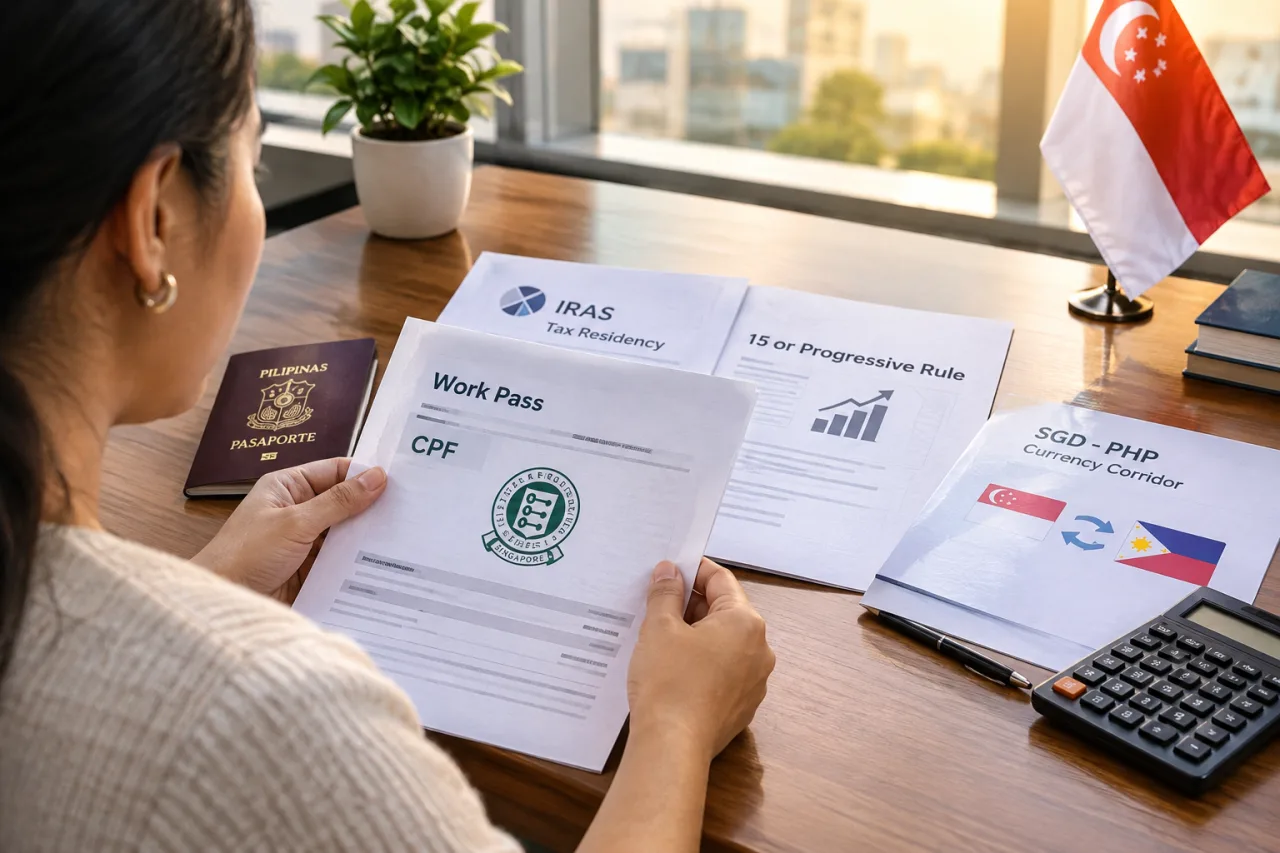
- 🏦 The CPF gap — Filipinos in Singapore face their own verified spine: “Foreign employees (EP, S-Pass, work-permit holders) are not covered by CPF” — the Singapore retirement system locals run (the 17% employer + 20% employee classes on up to SGD 6,800/month of ordinary wages) simply excludes the Filipino pass-holder; the honest consequence: the retirement accumulation is entirely the worker’s own rails — the SSS-voluntary, the ladders, the PERA class.
- 🧾 The tax classes (IRAS rules, verified 2026): 183+ days = tax resident; a work pass valid 12+ months grants resident status regardless of days; the ≤60-day class (non-director/professional) = employment income exempt; the non-resident pays 15% flat OR progressive — whichever is higher (the progressive overtakes past 15% around the S$369K-class).
- 💸 The worked honest example: the S$85,000 salary held 90 days: the non-resident tax = S$12,750 (15% flat) vs the resident’s ≈S$3,900 — the same days cost S$8,850 more on the wrong side of the residency line; the desk’s honest arithmetic: the pass’s own validity often decides the year’s class better than the days do.
- 🚫 The non-resident pays NO reliefs: no earned-income relief, no parent/child classes, no NSman/SRS deductions — the 15%-or-progressive comparison runs on gross income minus the employment-expense class — the honest planning class most newcomer guides skip.
- 💱 The money’s journey home: the SGD→PHP corridor runs the desk’s own corridor-method (the “recipient gets” test — the desk’s corridor guides); the honest SGD-class: Singapore’s send-sizes run high (the wages class) so 0.1% of margin = real pesos monthly.
The Filipinos in Singapore story runs the region’s highest-wage corridor — and its money-arithmetic hides one verified truth most newcomer guides bury: the CPF retirement system that carries Singaporean workers does NOT cover the foreign pass-holders, which makes every Filipino’s Singapore year a self-architected retirement year. This guide is the verified walkthrough: the CPF-gap’s own class, the IRAS tax residency rules (the 183 days, the 12-month pass, the 60-day exemption, the 15%-flat-or-progressive), the worked honest example, the reliefs’ honest absence, the SGD-PHP corridor’s rails, and the honest retirement-geography (the SSS-voluntary classes, the ladders, the PERA class) — every rule anchored to the IRAS-class sources and the dated payroll desks.
Filipinos in Singapore: the CPF Gap — What Locals Get and We Don’t
The verified structure (the dated payroll desk, the team.global 2026 guide): the Singaporean and PR workers run the Central Provident Fund — the 17% employer + 20% employee classes on ordinary wages up to SGD 6,800/month — the forced-retirement machine that builds their housing, medical and retirement accounts. “Foreign employees (EP, S-Pass, work permit holders) are not covered by CPF” — the pass-holding Filipino runs NO CPF class. The honest consequences, stated plainly: (1) every peso of retirement accumulation in the Singapore years must run through the worker’s OWN rails (the SSS-voluntary classes — the desk’s contributions guide), the ladders (the MP2, the TD-classes, the PERA account), and the investments; (2) the take-home’s honest arithmetic RUNS HIGHER — no 20% employee-class deduction — but the honest trap sits there: the take-home looks like savings and spends like salary unless the ladders carry it; (3) the employer-side’s own “17%” runs to the locals’ CPF, not to the foreign worker’s pocket — don’t let any offer-conversation price it as your savings.
Filipinos in Singapore: the IRAS Residency Classes That Decide the Tax Year
The verified classes (the IRAS-rules tax desk, the piloto 2026 guide): 183+ days in Singapore = tax resident (the year’s income runs the progressive rates 0-24% with the resident-relief classes); a work pass valid 12+ months = automatic resident class, regardless of days present (the honest class that catches the frequent-flyer deployments: the PASS decides, not the stamps); ≤60 days (the non-director/professional class) = employment income exempt (the short-contract class; the director/entertainer/professional classes never ride it); everything between = the non-resident class: 15% flat or the progressive classes — IRAS applies the HIGHER (the honest threshold: the progressive overtakes 15% past ≈S$369,286 taxable — most workers stay under it and pay exactly 15%). The reliefs’ honest absence: the non-resident class runs NO personal reliefs (no earned-income, no parent/child, no NSman/SRS) — the comparison’s honest arithmetic runs gross-minus-employment-expenses, and the desk’s own worked row prices it exactly.
Filipinos in Singapore: the Same Salary, Two Residency Classes
The S$85,000 deployment-year, run honestly at both classes: the non-resident class (90 days present): 15% flat = S$12,750 (the no-reliefs class; the progressive’s comparison runs lower so 15% binds); the resident class (the 12-month pass or the 183 days): the progressive rates with the standard reliefs ≈ S$3,900 — the same work, S$8,850 apart, decided by the pass’s own validity and the days’ class. The desk’s honest planning-class: the contract’s DURATION field is a tax-decision in Singapore — a 12-month-valid pass books the resident class even on split deployments; a series of short passes books non-resident years at 15% — the honest arithmetic runs BEFORE the signature, and the desk computes; the individual’s own year re-verifies at the IRAS-class tables.
Filipinos in Singapore: the Money’s Journey Home via the SGD Corridor
- The send’s rails: the SGD→PHP corridor runs the digital rails (the Wise-class, the bank-transfers, the wallets) — the desk’s “recipient gets” test prices the honest lane (the corridor guide); the honest SGD-class note: the send-sizes run high, so the margin classes (0.1-2%) price bigger pesos — the one-evening corridor check saves months.
- The retirement-geography plan: no CPF means the honest ladder’s design: the SSS-voluntary contributions (the floor’s own pension-class — the desk’s pension guide), the MP2’s dividend layer, the TD/PERA classes, and the capital ladder — the desk’s ₱1M blueprint prices the stack; the honest rule: the CPF-gap year is the ladder’s most important year because nothing else compounds it.
- the housing-cost honesty: the Singapore rents run the corridor’s biggest cost class — the shared-vs-solo arithmetic prices the savings-rate before the send-size does; the desk’s honest framing: the SG-salary’s own advantage materializes only after rent, and the family-budget conversation (the desk’s split guide) starts there.
Why Filipinos in Singapore Run This Corridor
The honest context the desks carry: Singapore runs the region’s highest-wage worker market, and the Filipino worker classes there span the domestic-work class to the specialized-professional class (the EP’s fields); the handbook-class materials (the newly-arrived workers’ own settlement guides) exist because the arrival’s honest walls are real — the rent classes, the pass-rules’ classes, and the CPF-gap the piece carries. The corridor’s own scale (the remittance flows’ classes) prices the SGD lane among the biggest in the region; the honest desk’s framing: Filipinos in Singapore run the corridor where the wage’s own class makes every percentage-point honest — the corridor’s own class decides more pesos here than in most deployment classes; a 1% corridor error prices more pesos monthly than the class below it; the ladder’s own design (the CPF-gap class) runs hardest here, because the Singapore year’s own economics reward the disciplined rail-building more than any other deployment class. Filipinos in Singapore who skip the ladders in year one often spend year three rebuilding what the class gap quietly ate.
The Settlement Questions Filipinos in Singapore Ask First
The handbook-class topics, answered at the desk’s honest level: the bank account — the pass’s own papers open the account classes (the foreigner-verification runs the pass + the employer-letter class); the account doubles as the corridor’s funding rail. the SIM: the passport + the pass run the registration class (the prepaid-to-postpaid upgrades run the pass’s validity class). the transport: the EZ-Link/NETS-class cards ride the account’s rails; the transport’s cost-class runs low. the housing: the shared-room classes price the arrival’s own wall — the desk’s honest framing: Filipinos in Singapore run the rent class FIRST because its own class decides the savings-rate more than any other line; the shared-arithmetic honestly prices the CPF-gap’s own compensation. the etiquette-class: the handbook’s own lines (the MRT’s quiet-class, the hawker-centres’ own rows, the apartment rules) — the settlement’s own social rails; the desk’s honest note: Filipinos in Singapore run into the class where politeness is compliance — the quiet MRT, the no-eating rules — and the honest worker learns them in week one, because the fines’ own classes are real. the honest work-life row: the overtime classes (the pass-class’s own entitlements run the MOM rules — the desk’s honest framing: Filipinos in Singapore learn early that the law’s classes protect the pass-holder differently by pass-type; the MOM’s own pages carry each class) — the honest read at contract-signing prices the schedule-class and the entitlement’s own rows before the salary’s number convinces anyone. the community-class: the Filipino associations and the weekend-church classes run the social layer — the honest rails the new-arrival’s first months ride (the desk’s framing: the community is infrastructure, not entertainment; the information that saves a class usually arrives through it). The honest desk’s closing note on settlement: Filipinos in Singapore build their rails in this order — the bank, the rent, the corridor, the ladders — and the workers who reversed it (the sends before the account, the plans before the papers) paid in delays and margins what the order saves in a single honest week.
What Would Change This Reading: the Invalidation Ledger
- An IRAS-class change: the residency thresholds and the 15%/progressive classes — the IRAS rules re-print; each move re-prices the piece’s rows.
- The CPF classes: the wage-cap and the rates move with the CPF Act’s schedules — the locals’ class; the foreign-class changes would be the honest shock the ledger watches.
- The corridor’s margins: the SGD-lane fees re-price monthly — the desk’s own method re-runs.
- The pass classes: the MOM’s own pass rules (the durations, the validity classes) — the MOM’s pages carry them; the tax classes follow.
What the Evidence Supports, by Reader Situation
Education desk, not an advisory service — decision inputs, never instructions.
- If Singapore’s offer is on the table: the honest read: the pass’s validity class + the rent class + the CPF-gap — the three decide the year’s honest math; the desk’s guides carry each layer.
- If you’re mid-deployment (the SG-years): the CPF-gap’s honest consequence: the retirement rails run YOUR class — the voluntary-SSS decision tonight, the ladder’s schedule next; the desk’s pieces carry them.
- If the year runs split (short passes): the 15%-flat class reads — the honest arithmetic prices the residency’s own threshold honestly before the family-budget conversation runs.
FAQ
Do Filipinos in Singapore pay CPF?
No — the verified class: foreign employees (EP, S-Pass, work-permit holders) aren’t covered by CPF; the locals run the 17+20% classes. The honest consequence: the retirement accumulation runs the worker’s own rails — the SSS-voluntary, the ladders, the PERA class.
How is income tax computed for Filipinos in Singapore?
By the residency class: 183+ days or the 12-month pass = the resident rates (0-24% progressive with reliefs); the ≤60-day short class = exempt (non-professional classes); otherwise the 15% flat-or-progressive, higher applies — the non-resident runs no reliefs.
Is the 60-day rule available to a Filipino professional?
The exemption’s own class explicitly excludes the directors, the public entertainers and the professional classes; the honest verification: the individual’s own class reads the IRAS rules at the year’s filing — the desk computes, the IRAS decides.
How much tax does an S$85,000 Singapore year pay?
The worked honest rows: the non-resident class pays S$12,750 (15% flat); the resident class with reliefs ≈ S$3,900 — the pass’s validity and the days’ class decide which line applies.
What should Filipinos in Singapore do about retirement?
The honest ladder, no advice: the SSS-voluntary contributions keep the pension floor alive; the MP2/WISP and the PERA classes run the accumulation; the ₱1M ladder prices the capital class — the CPF-gap means the design is the worker’s own; the desk’s pieces carry each rail.
How do I send money home from Singapore?
The corridor’s “recipient gets” test: the digital rails (the Wise-class, the banks, the wallets) price the SGD→PHP lanes — the honest one-evening check of the fees and margins runs before the first send; the desk’s guide carries the method.
Financial Disclaimer
This article is for general information and education only. It is not financial, investment, legal or tax advice, and it does not recommend any tax position or course of action. Residency rules, CPF classes, tax rates and corridor margins change by instrument without notice; every figure was verified against the IRAS-class sources and the cited dated desks as of November 2026 and must be re-confirmed with IRAS, MOM and your own payroll desk before any decision. WorldNgayon is not affiliated with any institution named; no content on this site should be acted upon without independent verification and, where appropriate, advice from licensed professionals.
- accessfinancial.com/singapore-payroll-guide-2026 — the dated payroll desk
- teamed.global/country-hiring-guides/singapore/tax-and-payroll — the team.global 2026 guide
- sgfinancecalculators.com/tax/non-resident-tax-calculator — the IRAS-rules tax desk
- pilotoasia.com/guide/personal-income-tax-singapore — the piloto 2026 guide
External sources linked in this article, in order of first mention. Spotted an error or a broken link? Tell us.
Cite this pagePublished Nov 2, 2026
Agron, E. (2026, November 2). Filipinos in Singapore 2026: Work Passes, the CPF Gap, Taxes and the SGD-PHP Corridor. WorldNgayon. https://worldngayon.com/filipinos-in-singapore-guide/
Agron, Edmon. “Filipinos in Singapore 2026: Work Passes, the CPF Gap, Taxes and the SGD-PHP Corridor.” WorldNgayon, 2 Nov. 2026, worldngayon.com/filipinos-in-singapore-guide/.
Agron, Edmon. “Filipinos in Singapore 2026: Work Passes, the CPF Gap, Taxes and the SGD-PHP Corridor.” WorldNgayon, November 2, 2026. https://worldngayon.com/filipinos-in-singapore-guide/.
Agron, E. (2026) ‘Filipinos in Singapore 2026: Work Passes, the CPF Gap, Taxes and the SGD-PHP Corridor’, WorldNgayon, 2 November. Available at: https://worldngayon.com/filipinos-in-singapore-guide/.
E. Agron, “Filipinos in Singapore 2026: Work Passes, the CPF Gap, Taxes and the SGD-PHP Corridor,” WorldNgayon, Nov. 2, 2026. [Online]. Available: https://worldngayon.com/filipinos-in-singapore-guide/
@online{agron2026filipinosin,
  author       = {Agron, Edmon},
  title        = {{Filipinos in Singapore 2026: Work Passes, the CPF Gap, Taxes and the SGD-PHP Corridor}},
  year         = {2026},
  date         = {2026-11-02},
  organization = {WorldNgayon},
  url          = {https://worldngayon.com/filipinos-in-singapore-guide/},
  urldate      = {}
}TY - ELEC AU - Agron, Edmon TI - Filipinos in Singapore 2026: Work Passes, the CPF Gap, Taxes and the SGD-PHP Corridor T2 - WorldNgayon PY - 2026 DA - 2026/11/02/ UR - https://worldngayon.com/filipinos-in-singapore-guide/ Y2 - ER -
Cite the version you read; the page may be updated. Zotero and Mendeley can also import this page directly.