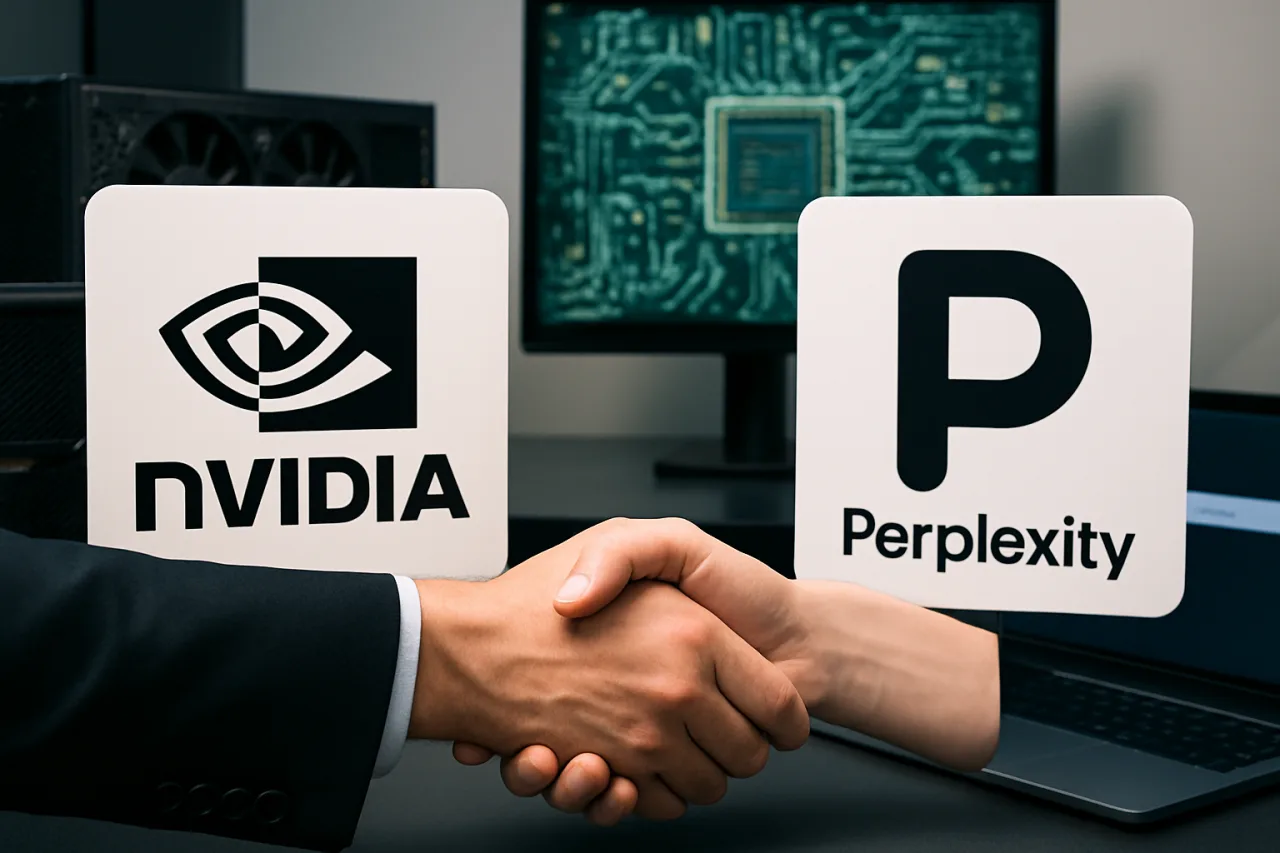
Nvidia Perplexity talks are the most revealing business story of the week: the company that sells nearly every chip the AI industry runs on is reportedly negotiating a stake in the company millions of people now use instead of Google. The Information reported on August 23, 2026 — and Reuters confirmed — that Nvidia is in discussions to invest in Perplexity as part of an equity round that would value the AI answer engine at more than $30 billion, a potential jump of over 50 percent from the roughly $20 billion valuation Perplexity carried into its previous financing a year earlier. The round under discussion is reportedly worth several billion dollars. Look past the headline numbers and the deal, if it closes, answers a harder question that will shape the next decade of technology work: what happens to the web — and to everyone who earns a living from what gets published on it — when the shovel seller starts buying stakes in the people replacing the search engine.
Table of Contents
Key Takeaway
- 💰 The deal: Nvidia is reportedly in talks to invest in Perplexity at a valuation above $30 billion — a jump of more than 50 percent from its roughly $20 billion valuation at its previous financing, per The Information on August 23 and Reuters.
- 🔁 Why it’s revealing: Nvidia has built a pattern of investing in AI companies that then buy Nvidia chips — a circular money machine that locks in GPU demand and extends the chipmaker’s reach from the data center into the application layer.
- 📈 Perplexity’s numbers: The AI answer engine’s annual recurring revenue climbed from about $100 million in March 2025 to $200 million by late 2025 and roughly $450 million by spring 2026, according to Reuters-tracked figures — growth that still prices the company near 50x revenue.
- 🔍 What’s really at stake: Not a stock pick — a bet that AI answers replace Google search as the front door of the internet. Whoever part-owns that front door shapes what billions of people see, buy, and believe.
- 🇵🇭 Why Filipinos should care: If you publish, sell, freelance, or build an audience online, answer-engine visibility is becoming the new search ranking. The companies winning these deals decide which content the next billion queries ever surface.
The Deal On The Table: What The Reporting Actually Says
Start with what is confirmed, because deal reporting travels fast and mutates faster. The Information broke the story on August 23, 2026: Nvidia is in discussions to invest in Perplexity as part of an equity funding round that would value the AI search company at more than $30 billion. Reuters carried the same reporting, noting the round would lift Perplexity’s valuation by more than 50 percent from its previous financing roughly a year prior. Neither company has announced a signed deal — these are talks, and talks at this stage sometimes close, sometimes reprice, and sometimes dissolve.
The Nvidia Perplexity valuation math tells you the story behind the story. A move from roughly $20 billion to above $30 billion in a single year means investors are paying a premium for a company whose revenue, while growing fast, is still measured in hundreds of millions. Reuters-tracked figures put Perplexity’s annual recurring revenue at about $100 million in March 2025, around $200 million by late 2025, and approximately $450 million by spring 2026. Even at tripling revenue, a $30 billion-plus price tag embeds an assumption that AI-native search keeps compounding — and that the incumbent it is circling does not respond in time.
The identity of the reported investor is the twist. Nvidia does not need a search engine. Perplexity does not primarily sell chips. When the two meet at the negotiating table, the deal logic is not conventional venture capital — it is infrastructure strategy, which is exactly where this story stops being a funding rumor and starts being a map of how the AI economy now works.
The Circular Money Machine: Why Nvidia Funds Its Own Customers
Here is the question that matters, and the one Wall Street analysts keep circling: why does the world’s most valuable chipmaker keep writing checks to the companies that buy its chips? The Nvidia Perplexity talks fit a familiar pattern. Nvidia has invested in AI labs and cloud providers whose enormous compute appetites translate directly into Nvidia GPU orders — capital flowing out, orders flowing back, revenue compounding on both lines. Critics call it circular; defenders call it ecosystem-building. Both are right.
Perplexity adds a new limb to the machine: demand generation. Every AI answer served requires inference — GPUs running models continuously, at a cost structure entirely different from training. An answer engine that grows from a few million to hundreds of millions of monthly queries is not just a nice investment; it is a live inference workload that someone’s chips must serve. Part-owning the workload while selling the silicon is vertical integration by balance sheet — influence without acquisition, exposure without a merger filing.
The boundary between infrastructure provider and application layer is blurring, as the financial press’s analysis of the reported Nvidia Perplexity talks tracked by Dealroom put it, and that blurring is the strategic point. Nvidia already touches the model layer through its investments and the cloud layer through its partnerships. An answer-engine stake extends the franchise to the interface where consumers actually meet AI. Reuters’ reporting on the talks treats the story as a funding round; read it instead as a distribution map. The chip company is buying a seat at every layer that decides how AI reaches a user in Manila, in Riyadh, anywhere.
Why Perplexity? The Answer Engine’s Quiet Rise
Perplexity is an odd crown prince. It is not the largest AI lab, it does not train the biggest models, and its consumer numbers trail the giants. What it owns is position: the cleanest brand in AI-native search, a product that answers questions with cited sources instead of ten blue links, and an audience that behaves like early Google’s did — people who came for utility and stayed for the habit. That citation-first design is exactly why publishers have a complicated relationship with it, and exactly why it keeps growing.
The revenue curve shows the habit forming at scale. From near $100 million ARR in early 2025 to about $200 million by late 2025 and roughly $450 million by spring 2026, Perplexity has roughly doubled its subscription and API revenue more than once in eighteen months, per Reuters-tracked reporting. Strip the hype and you still find a company monetizing one of the stickiest behaviors on the internet: asking questions. When a company monetizes curiosity itself, valuation debates become arguments about the future of the entire attention economy.
The strategic suitors tell the same story from outside. Apple has reportedly explored an acquisition of Perplexity in the past year; Meta has been linked to rival AI search efforts; Google and OpenAI keep compressing answer quality into their own products. Into that auction steps the one company with the deepest margins and the most to lose if search behavior shifts faster than it can hedge. The Nvidia Perplexity conversation is best understood as the infrastructure giant refusing to let the front door of AI belong entirely to somebody else.
What It Means For Anyone Who Publishes Online
This is the part of the story that rarely makes the funding news, and it is the part that touches more Filipinos than any valuation. Every answer engine — Perplexity, ChatGPT search, Gemini — decides which sources get quoted, summarized, and linked. When capital concentrates around a handful of answer engines, the practical rules of visibility shift from classic search engine optimization toward what the industry now calls generative engine optimization: being the source that AI systems choose to cite.
For Filipino publishers, freelancers, and e-commerce sellers, the shift is already measurable. Traffic no longer arrives only through a Google results page; it arrives inside a synthesized answer, attributed in a line of text. A site that is quotable — clear structure, verifiable facts, named sources — increasingly wins the citation that used to be a rank. A site that is not, slowly disappears from the journey even if its Google position looks fine. The Nvidia Perplexity talks matter because they signal how much money is about to defend and accelerate exactly that behavior: more capital, more distribution, more of the world’s questions flowing through answer engines that someone owns.
The practical response is not panic; it is adaptation. Publish with citation-grade clarity, keep author identity and sourcing verifiable, and diversify the surfaces where your work can be found — because the front door of the internet is being repriced at $30 billion while we watch. Our breakdown of AI’s disruption of the $42 billion BPO economy covers the same fault line on the services side, and our guide to AI-era skills screening shows how hiring is drifting toward the same answer-first logic. Even the capital flowing through events like LEAP 2026 in Riyadh — where sovereign AI money and answer-engine ambitions meet — is part of the same redistribution of who controls what people see.
The Bubble Question: Reading The 50x Multiple
Skepticism is the honest response to the Nvidia Perplexity price: $30 billion on $450 million of revenue. At roughly 50x forward-looking revenue — richer even than the frothy standards of the 2026 AI market — the Nvidia Perplexity number prices in years of uninterrupted triple-digit growth, successful monetization of agents and commerce, and no decisive counterattack from Google, OpenAI, or a reassembled Microsoft-Bing. That is not a valuation; that is a prophecy. And it is being written while one of the year’s biggest liquidity events — Anthropic’s reported October IPO — is expected to recalibrate what the market pays for AI assets at scale.
The bull case is not stupid, though. Perplexity’s revenue has tripled annually twice. Answer engines are compressing a habit Google took decades to build. And the buyer reportedly at the table is not a fund betting on exit multiples — it is a company with hardware margins deep enough to hold an asset through a cold decade if it has to. If the deal closes, the multiple will be absorbed into Nvidia’s balance sheet the way whale stakes get absorbed: loudly, then quietly, then structurally.
The risk to price in is behavioral, not financial. Circularity was amusing when it moved ad budgets; it is systemic when the industry’s single chokepoint part-owns its customers and its distribution. Regulators on three continents have already been asking whether AI money is building a market that competes with itself. A confirmed Nvidia Perplexity deal would hand them their cleanest exhibit yet — and Filipino professionals watching from the outside should understand that antitrust in one hemisphere has a habit of repricing careers in another.
What To Watch Next
Three checkpoints turn the Nvidia Perplexity talks from rumor into forecast. First, the signature: if a round is announced, the headline number matters less than the cap table — who joins Nvidia, what stake they take, and whether any defensive investor arrives to keep the answer engine independent. Second, the response: Google’s next search overhaul and OpenAI’s search ambitions are the competitive clock this deal is racing against; watch for product moves timed to blunt the announcement. Third, the regulator: any formal review of the deal’s circularity — chip supplier investing in a chip customer at the top of the market — will set the precedent that governs every future AI investment with the same shape.
Until then, treat the Nvidia Perplexity talks as they should be treated: not as a stock tip, but as a map. The money is telling you where the industry believes attention is going. The only question is whether you are positioned on the map it is drawing.
Financial Disclaimer
This article is published for general information and analysis only. It does not constitute financial, investment, or trading advice, and it should not be relied upon as a recommendation to buy, sell, or hold any security, including Nvidia or any private AI company. Figures cited are based on third-party reporting available at publication time and may change. Readers should verify facts independently and consult a licensed financial advisor before making investment decisions.
Frequently Asked Questions About Nvidia Perplexity
Is Nvidia buying Perplexity?
No. As of the latest reporting on August 23, 2026, Nvidia is in discussions to invest in Perplexity as part of an equity funding round — not an acquisition. The Information first reported the talks, which Reuters confirmed, valuing the AI answer engine at more than $30 billion should the round close.
How much would Perplexity be worth in the reported deal?
The talks reportedly value Perplexity at more than $30 billion, an increase of over 50 percent from its roughly $20 billion valuation at its previous financing about a year earlier. The round itself is reportedly worth several billion dollars, with Nvidia among the prospective investors.
Why does Nvidia want to invest in an AI search company?
Nvidia’s reported strategy ties investment to its core business: AI companies it backs become heavy buyers of its GPUs. An answer engine adds a fast-growing inference workload — the continuous GPU computation behind every AI answer — plus consumer distribution. Part-owning Perplexity aligns Nvidia with the layer where users meet AI, extending its reach beyond chips into the application economy.
How big is Perplexity’s revenue?
Reuters-tracked figures show Perplexity’s annual recurring revenue growing from about $100 million in March 2025 to roughly $200 million by late 2025, and approximately $450 million by spring 2026. Even at that growth rate, a $30 billion valuation implies a revenue multiple near 50x, which is why analysts debate whether the deal signals conviction or froth.
What does the Nvidia Perplexity deal mean for publishers and SEO?
It accelerates the shift from classic SEO to generative engine optimization — being chosen as a source inside AI answers. As investment concentrates around answer engines, publishers who structure content for citation (clear facts, named authors, verifiable sourcing) gain visibility; those who rely only on traditional rankings risk disappearing from the answer layer entirely.
When will the deal be confirmed?
No deal has been announced. The August 23 report describes ongoing talks; confirmation would come through an official funding announcement or regulatory filing. Watch for the round’s size, the full investor list, and whether any antitrust review of the chip-customer relationship is triggered.