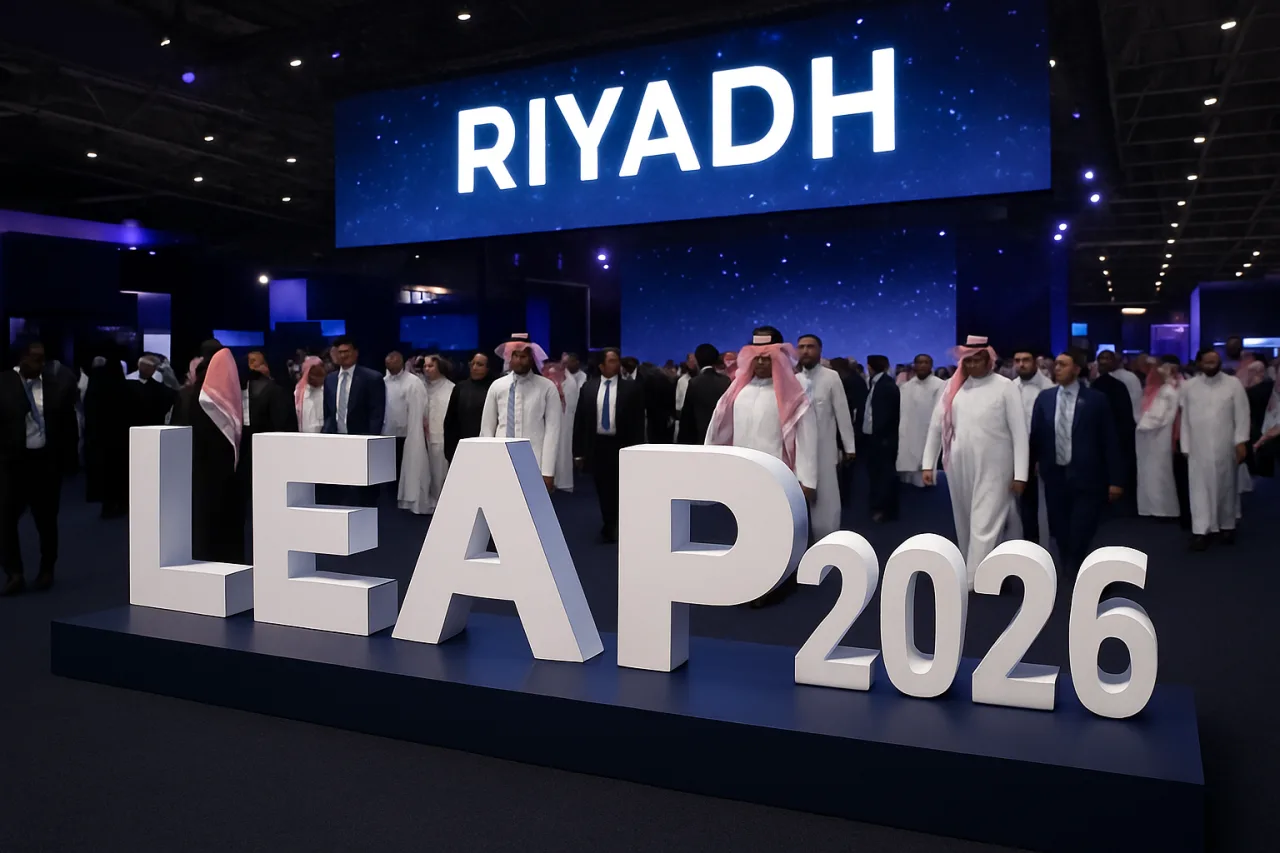
LEAP 2026 opens in Riyadh today, August 31, and its timing tells two stories at once. The fifth edition of the world’s most attended technology conference — 1,000+ speakers, 1,800+ global tech brands, 600+ startups, and an investor programme of more than 1,000 investors from over 900 firms representing $14.3 trillion in combined assets — runs through September 3 at the Riyadh Exhibition & Convention Centre (RECC) in Malham. It was supposed to happen in April. The Iran-Hormuz war disruption pushed it to the end of summer, and its reopening is now the Gulf’s loudest post-crisis signal that the money, the data centers, and the AI race are back on schedule. Last year’s LEAP delivered a record $14.9 billion in AI investment announcements on day one alone. This week’s edition opens in the same city where hundreds of thousands of Filipinos live and work — and the four days ahead could quietly redraw what tech work in Saudi Arabia means for OFWs.
Table of Contents
Key Takeaway
- 📅 The event: LEAP 2026 runs August 31 to September 3, 2026 at RECC Malham in Riyadh — the fifth edition of the world’s most attended tech event, co-organised by Saudi Arabia’s MCIT, SAFCSP, and Tahaluf under the theme “Into New Worlds.”
- 💰 The stakes: More than 1,000 investors from over 900 firms, holding $14.3 trillion in combined assets, are in Riyadh this week. Across its first four editions, LEAP generated over $44.2 billion in announced investments — including a record $14.9 billion on the first day of LEAP 2025.
- ⏳ Why it matters now: LEAP 2026 was postponed from April because of the Iran-Hormuz war disruption. Its successful reopening this week is a signal to global markets that Saudi Arabia’s technology buildout — and Vision 2030’s AI ambitions — survived the region’s worst security crisis in years.
- 🇵🇭 The OFW angle: Saudi Arabia is the world’s largest employer of overseas Filipino workers, and more than a million land-based OFWs work across the Middle East. What gets announced on LEAP’s stages this week — AI infrastructure, cloud regions, automation — will shape the jobs, and the job losses, waiting for Filipino workers in the Kingdom.
- 🔭 What to watch: Day-one investment announcements (can they beat $14.9 billion?), new cloud and AI infrastructure deals, DeepFest’s regional AI showcase, and the quiet story underneath: Saudization of the very administrative roles many OFWs hold.
LEAP 2026 Opens Today: What the Fifth Edition Actually Is
LEAP 2026 is the fifth edition of Saudi Arabia’s national technology event, founded in 2022 by the Ministry of Communications and Information Technology (MCIT), the Saudi Federation for Cybersecurity, Programming and Drones (SAFCSP), and Tahaluf — the Riyadh-headquartered events joint venture that includes Informa PLC, the world’s largest trade show organiser. Since its debut in 2022, the event has grown from a domestic technology showcase into one of the most commercially productive gatherings in the events industry, and this year’s theme, “Into New Worlds,” carries the confidence of a platform that no longer has anything to prove.
The scale on the ground is deliberate. The organisers’ published counters list more than 1,800 global tech brands, 1,000+ speakers, 600+ startups, 1,900+ investors, and attendance exceeding 201,000 — figures that made LEAP 2025 the most attended technology event on the planet. The 2026 floor is organised into stages that map exactly onto the technologies Saudi Arabia is buying: a dedicated Cyber track, Fintech & eCommerce, Cloud & SaaS, GovTech, Smart Cities, Space Tech, and an Investor & Founder Stage, alongside DeepFest, the region’s largest standalone AI festival running inside the event. The official LEAP 2026 programme confirms the four-day run from August 31 to September 3, free general admission passes sponsored by stc ahead of the opening, and premium tracks for investors and founders.
For Filipinos tracking the event from outside, one detail matters more than the celebrity keynotes: LEAP is not a conference where ideas are discussed and forgotten. It is where Saudi Arabia books its technology future in public — ministry podium, cheque, and press release in the same hall.
Why the World’s Biggest Tech Summit Was Four Months Late
The strangest fact about LEAP 2026 is the one most coverage won’t mention: it was never supposed to open in August. Independent Vision 2030 analysis records that the event was postponed from its original April window to August 31 to September 3 because of the Iran-Hormuz war disruption — the spring conflict that closed shipping lanes, triggered mass repatriations across the Gulf, and put more than one million overseas Filipino workers in the region on heightened risk advisories, according to the Philippine media monitoring that tracked the crisis.
That postponement was more than a calendar move. A flagship event that draws six-figure crowds cannot simply relocate; sponsors book a year ahead, delegations plan state visits around it, and the startups on the Rocket Fuel pitch stage arrange funding meetings months in advance. Sliding LEAP from spring to summer meant rewriting the Kingdom’s entire technology calendar — and it happened while regional airspace and logistics were still unreliable.
Here is the question that matters now that the doors are open: does a war-delayed LEAP still command the same gravity? The early answer is yes, on paper. The $14.3 trillion investor figure is higher than comparable figures quoted in earlier editions, the speaker list survived, and government partners kept their commitments. But an opening day in Riyadh under a warm late-August sun is also the first real test of whether global executives will still travel to the Gulf at scale after the crisis. Every handshake this week doubles as a vote of confidence in regional stability — and Saudi Arabia knows the world is watching.
The Money: $44.2 Billion Booked, $14.3 Trillion On The Floor
The commercial track record is the reason serious investors circle this event, and none of it is speculation. Saudi Press Agency, the Kingdom’s official news agency, reports that announced launches and investment commitments across LEAP’s first four editions exceeded $44.2 billion. The trajectory explains why: LEAP 2024 drew $11.9 billion on its first day alone, and LEAP 2025 topped it with a record $14.9 billion in new AI investments announced on opening day — at that point the single largest day of AI deal-making ever staged at a technology event.
| Edition | Headline Investment | Attendance |
|---|---|---|
| LEAP 2024 (Feb–Mar) | $11.9 billion on day one | 170,000+ |
| LEAP 2025 (February) | $14.9 billion in AI on day one (record) | 201,000+ from 180+ countries |
| All four editions combined | $44.2 billion+ in announced investments | 500,000+ cumulative visitors |
| LEAP 2026 (opens today) | Investor programme: 1,000+ investors, 900+ firms, $14.3T AUM | Four days, August 31 – September 3 |
Where did that money land? The earlier editions tell the pattern: Salesforce committed $500 million to expand Hyperforce and regional cloud capability, Tencent Cloud put $150 million into the Middle East’s first AI-powered cloud region, and IBM announced a $250 million package — each announcement staged on the LEAP floor to convert the Kingdom’s tech ambitions into signed infrastructure. Those are the deals that later became the buildings, the cloud regions, and the Saudi data center expansion that analysts now track as one of the fastest AI infrastructure buildouts in the world.
For this week’s edition, expect the same choreography with higher stakes: sovereign AI partnerships following the template of recent deals like the Mistral–HUMAIN agreement, cloud capacity announcements, and a race among global AI firms to attach their names to Vision 2030. The question is no longer whether LEAP produces billions — it never fails to — but whether a crisis-delayed edition can sustain the momentum of a $14.9 billion opening day. Watch the wire on September 1.
LEAP 2026 and the OFW Question Nobody Is Asking Out Loud
Riyadh headlines rarely travel to Manila, but this one should. Saudi Arabia is the largest single employer of overseas Filipino workers and home to the largest Filipino community in the Middle East — a population concentrated in Riyadh, Jeddah, and the Eastern Province, with more than a million land-based OFWs across the wider region according to Philippine monitoring during the conflict. When the Gulf’s tech economy moves, Filipino livelihoods move with it.
The movement is already visible on both sides. On one: the Kingdom’s Saudization programme quietly expanded this year to cover 69 additional administrative support professions — exactly the office, clerical, and coordination roles where many Filipino workers currently build their careers. On the other: the technology being announced at events like LEAP 2026 — AI cloud regions, automation platforms, digital government — creates the senior technical roles that a Saudizing labour market will increasingly reserve for its own citizens or import through specialised talent programs.
Caught between those forces, the practical question for Filipino workers in the Kingdom is not “will AI change my job” but “which side of this buildout will I be on.” The Philippine government is already responding: skills-mapping for overseas work, upskilling mandates, and platforms like DICT’s eTrabaho AI job-matching system exist precisely to move Filipino workers from the vulnerable middle of that transition toward the technical top. Workers who read the announcements coming out of LEAP this week as a job market forecast — not just tech news — will have a two-to-three-year head start on the skills shift everyone else notices too late. For a closer look at how AI hiring is reshaping Filipino employment strategy, our AI skills and hiring guide breaks down the exact competencies employers are screening for.
The Second-Order Effect: What This Week Signals Beyond Riyadh
There is a deeper signal under the headline numbers, and it is geopolitical. LEAP 2026 postponed is still LEAP 2026 running: a Gulf technology complex that absorbed a war shock, rescheduled its most important commercial week, and reopened with its investor numbers intact. In 2022, the event was an experiment. In 2026, it is infrastructure — the place where the world’s largest technology companies transact their Middle East strategy in public.
The competition underneath is sovereign AI: who controls the chips, the data centers, and the models that a region of half a billion people will run on. Recent sovereign AI partnerships in Riyadh — including the Mistral–HUMAIN arrangement covering AI infrastructure and deployment across the Kingdom, which we analysed in detail in our coverage of AI’s disruption of the BPO economy — show the pattern: global AI players concede local control and Arabic-first capability in exchange for Gulf capital and scale. Expect LEAP 2026’s podium to extend that pattern with new names.
For the Philippines, the message cuts both ways. Filipino AI infrastructure investment and data center ambitions — which we’ve tracked in our Philippine AI infrastructure analysis — compete with Saudi Arabia for the same global capital that LEAP aggregates under one roof this week. A strong LEAP 2026 raises the bar for every ASEAN tech economy courting the same investors. That is not a reason for pessimism; it is a deadline for regional competitiveness written in someone else’s announcement schedule.
What to Watch: September 1-3 at LEAP 2026
The four days ahead have a short scoreboard, and Filipino readers can follow it from Manila hours:
- Day one investment total. The number to beat is $14.9 billion. If opening-day announcements clear it, LEAP reasserts itself as the world’s dominant AI deal floor. If they fall short, the war-delay argument has its first data point.
- Cloud and AI infrastructure names. New regional cloud regions, AI factory commitments, and chip partnerships — the infrastructure that turns billions into buildings and, eventually, jobs.
- DeepFest announcements. The AI festival inside LEAP is where regional AI products and Arabic-first models surface, and where sovereign AI policy gets its public-facing debut.
- The OFW-relevant tracks. GovTech and Future of Work sessions will preview the digital government services and workplace automation that will reach multinational employers — and their Filipino workforces — first in the Gulf.
LEAP 2026 closes on September 3. By then, the Kingdom will have added its fifth year of numbers to a ledger that already exceeds $44.2 billion — and every one of those figures, eventually, becomes a contract, a data center, a hire, or a displacement somewhere in the real economy that Filipinos in Saudi Arabia live inside.
Frequently Asked Questions About LEAP 2026
When and where is LEAP 2026?
LEAP 2026 runs from August 31 to September 3, 2026 at the Riyadh Exhibition & Convention Centre (RECC) in Malham, Riyadh, Saudi Arabia. It is the fifth edition of the world’s most attended technology event, co-organised by Saudi Arabia’s MCIT, SAFCSP, and Tahaluf. LEAP 2026 was postponed from its original April window due to the Iran-Hormuz war disruption.
Why was LEAP 2026 postponed?
LEAP 2026 was moved from April to August 31–September 3 because of the Iran-Hormuz war disruption that affected regional travel, shipping, and security earlier in 2026. The postponement shifted the event to late summer, making this week’s edition the first major global technology gathering in the Gulf since the crisis.
How much money has LEAP brought to Saudi Arabia?
Announced investments across LEAP’s first four editions exceed $44.2 billion, according to the Saudi Press Agency. LEAP 2025 alone produced a record $14.9 billion in AI investment announcements on its opening day, and LEAP 2024 drew $11.9 billion on day one. For LEAP 2026, organisers say more than 1,000 investors from over 900 firms are attending, representing $14.3 trillion in combined assets under management.
Who are the biggest LEAP 2026 speakers?
The official LEAP 2026 programme lists more than 1,000 speakers across its main and specialist stages, spanning global tech CEOs, policymakers, and startup founders. Saudi Minister of Communications and Information Technology Eng. Abdullah Alswaha has delivered keynote addresses at previous LEAP openings, and the speaker roster for past editions has included leadership from the world’s largest cloud, AI, and telecom companies. The full current roster is published on the official LEAP website.
How many Filipinos work in Saudi Arabia?
Saudi Arabia is the largest single employer of overseas Filipino workers and hosts the largest Filipino community in the Middle East. Philippine monitoring counted more than 1.1 million land-based OFWs across the Middle East during the 2026 regional crisis, with Saudi Arabia as the primary destination. Filipinos work across Saudi Arabia’s healthcare, construction, hospitality, logistics, domestic work, and increasingly its technology sectors.
What does LEAP 2026 mean for OFWs?
The technologies announced at LEAP 2026 — AI infrastructure, cloud regions, automation, and digital government — will shape the Saudi labour market that hundreds of thousands of Filipinos work in. Two trends matter most: Saudization’s expansion into administrative roles, which pressures traditional OFW positions, and the Kingdom’s tech buildout, which creates new specialised roles. OFWs who upskill toward AI-adjacent and technical roles position themselves on the growth side of that transition.