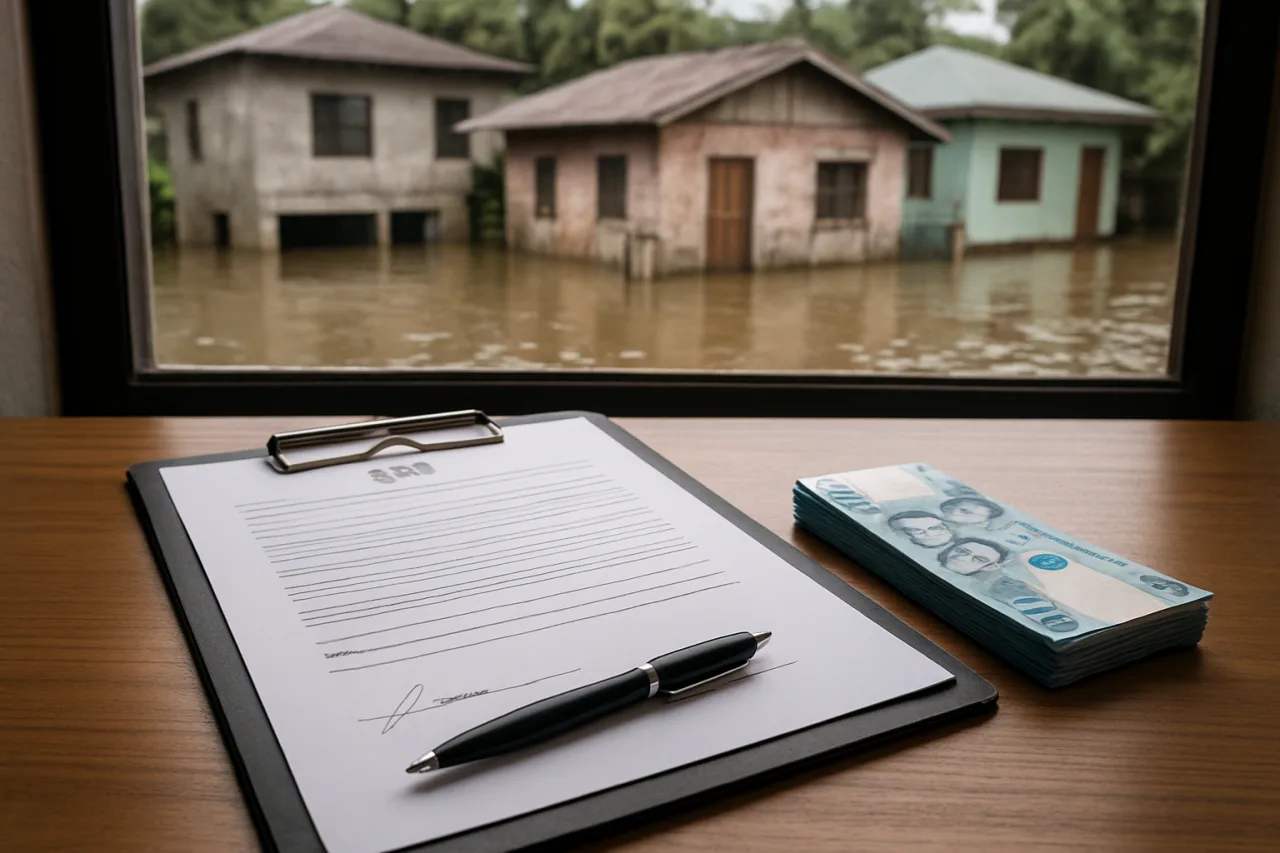
SSS emergency loan windows are open nationwide under the State of National Calamity, and the Social Security System used its August 14, 2026 announcement to remind members hit by Tropical Storm Maymay and the Habagat flooding — the same severe southwest monsoon rains that forced Malacañang to suspend government work and classes in Metro Manila and surrounding provinces again on August 28 to 30 — that they can borrow at 7 percent per annum with no service fee and a 6-month payment moratorium. But there is a detail in the flood of headlines worth pausing on: the “up to ₱20,000” figure being quoted in coverage including the Inquirer’s traces to the program’s original December 2025 guidelines, and the current rulebook — SSS Circular No. 2026-003, signed April 29, 2026 — actually computes the loanable amount from your posted monthly salary credits with no stated peso ceiling. For workers deciding whether to tap their SSS emergency loan this storm season, the difference between the headline and the circular is money, and this guide walks through who qualifies, how the real amount is computed, and exactly how to apply.
Table of Contents
Key Takeaway
- 🏦 The window: The SSS Emergency Loan Program is active nationwide while the State of National Calamity under Proclamation No. 1077 (November 6, 2025) runs, and SSS’s August 14, 2026 announcement reminded members affected by Tropical Storm Maymay and the Habagat that they can avail of it.
- 💡 The catch everyone missed: The widely reported “up to ₱20,000” cap came from the original December 2025 circular. Under the current rulebook, SSS Circular No. 2026-003 (April 29, 2026), the loanable amount is a formula — 50% or 100% of the average of your 12 latest posted monthly salary credits, rounded up to the nearest ₱1,000, with no stated peso ceiling.
- 📉 The terms: 7% interest per annum on a diminishing balance, no service fee, a 6-month payment moratorium, 24 monthly amortizations on top of the deferment — 30 months total — and proceeds are not taxable.
- 🧾 The trigger difference: The emergency loan opens nationwide off a presidential declaration — no calamity list, no reference number — while the SSS calamity loan activates only for LGUs the NDRRMC declares under a state of calamity.
- 📱 How to apply: Everything runs through the My.SSS portal, whose ELP application link goes live only when a window is active — check the official SSS Emergency Loan Program page before counting on the program for storm relief.
The SSS Emergency Loan Window Is Open Under Proclamation 1077
The SSS emergency loan is not a standing product. By design, it appears only when the President declares a State of National Calamity or a State of National Emergency — and the current window traces to Proclamation No. 1077, signed November 6, 2025 after Typhoon Tino, which declared a State of National Calamity for one year unless lifted earlier. SSS opened the corresponding loan window in late December 2025, and it has kept running: the availment period lasts one year from the SSS announcement, or for the duration of the declared national state of calamity, whichever ends first. Unless the declaration is lifted early, the window runs to around November 6, 2026 — which is why the August 14 announcement about Tropical Storm Maymay and the Habagat did not create a new program. It pointed members to the existing one.
That design choice matters more than it looks. A typhoon or a monsoon by itself opens nothing — as SSS itself has cautioned in coverage of earlier storms, availability follows official declarations and activation notices, not weather bulletins. The practical effect for a member whose house flooded during the Habagat this August is this: the nationwide SSS emergency loan window is already open, so you do not need to wait for your city or province to be declared under a local state of calamity to qualify for this particular loan. Members in LGUs that do get individually declared can also consider the separate calamity loan program — the two run on different triggers, and understanding the difference determines which door you knock on.
The clock, however, is unforgiving in one direction: a new emergency loan announcement automatically terminates and supersedes any ongoing window, and the current state-of-calamity proclamation can be ended by the President at any time. A member who intends to use the SSS emergency loan should treat the window as perishable rather than permanent — the terms are good precisely because the program is temporary.
The ₱20,000 Question: What Circular 2026-003 Actually Says
Here is where the reporting and the rulebook part ways — and where members can either overestimate or underestimate what they can borrow. Most coverage of the Maymay and Habagat announcement, echoing SSS’s own press materials, describes the SSS emergency loan as “up to ₱20,000.” That figure is real, but it comes from the program’s original guidelines in Circular 2025-011, signed December 9, 2025. The current rulebook — Circular 2026-003, published on the official SSS portal, signed April 29, 2026, which repealed and replaced the original guidelines — contains no peso ceiling at all, according to a detailed analysis of the circular by personal finance guide SweldoPH. Under the new circular, the loanable amount depends entirely on two things in your SSS record: your posted contributions count and your monthly salary credits.
The formula works like this. Members with 18 to 35 posted monthly contributions can borrow 50 percent of the average of their 12 latest posted monthly salary credits, rounded up to the next higher ₱1,000. Members with 36 or more posted contributions can borrow 100 percent of that average, also rounded up to the nearest ₱1,000. Run the arithmetic and the old ₱20,000 framing snaps into focus: against the minimum monthly salary credit of ₱5,000, the old ceiling mattered. But a member earning above the minimum whose record shows 36-plus posted contributions can be approved for more than ₱20,000 under the current rules — the ceiling is your contribution history, not a fixed number. The practical instruction is simple: check your My.SSS account, where the computed loanable amount appears once the application flow is open, rather than budgeting off the headline number.
Why does this distinction matter enough to lead an article? Because crisis borrowing decisions are made on summaries. A member who read only the ₱20,000 headline either overestimates a small loan — and then blames SSS when the approved amount is lower — or underestimates a larger one and borrows from more expensive sources, like payday lenders or credit card cash advances, without first checking the cheapest money available to them. Precision in the fine print is not pedantry during a flood; it is money.
SSS Emergency Loan Terms 2026: Rate, Moratorium, and Payment Schedule
The terms are where the program earns its name — softer than almost any formal credit a typical member can access in a disaster week. The interest rate is 7 percent per annum computed on a diminishing balance, expressly pegged to the prevailing rate of the SSS calamity loan program and adjusted automatically if that rate moves. There is no service fee. The payment structure begins with a 6-month moratorium: the first payment falls due only after the deferment ends, which is designed to carry a household through the immediate repair-and-recovery window when cash is most strained.
| Term (Circular 2026-003) | Detail |
|---|---|
| Interest rate | 7% per annum, diminishing balance |
| Service fee | None |
| Payment moratorium | 6 months |
| Repayment | 24 monthly amortizations after the moratorium (30 months total) |
| Loanable amount | 50% (18-35 posted contributions) or 100% (36+ posted contributions) of the average of the 12 latest posted MSCs, rounded up to the nearest ₱1,000 — no stated peso ceiling |
| Tax treatment | Loan proceeds are not taxable income |
| Effective interest | Effective rate around 7.03%–7.39% depending on schedule |
Set against the alternatives, the value is stark. The regular SSS salary loan charges 8 percent and has no moratorium tied to disasters. Credit card cash advances typically run 3 percent-plus per month — an annualized cost above 40 percent — and informal lender rates during disasters are worse. For an SSS member with posted contributions, the 7 percent emergency loan is usually the cheapest formal credit available in a calamity, and the moratorium is the feature that makes it crisis-appropriate: you receive cash now and begin repaying half a year later.
Who Qualifies for the SSS Emergency Loan
Eligibility under Circular 2026-003 follows the standard short-term loan architecture, with a few conditions worth spelling out. An applicant must be an active member — employed, self-employed, or voluntary — who is of legal age and below 65 at the time of application, with at least 18 posted monthly contributions out of the relevant 24-month period, and currently employed or actively contributing in the applicable months. Members must have no pending final benefits claims, and — the trap that catches many returning borrowers — no existing emergency, calamity, or salary loan that has gone past maturity, with no unpaid amortizations beyond three months overdue.
The renewal rule adds one more wrinkle specific to this program: renewing or taking a new SSS emergency loan requires a new and separate presidential proclamation or executive order, distinct from the one your current loan was granted under. Because Proclamation 1077 dates from November 2025 and new storm announcements ride that same window, this is one reason a member’s loan availability can differ from a coworker’s — loan history and the legal basis of each window interact. OFWs and overseas members should note the program also covers them through voluntary SSS membership; our SSS contribution guide for OFWs and the self-employed explains how to keep contributions posted while abroad, which is exactly what determines loanable amounts back home.
ID and account requirements are modest since everything runs through My.SSS: an active My.SSS account with verified email and mobile number, bank or e-wallet disbursement details enrolled under the Disbursement Account Enrollment Module, and the standard one-time password flow. Members without an activated account should fix that before the next weather event, not during it — account recovery during a typhoon week is its own emergency.
How to Apply, Step by Step, via My.SSS
The application process is entirely digital, which after a flood is a mercy.
- Step 1 — Confirm the window. Visit the official SSS Emergency Loan Program page on sss.gov.ph; the “Apply via My.SSS” link is live only when a window is active. SSS’s August 14 announcement confirmed the window is open for Maymay- and Habagat-affected members, alongside the standing nationwide availability under Proclamation 1077.
- Step 2 — Log in to My.SSS. Access your account on the SSS member portal and navigate to the E-Services menu, where the Emergency Loan application appears when available.
- Step 3 — Review your computed amount. The portal displays the loanable amount calculated from your 12 latest posted monthly salary credits and contribution count — this is where you verify the real figure against the ₱20,000 you may have read in the news.
- Step 4 — Enroll your disbursement account. Choose a participating bank account, or the UnionBank Quick Card, or an e-wallet enrolled under SSS’s disbursement rules; loan proceeds are credited there, not over the counter.
- Step 5 — Submit and track. Confirm the loan terms — rate, moratorium, amortization schedule — and track the status in the portal. Approved proceeds typically post to the enrolled account within the program’s standard processing window.
One practical note for workers hit by the Habagat: documentation of damage is not the loan’s gating requirement the way it is for some government calamity assistance — the trigger is the national declaration itself, not your household’s certificate of damage. That is by design: the nationwide structure means a member in a flooded barangay in Metro Manila and one hit by Maymay’s winds in the provinces stand before the same door, with the same computed amount waiting behind it.
Emergency Loan vs Calamity Loan vs Salary Loan
SSS runs three short-term member loans that get confused constantly — in disaster weeks, mixing them up costs real money, so here is the clean split.
The emergency loan opens nationwide, off a presidential State of National Calamity or Emergency declaration — no locality list, no calamity loan reference number, no service fee, 7 percent. The calamity loan activates per locality, keyed to areas the NDRRMC declares under a state of calamity, and requires a calamity loan reference number tied to your listed address; its guidelines were revised in July 2025 to also carry a 7 percent rate, and its service fee is currently shown as waived on the SSS calamity loan page. The salary loan is the year-round standard: 8 percent per annum under Circular 2025-004, with no disaster trigger at all. In a storm week, the hierarchy is usually obvious — if the national emergency window is open, compare the emergency loan against the calamity loan only if your LGU is on the declared list, and treat the salary loan as the fallback for everything that is not a crisis.
The programs also interact at renewal: a renewed emergency loan requires a new, separate proclamation, and no overlapping emergency windows exist — a new program announcement terminates the old one. Members juggling an existing salary loan should clear past-due amortizations first, since loan standing above the three-month threshold disqualifies new borrowing across the short-term suite.
Frequently Asked Questions About the SSS Emergency Loan
Is the SSS emergency loan still available after the Maymay and Habagat announcement?
Yes. SSS’s August 14, 2026 announcement opened the existing Emergency Loan Program to members affected by Tropical Storm Maymay and the Habagat, riding the nationwide window under Proclamation No. 1077 issued November 6, 2025. The window runs one year from the SSS announcement or the duration of the declared national state of calamity, whichever ends first — unless lifted earlier by the President.
How much can I actually borrow under the SSS emergency loan?
Under SSS Circular No. 2026-003, the loanable amount is 50 percent of the average of your 12 latest posted monthly salary credits if you have 18 to 35 posted contributions, or 100 percent of that average if you have 36 or more, rounded up to the nearest ₱1,000. The current rulebook has no stated ₱20,000 ceiling — that figure came from the original December 2025 circular. Your exact amount appears in the My.SSS portal when you apply.
What is the interest rate and payment schedule?
The SSS emergency loan charges 7 percent per annum on a diminishing balance with no service fee. Payments start after a 6-month moratorium, followed by 24 monthly amortizations — 30 months in total. The rate automatically adopts any movement in the prevailing calamity loan rate, and loan proceeds are not taxable.
What is the difference between the SSS emergency loan and calamity loan?
The emergency loan opens nationwide under a presidential State of National Calamity or Emergency declaration — available regardless of your specific locality. The calamity loan activates only for LGUs the NDRRMC declares under a state of calamity and requires a calamity loan reference number. Both now carry a 7 percent rate; the emergency loan’s structure, moratorium, and nationwide trigger are what set it apart.
Who cannot apply for the SSS emergency loan?
Members under 65 with at least 18 posted contributions in the relevant window can generally apply, but borrowers with an emergency, calamity, or salary loan past maturity, or with unpaid amortizations more than three months overdue, are disqualified until they settle first. Members drawing their final benefits are also outside the program’s rules.
When does the current SSS emergency loan window close?
Whichever comes first: one year from the SSS announcement that opened the window, or the end of the declared State of National Calamity. The current proclamation runs one year from November 6, 2025 — so plan around early November — unless the President lifts the declaration sooner or SSS opens a superseding window tied to a new proclamation.
Financial Disclaimer
This article is published for general information only and does not constitute financial, legal, or investment advice. Loan programs, interest rates, and eligibility rules change; verify all terms directly with the Social Security System through its official channels — sss.gov.ph and the My.SSS portal — before making financial commitments. WorldNgayon is not affiliated with, endorsed by, or acting on behalf of the SSS.
📩 Get the Free OFW Money Starter Kit
25 practical money moves, plus WorldNgayon’s weekly OFW money tips and scam alerts.
No spam. Unsubscribe anytime. Download directly →