Key Takeaway
- 📰 The NVIDIA rule claim, sourced and dated: the Financial Times reported on November 3, 2026 (citing people with knowledge of the matter) that NVIDIA told its cloud and data-center clients to cut their exposure to Chinese customers — with the 51% floor (at least 51% of services sold to non-Chinese companies) relayed by Bloomberg from the FT’s reporting.
- 🎤 The verification tiers, honestly separated: the FT is the named source; Bloomberg and other outlets relayed the figure; NVIDIA has NOT confirmed anything; Reuters reported it could not verify; and the directive was reportedly conveyed VERBALLY through sales and regional teams rather than in writing — this guide keeps every claim at its named tier.
- 🧭 The mechanism, as reported: the rule targets the side door — Chinese firms renting cloud compute overseas to reach high-end silicon; a cloud provider whose client base leans Chinese must rebalance toward non-Chinese customers or risk losing access to NVIDIA hardware, effectively a customer-composition test running on the supply chain.
- 📅 The policy context, dated: US export controls have tightened since 2022; the Commerce Department issued guidance in May 2026 to curb diversion of advanced chips (the Blackwell series in focus); Super Micro employees were charged this year with smuggling ~$2.5 billion of NVIDIA AI servers; and NVIDIA previously ran buyer whitelists and tightened compliance checks across Asian markets.
- ⚠️ What nobody has verified: that the measure was government-demanded (not established in available sources), that it applies in writing to anyone, or how enforcement would run — the story is a supply-chain compliance shock built on a single-source report; treat every downstream claim at its tier.
The NVIDIA 51% rule is the supply chain’s newest compliance shock — and its honest telling starts with who said what. The Financial Times reported on November 3, 2026, citing people with knowledge of the matter, that NVIDIA instructed its cloud and data-center clients to scale back exposure to Chinese customers — with the reported floor being that at least 51% of a client’s services go to non-Chinese companies, relayed by Bloomberg from the FT. NVIDIA has not confirmed; Reuters could not verify; and the directive reportedly ran verbally through sales and regional teams. This guide carries the claim at its verified tier, explains the side door it targets (Chinese firms renting overseas cloud compute to reach NVIDIA-grade silicon), dates the policy ladder behind it, and maps the affected players — the neoclouds of Singapore, Malaysia and Japan first.
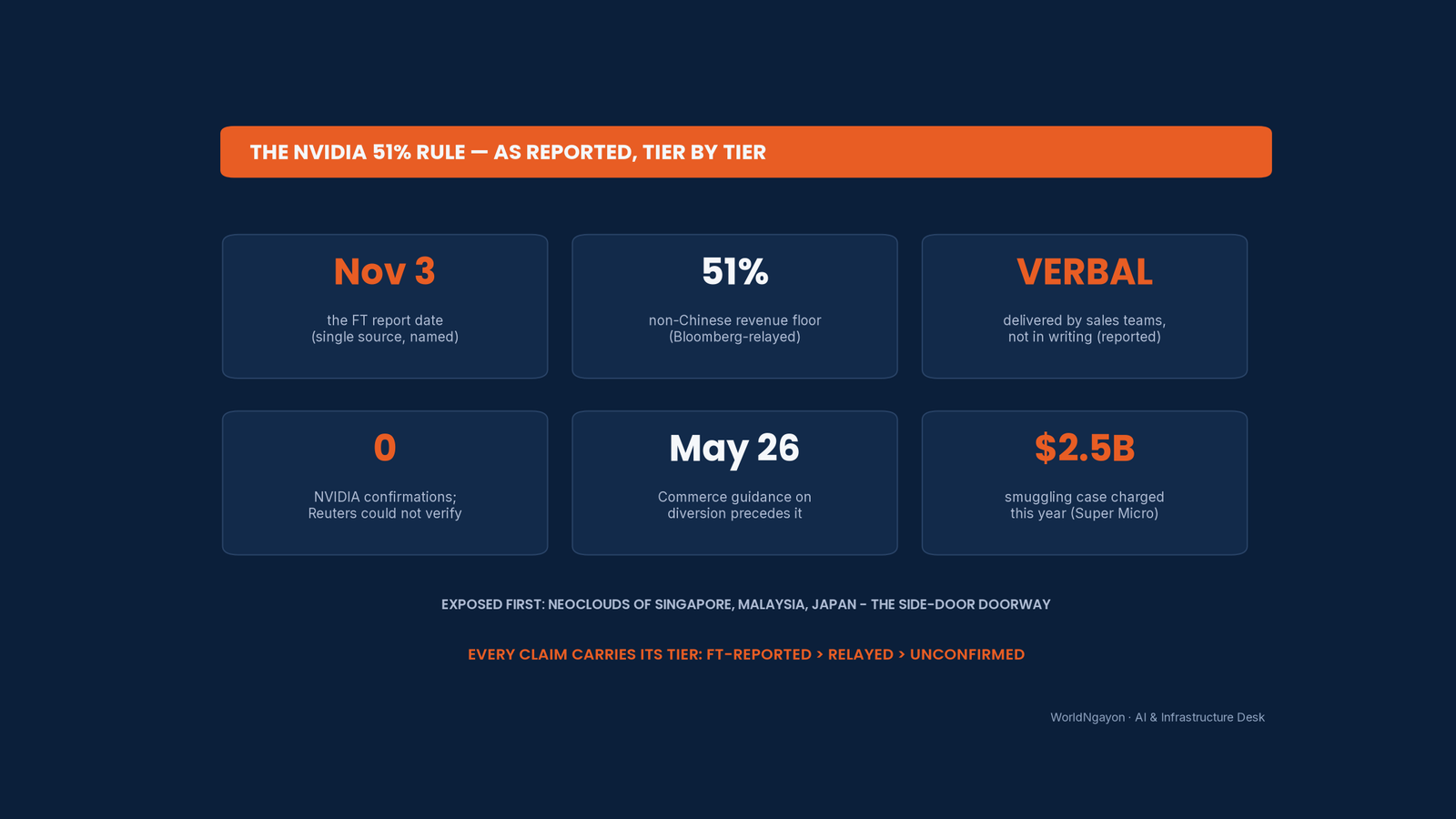
Table of Contents
The NVIDIA 51 rule: the claim and its tiers
The claim, tier by tier: Verified-tier facts: the FT published the story on November 3, 2026 (a named outlet citing unnamed people with knowledge); Bloomberg and other outlets relayed the 51% figure FROM the FT. Relay-tier claims: the verbal delivery mechanism (via sales and regional teams rather than writing) — reported by secondary outlets. Unverified-tier claims: any statement that NVIDIA confirmed the rule (nothing found); that Reuters verified it (the agency explicitly could not); and that the measure stems from direct US-government demands (not established in available sources). The guide’s rule: every downstream use of this story inherits the tier of its source — the claim is real news ABOUT a supply-chain instruction; the instruction’s text, scope and enforcement rung remain unnamed.
WorldNgayon Analysis: this is the claims-discipline instrument (the dated-claims ledger) doing exactly its job: a market-moving story whose core fact is a REPORT. The market treats single-source stories about NVIDIA-China as provisional until the company or the government confirms — the stock tape read it that way, and this guide’s tables keep it that way.
Bottom Line: one named source, one relayed number, zero confirmations — read every line at its tier.
Why the 51 percent line matters: the side door
The side door, explained: direct US chip exports to China are heavily restricted — so Chinese firms rent cloud computing power OVERSEAS, using a third country’s data centers to reach advanced NVIDIA silicon. The reported NVIDIA rule attacks the door’s economics: a cloud client who must keep at least 51% of services on non-Chinese customers cannot carry a China-weighted rental book without risking its chip supply — the compliance test moves from the buyer’s identity to the buyer’s REVENUE MIX. Why it’s the strongest lever yet: prior measures (whitelists, compliance checks) screened WHO bought; the reported rule shapes whom the buyer SELLS TO — a structural demand on the intermediary layer that limits how much Chinese business can run on premium silicon anywhere in Asia.
WorldNgayon Analysis: the mechanism extends the export-control era’s evolution this site tracks: controls migrated from destination bans to buyer lists to supply-chain revenue composition (the custom-chips pieces and the sovereign-AI guides carry the macro frame). The revenue-mix lever is the era’s fourth generation — and it enforces itself through the chipmaker’s sales teams, not through customs forms.
Bottom Line: the rule (as reported) turns customer composition into a supply condition — the side door’s economics change even if its legality never gets printed.
The policy ladder behind it: 2022 to today
| Dated rung (as reported) | The measure |
| 2022 onward | US export controls on advanced chips begin tightening — the era’s floor |
| Through 2025 | Chinese firms pivot to renting overseas cloud compute; NVIDIA runs approved-buyer whitelists and compliance checks across Asian markets |
| May 2026 | US Commerce Department guidance aims at curbing diversion of advanced technology (Blackwell-class in focus) |
| This year | Super Micro employees charged with smuggling ~$2.5 billion of NVIDIA AI servers to China; NVIDIA cuts approved Asian customer lists by more than half per the coverage |
| November 3, 2026 | The FT’s report: the 51% non-Chinese floor, delivered orally per the secondary reports; NVIDIA unconfirmed; Reuters could not verify |
WorldNgayon Analysis: the ladder’s shape is the telling part: each rung enforces where the last rung leaked — destination bans leaked to third countries, buyer lists leaked to intermediaries, and the newest rung (per the report) reaches the intermediary’s own customer mix. The pattern predicts the next enforcement layer: audits and attestation — the compliance functions the chipmaker’s clients will hire for (the AI-jobs analyses carry that demand).
Bottom Line: the era’s rungs now reach revenue composition — the last layer before audit-grade enforcement.
The affected players: neoclouds, data centers, workloads
The named exposure set (as reported): the neocloud operators of **Singapore, Malaysia and Japan** — providers whose client base previously carried meaningful Chinese rental demand — face a three-way choice per the coverage: rebalance toward non-Chinese customers, shrink their NVIDIA footprint, or exit. The second ring: Asian clouds and data centers generally, whose sales teams now run the customer-composition test alongside the buyer-screening checks. The third ring: every tenant workload — an AI deployment’s supply chain now includes the landlord’s compliance posture, which is a new DDQ (diligence questionnaire) line item for anyone renting Asian capacity (the GPU-rental market guide carries the rental layer).
WorldNgayon Analysis: the second-order effect is the relocation demand: Chinese-weighted bookings will migrate to jurisdictions and providers outside the rule’s reach — the capacity shuffles toward providers with cleaner mixes, repricing regions (the SEA buildout analysis carries the regional capacity economy). For the chipmaker itself, the coverage notes the trade: cutting approved Asian customers by more than half means turning away some buyers — while demand stays high (the capex economics carry the demand side).
Bottom Line: three rings of exposure, starting with the neoclouds — and the compliance posture becomes a pricing factor in every Asian capacity deal.
What this means for work, money and the Philippines
For investors: treat the story at its tier — a single-source report moved the tape’s read on NVIDIA-China exposure; the watchlist discipline (the bubble-stocks numbers) applies to the neocloud names until the rule confirms or dies; and the money-trail pieces carry the supply-chain financing side.
For careers: compliance and trade-control roles inside AI infrastructure are this era’s steady lane — export-control analysts, supply-chain auditors, the diligence functions the rental markets now write into contracts (the jobs analyses).
For Filipino professionals and OFWs: Southeast Asia IS the rule’s named geography — the neoclouds of Singapore, Malaysia and Japan sit inside the regional jobs and buildout map (the regional analyses), and the Philippines’ own capacity plans (the SEA buildout guide) inherit the same compliance conversation. The practical takeaway for renters and builders everywhere: ask the landlord’s compliance posture before the GPU count — the region’s capacity pricing now embeds it (the peso lens carries the currency side of capacity imports).
Verdict: a compliance shock at single-source tier
The NVIDIA 51 rule, settled at its tier: a Financial Times report dated November 3, 2026 — relayed by Bloomberg with the 51% non-Chinese floor, delivered verbally per the secondary coverage, unconfirmed by NVIDIA, unverifiable per Reuters — describing a supply-chain instruction that turns customer composition into a condition for chip access. The mechanism targets the side door (Chinese firms renting overseas compute); the policy ladder behind it runs 2022’s controls to May 2026’s Commerce guidance to this year’s smuggling case; and the exposed names start with the neoclouds of Singapore, Malaysia and Japan. The market moved on the report; the guide prices the claims at the tiers their sources carry — and the next confirmations (or contradictions) are the dated events this story’s second act turns on.
Sources on the record: the FT-report verified-vs-claimed ledger · Reuters.
Financial Disclaimer
This article is editorial analysis of publicly reported information, not investment or financial advice, and no outcome is promised. Figures and claims are as reported by the named sources at the stated dates; verify before acting. Markets and policy carry substantial risk.
Three more lines complete the NVIDIA 51% rule picture. The delivery mechanism, per the secondary coverage: the NVIDIA 51% rule was conveyed VERBALLY — via NVIDIA’s sales and regional teams — rather than issued in writing, and no such restriction previously existed; the compliance posture (the NVIDIA 51% rule’s shape) therefore lives with the sellers’ conversations, not in a public filing. The second line is the enforcement context: NVIDIA’s earlier levers — whitelists of approved buyers, tightened compliance checks across Asian markets, and approved-customer cutbacks that trimmed the list by more than half — all preceded the 51% revenue test the FT reported; the NVIDIA 51% rule is the escalation, not the first step. The third is the timing: the NVIDIA 51% rule story arrived November 3, 2026 — a Financial Times exclusive, Bloomberg-relayed, NVIDIA-unconfirmed, Reuters-unverifiable. Until a confirmation or denial lands, every position on the NVIDIA 51% rule carries that tier — the rule is a report about a supply-chain condition, and the supply chain will price it that way.
The neocloud economy, the rule’s (reported) ground zero: the specialist operators across Singapore, Malaysia and Japan built businesses renting NVIDIA-grade capacity to whoever paid — including, as the coverage describes, intermediaries serving Chinese demand — and the NVIDIA 51% rule, if it holds in practice, reprices that business model in one instruction: keep the customer mix non-Chinese-majority or risk the silicon. The operators’ realistic options as the reporting sketches them: rebalance the customer base toward non-Chinese demand (sales-cycle length measured in quarters), shrink the NVIDIA-dependent footprint, or convert to the provider classes the rule’s tiers still allow. The NVIDIA 51% rule’s second-order map: capacity prices diverge by compliance posture — providers with clean mixes charge for it; providers inside the rule’s reach discount to retain tenants; and the arbitrage migrates demand toward whichever jurisdiction’s providers can document their books. The compliance market — auditors, mix-attestation services, trade-control counsel — is the NVIDIA 51% rule story’s quietest growth line, and it exists whether or not any written rule ever surfaces: the vendors’ conversations already set the standard the tenants must meet. The honest close of the NVIDIA 51% rule reading: a supply-chain conversation priced before its confirmation — the second act belongs to whatever document, denial or enforcement detail lands next, and the tiers of this guide’s tables are exactly the structure to check it against.
The compliance market, named: every tier of this story creates work downstream — diligence questionnaires that now carry the customer-mix question, attestation services that document a provider’s revenue composition, and the trade-control counsel whose briefs the rental contracts now demand. The NVIDIA 51% rule conversation (as reported) also reaches the tenants: an AI deployment whose landlord sits inside the rule’s reach inherits the posture question in its own vendor contracts — the mix question travels the whole chain. The second act’s decision points are dated in this guide’s tables: the FT report (November 3), the relays that followed, and whatever confirmation, denial or enforcement document comes next — each is the kind of dated event the claims discipline prices before the market does. Until then, the supply chain’s honest state: vendors talking, tenants asking, capacity pricing shifting at the edges — and the NVIDIA 51% rule’s ultimate authority undecided in any document the public record carries.
The tenant’s checklist, built from the tiers: for anyone renting capacity or building in the region the reported rule touches, the diligence set writes itself from the reporting: ask the provider (1) whether it has received such an instruction (the verbal-delivery tier is the actual mechanism, per the coverage); (2) how it documents customer mix — the attestation form existing or not; (3) what its fallback plan is if chip access narrows — the continuity answer; (4) which providers it is itself renting from (the chain’s second hop — the NVIDIA 51% rule, as reported, reaches intermediaries of intermediaries the same way whitelists did). The checklist costs one email and prices the NVIDIA 51% rule into the deal before the market does — the tenant-version of the tier discipline this guide’s tables carry.
- explainx.ai/blog/nvidia-tells-cloud-clients-sell-51-percent-non-chine… — the FT-report verified-vs-claimed ledger
- reuters.com/business/openai-cuts-funding-target-by-10-billion-ft-repo… — Reuters
External sources linked in this article, in order of first mention. Spotted an error or a broken link? Tell us.
Cite this pagePublished Nov 4, 2026
Agron, E. (2026, November 4). NVIDIA’s 51% Rule: Why Asian Clouds Must Prove Non-Chinese Revenue. WorldNgayon. https://worldngayon.com/nvidia-51-rule/
Agron, Edmon. “NVIDIA’s 51% Rule: Why Asian Clouds Must Prove Non-Chinese Revenue.” WorldNgayon, 4 Nov. 2026, worldngayon.com/nvidia-51-rule/.
Agron, Edmon. “NVIDIA’s 51% Rule: Why Asian Clouds Must Prove Non-Chinese Revenue.” WorldNgayon, November 4, 2026. https://worldngayon.com/nvidia-51-rule/.
Agron, E. (2026) ‘NVIDIA’s 51% Rule: Why Asian Clouds Must Prove Non-Chinese Revenue’, WorldNgayon, 4 November. Available at: https://worldngayon.com/nvidia-51-rule/.
E. Agron, “NVIDIA’s 51% Rule: Why Asian Clouds Must Prove Non-Chinese Revenue,” WorldNgayon, Nov. 4, 2026. [Online]. Available: https://worldngayon.com/nvidia-51-rule/
@online{agron2026nvidia51,
  author       = {Agron, Edmon},
  title        = {{NVIDIA’s 51\% Rule: Why Asian Clouds Must Prove Non-Chinese Revenue}},
  year         = {2026},
  date         = {2026-11-04},
  organization = {WorldNgayon},
  url          = {https://worldngayon.com/nvidia-51-rule/},
  urldate      = {}
}TY - ELEC AU - Agron, Edmon TI - NVIDIA’s 51% Rule: Why Asian Clouds Must Prove Non-Chinese Revenue T2 - WorldNgayon PY - 2026 DA - 2026/11/04/ UR - https://worldngayon.com/nvidia-51-rule/ Y2 - ER -
Cite the version you read; the page may be updated. Zotero and Mendeley can also import this page directly.