Key Takeaway
- 🤝 The deal, dated: on November 2, 2026, Marvell Technology agreed to buy Lumentum in an all-stock transaction valuing Lumentum at $115 billion implied enterprise value — 4.5 Marvell shares per Lumentum share — the second-largest tech acquisition ever, with closing expected in H1 2028 pending shareholder and regulatory approvals.
- ⚡ Why Marvell is paying for lasers: Lumentum makes the optical components, network modules and commercial lasers that carry AI data center traffic as light — Marvell says the deal combines its electrical chipmaking with Lumentum’s optical portfolio to meet “accelerating and shifting AI connectivity demands”; the AI buildout’s next bottleneck is the photon inside the interconnect.
- 📉 The market’s verdict was instant and sour: both stocks fell more than 10% on the announcement (Marvell −13%) — investors priced the dilution (the buyer pays in its own shares) and financing risk immediately; the headline value already trades below the printed $115 billion, and Reuters’ math values Lumentum at ~33× forward core operating profitability versus a peer median near 16×.
- 🧭 The strategic frame: this is the AI optical-arms race consolidating — Marvell already closed a multibillion-dollar Celestial AI deal this year and has a $20 billion FY2028 revenue outlook (its Oct 6 Investor Day set a $70-90 billion FY2031 target); photons are the lane where the electrical interconnect’s power wall gets broken, and the buyer just bought its way deeper into it.
- 🎯 The honest read: the deal prices AI connectivity for the LATE-2020s — a bet on optical integration, made in an era where the co-packaged-optics transition just went to mass production; the market hated the price and the dilution, the strategy is the industry’s consensus, and the two live together for the 2028 close.
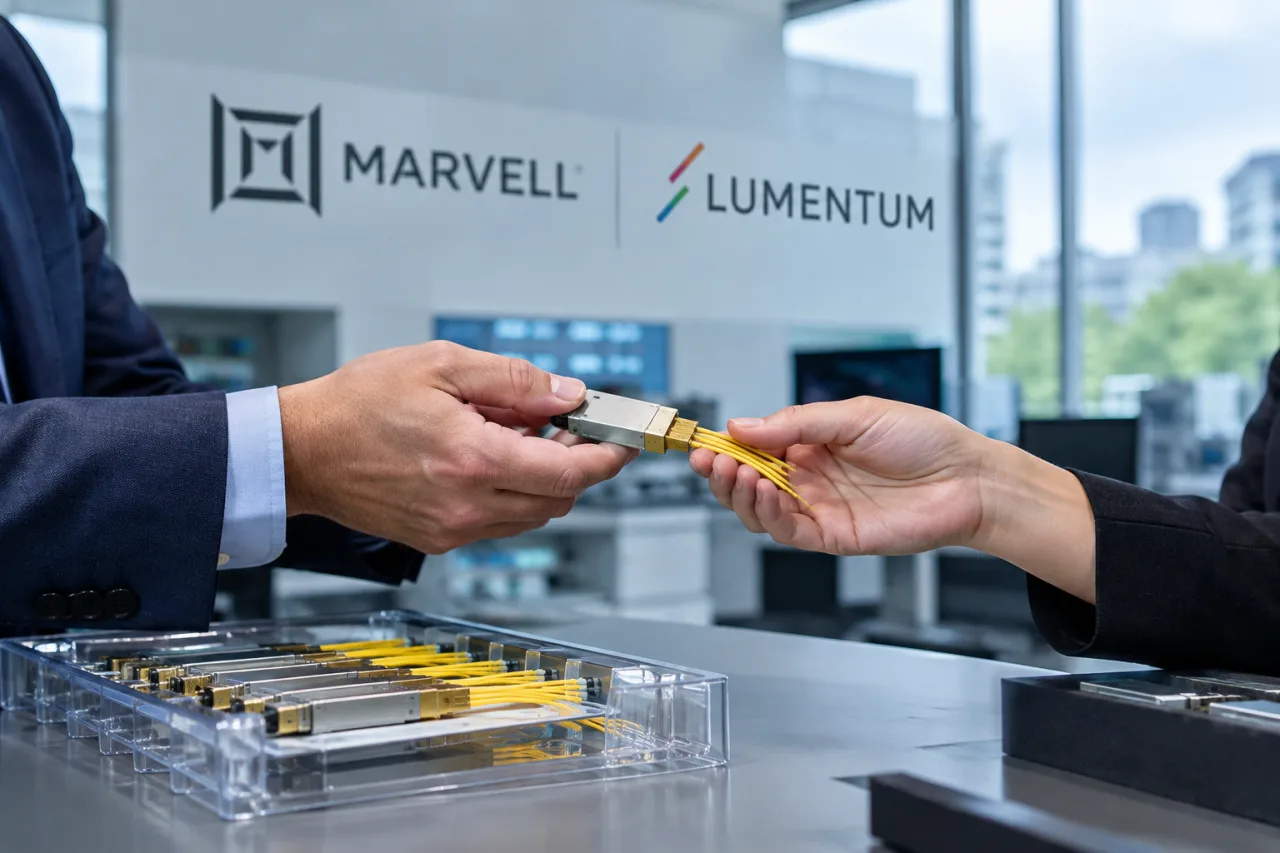
Marvell’s $115 billion bet on lasers is the AI infrastructure story of the week — and this guide explains exactly what Marvell bought and why. On November 2, 2026, Marvell Technology announced an all-stock acquisition of Lumentum — the maker of the optical components, network modules and commercial lasers whose photons carry data center traffic — at an implied enterprise value of $115 billion (4.5 Marvell shares per Lumentum share, closing expected H1 2028). The market’s verdict: both stocks fell more than 10% in a day, Marvell’s share price by 13%, as investors priced the dilution of paying in paper and the 33-times-earnings ratio Reuters calculated against a 16-times peer median. The strategic thesis is bigger than the tape: AI data centers need optical connectivity on a scale the electrical path cannot carry, and the buyer now owns the lasers’ maker. This guide dates the numbers, reads the Connectivity thesis, and prices the dilution math honestly.
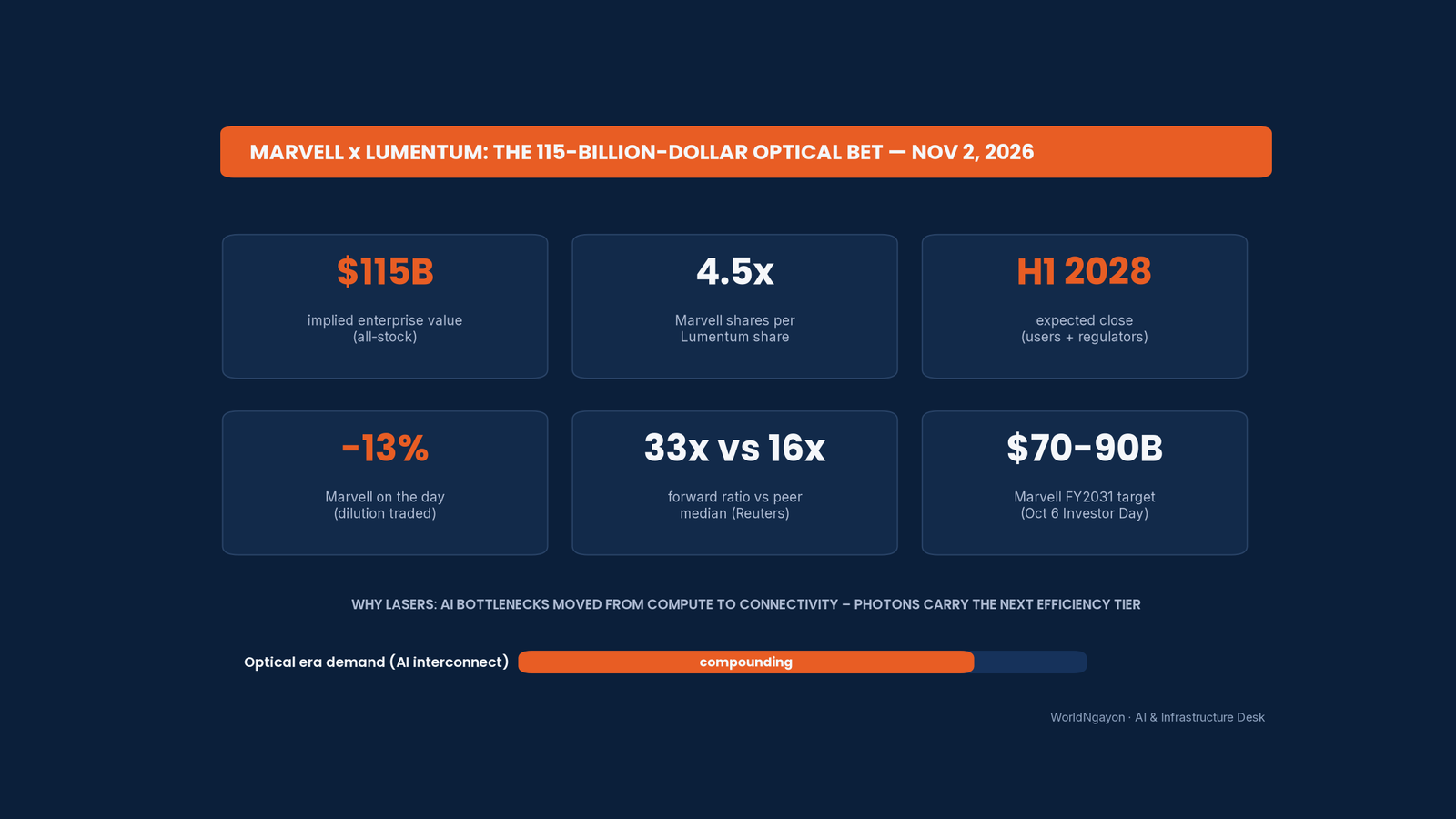
Table of Contents
Marvell lasers explained: the deal in one paragraph
What Marvell is buying, precisely: Lumentum builds the optics stack inside AI data centers — the laser chips that turn electrical signals into light, the network modules that move the traffic between racks and campuses, the components that co-packaged-optics switches and pluggable transceivers both consume. Marvell, a data-infrastructure chipmaker whose custom AI silicon book this site’s custom-chip analysis carries, says the acquisition combines “electrical and optical technologies” for the AI connectivity demand that is accelerating across regions and systems. Marvell has seen its market value more than triple in three years on AI enthusiasm; Lumentum’s stock more than doubled in 2026; the merger concentrates both books into one supplier when the industry’s binding constraint — interconnect power and capacity — is exactly where their portfolios overlap.
WorldNgayon Analysis: this deal is the supply-side answer to the interconnect layer’s physics (the CPO guide carries the technology shift; the rack-density analysis carries the gigawatt frame): the optical components market is where AI’s next efficiency comes from, and Marvell just paid a peer-median-busting multiple to own it. The 2028 close is the strategy’s maturity date — the AI campuses that matter then will be built on photons.
Bottom Line: the deal is a vertical integration play on AI’s light layer — the chips meet the lasers, and the customer list is the AI buildout.
The numbers: price, ratio, dates
| Figure | Value (as reported) |
| Deal value | $115 billion implied enterprise value (all-stock) |
| Exchange | 4.5 Marvell shares per Lumentum share |
| Announcement | November 2, 2026 — minutes after Lumentum reported $1.26 billion quarterly revenue (quarter ended September 26, 2026) |
| Market reaction | Both names fell more than 10% (Marvell −13%) on announcement day |
| Valuation ratio | ~33× forward core operating profitability vs ~16× peer median (Reuters, LSEG data) |
| Expected close | H1 2028 — subject to both shareholder bases and regulators |
| Marvell’s arc | Market value tripled in three years; FY2028 outlook $20 billion (raised Oct 6 Investor Day); FY2031 target $70-90 billion |
| Lumentum’s arc | Stock more than doubled in 2026 on AI-optics demand |
WorldNgayon Analysis: the ratio is the story the print headlines skip: paying 2× the peer-median multiple in stock converts Lumentum’s premium into the buyer’s share-price risk — every point of Marvell weakness before close reduces the effective price, and every point of weakness the DEAL causes reduces it further (the circular dilution the market traded on instantly). The crash-series discipline reads this trade class exactly the way the circular-financing coverage does (the money-circle pieces).
Bottom Line: 4.5 shares per share, 33× earnings, a 2028 close — the numbers price AI optimism in the buyer’s own currency.
Why lasers: the AI connectivity thesis
The thesis, in three moves: 1 — AI’s bottlenecks moved from compute to connectivity: a training run or an inference fleet spends as much of its power and latency budget MOVING data between chips, nodes and campuses as computing on it — the interconnect is where the next efficiency tier lives (the serving economics, the serving-layer guide). 2 — the optical conversion is winning: pluggable transceivers give way to co-packaged optics (the July 2026 mass-production record), clusters connect across campuses, and every step multiplies the demand for laser chips and optical modules — Lumentum’s product line. 3 — vertical integration captures the margin: the supplier who owns both the electrical silicon and the optical components sells the whole interconnect story; Marvell’s deal (and its earlier Celestial AI acquisition) buys the second half of its own stack.
The risk the thesis carries: optical integration concentrates on TSMC-class packaging bottlenecks (the CPO field’s named constraint), and the laser supply chain’s yields set the industry’s pace — Marvell’s bet assumes the bottleneck stays SOLD OUT through the integration (the bet’s shape is the same one the memory lane’s sold-out HBM4 story carries).
Bottom Line: AI’s next efficiency tier is optical — and the buyer just bought a second share of it.
Why the market sold it: the dilution math
The math, plainly: all-stock deals pay with buyer shares — 4.5 new Marvell shares for each Lumentum share — which dilutes EXISTING holders and gives the seller a claim whose value moves with the buyer’s stock. The market’s November-2 verdict (−13% Marvell, −10%+ both) priced three things at once: the dilution, the price-to-earnings gap (33× against a 16× peer median) and the integration risk of merging electrical and optical engineering cultures before an H1-2028 close. The honest counter-read: the market disliked the PRICE, not the STRATEGY — the same session’s tape carried Marvell’s earnings story and an infrastructure-spending rebound, which is why the deal’s arc lands as ‘expensive consensus’ rather than ‘strategic mistake’ in the analyst frames the coverage carried.
WorldNgayon Analysis: the deal-announcement-day pattern is the tape’s newest grammar (the money-trail pieces track it): big-ticket optical/AI consolidation trades DOWN on dilution fears and up on strategy confidence in the same week — the divergence between the print and the thesis is where the next month’s read lives. Watch the ratio, not the reaction: if Marvell’s shares recover ahead of close, the effective price falls and the deal’s math improves — the all-stock structure makes both parties shareholders in the same question.
Bottom Line: the market sold the price and kept the thesis — the spread is the story to watch through 2028.
What this means for work, money and the Philippines
For investors: the deal is a real-time lesson in reading AI infrastructure M&A: enterprise value in an all-stock deal is a MOVING number (the $115B headline already trades lower), the ratio matters more than the print, and the 2028 close is where the strategy gets graded (the watchlist discipline applies to the optical names and the buyer’s paper).
For careers: optical engineering and photonics-packaging roles are the merge’s talent map — laser chip design, optics test, SiPho packaging — the specialization the CPO field already hiring for (the AI-jobs analyses carry the wage logic).
For Filipino professionals and OFWs: the supplier side hires globally and the region’s data center buildout (the SEA analysis) imports the same optical generations — the connectivity layer’s careers are travel-capable (the Gulf and regional maps). And the peso lens (the playbook) carries what imported optical infrastructure bills the region that consumes it.
For builders: the co-packaged-optics transition (July 2026’s mass-production date) plus this consolidation says the 2027+ planning set is optical-first — price connectivity into every AI deployment proposal before the compute math (the rental-market guide carries the compute half).
Verdict: a late-2020s bet, priced today
Marvell’s $115 billion laser bet, settled: an all-stock second-largest-tech-deal-ever (4.5 shares per Lumentum share, announced November 2, 2026 minutes after Lumentum’s $1.26 billion quarter), repriced −10%+ in a day on dilution and a 33×-against-16× ratio, closing H1 2028 — buying the optical half of AI’s connectivity stack exactly when the CPO transition went to mass production and AI’s bottleneck moved from compute to interconnect. The market sold the price and kept the thesis; the thesis says AI campuses will be built on photons; the photons’ maker now answers to Marvell’s shareholders. A late-2020s bet, priced today — and the tape that hated the number will grade the strategy.
Sources on the record: the CNBC deal report · the StockTitan deal record.
Financial Disclaimer
This article is editorial analysis of publicly reported information, not investment or financial advice, and no outcome is promised. Figures and claims are as reported by the named sources at the stated dates; verify before acting. Markets and policy carry substantial risk.
Two more angles complete the Marvell lasers picture. First, the supplier’s own road: Lumentum’s quarter to September 26, 2026 printed revenue of $1.26 billion — the deal was announced MINUTES after that print — and the stock had more than doubled through 2026 on exactly the AI-optics demand the buyer is underwriting. Second, the roadmap the buyer disclosed to its own investors: at the October 6 Investor Day, Marvell raised its fiscal 2028 revenue outlook to $20 billion and set a $70-90 billion target for FY2031 — the Marvell lasers thesis is priced off those curves, with the optical portfolio compounding the custom-silicon book this analysis’ companion pieces document. The Marvell lasers story is the first $100 billion-plus optical acquisition of the AI era; read its price the way its structure reports it: 4.5 shares per Lumentum share, the ratio the market traded, and a close expected in the first half of 2028.
Two more angles complete the record: the buyer’s own M&A history and the deal’s industry context. 1 — the Celestial AI precedent: this year Marvell closed a multibillion-dollar acquisition of Celestial AI, the optical-interconnect startup — the Lumentum agreement is the SECOND optical bet inside twelve months, which turns the deal from a one-off purchase into a stated program: silicon, then interconnects, then lasers — the full light-layer stack. The program’s read: the buyer intends to sell connectivity as an integrated product, not as components. 2 — the industry context: the deal lands as the second-largest tech acquisition ever recorded, inside the same month the co-packaged-optics transition reached mass production and AI’s interconnect bottleneck became the industry’s planning constraint — the $115 billion is the price of being the supplier who owns both halves of an AI cluster’s data path. The Marvell lasers record also carries a governance note: an H1-2028 close means two years of integration under market scrutiny; the buyer’s shares (the deal’s currency) and the seller’s book (the deal’s asset) trade the same risk for two years — the merger arbitrage, the dilution debate and the strategy confirmation all live in that window, and each is a dated event this guide’s companion analyses track. The honest bottom line of the Marvell lasers story: consensus strategy, controversial price, structural signal — the optical era just got its balance sheet.
The M&A context, in one more layer: this transaction is the AI era’s largest optical consolidation and the second-largest technology acquisition on record — and it arrives with the buyer’s own balance of power on display. Marvell’s rise through the AI buildout priced its shares at triple the level of three years ago; Lumentum’s 2026 doubled on AI-optics demand; and the market’s skepticism on announcement day was precisely the kind of test every large AI-infrastructure deal in this cycle has faced — dilution worries against strategy conviction. The two-year integration window decides which force was stronger: the connectivity thesis needs the optical components the acquisition carries, the customer list needs the integrated product, and the AI campuses’ planning (the gigawatt frames in the companion analyses) has already adopted co-packaged-optics-class connectivity. Watch the ratio through close as the deal’s live price; watch the integration’s product announcements as the strategy’s receipts; and treat the whole Marvell lasers record as the supply chain’s own statement about where the AI economy’s next margin lives — not in the chips’ clocks, but in the photons that move their work.
- cnbc.com/2026/11/02/marvell-lumentum-ai-deal.html — the CNBC deal report
- stocktitan.net/articles/marvell-to-buy-lumentum-all-stock-deal-2026 — the StockTitan deal record
External sources linked in this article, in order of first mention. Spotted an error or a broken link? Tell us.
Cite this pagePublished Nov 4, 2026
Agron, E. (2026, November 4). Why Marvell Is Paying $115 Billion for Lasers: the AI Connectivity Deal. WorldNgayon. https://worldngayon.com/marvell-lumentum/
Agron, Edmon. “Why Marvell Is Paying $115 Billion for Lasers: the AI Connectivity Deal.” WorldNgayon, 4 Nov. 2026, worldngayon.com/marvell-lumentum/.
Agron, Edmon. “Why Marvell Is Paying $115 Billion for Lasers: the AI Connectivity Deal.” WorldNgayon, November 4, 2026. https://worldngayon.com/marvell-lumentum/.
Agron, E. (2026) ‘Why Marvell Is Paying $115 Billion for Lasers: the AI Connectivity Deal’, WorldNgayon, 4 November. Available at: https://worldngayon.com/marvell-lumentum/.
E. Agron, “Why Marvell Is Paying $115 Billion for Lasers: the AI Connectivity Deal,” WorldNgayon, Nov. 4, 2026. [Online]. Available: https://worldngayon.com/marvell-lumentum/
@online{agron2026marvelllumentum,
  author       = {Agron, Edmon},
  title        = {{Why Marvell Is Paying \$115 Billion for Lasers: the AI Connectivity Deal}},
  year         = {2026},
  date         = {2026-11-04},
  organization = {WorldNgayon},
  url          = {https://worldngayon.com/marvell-lumentum/},
  urldate      = {}
}TY - ELEC AU - Agron, Edmon TI - Why Marvell Is Paying $115 Billion for Lasers: the AI Connectivity Deal T2 - WorldNgayon PY - 2026 DA - 2026/11/04/ UR - https://worldngayon.com/marvell-lumentum/ Y2 - ER -
Cite the version you read; the page may be updated. Zotero and Mendeley can also import this page directly.