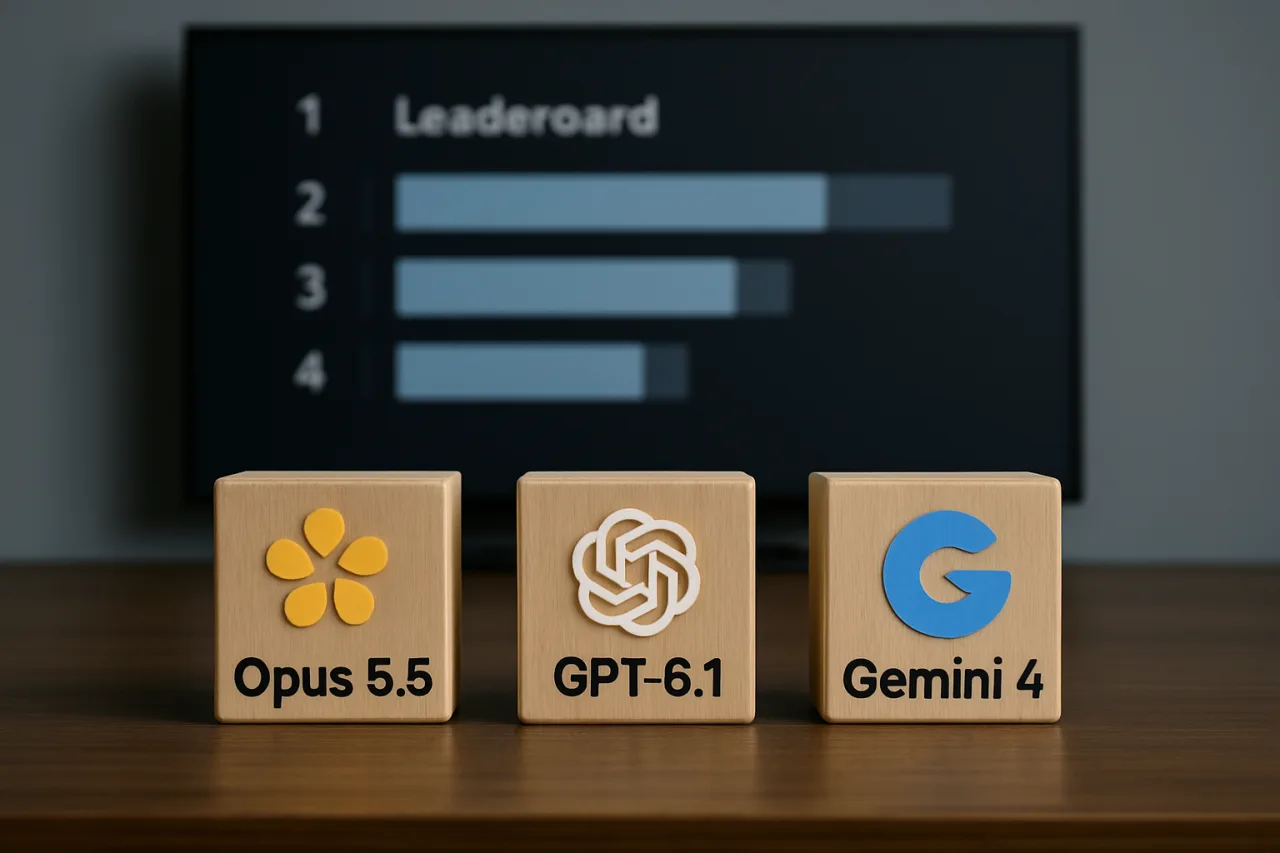
Three frontier models shipped inside five weeks and the LLM leaderboard cannot agree on which one leads. Google’s Gemini 4 Argon went fully public October 13; Anthropic’s Claude Opus 5.5 and OpenAI’s GPT-6.1 Sol arrived September 22; by October 21, LiveBench put a separate Anthropic model first, Anthropic’s own FrontierCode test scored Opus 5.5 ahead of GPT-6 Astra, and OpenAI’s cost-per-task math said GPT-6.1 Sol runs the same work at more than 4x cheaper. Every number is real. Every ranking contradicts the others. This guide decodes the LLM leaderboard mess: who leads on what measure, which claims are vendor-reported, and how to actually pick a frontier model when the benchmarks disagree – the practical question every builder, freelancer and enterprise buyer is asking this quarter.
Key Takeaway
- The LLM leaderboard problem: LiveBench ranks Claude Fable 5.1 first overall (88.0) with GPT-6 Astra second (86.1); Anthropic’s FrontierCode test has Opus 5.5 (54.6%) beating GPT-6 Astra (53.3%) at roughly one-fifth the cost per task; OpenAI’s own math prices GPT-6.1 Sol at $5.47 per task versus Opus 5.5’s $23.21. Different measures, different winners.
- The release crunch: Opus 5.5 and GPT-6.1 Sol both landed September 22; Gemini 4 Argon went global October 13; DeepSeek shipped a Flash update October 17 – any LLM leaderboard table older than a month describes superseded checkpoints.
- The tier truth: GPT-6.1 Sol is not OpenAI’s flagship – GPT-6 Astra holds that title, and Sol is the ‘near-Astra intelligence at one-fifth the token price’ tier, available inside ChatGPT Work and Codex rather than ordinary Chat.
- The price stack: Opus 5.5: $4/$20 per million tokens (40% less to run than Opus 5, per Anthropic); GPT-6.1 Sol: $2/$10 with $0.10 cached; Argon: $2/$10 introductory through November 30, then $4/$20 from December 1.
- The pick method: score on YOUR workload – the leaderboards disagree precisely because they measure different things, and the vendor numbers are directional, not audited.
The contenders: who shipped what, at what price
The LLM leaderboard season’s roster, with the specs that matter. Anthropic’s Claude Opus 5.5 (API id claude-opus-5-5, launched September 22) is the company’s flagship at $4 input/$20 output per million tokens, with Fast mode at $8/$40 offering roughly 2.5x speed; Anthropic frames its headline as cost – ‘40% less to run than Opus 5’ – backed by a 99%-evenhandedness internal evaluation claim and the release-notes history Anthropic keeps published ahead of the midterms. OpenAI’s GPT-6.1 Sol (gpt-6.1-sol, launched the same day) prices $2/$10 with $0.10 cached input, and lives inside ChatGPT Work and Codex tiers (Pro 100/200/500 plans, with the $500 tier bundling Ultrafast versions of both GPT-6.1 Sol and Astra); OpenAI’s own reporting prices it at $5.47 per task against Opus 5.5’s $23.21. Google’s Gemini 4 Argon (gemini-4-argon, global October 13 after a limited defender launch October 1 through the Fairwind program) carries the 1,000,000-token output jump – from Argon’s predecessor’s 64,000 – at $2/$10 introductory until November 30, then $4/$20. The consumer plans layer on top: Anthropic Pro $20, OpenAI’s three Pro tiers at $100/$200/$500 (documented October 22), Google’s AI Pro/Ultra with Antigravity access.
That roster is why the LLM leaderboard question got harder this month instead of easier: three new capable checkpoints inside five weeks, each priced for a different segment, each with its own access surface – and every comparison table that predates the month describes a different market.
What each leaderboard actually measures
The contradictions dissolve once you read what is being scored. LiveBench’s broad task suite ranks Claude Fable 5.1 – a separate Anthropic model, not Opus 5.5 – first at 88.0, with GPT-6 Astra at 86.1 carrying standout sub-scores (92.7 coding, 93.7 browser use) and GPT-6.1 Sol close behind at 85.4. Anthropic’s FrontierCode test measures something narrower and more commercial: whether an agent’s code changes would actually get merged – Opus 5.5 scored 54.6% at default effort, ahead of GPT-6 Astra’s 53.3% ‘at roughly one-fifth of the cost per task’ per Anthropic. OpenAI’s cost-efficiency math prices GPT-6.1 Sol at $5.47 per task at maximum reasoning effort versus $23.21 for Opus 5.5 – a 4x cost gap that is OpenAI-reported, from unspecified task sets, and explicitly directional. Anthropic also cites Zapier-built AutomationBench (cross-app business workflows) where Opus 5.5 outscored both Opus 5 and GPT-5.6 Sol at every effort level, and Perplexity’s WANDR for large data-collection tasks.
The meta-lesson of every LLM leaderboard is therefore definitional: ranking is a property of the test, not the world. Coding-merge tests crown Opus 5.5. Broad-suite indexes crown Fable 5.1 and Astra. Cost-per-task crowns Sol. Browser-use sub-scores crown Astra. A buyer who reads only the headline leaderboard inherits its definition of ‘best’ without agreeing to it.
The vendor claims, decoded
Three claims dominate the launch materials, and each needs its decoder. Anthropic’s ‘40% less to run than Opus 5’ is a workload-cost claim (efficiency plus price), not a token-price claim – the token prices fell 20% and the efficiency did the rest; treat the composite as directional. OpenAI’s ‘$5.47 per task versus $23.21’ is self-reported, lacks a published task set, and was reported the same month OpenAI priced GPT-6.1 Sol as a Work/Codex-native tier – a competitive framing aimed at exactly the buyers comparing against Opus-class prices. Google’s ‘1M output tokens’ is architectural, not comparative – no rival publishes a similar max-output ceiling, which makes the number impressive and unbenchmarked; the Vals Index ranking claim rides the same caution. Every vendor also runs a security-access program this quarter (Anthropic’s Cyber Verification tiers expanded October 6; Google’s Fairwind; OpenAI’s Pro-500 Ultrafast tier) – the LLM leaderboard for those programs is private by design, which readers should hold in mind when frontier-security claims circulate.
The honest cross-vendor note each lab’s own materials concede: independent verification lags announcement by weeks. The LLM leaderboard landscape of late October will look different by the time Anthropic’s prospectus-era spending numbers, OpenAI’s Work-tier adoption data and Google’s post-introductory pricing print.
The cost layer: where the leaderboards agree
Where the models themselves disagree, the economics agree – and our prompt-caching analysis tracks it in full: cached input converged at ~$0.10 per million tokens across all three labs, batch discounts halve asynchronous work on Anthropic and OpenAI, and Argon’s introductory rates run through November 30 before doubling. For agent workloads – the category all three labs now optimize for – the caching rate dominates the bill, which means the LLM leaderboard that matters for a budget is the cost-per-completed-task on YOUR traffic, where cache hit rates and batch eligibility reshape any benchmark ranking. The price table above is the frame; the bill is the referee.
How to pick a frontier model when the benchmarks disagree
The desk’s method, in five steps. One: define your workload’s actual mix – coding-merge tasks, browser workflows, long-output generation, cross-app automation – because the leaderboards already told you which test crowns which model for each. Two: benchmark on your own traffic before buying any plan tier – the vendor per-task numbers are directional; your tickets are audited. Three: price the caching architecture, not the token rate – two models with similar headline rankings can differ 4x on your real bill once cache behavior and batch eligibility enter. Four: match the access surface – GPT-6.1 Sol lives in Work/Codex not Chat; Argon rides the Gemini app and Antigravity; Opus 5.5 spans Pro through Enterprise – the LLM leaderboard never scores where the model actually runs. Five: date-stamp every decision – the release crunch means a selection made today gets re-adjudicated by the next flagship inside weeks; write the decision memo with the checkpoint IDs so the re-run is mechanical.
The quarter’s honest summary: the LLM leaderboard wars are a symptom of a market where three labs ship inside five weeks and every definition of ‘best’ got contested at once. The winners are the buyers who stopped reading rankings as verdicts and started using them as filters – the model you pick on your own workload, at your own measured cost, is the only leaderboard that pays out.
Two structural notes complete the decoder, because they outlast this month’s table. First: the LLM leaderboard industry now has three layers – the independent general suites (LiveBench-class), the vendor-built commercial tests (FrontierCode, AutomationBench, WANDR), and the private security-access evaluations behind the Fairwind/Cyber-Verification programs – and a buyer who understands which layer a claim came from already knows how much weight it can carry. Vendor-layer numbers are marketing-adjacent; independent-layer numbers are dated; private-layer numbers are unverifiable by outsiders. Second: the cadence itself is a signal. Three frontier releases inside five weeks from three labs that all cite each other’s prices and tests means the evaluation cycle has become the product cycle – the LLM leaderboard you read next month will describe different checkpoints, and the selection discipline that survives is the one anchored to your own workload benchmarks and your own measured bill, re-run on every new checkpoint ID like a software regression test. The desk’s standing advice to builders: keep a two-week rotation on your model selection memo, treat every leaderboard as a filter rather than a verdict, and let the cost layer’s convergence – the same $0.10 cached rate all three labs print – keep the switching cost near zero, because the only durable advantage in this market is the evaluation infrastructure you own.
FAQ
Which frontier model is the best right now?
There is no single answer: LiveBench ranks Anthropic’s Claude Fable 5.1 first (88.0) with GPT-6 Astra second; Anthropic’s FrontierCode coding-merge test has Opus 5.5 ahead of GPT-6 Astra at one-fifth the cost per task; OpenAI’s own math prices GPT-6.1 Sol at the lowest cost per task. The LLM leaderboard depends on what is measured.
Is GPT-6.1 Sol OpenAI’s best model?
No – GPT-6 Astra remains the flagship. GPT-6.1 Sol is positioned as near-Astra intelligence at roughly one-fifth the token price ($2/$10 per million with $0.10 cached), available inside ChatGPT Work and Codex rather than ordinary Chat, aimed at agentic coding, computer use and professional work.
What did Gemini 4 Argon change?
Argon went globally available October 13 (after an October 1 defender-only launch via Google’s Fairwind program), carries a 1,000,000-token output ceiling – up from 64,000 – and runs introductory $2/$10 pricing through November 30 before moving to $4/$20 from December 1.
How much does each frontier model cost?
Opus 5.5: $4/$20 per million input/output tokens with $0.20 cache reads and $8/$40 Fast mode; GPT-6.1 Sol: $2/$10 with $0.10 cached; Gemini 4 Argon: $2/$10 introductory through November 30, then $4/$20. Batch discounts halve asynchronous processing on Anthropic and OpenAI.
Are the vendor benchmark claims trustworthy?
Treat them as directional, not audited: every headline this cycle – FrontierCode, cost-per-task, the Vals Index, even the 99% evenhandedness score – came from the vendor’s own evaluation of its own model. The cross-checked pattern to hold: independent LiveBench results and vendor claims disagree on the same models, which is the disagreement this guide decodes.
How should a team choose between them?
Benchmark on your own traffic with your real tickets, price the caching architecture (where the labs agree) rather than the token rate (where the marketing lives), match your access surface – Work/Codex, the Gemini app, or the Claude platform – and date-stamp the decision with checkpoint IDs, because the next flagship re-runs the table inside weeks.
Sources & tables: tech-insider, the full LLM leaderboard tables (Oct 21-22, 2026) · Anthropic release notes (Opus 5.5, Sonnet 5.5, Oct 2026) · the cache-pricing convergence tables (Oct 22, 2026)