Table of Contents
Key Takeaway
- ⚖️ Full criminal coverage by market: Every major Southeast Asian market now criminalizes the cybercrimes that actually drain households (scams, unauthorized access, identity abuse), and 2026 added the enforcement powers to match: Singapore’s Scams (Countermeasures) Act reached first reading with service-blocking orders and penalties up to S$10 million, Vietnam enacted its anti-fraud law on June 18, 2026, and Malaysia’s five new cyber-offense provisions took effect June 1, 2025.
- 🏛️ The legal spine is shared: a criminal statute against unauthorized access and identity abuse (RA 10175 in the Philippines, the ITE Law in Indonesia, the Computer Misuse Act in Singapore), plus a growing fraud-specific layer on top.
- 📞 The reporting door is real and free: the Philippines’ CICC hotline 1326 and formal complaint route, Singapore’s police hotline, and each nationalCERT take reports that feed the enforcement statistics the region now publishes.
- 🧑💼 Penalties scale up the chain: individuals face years of imprisonment, entities face doubled fines, and 2026’s bills shifted duties onto platforms and service providers, not just consumers.
- ✅ Tonight-action: if you were hit, save the evidence (screenshots, numbers, transactions), call your national reporting line, and file with the named agency in this map, hours matter for fund-tracing.
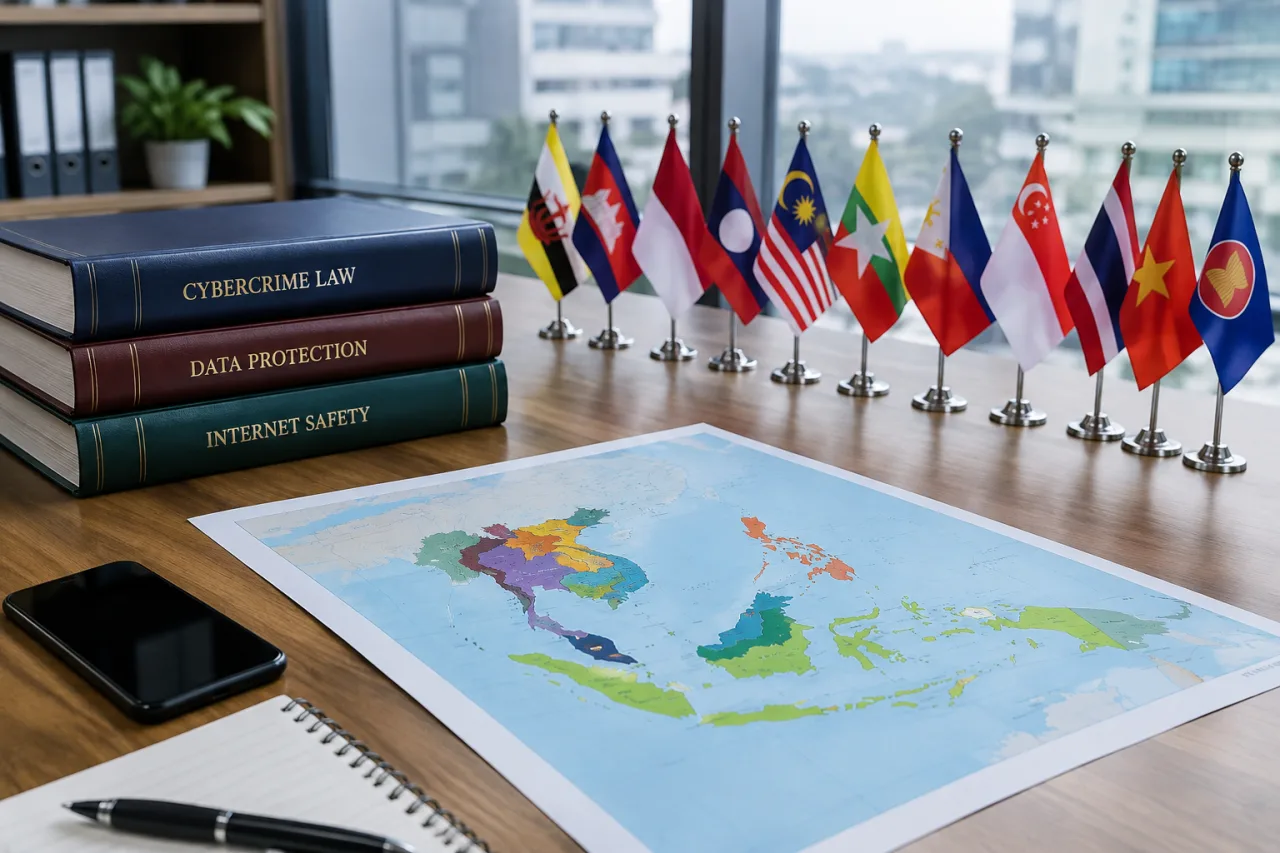
Cybercrime in Southeast Asia has a legal map, and 2026 redrew three of its corners; the regional cybercrime map now runs six statute sets and a new anti-fraud layer. The region’s baseline criminal statutes ran for more than a decade; the new layer criminalizes the fraud industry’s specific mechanics, imposes upstream duties on the platforms criminals abuse, and arms police with the blocking powers regulators debated for years. This guide walks the six-country map, cites each statute and its 2026-era amendments with their as-of moments, and ends with the reporting routes a victim actually uses after a cybercrime attempt. The law is one lane of the story; the scam-industry map and the Singapore scam-case coverage carry the rest.
The Cybercrime Laws Map: Six Statutes, One Table
| Jurisdiction (as of Nov 2026) | Core cybercrime statute | The 2026-2025 additions | Enforcement route |
|---|---|---|---|
| Singapore | Computer Misuse Act + Protection from Scams Act | Scams (Countermeasures) and Other Matters Bill (first reading August 4, 2026): service-limitation and account-disabling orders, entity fines doubled, penalties to S$10 million | Police + NCPC machinery |
| Philippines | Cybercrime Prevention Act (RA 10175) of 2012, IRR in force | House Bill 8048 (20th Congress) proposing a cybercrime and scam-prevention framework amending RA 10175 | CICC hotline 1326, PNP-ACG, NBI complaints |
| Indonesia | ITE Law (Law 11/2008 as amended 2024) | Enforcement pressure on the law’s criminal provisions continues (rights groups push for further amendment) | National police cyber directorate |
| Malaysia | 2010 act (online crimes) + 2024 amendment acts | Five new cyber-offense provisions effective June 1, 2025 (identity misuse, account control, fake credentials) | National scam response centre |
| Vietnam | Igara network-security + telecom statutes consolidated 2025-2026 | Vietnam’s anti-fraud law (June 18, 2026) targeting the scam industry’s production chain | Public-security cyber units |
| Thailand | Computer Crimes Act | Content-labelling and counterfeit-draft rules with fines to THB 5 million at the Cabinet gate | Police Technology Crime Suppression |
Every row above is dated “as of November 2026”, and the FAQ names the trigger events that force a refresh. The deep dives live in the linked cluster guides.
Singapore: the Enforcement-First Model
Singapore built the region’s most layered machinery: the Protection from Scams Act already armed the police with transactional freezing powers, and the new Scams (Countermeasures) and Other Matters Bill, filed for first reading on August 4, 2026, per the Baker McKenzie briefing and the Allen & Overy analysis, shifts more burden upstream: service-limitation and account-disabling orders, corporation-scoped offenses with doubled entity fines, and maximum penalties reaching S$10 million, per the parliamentary analysis. The design premise: most scam victims hand over funds through channels platforms control, so the law now obliges those channels to slow the drain, not just the consumer to notice it. Our companion privacy-laws map covers the sibling rule.
Philippines, Malaysia, Vietnam: the Statute-and-Amendment Tier
The Philippines runs the region’s named hotlines (CICC’s 1326, the filing route per the complaint walkthrough) on RA 10175’s criminal spine, and the 20th Congress carries House Bill 8048, a scam-prevention framework amendment, per the bill text. Malaysia’s 2024 amendment acts switched on June 1, 2025 with five new offense provisions for the identity- and account-abuse mechanics regional frauds rely on. Vietnam’s consolidated network-security and telecom statute stack gained the region’s newest dedicated anti-fraud law on June 18, 2026, aimed at the production chain (mule accounts and scripts) rather than victims’ mistakes. Indonesia’s ITE Law remains the active criminal base for cybercrime prosecutions, with enforcement documented by the national police’s cyber directorate, and its ongoing criminal-terms debate tracked by the ICJ review.
What the Laws Actually Cover
Across the six statutes, the criminal lanes of cybercrime repeat with local names:
- Unauthorized access and interference. The original core: hacking, damaging, or intercepting computer data. Penalties run from months to years of imprisonment depending on the harm.
- Identity and account abuse. Using another person’s credentials or account without consent, the mechanics behind the region’s account-takeover losses, and the 2026 amendment targets in Malaysia and Singapore.
- Electronic fraud and misrepresentation. The scam-call and phishing substance: inducing transfers by false pretenses, now with entity-level liability for platforms that fail the blocking duties.
- Content and communication offenses. The ITE-style provisions (defamation-style and fake-news-adjacent clauses) that human-rights bodies keep challenging, the region’s recurring civil-liberties friction in the map.
Civil and administrative routes (privacy probes, PDPC-style actions) run alongside, covered in the privacy-laws map.
Victim Playbooks: What to Do After Being Hit
The law only pays out through its reporting doors, and each market’s route works the same:
- Freeze first. Call your bank’s fraud line immediately; the first hour decides whether the transfer can be recalled.
- Report to the named route. The Philippines: hotline 1326, then PNP-ACG or NBI with the formal complaint. Singapore: police hotline or the online portal. Malaysia: the national scam response centre. Indonesia: the police cyber directorate. Vietnam: provincial public-security units. Thailand: Technology Crime Suppression.
- Preserve the chain. Screenshots, call logs, transaction records, and the account names you interacted with, the evidence a fraud case turns on.
- Expect the platform action. Under the 2026-era duties, the platform that moved the funds owes a blocking response in several markets, which is why reporting fast raises recovery odds.
The reporting step also feeds the enforcement statistics the region now publishes, and the prevention side runs through the checklists in our response-plan guide and the passkeys switch.
Maintenance Triggers for This Map
The cybercrime statute rows refresh on named events: Singapore’s bill passing second and third readings (expected before the year ends, given its August filing), the Philippine amendment’s progress in the 20th Congress, Thailand’s content rules clearing the Cabinet gate, and each national CERT’s annual-enforcement report. Those four events decide whether the 2027 edition of this map opens differently from this one.
How the Statutes Meet the Scam Industry
The map turns practical when you read it against the scam industry’s four mechanics, and each mechanic now meets a named criminal provision somewhere in the table:
- The mule layer. Fraud proceeds move through recruited account holders and shell accounts; the 2026-era amendments (Malaysia’s account-control offense, Vietnam’s June 2026 anti-fraud law, the new corporate offenses in Singapore’s bill) now target the accounts and the recruiters, not just the final cash-out, and the corporate-liability provisions pull the platforms that moved the transfers into the case when they ignore the block signals.
- The script layer. Impersonation content, cloned voices, screen-shared authority theatrics, AI-produced proof pages, meets electronic-fraud provisions on content used to induce transfers; the production itself stays legally harder to reach, which is why the reporting routes and takedown machinery matter as much as criminal statutes.
- The cash-out layer. Cryptocurrency conversion and cross-border remittance meet anti-money-laundering statutes layered on top of the cybercrime codes; the freeze powers in Singapore and Malaysia operate here, inside the same first-hours window the reporting guides teach.
- The recruitment layer. Trafficked workers inside regional fraud compounds meet human-trafficking statutes, and the enforcement actions that dismantle compounds pair police work in Thailand and Myanmar corridors with the regional cooperation frameworks our scam-compounds guide follows.
The consequence for a business operating regionally: the statutes now touch the corporate tier (service providers, money movers, platforms), so compliance is no longer a consumer-affairs footnote but a board-level cybercrime exposure with entity-fine ceilings in at least one market.
And for a household: the protections read the same whether or not a particular statute names your exact scam variant, because the fraud-inducing-transfer provisions plus the platform-blocking duties plus the freeze orders cover the practical sequence a victim runs through. Law is one lane, the fastest available one when the freeze window is open, and the industry map shows why prevention still beats any recovery the statute stack can deliver.
The comparison habit stays: check the table before any regional expansion or new payment-product launch, because the entity-level exposures (platform duties, doubled fines, service-limitation orders) now bind companies inside three of the six rows, on the way to six.
A third read the enforcement files reveal: prosecution paths diverge by market speed. Singapore’s courts handle the highest case volumes per statute because the police machinery plus the platform duties create earlier, better-documented files; the Philippines’ cybercrime units juggle the region’s largest complaint intake against a smaller specialist bench, which is why the hotline’s triage step matters; and Indonesia’s enforcement carries the ITE Law’s contested clauses alongside its fraud convictions, producing a mixed public record. None of this changes what a victim’s first hour should be, because the freeze-plus-report sequence is jurisdiction-proof, but it explains why identical scams produce different case outcomes across the map, and why the 2026 amendments aiming at platforms matter more for the region’s aggregate numbers than any single statute change.
Employers carry one more duty from this map: staff who handle transfers (finance, HR, support) now sit inside the blocking-duty perimeter, because platform-side inaction draws entity liability in Singapore’s regime and market expectations elsewhere. A payment-change request received over email, verified by a dial-back call, documented in the ticket, is both the anti-fraud habit and the evidence of diligence a corporate file needs in any of the six jurisdictions. The response-plan guide builds this in an afternoon, and the passkey switch removes the weakest credential that these request scams aim for.
Two enforcement-data notes close out the cybercrime map. First, the region’s annual enforcement reports now publish hard counts rather than press releases: national CERT summaries, police cyber-directorate tallies, and platform-transparency disclosures together form the countable layer our breach-numbers guide indexes. These numbers have their own methodology (reports filed, actions opened, conviction counts), and reading them across years is the plain way to see whether the statute rows above are changing outcomes. Second, the trend line in the reports supports the map: enforcement actions cluster around the mule and cash-out layers, while the script layer (AI-fabricated content) grows faster than the case files can process, which is exactly why the 2026 legislative wave shifted duties upstream, and why this map pairs every statute row with the reporting routes that make it usable.
FAQ
Which law covers online scam money transfers in the Philippines?
RA 10175 (the Cybercrime Prevention Act) criminalizes the fraud mechanics, and the 20th Congress carries House Bill 8048 proposing a dedicated scam-prevention framework. Victims report through CICC hotline 1326, then file formal complaints with PNP-ACG or the NBI.
What changed in Singapore’s anti-scam laws in 2026?
The Scams (Countermeasures) and Other Matters Bill, filed August 4, 2026, adds service-limitation and account-disabling orders, applies new offenses to corporations with doubled entity fines, and raises maximum penalties to S$10 million, shifting enforcement duty toward the platforms and channels that carry scam transfers.
Is using someone else’s account a crime in the region?
Yes across all six major markets: identity and account abuse sits in Malaysia’s new offense provisions (June 1, 2025), Singapore’s amendments, the Philippines’ RA 10175, and each statute stack’s unauthorized-access clauses, with penalties that scale with harm.
Do the laws help recover lost money?
Partially and fast, if the report is fast: the freeze-and-block powers in Singapore and Malaysia work directly on transfers, and every market’s first step (calling the bank, then the reporting line) exists precisely because the recall window inside the first hours decides the outcome. The law’s recovery power is real but time-bound.
Where is the region’s civil-liberties friction?
Indonesia’s ITE Law draws continuing criticism over its criminal speech clauses, per the ICJ review, and similar content provisions in other statutes face periodic challenge. The enforcement architecture and the speech clauses debate run in parallel, and this map tracks both lanes.
What should I do right now to be ready?
Save the reporting numbers for your market from the table (hotline 1326 in the Philippines is the regional reference case), turn your banking second factor into a passkey or token, and run the two-sentence verify-first habit from the defense guide. Preparation takes an evening; its value arrives the day a call tries you, and the map above is the evening’s checklist: one statute table, one reporting route, one rehearsed response.
- bakermckenzie.com/en/insight/publications/2026/08/singapore-new-anti-… — Baker McKenzie briefing
- allenandgledhill.com/sg/perspectives/articles/33556/sgkh-scams-counte… — Allen & Overy analysis
- respicio.ph/commentaries/where-to-file-a-cybercrime-complaint-in-the-… — complaint walkthrough
- docs.congress.hrep.online/legisdocs/basic_20/HB08048.pdf — bill text
- icj.org/indonesia-newly-revised-ite-law-threatens-freedom-of-expressi… — ICJ review
External sources linked in this article, in order of first mention. Spotted an error or a broken link? Tell us.
Cite this pagePublished Nov 12, 2026
Agron, E. (2026, November 12). Cybercrime Laws in Southeast Asia: the Country-by-Country Map. WorldNgayon. https://worldngayon.com/cybercrime-laws-southeast-asia/
Agron, Edmon. “Cybercrime Laws in Southeast Asia: the Country-by-Country Map.” WorldNgayon, 12 Nov. 2026, worldngayon.com/cybercrime-laws-southeast-asia/.
Agron, Edmon. “Cybercrime Laws in Southeast Asia: the Country-by-Country Map.” WorldNgayon, November 12, 2026. https://worldngayon.com/cybercrime-laws-southeast-asia/.
Agron, E. (2026) ‘Cybercrime Laws in Southeast Asia: the Country-by-Country Map’, WorldNgayon, 12 November. Available at: https://worldngayon.com/cybercrime-laws-southeast-asia/.
E. Agron, “Cybercrime Laws in Southeast Asia: the Country-by-Country Map,” WorldNgayon, Nov. 12, 2026. [Online]. Available: https://worldngayon.com/cybercrime-laws-southeast-asia/
@online{agron2026cybercrimelaws,
  author       = {Agron, Edmon},
  title        = {{Cybercrime Laws in Southeast Asia: the Country-by-Country Map}},
  year         = {2026},
  date         = {2026-11-12},
  organization = {WorldNgayon},
  url          = {https://worldngayon.com/cybercrime-laws-southeast-asia/},
  urldate      = {}
}TY - ELEC AU - Agron, Edmon TI - Cybercrime Laws in Southeast Asia: the Country-by-Country Map T2 - WorldNgayon PY - 2026 DA - 2026/11/12/ UR - https://worldngayon.com/cybercrime-laws-southeast-asia/ Y2 - ER -
Cite the version you read; the page may be updated. Zotero and Mendeley can also import this page directly.