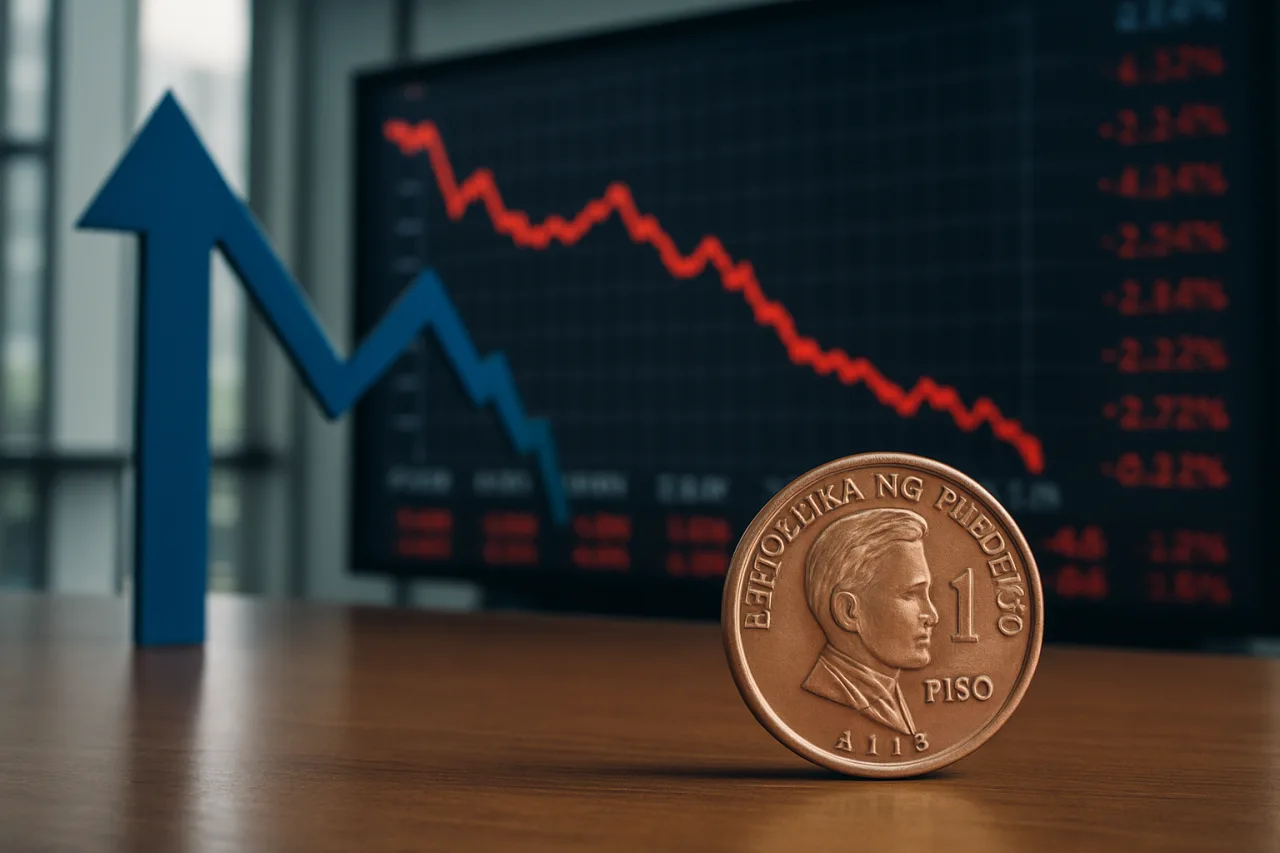
The PSEi closed at 5,813.35 on Thursday’s session with the PSE’s own board showing +0.26% on the day, but the tape around the BSP’s 50-basis-point jumbo told the real story: the peso printed a fresh fix at ₱63.4190 to the dollar, the PSEi had already shed 0.73% as the peso weakened through the week’s run-up, and the market’s first verdict on the biggest rate move of the cycle is best read across three numbers – the index that barely moved, the currency that did, and the reserves that fund the defense. Governor Eli Remolona chose this exact week to restate the central bank’s hands-off approach to defending the peso – monetary policy, he said, is not used to support the currency – which is precisely the sentence that turns a rates story into a stock-market story. This piece reads the PSEi, the peso and the reserve picture as one tape.
Key Takeaway
- The week’s verdict: the PSEi’s 0.73% fall through the peso’s slide and Thursday’s +0.26% finish at 5,813.35, alongside a ₱63.4190 reference rate – the market’s first reading of the BSP’s 50-basis-point jumbo is: rates moved, equities shrugged, the currency did not.
- The governor’s line: Remolona restated that the BSP does not use monetary policy to support the peso – the hands-off doctrine that keeps the burden of the peso’s floor on reserves, rates and growth, not on FX intervention.
- The rate path: four straight increases to 5.50%, with the PNB house view published earlier this cycle seeing the possibility of the cycle ending after this hike – and the peso-slide scenario pushing the policy rate toward 6.00% by year-end if the Middle East conflict escalates.
- The reserves: gross international reserves settled at US$99.5 billion and the September balance-of-payments deficit printed at $3.1 billion – the defense budget behind the peso, now public.
- The remittance side: OFW cash remittances rose 1.9% year-on-year to $3.03 billion in August – the corridor that feeds the reserves while the peso tax hits its imported spending.
The three numbers that scored the week
The PSEi’s prints this week need context to read. The index fell 0.73% as the peso weakened into the decision window – the market pricing the hike before it landed, as the peso probed fresh intraday lows (63.23 intraday last Friday, record closes around 63.06) and analysts priced the magnitude question: 25 or 50 basis points. Then Thursday delivered the jumbo to 5.50% and the PSEi finished +0.26% at 5,813.35 – the index neither rewarded the defense nor punished it, which is itself the signal: the local equity market had already priced the tightening path and traded the decision as settled. The peso did not settle: the reference print at 63.4190 keeps the currency within a basis point of the record zone, and the intraday trading since has been a holding action.
Context for the PSEi’s resilience: regional peers spent the same week in retreat – Kospi losing 3.5% on the AI-financing question, Hang Seng down 3% with CSI 300 entering bear-market territory, Nikkei -2.7% – so a flat-to-slightly-green local index against that global tape is outperformance by construction. The PSE’s relative stability tracks its composition: the index’s heavyweights are banks and conglomerates whose rate sensitivity runs both directions, with the banks’ net-interest-margin story improving in a rising-rate cycle even as the loan-demand story softens – a wash the global tech-heavy indices do not carry.
Why the PSEi barely moved while everything else did
Three mechanics explain the flat score. First: the PSEi’s rate story was front-run – four consecutive hikes into 5.50% meant Thursday’s jumbo was the expected-sized surprise at the high end the peso-slide commentary had set up, and markets trade surprises, not confirmations. Second: the banks bid their own story – a 50-basis-point move lifts loan and deposit repricing on books that had been squeezed by the earlier tightening, and the PSEi’s heavyweight banks dominate the tape’s volume. Third: the external tape’s own volatility (the AI-financing question that hammered Asian tech) does not map onto the PSEi’s composition the way it maps onto Seoul or Hong Kong; the local index traded a domestic rates story inside an imported volatility storm, and the domestic story resolved Thursday. The honest caveat: flat against a falling regional tape in a risk-off week is not the same as strength – it is insulation, and insulation works until the imported risk finds a local door: the peso itself.
The reserve picture: the number that frames the peso’s floor
Two BSP prints this week framed the peso’s defense budget for the market. Gross international reserves: US$99.5 billion. September balance-of-payments: a $3.1 billion deficit, part of a projected full-year BOP shortfall the central bank itself sees reaching $9.2 billion this year and $8.5 billion in 2027, driven by elevated oil prices and transport flows. The arithmetic the PSEi’s investors should hold: reserves near $100 billion cover many months of imports and the year’s projected deficits combined – the floor exists – but the direction of the flows (deficits two years running, oil elevated, El Niño ahead) is the pressure the 50-basis-point move was built to slow. The governor’s hands-off-peso line completes the frame: without FX intervention as a tool, the peso’s stabilization runs through exactly these channels – rates that make peso assets attractive, reserves that backstop confidence, and the current-account inflows led by remittances.
The analyst chorus around the decision matters for the next prints too: BPI’s commentary earlier in the window tied the hike’s size to the peso’s path; the PNB house view sees the tightening cycle possibly ending after this jumbo in its base case with a 6.00% year-end tail if the conflict escalates; and the former-Deputy-Governor advocacy for exactly this size landed the week before. The market’s next PSEi move prices whichever of those paths the next data confirms.
The OFW corridor: the other side of 63
The same peso that pressures the index enriches the corridor. OFW cash remittances rose 1.9% year-on-year to $3.03 billion in August, bringing eight-month inflows higher – dollar earnings converting at 63 pesos do more household work than the same dollars did at 58, and the remittance stream feeds exactly the reserves the peso’s floor rests on. The corridor’s costs are the negotiable slice – our two-percent remittance-fee coverage tracks that battle – while the peso’s level is the volatile one the corridor cannot control, only time. The household playbook stays the same as our weak-peso guide: convert on corridor strength, price imported groceries as a separate budget line, and treat the BSP jumbo hike’s deposit-rate knock-ons as the household’s own rate-capture opportunity. The corridor is the market’s quiet counterweight: every remittance at 63 is a small participant in the same defense the governor just described – no intervention, just flows.
What to watch into the next two meetings
Four tells for the PSEi’s next move. One: the October inflation print – 7.2% for September was the acceleration that set the jumbo up; October’s number decides whether 5.50% is the ceiling or the plateau, and the El Niño supply question sits behind it. Two: the peso’s closing path around 63 – the BPI framing made the currency the hike’s size-determinant, and it remains the next decision’s size-determinant. Three: the banks’ repricing behavior – loan rates up, deposit rates chasing, and the N-margin story the PSEi’s heaviest sector trades on. Four: the global AI-financing tape – imported volatility found no local door this week, but a deepening global risk-off finds one eventually through flows. The PSEi traded this week like an index whose story resolved on schedule; the next two BSP meetings decide whether that schedule holds.
Financial Disclaimer
This article is market analysis for general information, not financial advice or a solicitation. Index levels, currency rates, reserve flows and policy decisions described here reflect sources believed reliable at publication and change without notice; equity and currency positions carry risk including loss of principal. Nothing here recommends buying, selling or holding any security. Consult licensed financial professionals – and for Philippine readers, PSE-accredited brokers or BSP-regulated institutions – before acting. WorldNgayon holds no positions in any security discussed.
FAQ
How did the PSEi react to the BSP’s 50-basis-point hike?
The PSEi had already fallen 0.73% as the peso weakened into the decision, then finished +0.26% at 5,813.35 on the day the jumbo printed – flat against a sharply falling regional tape, which reads as the market having priced the tightening path in advance.
What is the peso doing after the BSP jumbo hike?
The peso’s reference print held at ₱63.4190 to the dollar the day after the decision, inside the record zone it probed all week (intraday lows past 63.15-63.23). Governor Eli Remolona restated the BSP’s hands-off approach: monetary policy is not used to defend the peso.
Why didn’t the PSEi fall like other Asian markets?
Insulation, not strength: the regional crash was tech-financing-driven (Kospi -3.5%, Hang Seng -3%, CSI 300 into a bear market) and the PSEi’s bank-and-conglomerate composition trades a domestic rates story – plus the local index had front-run four straight hikes. Banks’ net-interest margins improve in a rising-rate cycle even as loan demand softens.
What are the Philippines’ reserves after the hike?
Gross international reserves settled at US$99.5 billion, with a $3.1 billion September balance-of-payments deficit and projected BOP deficits of $9.2 billion this year and $8.5 billion in 2027 – the defense budget behind the peso’s floor, now public ahead of the currency’s next tests.
What does this mean for OFW families?
The peso at 63 raises each dollar remittance’s peso value – OFW cash remittances rose 1.9% to $3.03 billion in August – while imported goods carry the weak-peso tax. The corridor playbook: convert on strength, optimize fees on the rails that exist, and capture the deposit-rate knock-ons of the BSP jumbo hike.
Sources: Daily Tribune, BSP jumbo rate-hike topic page (Oct 22, 2026) · SunStar, BSP hikes rates by 50 basis points (Oct 22, 2026) · BSP.gov.ph key rates and reserves pages (accessed Oct 22-23, 2026; site 403s automated readers, cited by name)