Table of Contents
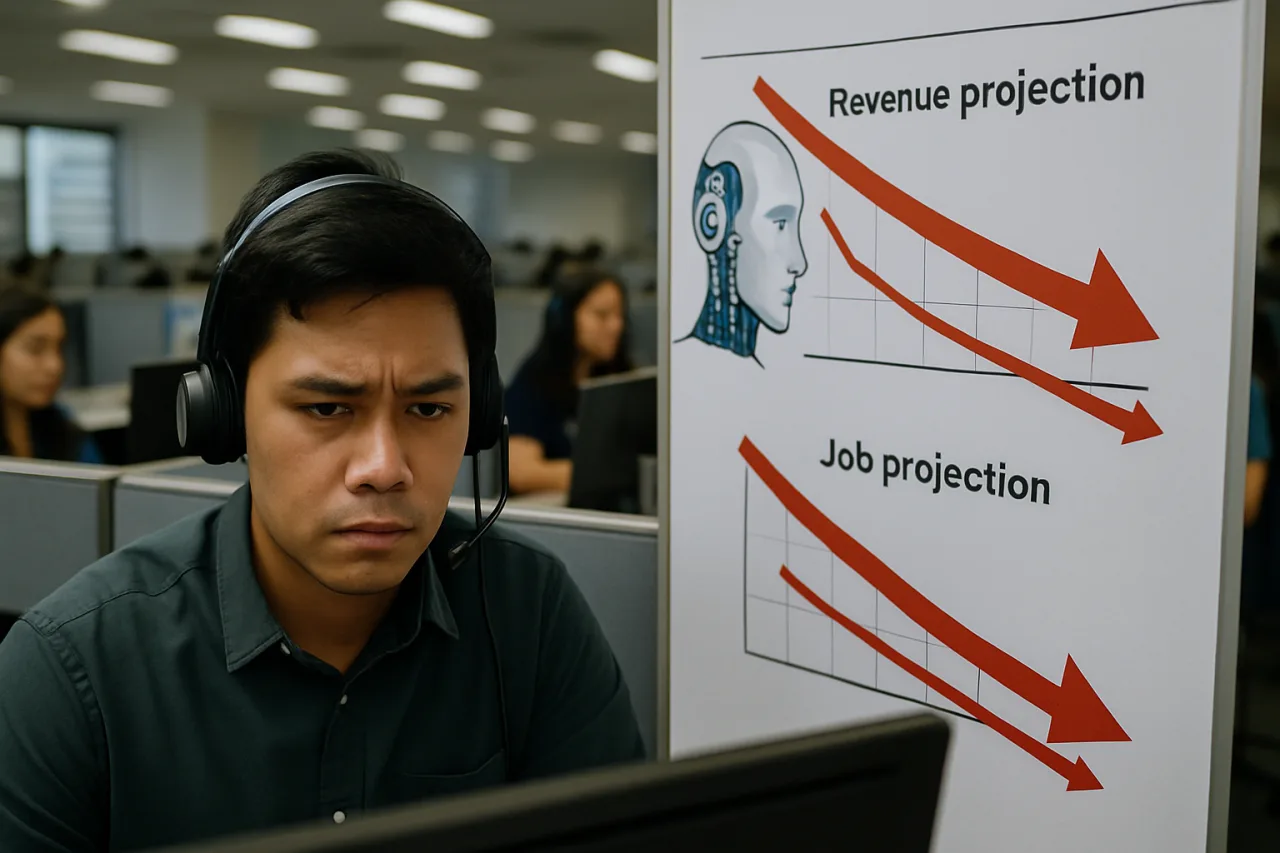
The Philippine IT-BPM industry has slashed its 2028 revenue and employment targets, citing rapid AI adoption and intensifying global competition. The IT-BPM target cuts reduce the original $59 billion revenue projection to a best-case $50.5 billion and a downside scenario of $43.3 billion, while employment projections dropped from 2.5 million to a range of 1.85 million to 2.14 million workers. For the 1.9 million Filipinos currently employed in the sector, these IT-BPM target cuts signal a fundamental restructuring of the industry that demands new skills, new specializations, and new career strategies.
Key Takeaway
- 📉 Revenue targets cut: IBPAP reduced 2028 revenue projections from $59 billion to $50.5 billion (best-case) or $43.3 billion (downside) — a reduction of up to $15.7 billion from original targets.
- 👥 Employment targets cut: 2028 employment projections dropped from 2.5 million to 1.85-2.14 million workers, with 2027 headcount now expected at 1.99 million (down from 2.0-2.3 million).
- 🤖 AI is the driver: IBPAP President Jack Madrid cited rapid AI adoption, changes in buyer behavior, and heightened global competition as the three forces behind the IT-BPM target cuts.
- 💼 2026 remains strong: Despite the cuts, 2026 revenue is projected at $42.3 billion with 1.95 million workers — the industry is not shrinking, but growing slower than originally planned.
- 🎯 Career action: Filipino BPO workers must transition from routine tasks to AI-enabled roles — upskilling in AI tools, data analysis, and specialized domain knowledge is now essential for job security.
What Are the IT-BPM Target Cuts and Why Do They Matter?
The IT-BPM target cuts were announced on July 15, 2026, by the Information Technology and Business Process Association of the Philippines (IBPAP), the umbrella organization representing the country’s IT-BPM sector. According to BusinessWorld Online, IBPAP President and CEO Jack Madrid presented revised projections that significantly lower the industry’s 2028 revenue and employment targets from the original roadmap.
Under the previous roadmap, IBPAP had projected $59 billion in revenues and 2.5 million full-time employees by 2028. The revised roadmap presents two scenarios. In the best-case scenario, the industry generates $50.5 billion in revenues with 2.14 million workers. In the downside scenario, revenues reach $43.3 billion with 1.85 million workers. The reduction represents a cut of up to $15.7 billion in projected revenue and up to 650,000 fewer jobs than originally planned.
For 2027, IBPAP now expects revenues of $45.3 billion and headcount of 1.99 million — lower than the original baseline estimate of $44.8-$53.3 billion in revenue and 2.0-2.3 million workers. For 2026, the industry is projected to reach $42.3 billion in revenue with 1.95 million workers, according to the Manila Bulletin. This means the industry is still growing — but at a significantly slower pace than originally expected.
Why IBPAP Cut the IT-BPM Targets: Three Forces
IBPAP President Jack Madrid identified three primary forces driving the IT-BPM target cuts. Each represents a structural shift in the global outsourcing industry that Filipino professionals must understand.
1. Rapid AI Adoption
Artificial intelligence is transforming how BPO work gets done. Tasks that previously required human agents — customer service, data entry, content moderation, basic technical support — are increasingly being automated by AI systems. This doesn’t mean AI is replacing all BPO workers, but it does mean fewer workers are needed for routine tasks, while new roles are emerging for those who can manage, train, and oversee AI systems. The impact of AI on Filipino BPO workers has been a growing concern, and these target cuts confirm that the disruption is real and measurable.
2. Changes in Buyer Behavior
Global companies that outsource to the Philippines are changing how they buy BPO services. Instead of large, long-term contracts for hundreds of agents performing routine tasks, buyers are increasingly seeking smaller, specialized teams with higher-value skills. They want AI-enabled workers who can handle complex tasks, use AI tools to improve productivity, and deliver outcomes rather than simply processing transactions. This shift reduces the total headcount needed while increasing the skill requirements for each position.
3. Heightened Global Competition
The Philippines is no longer the only game in town for BPO services. India continues to dominate the market. Vietnam, Malaysia, and Eastern European countries are competing aggressively for outsourcing contracts. AI-powered tools are enabling nearshore and onshore alternatives that were not viable before. The combination of AI automation and competitive pressure from other countries means the Philippines must offer higher-value services to maintain its market position.
The Numbers: Old Targets vs. New Targets
| Metric | Original Target (2028) | Best-Case (2028) | Downside (2028) | Cut Amount |
|---|---|---|---|---|
| Revenue | $59 billion | $50.5 billion | $43.3 billion | -$8.5B to -$15.7B |
| Employment | 2.5 million FTEs | 2.14 million FTEs | 1.85 million FTEs | -360K to -650K jobs |
| 2027 Revenue | $44.8-$53.3B | $45.3B | $45.3B | Adjusted |
| 2027 Employment | 2.0-2.3 million | 1.99 million | 1.99 million | Reduced |
| 2026 Revenue | — | $42.3 billion | $42.3 billion | Current year |
| 2026 Employment | — | 1.95 million | 1.95 million | Current year |
What the IT-BPM Target Cuts Mean for Filipino Workers
The IT-BPM target cuts are not a doomsday scenario — the industry is still projected to grow from $40 billion in 2025 to $42.3 billion in 2026. But the cuts signal that the era of effortless BPO job growth is over. Filipino workers who want to thrive in the evolving IT-BPM sector need to adapt.
Transition from Routine to AI-Enabled Work
The workers most at risk from the IT-BPM target cuts are those performing routine, repetitive tasks that AI can automate. Customer service agents handling basic inquiries, data entry clerks, and content moderators performing simple classification tasks are in the most vulnerable positions. The path forward is to become an AI-enabled worker — someone who uses AI tools to handle routine tasks while focusing their own effort on complex problem-solving, emotional intelligence, and quality assurance. The AI remote work transformation is already reshaping which tasks get automated and which roles get created.
Develop Specialized Domain Knowledge
As buyers shift from large generic teams to smaller specialized teams, workers with deep domain expertise become more valuable. Healthcare BPO workers who understand medical terminology and HIPAA compliance. Financial services BPO workers who understand banking regulations and fraud detection. Technology BPO workers who understand cloud infrastructure and cybersecurity. The AI career Philippines landscape rewards those who combine AI literacy with specialized industry knowledge.
Invest in AI Skills and Certifications
The IT-BPM target cuts make AI skills not optional but essential. Workers who can use AI tools, manage AI agents, and interpret AI outputs will be the ones who keep their jobs and advance. The AI certifications from Google Cloud, Microsoft Azure, and AWS provide structured pathways for BPO workers to build AI expertise. The TESDA Digital Skills Passport also offers free access to training programs that can help BPO workers upskill.
Consider Non-BPO Career Paths
For workers in the most vulnerable routine-task roles, the IT-BPM target cuts are a signal to explore alternative career paths. The Philippine digital economy, now at $40 billion and 8.5% of GDP, is creating jobs in e-commerce, digital marketing, software development, and AI operations that didn’t exist five years ago. The AI jobs for Filipinos include remote roles paying ₱123 to ₱2,460 per hour — often more than equivalent BPO positions.
The Broader Economic Impact of the IT-BPM Target Cuts
The IT-BPM sector is a pillar of the Philippine economy, generating $40 billion in export revenues in 2025 and employing 1.9 million workers. The IT-BPM target cuts have implications beyond the industry itself. Slower job growth means fewer opportunities for new graduates entering the workforce. Reduced revenue projections may affect investor confidence in Philippine BPO companies. The real estate market, particularly office space in Metro Manila and Cebu, could see reduced demand if fewer workers are needed.
However, the cuts also reflect a maturing industry. The shift from quantity (more agents doing routine work) to quality (fewer agents doing higher-value work) is a natural evolution. If the Philippines can successfully transition its BPO workforce to AI-enabled roles, the industry could emerge stronger — with higher revenue per worker, better wages, and more resilient employment. The Philippine digital economy is broader than BPO alone, and the skills developed in BPO roles — communication, process management, quality assurance — are transferable to other digital economy sectors.
What the Government and Industry Are Doing
The Philippine government and IBPAP are not passively accepting the IT-BPM target cuts. Several initiatives are already underway to help the industry adapt and reposition for the AI-driven future. The DMW, TESDA, and OWWA have launched AI training programs for OFWs and BPO workers, including the K2K program offering free certified AI courses. The TESDA Digital Skills Passport provides a platform for workers to document their credentials and find new training opportunities. The government’s PAIIM 2033 plan targets 500,000 AI-related jobs — roles that could absorb workers transitioning from routine BPO positions.
IBPAP itself is working on repositioning the Philippine IT-BPM sector as a destination for higher-value services. The revised roadmap emphasizes AI-enabled services, digital transformation consulting, and specialized domain expertise over traditional voice and back-office operations. This strategic pivot is critical because the global BPO market is not disappearing — it is transforming. Companies still need outsourced services, but they need different services: AI training data annotation, AI system oversight, complex customer experience management, and specialized knowledge-process outsourcing. The Philippine AI talent gap — where 76% of companies face critical AI skills shortages — represents an opportunity for BPO workers who develop AI expertise to fill a market need that the traditional BPO model was not designed to serve.
Frequently Asked Questions About the IT-BPM Target Cuts
What are the IT-BPM target cuts?
The IT-BPM target cuts are revised projections by IBPAP that lower the Philippine IT-BPM industry’s 2028 revenue target from $59 billion to $50.5 billion (best-case) or $43.3 billion (downside), and employment from 2.5 million to 1.85-2.14 million workers. The cuts were announced on July 15, 2026, citing AI adoption, changing buyer behavior, and global competition.
Is the Philippine BPO industry shrinking?
No. The industry is still growing — from $40 billion in 2025 to a projected $42.3 billion in 2026 with 1.95 million workers. The cuts reduce the growth rate, not the current size. The industry is growing slower than originally expected, but it is not contracting.
Why did IBPAP cut the IT-BPM targets?
IBPAP President Jack Madrid cited three forces: rapid AI adoption automating routine tasks, changes in buyer behavior toward smaller specialized teams, and heightened global competition from India, Vietnam, and other outsourcing destinations. These forces reduce the total headcount needed while increasing skill requirements.
How many jobs were cut from the IT-BPM targets?
The 2028 employment target was reduced from 2.5 million to a range of 1.85 million (downside) to 2.14 million (best-case) — a reduction of 360,000 to 650,000 projected jobs. For 2027, the headcount target was reduced from 2.0-2.3 million to 1.99 million.
What should Filipino BPO workers do about the IT-BPM target cuts?
Filipino BPO workers should transition from routine tasks to AI-enabled roles by developing AI skills, specialized domain knowledge, and AI tool proficiency. Earning AI certifications, using the TESDA Digital Skills Passport for free training, and exploring non-BPO digital economy roles are all viable strategies.
Will AI replace Filipino BPO workers?
AI is transforming rather than purely replacing Filipino BPO workers. While routine tasks are being automated, new AI-enabled roles are emerging — AI operations coordinators, AI trainers, prompt specialists, and quality assurance managers. Workers who develop AI skills will find new opportunities; those who remain in routine-task roles face the highest risk.
How do the IT-BPM target cuts affect the Philippine economy?
The IT-BPM sector generates $40 billion in export revenues and employs 1.9 million workers. Slower growth means fewer new jobs for graduates and potentially reduced office space demand. However, the shift to higher-value AI-enabled services could increase revenue per worker and create more resilient, better-paying jobs in the long term.
The IT-BPM target cuts also highlight the importance of the Philippine government’s broader digital workforce strategy. The convergence of TESDA’s Digital Skills Passport, the DMW’s K2K AI training program, the CHED ETEEAP schools system, and the PAIIM 2033 infrastructure plan creates a multi-agency approach to workforce transformation. No single program can solve the challenge alone — but together, they provide pathways for Filipino workers to transition from routine BPO tasks to AI-enabled roles across the digital economy. The key for individual workers is to take action before the cuts affect their specific role, not after.
Disclaimer: This article is for informational purposes only and does not constitute career or investment advice. Revenue and employment projections are based on IBPAP’s revised roadmap as of July 2026 and may change. For official IT-BPM industry data, visit IBPAP at ibpap.org. The revised roadmap and scenario projections are available through IBPAP’s official communications and briefings.
Related reading: The AI disruption debate in the sector: Huang’s “out of imagination” argument on AI layoffs versus the harvest playbook.