Table of Contents
Key Takeaway
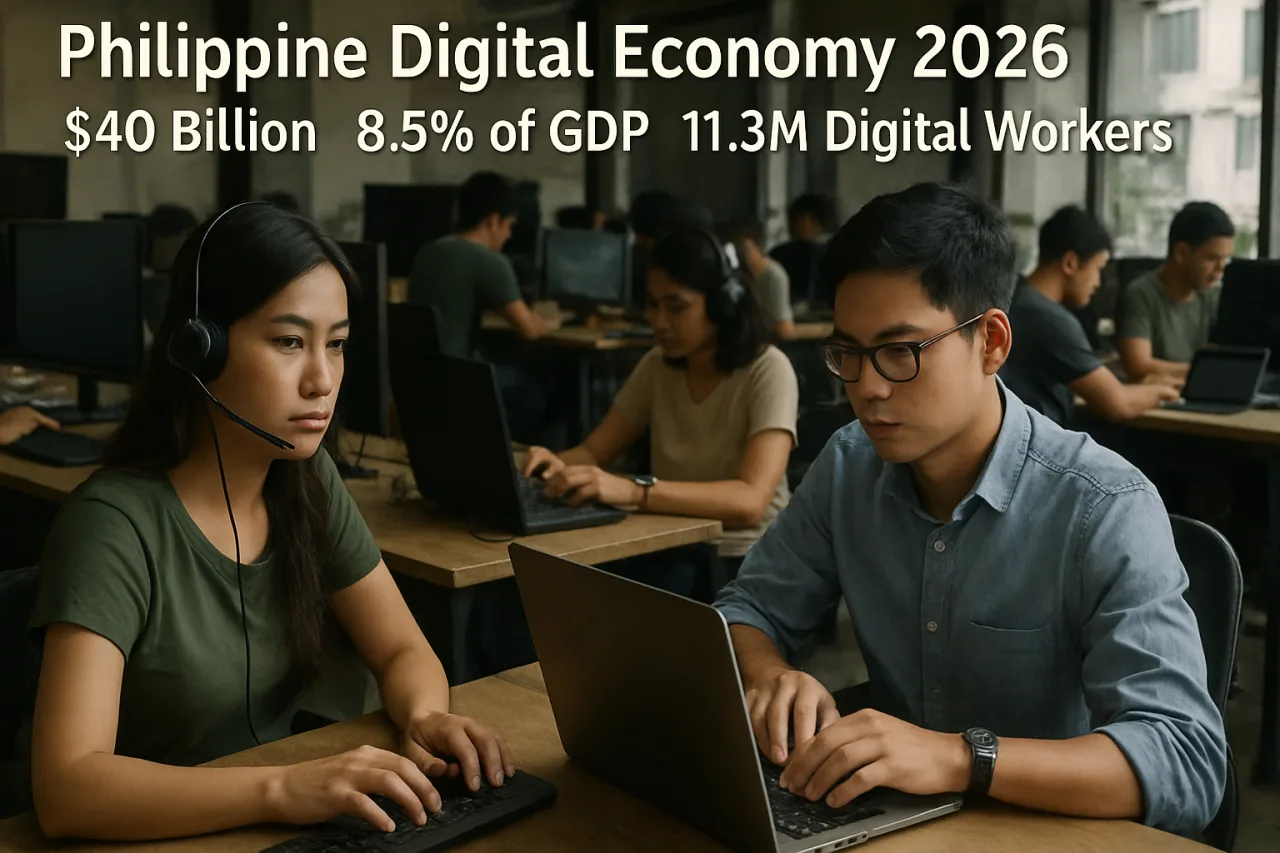
- The Philippine digital economy reached ₱2.25 trillion ($40 billion), representing 8.5% of national GDP according to Philippine Statistics Authority (PSA) data — a milestone that confirms the country’s digital transformation has moved from emerging trend to structural economic pillar.
- 11.3 million Filipinos now work in digital roles, accounting for 23.1% of total employment — nearly one in four working Filipinos depends on the digital economy for their livelihood.
- 98 million internet users (83.8% penetration) and 137 million mobile connections form the connectivity backbone driving this growth, with Filipinos spending 54 hours per week online — the second-highest globally.
- 92% of Philippine organizations have adopted AI, with the BPO sector (1.9 million workers, $32.5 billion revenue) leading the pivot to AI-augmented operations.
- Filipino professionals must prepare for an AI-driven digital economy by upskilling in AI implementation, data analytics, cybersecurity, and digital commerce — the next 12-18 months will determine which companies and workers capture the productivity gains.
How Large Is the Philippine Digital Economy in 2026?
The Philippine digital economy has reached a defining milestone. According to data from the Philippine Statistics Authority (PSA), the digital economy grew to ₱2.25 trillion ($40 billion) in 2024, representing 8.5% of the country’s total GDP. This figure is not a projection — it is a measured economic contribution that places the digital economy alongside the Philippines’ traditional powerhouses like manufacturing, agriculture, and construction. For Filipino professionals, the Philippine digital economy is no longer a niche sector; it is a core economic engine that shapes career trajectories, investment decisions, and business strategies.
The growth of the Philippine digital economy is structural rather than cyclical. The country possesses three fundamental advantages that drive sustained digital expansion: a young population with a median age of 25.7 years, high internet adoption rates that continue to climb despite infrastructure gaps, and a global diaspora that channels remittances through digital channels. These advantages create compounding demand for digital products, services, and skills that work at mobile speed and smartphone scale.
What distinguishes the Philippine digital economy from many global counterparts is how digital growth has translated into employment expansion rather than displacement. The digital economy employs 11.3 million workers, representing 23.1% of total employment in the Philippines. These digital roles span BPO operations, e-commerce management, digital freelancing, fintech services, software development, data analytics, and increasingly, AI-augmented positions. When GCash and Maya expanded their digital wallet platforms, they did not replace traditional bank workers — they created entirely new categories of employment in customer success, merchant support, compliance, and digital operations. The Philippine digital economy absorbed technological change as workforce expansion, not workforce contraction.
For Filipino professionals evaluating career directions, this employment concentration matters profoundly. The Philippine digital economy is not concentrated in a single sector or geography. Digital roles exist across Metro Manila, Cebu, Davao, and increasingly in provincial hubs where remote work and digital infrastructure have opened new employment pathways. The breadth of this employment base means professionals in virtually any region can participate in the Philippine digital economy without necessarily migrating to the capital.
What Is Driving the Philippine Digital Economy’s Growth?
Connectivity Infrastructure: 98 Million Internet Users and 137 Million Mobile Connections
The Philippine digital economy rests on a connectivity foundation that is both massive and intensive. The country counts 98 million internet users, representing 83.8% internet penetration across a population of approximately 120 million. Mobile connections reach 137 million — exceeding the total population because many Filipinos maintain multiple SIM cards, a behavior unique to this market. Globe Telecom leads with 63.1 million subscribers, while Smart Communications reaches 97% of the population overall.
But raw user counts only tell part of the story. The intensity of digital engagement is what truly drives the Philippine digital economy. Filipinos spend 54 hours per week online, ranking second globally behind only Kenya. Of that time, approximately 3 hours and 50 minutes per day goes to social media alone. This level of digital engagement creates demand patterns that shape how businesses operate, how products are marketed, and how services are delivered. For professionals in digital marketing, content creation, e-commerce, and user experience design, the Philippine digital economy offers a market where digital-first strategies are not experiments — they are the baseline expectation.
The infrastructure buildout continues to accelerate. By 2026, 11 submarine cable projects are expected to come online, significantly increasing international bandwidth capacity. PLDT’s Apricot cable alone provides 190+ terabits per second of capacity. Globe added 235 new 5G sites in Q1 2025 alone, bringing Metro Manila coverage to 98.7%. These investments address the connectivity gaps that have historically constrained the Philippine digital economy, particularly in provincial areas where reliable internet access remains inconsistent.
E-Commerce: From $17.65 Billion to $40.5 Billion by 2027
E-commerce is one of the most visible growth engines of the Philippine digital economy. The market reached $17.65 billion in 2025 and is projected to hit $40.5 billion by 2027. Shopee leads with 70 million monthly active users, while Lazada holds approximately 37 million. Together, the two platforms control roughly 70% of the traditional e-commerce market. But the real growth story lies in social commerce — shopping that happens through social feeds, livestreams, and creator recommendations rather than dedicated e-commerce platforms.
Social commerce in the Philippines is projected at $28.4 billion in 2025, heading toward $96.4 billion by 2034. TikTok Shop, barely a full year old in the Philippines at the start of 2025, reached 15 million monthly active users by the end of 2026. Fifty-six percent of Filipinos shop online at least weekly, and 85% follow social sellers on TikTok, Facebook, or Instagram. For Filipino entrepreneurs and professionals in retail, marketing, and supply chain, the shift toward social commerce represents a fundamental restructuring of how products reach consumers. Understanding these channels is no longer optional — it is essential for participating in the Philippine digital economy.
Fintech: GCash’s 89% Wallet Market Share and 393.6 Million E-Wallet Accounts
Fintech represents the financial backbone of the Philippine digital economy. GCash reached 89% wallet market share by mid-2025, with 86 million registered users. The platform functions as a financial operating system — Filipinos use it to pay bills, send money domestically and internationally, buy insurance, invest in mutual funds, and access credit. GCash’s dominance reflects a strategic focus on use cases that traditional banks ignored: paying electricity bills, buying mobile load for family members, and sending money to relatives in provinces.
The broader fintech infrastructure shows deep adoption. As of late 2023, the Philippines had 393.6 million registered e-wallet accounts. InstaPay and PESONet standardized the rails for instant domestic transfers, meaning payment transfers between banks and e-wallets now settle in real-time. The government targets 70% cashless adoption by 2026, up from roughly 35% in early 2024. For professionals in finance, banking, and financial technology, the Philippine digital economy’s fintech sector offers career opportunities in compliance, product development, risk management, and digital banking — particularly as the Bangko Sentral ng Pilipinas (BSP) continues shaping the regulatory landscape with its cap of 10 digital banks (6 already licensed).
The launch of BIS Project Nexus in July 2026 will fundamentally reshape remittance flows. This initiative enables cross-border payments across participating ASEAN countries — Thailand, Singapore, and Malaysia initially — with settlement in minutes rather than days. For a country where remittances represent the largest source of foreign currency at $40+ billion annually, this infrastructure shift has profound implications for Filipino professionals working abroad and their families at home. For more on how digital transformation is reshaping financial systems, see our analysis of digital transformation in the Philippines.
What Role Does AI Play in the Philippine Digital Economy?
Artificial intelligence is the most significant force reshaping the Philippine digital economy in 2026. The statistics are striking: 92% of organizations in the Philippines have adopted some form of AI, but 65% remain in pilot mode. That gap between adoption and operationalization is where the real economic transformation is happening. The AI market itself is projected to reach $1.025 billion by 2025-2026, growing at 28% compound annually.
The BPO sector — employing 1.9 million people and generating $32.5 billion in annual revenue — is leading the AI pivot. Sixty-seven percent of BPO companies now run AI implementations, and the results are measurable. First-contact resolution rates have jumped from 65-72% in traditional voice operations to 85-92% with AI-assisted handling. AI chatbots now handle 60-75% of routine inquiries, which means human agents spend more time on complex, higher-value problems. This shift actually increases job quality rather than reducing headcount, a pattern that distinguishes the Philippine digital economy from markets where AI adoption drives workforce displacement.
Filipino professionals should pay close attention to this AI pivot. The National AI Upskilling Roadmap launched in early 2026 recognizes that AI operationalization requires skills that existing education systems have not addressed. For professionals in IT, customer service, operations, and management, the next 12-18 months represent a critical window. Companies that successfully move from pilot to production will create demand for AI implementation specialists, data engineers, prompt engineers, AI ethics officers, and automation strategists. The ones that lag will face margin pressure. Understanding how AI is reshaping Southeast Asia’s broader digital economy is essential context — see our coverage of the Southeast Asia AI infrastructure landscape for the regional picture.
What Does the Philippine Digital Economy Mean for Filipino Careers?
High-Demand Skills in the Digital Economy
The Philippine digital economy’s 11.3 million digital workers span a wide range of roles, but certain skills are experiencing acute demand. For Filipino professionals planning their career trajectory, the following skill areas offer the strongest growth prospects within the Philippine digital economy:
AI Implementation and Operations: With 92% of organizations adopting AI but 65% still in pilot mode, professionals who can bridge the gap between pilot projects and production deployments are in critical demand. This includes skills in machine learning operations (MLOps), AI system integration, and AI-augmented workflow design. The BPO sector alone will need thousands of professionals who can manage AI-assisted customer service platforms, train AI models on Philippine market data, and oversee the transition from voice-centric to AI-augmented operations.
Data Analytics and Data Engineering: The Philippine digital economy generates enormous volumes of data — from 393.6 million e-wallet transactions to 137 million mobile connections to 90.8 million social media accounts. Professionals who can collect, clean, analyze, and derive business insights from this data are essential to every sector of the digital economy. The demand spans e-commerce analytics, financial data analysis, marketing analytics, and operational data engineering.
Cybersecurity: As the Philippine digital economy grows, so does the attack surface. The BSP’s Circular 1213, released in May 2025, establishes comprehensive IT risk management guidelines for financial institutions, setting minimum standards for cybersecurity, data protection, and operational resilience. The SIM Registration Act (RA 11934) and the Internet Transactions Act further expand the regulatory framework. Filipino professionals with cybersecurity certifications and skills in threat detection, compliance, and security architecture face strong demand across the BPO, fintech, and enterprise sectors. Our detailed guide on cybersecurity careers in the Philippines covers specific certifications and salary expectations.
Digital Commerce and Social Commerce: With social commerce projected to reach $96.4 billion by 2034 and 85% of Filipinos following social sellers, professionals who understand livestreaming commerce, short-form video marketing, creator partnerships, and social-first customer acquisition strategies are in high demand. This includes content creators, social media managers, e-commerce operations specialists, and digital marketing strategists.
Cloud and Infrastructure Engineering: The Philippine data centre market reached $690 million in 2025 and is projected to grow to $1.9 billion by 2030 at 23.35% CAGR. AWS, Microsoft Azure, and Google Cloud all maintain points of presence in the Philippines. Professionals with cloud architecture, DevOps, and infrastructure engineering skills will find strong demand as enterprises migrate workloads to the cloud and as data centre capacity expands.
The BPO Pivot: From Voice Services to AI-Augmented Operations
The BPO sector’s transformation deserves special attention because it employs 1.9 million Filipinos — a significant portion of the 11.3 million digital workers in the Philippine digital economy. The sector is mid-pivot from voice-centric customer service to AI-augmented operations. First-contact resolution rates have improved from 65-72% to 85-92% with AI assistance, and AI chatbots handle 60-75% of routine inquiries. This is not contraction — it is reinvention.
For the 1.9 million Filipinos working in BPO, this pivot means that traditional voice agent roles are evolving into AI-assisted roles that require different skills. Agents now need to manage AI systems, handle complex escalations that AI cannot resolve, and work alongside AI co-pilots. Professionals who develop skills in AI system management, quality assurance for AI outputs, and complex problem resolution will thrive in this transition. Those who do not adapt face increasing margin pressure as AI handles more routine interactions.
What Does the Philippine Digital Economy Mean for Investment?
The Philippine digital economy presents several investment themes for Filipino professionals and investors evaluating where to allocate capital. The data centre market, growing at 23% annually to a projected $1.9 billion by 2030, represents infrastructure investment opportunity driven by AI workloads, video streaming, and enterprise cloud migration. Fintech platforms, particularly those aligned with the BSP’s digital banking framework and the transition toward 70% cashless adoption by 2026, offer exposure to the financial digitization trend.
The e-commerce sector, projected to reach $40.5 billion by 2027, encompasses both platform investments and the ecosystem of logistics, payment processing, and digital advertising that supports online commerce. The Philippine digital advertising market alone reached $1.95 billion in 2025, with social media advertising accounting for $679 million. Companies positioned to capture the social commerce shift — where growth is concentrated in creator-driven, livestream-based selling rather than traditional platform browsing — represent a particularly dynamic segment.
However, the Philippine digital economy also carries structural risks that investors must weigh. Logistics costs run at 27.5% of GDP — the highest in ASEAN — because distributing goods across 7,641 islands with uneven population density is fundamentally expensive. Last-mile delivery takes 24-48 hours in Metro Manila but 7-14 days in remote provinces. This geographic constraint is permanent and affects any investment thesis that assumes nationwide logistics efficiency. Additionally, 65% of AI-adopting organizations remain in pilot mode, meaning that projected AI productivity gains are not yet guaranteed at scale. For authoritative economic data, the Philippine Statistics Authority provides official GDP and digital economy statistics, and the Bangko Sentral ng Pilipinas publishes digital payments and fintech regulatory data.
What Does the Philippine Digital Economy Mean for Business?
For Filipino entrepreneurs and business leaders, the Philippine digital economy offers both opportunity and imperative. The opportunity lies in the scale: 98 million internet users, 137 million mobile connections, 393.6 million e-wallet accounts, and 90.8 million social media accounts create a market where digital-first business models can reach massive audiences rapidly. The imperative lies in the competitive reality: businesses that do not adapt to mobile-first, social-first, and AI-augmented operating models face existential pressure from competitors that do.
The most successful businesses in the Philippine digital economy are those built for the specific constraints and behaviors of this market. GCash succeeded because it solved problems that banks ignored — small transactions, provincial remittances, and mobile-first financial access. TikTok Shop is growing rapidly because it aligns with how Filipinos already spend their time: 3 hours and 50 minutes per day on social media. Gaming cafes thrive as social infrastructure because they serve community needs that digital platforms alone cannot meet. The lesson for business leaders is clear: building for the Philippine digital economy requires understanding the market as it is — archipelago geography, mobile-first behavior, social-first commerce — rather than importing models designed for different markets.
The regulatory environment has also matured significantly. The SIM Registration Act, the Internet Transactions Act (fully effective June 2025), BSP Circular 1213 on IT risk management, and the digital bank licensing framework provide clearer rules for digital businesses. This regulatory clarity reduces uncertainty for businesses building compliance infrastructure and creates a more predictable operating environment. Companies that invest in compliance and regulatory alignment will find themselves better positioned as the Philippine digital economy continues to mature.
What Should Filipino Professionals Do Now?
The Philippine digital economy’s trajectory is clear: the $40 billion milestone is a waypoint, not a destination. E-commerce is heading toward $40.5 billion by 2027. Social commerce is projected to reach $96.4 billion by 2034. The data centre market is growing at 23% annually. The BPO sector is reinventing itself around AI. For Filipino professionals, the actionable priorities are specific:
1. Upskill in AI implementation and operations. With 65% of AI-adopting organizations still in pilot mode, professionals who can move AI from pilot to production will be in critical demand. Focus on practical AI implementation skills — MLOps, AI system integration, and AI-augmented workflow design — rather than theoretical AI knowledge.
2. Develop data literacy. Every sector of the Philippine digital economy generates data. Professionals who can analyze data, derive insights, and communicate data-driven recommendations will outperform those who cannot. This applies across marketing, operations, finance, and strategy roles.
3. Build digital commerce skills. Whether you are an entrepreneur, a marketer, or a product manager, understanding social commerce, livestreaming, creator partnerships, and mobile-first customer acquisition is essential. The growth is in social commerce, not traditional e-commerce.
4. Invest in cybersecurity awareness. As the Philippine digital economy grows, so does its vulnerability to cyber threats. Professionals in any digital role should understand basic cybersecurity principles, data protection requirements, and the regulatory framework governing digital operations in the Philippines.
5. Understand the regulatory landscape. The SIM Registration Act, Internet Transactions Act, BSP Circular 1213, and digital banking regulations shape what businesses can and cannot do in the Philippine digital economy. Professionals who understand these regulations — whether in legal, compliance, operations, or product roles — will be more valuable to their organizations.
The Philippine digital economy is not becoming like other digital markets. It is becoming itself at scale. The growth is real, the adoption is deep, and the structural advantages — labor, demographics, and digital behavior — are genuine. For Filipino professionals who invest in the right skills, understand the market’s specific dynamics, and position themselves for the AI-driven transition ahead, the Philippine digital economy offers career, investment, and business opportunities that are unprecedented in the country’s history.
Frequently Asked Questions
How large is the Philippine digital economy in 2026?
The Philippine digital economy reached ₱2.25 trillion ($40 billion) according to the Philippine Statistics Authority, representing 8.5% of the country’s total GDP. The digital economy employs 11.3 million workers, accounting for 23.1% of total employment in the Philippines. This makes the digital sector one of the largest contributors to the Philippine economy, comparable to traditional sectors like manufacturing and construction.
How many digital workers are in the Philippines?
The Philippines has 11.3 million digital workers as of 2026, representing 23.1% of total employment. These workers span BPO operations (1.9 million alone in the BPO sector), e-commerce management, digital freelancing, fintech services, software development, data analytics, and AI-augmented roles. Nearly one in four working Filipinos now depends on the Philippine digital economy for their livelihood.
What percentage of GDP is the Philippine digital economy?
The Philippine digital economy accounts for 8.5% of the country’s total GDP, valued at ₱2.25 trillion ($40 billion) according to Philippine Statistics Authority data. This represents a measured economic contribution — not a projection — that places the digital economy alongside the Philippines’ traditional economic pillars. The percentage has been growing steadily as digital adoption deepens across e-commerce, fintech, BPO, and digital services.
How many internet users are in the Philippines in 2026?
The Philippines has 98 million internet users as of 2026, representing 83.8% internet penetration. The country also has 137 million mobile connections, which exceeds the total population of approximately 120 million because many Filipinos maintain multiple SIM cards. Filipinos spend 54 hours per week online — the second-highest globally — demonstrating the intensity of digital engagement that drives the Philippine digital economy.
What are the fastest-growing digital economy sectors in the Philippines?
The fastest-growing sectors in the Philippine digital economy include AI-augmented BPO services (67% of BPO companies now run AI implementations), social commerce (projected to reach $96.4 billion by 2034, driven by TikTok Shop’s 15 million monthly active users), fintech and digital payments (GCash holds 89% wallet market share with 86 million users), data centre infrastructure (growing at 23% annually to $1.9 billion by 2030), and e-commerce (projected to reach $40.5 billion by 2027).
What does the Philippine digital economy mean for Filipino professionals?
The Philippine digital economy creates significant career opportunities for Filipino professionals. With 11.3 million digital workers and 92% of organizations adopting AI, professionals with skills in AI implementation, data analytics, cybersecurity, digital marketing, and e-commerce operations are in high demand. The BPO sector alone employs 1.9 million people and is pivoting toward AI-augmented operations, creating demand for professionals who can manage AI systems, handle complex escalations, and bridge the gap between AI pilot projects and production deployments.
Is the Philippine digital economy good for investment?
The Philippine digital economy presents investment opportunities in data centre infrastructure ($690 million growing to $1.9 billion by 2030), fintech platforms, e-commerce platforms, and digital payment systems. However, structural risks include logistics costs at 27.5% of GDP (highest in ASEAN) and 65% of AI-adopting organizations still in pilot mode. All investments carry risk, and readers should conduct independent research and consult licensed financial advisors before making investment decisions.
Sources and References
- Philippine Statistics Authority (PSA) — Official digital economy and GDP statistics: https://psa.gov.ph/
- Bangko Sentral ng Pilipinas (BSP) — Digital payments and fintech regulation: https://www.bsp.gov.ph/
- Digital in Asia — Philippines Digital Market Overview 2026: https://digitalinasia.com/philippines-digital-market-overview-2026/
- DataReportal — Digital 2026 Philippines: https://datareportal.com/reports/digital-2026-philippines
- Bain & Co / Google / Temasek — e-Conomy SEA Report: https://www.bain.com/insights/e-conomy-sea-2024/
Financial Disclaimer: This article is for informational and educational purposes only and does not constitute financial, investment, legal, or tax advice. The mention of specific sectors, companies, or market figures does not constitute a recommendation to buy, sell, or hold any investment. The Philippine digital economy carries both opportunities and risks, including but not limited to infrastructure constraints, regulatory changes, market volatility, and technology adoption uncertainty. All investments carry risk of loss. Readers should conduct their own independent research, consider their personal financial circumstances and risk tolerance, and consult with a licensed financial advisor registered with the Securities and Exchange Commission (SEC) before making any investment decisions. WorldNgayon and its authors are not registered financial advisors and do not accept liability for any financial decisions made based on the content of this article. Past performance and current market data do not guarantee future results.