Table of Contents
📱 THE BOARD — Thursday, October 1, 2026 → Events Intelligence: IoT Conference PH + AI Philippines Expo (Nov 10-11): Megatrade Halls, SM Megamall — the country’s IoT-plus-AI convergence floor — the IoT Conference Philippines at its most accessible, entrance free, 6,000+ guests, workshops and a startup pitch stage · the artifact: the hands-on tier list — which of the expo’s tracks a Filipino professional should sit in, what the free door actually buys, and the partnership openings for builders · kw: IoT Conference Philippines
Related: AI Skills Demand: The IMF Data Behind the 2X Career Map
Related: Philippines Ransomware 2026: AI Now Writes the Attacks — the Five Move
Key Takeaway
- 🎟️ The free door is real: the IoT Conference Philippines + AI Philippines Expo (AIPHX) runs November 10-11 at Megatrade Halls 1-3, SM Megamall, Mandaluyong — entrance free, making it the quarter’s most accessible hands-on tech floor after the online-only ASEAN summit.
- 🌐 The theme is execution, not pilots: IoTConPh 2026 anchors on “Shaping the Next Era of Intelligent Business and Cities” — enterprises and cities now buy deployed IoT/AI systems, which means the exhibit rows (AI platforms, telco/5G, automation, robotics, GIS) mirror actual Philippine procurement.
- 🤖 AIPHX rides alongside: the AI Philippines Expo showcases the AI-plus-IoT convergence — connected-device data turned into automated decisions — the exact applied layer between this site’s AI Watch (model-layer intel) and the operational tools Filipino firms buy.
- 🛠️ The format rewards doers: technical workshops, an AI masterclass, a hackathon, and a Roborumble sit inside the two days — the highest hands-on density per peso (zero) of any floor this quarter; the pitch-and-match program courts startups and partnerships openly.
- 🧭 Who this floor serves: IT-BPM staff upskilling into IoT/AI deployment, engineers and makers scouting vendor stacks, startup founders seeking exposure plus partnerships, and the LGU/smart-city side deciding 2027 budgets — each gets a row, and this piece maps which.
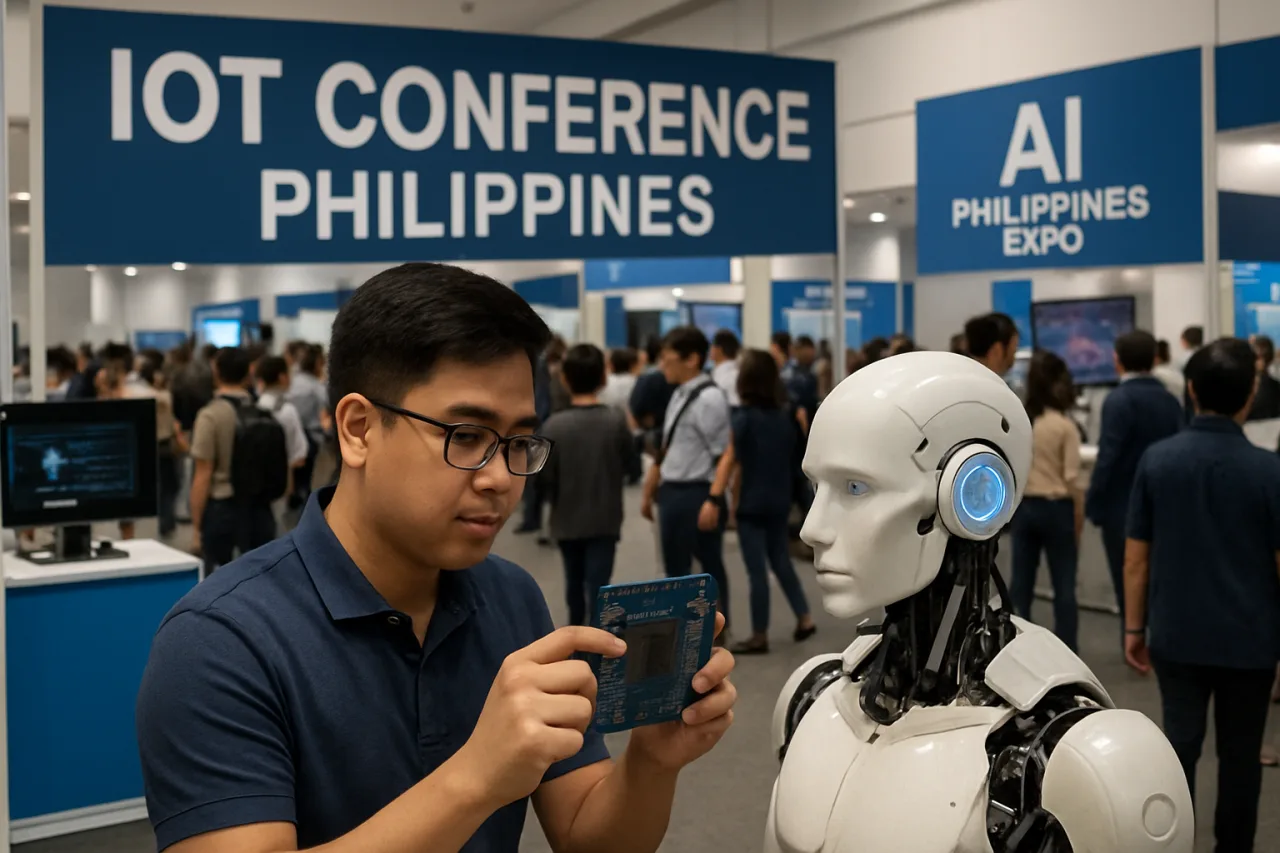
The IoT Conference Philippines opens November 10 at the Megatrade Halls of SM Megamall with a claim no consumer expo in this register can match: two days of IoT-and-AI exhibits, workshops, masterclasses, and competitions at zero admission cost. Organized as the country’s multi-sector convergence platform (IoTConPh 2026, alongside the AI Philippines Expo), the event expects 6,000+ guests from Metro Manila and the provinces — and sizes itself as the floor where “intelligent systems are designed, deployed, and scaled in real-world environments” — the execution-phase framing that separates it from the awareness-stage shows of past years. This register — episode #006 in the Oct-Dec tech events Philippines board — prices it as the hands-on tier of the quarter: less theory than the summits, more hardware than the marketing floors, and free in a way that makes it the default recommendation for students, career-switchers, and the IT-BPM professionals this site’s employment coverage tracks. Here’s what the floor actually contains, and what each reader type should do with the two days.
Inside the IoT Conference Philippines Free Floor — Tracks, Stacks, Exhibited
The exhibit spectrum spans the full Philippine intelligent-systems supply row: AI platforms (the enterprise-model deployment layer our AI Watch covers daily), telco and 5G infrastructure (the connectivity substrate — and the lane where Philippine carriers’ IoT ambitions price out), home and industrial automation (from smart-building systems to factory-floor retrofits — the segment growing fastest in Philippine manufacturing parks), robotics and automation (service bots through industrial arms), 3D printing (the prototyping layer every hardware-adjacent startup touches), and GIS (the geospatial substrate that LGU smart-city projects procure against). The program inside: plenary sessions and panels convening “technology pioneers, business leaders, and innovators,” technical IoT workshops, an AI workshop and masterclass, a hackathon, the Roborumble competition, and round-table discussions mixing global and local industry voices. The honest read of a free floor: exhibits exist to sell workshops and sponsorships — but the asymmetry works FOR the visitor: a professional who picks two workshop tracks and one masterclass leaves with hands-on hours that paid conferences elsewhere in Southeast Asia charge several thousand pesos for, and the B2B networking program (the organizer’s stated high-impact matchmaking between adopters, solution providers, and end users) runs on the same floor without a paywall. The visitor who walks aimlessly gets tote-bag value; the one who arrives with a track list gets the quarter’s cheapest skills demo.
Bottom Line: Six exhibit stacks, workshops-plus-masterclass-plus-hackathon, and matchmaking — the free floor pays whoever arrives with a plan.
The Four Reader Routes at the IoT Conference Philippines — Who Sits Where
Route 1 — the IT-BPM professional upskilling: your industry ($40B+ revenue, 1.9M workers per the IBPAP curve this site tracks) faces the automation transition directly, and IoTConPh’s AI masterclass plus automation exhibits are the cheapest reconnaissance on what client-side automation stacks actually run; sit one workshop, walk the automation row with questions scoped to your clients’ industries, and log the vendor names — the 2027 interview question “what automation stacks have you touched” has a free answer after this floor. Route 2 — the engineer/maker/scout: the hackathon and Roborumble are the participation layer — competing (or even attending the judging) puts you in the room with the country’s robotics-adjacent builders, the ecosystem’s real hiring pool — the same applied-AI community our AI World This Week coverage tracks globally; the 3D-printing and GIS rows fill the hardware-reality context that pure-software roles miss. Route 3 — the startup founder: the pitch stage and matchmaking program are the event’s stated partnership funnel — organizers explicitly court “partnerships, collaborations, and new business opportunities” between builders and adopters; for a Filipino startup, free floor exposure in front of 6,000 attendees plus curated meetings is a zero-cost go-to-market day — bring the one-pager, demo the thing, book follow-ups. Route 4 — the smart-city/LGU observer: the “intelligent cities” track convening the public-service side is where provincial LGU budgets surface — the suppliers who exhibit there are the ones bidding municipal contracts; the professional watching infrastructure procurement (our gov-cyber coverage readers) finds the physical-security-plus-connectivity overlap here. Four routes, one admission rule: register early on the official site (slots for workshops cap even when the door stays free).
Bottom Line: Upskill in the masterclass, compete in the hackathon, pitch from the startup stage, or observe the LGU row — pick your route before November 10.
Two timing notes complete the routes. The register-ahead rule: free events suffer registration-page chaos in the final week — the official site’s visitor form plus the workshop sign-up flow run through separate confirmations, and the hackathon and masterclass seats fill on a first-come basis that historically closes days before the doors open; a November 3 register-everything deadline protects the plan. The bring-a-colleague rule: the floor’s matching mechanics reward two-person coverage — one person anchors the workshop while the other works the meeting program, then the two debrief over the notes page; for the small-agency or startup reading this, the day’s output doubles per attendee added. And one security-era caveat that belongs in every 2026 event plan: a free tech expo’s public Wi-Fi and registration QR codes are exactly the attack surface this site’s cybersecurity coverage trains readers to distrust — hotspot-only browsing and in-app (not QR-code) verification of every exhibitor link keep the free day free of an aftermath — the discipline this site’s hotspot-safety coverage already teaches, applied one more time. The visitors who run these mechanics treat the two days as what they are: the market’s opening-price window for the automation wave, available to anyone willing to show up prepared.
The Practical Layer — Building a Free-Floor Workday That Compounds
The working plan for either day: morning — one plenary plus one workshop (register both weeks ahead; bring a laptop for the AI masterclass since these sessions run hands-on tooling); midday — one exhibit row, scoped (three booths deep beats thirty shallow — ask each vendor the same three questions: what’s deployed in the Philippines TODAY, what does it cost to pilot, who pays maintenance after); afternoon — the participation layer (hackathon viewing for engineers, matchmaking meetings for founders, round-tables for the LGU-and-enterprise observers); the close — one page of notes (vendor stacks, pricing anchors, and two contacts worth a same-week follow-up). The compounding move for the freelance-and-solopreneur readers: cross-reference this floor’s vendor list with the October floors already covered in this register — the AI Revolution Summit’s enterprise buyers and the Lifestyle Sourcing Expo’s suppliers both intersect with IoT/AI deployment vendors, and a professional who links the three floors’ intelligence (who sells, who buys, what prices) holds a quarter’s worth of Philippine market mapping for zero ticket spend. That composition — floors as one intelligence system rather than separate events — is the register’s whole point, and the next episodes complete it with the November marketing floor (Digital Experience Asia, Nov 17), the e-commerce twin (ECOMEX, Nov 20-21), and the regional heavyweight watched from home (the Singapore FinTech Festival, Nov 18-20).
Bottom Line: Morning workshop, scoped exhibit rows, participation layer, notes-to-follow-ups — and cross-floor composition turns free doors into market maps.
The Market Context Behind the Free Floor — Why Philippine IoT Finally Prices
The IoT Conference Philippines earns its execution-phase framing from three numbers this register tracks. One — the connectivity substrate is finally built: Philippine telcos’ 5G rollouts and fixed-wireless expansion crossed the coverage threshold where connected-device economics work beyond Metro Manila; the automation and smart-city stacks on the exhibit rows sell against that footprint, and their pricing improved accordingly. Two — the enterprise adoption gap is the market: the PIDS finding this site keeps current — only 14.9% of Philippine firms use AI — reads in the IoT context as the installed base’s headroom: the 85% not-yet-adopting firms are the demand pool every exhibitor at the IoT Conference Philippines wants; conferences of this type exist to shorten that sales cycle, which is why the matchmaking program matters more than the keynotes. Three — the public-sector tranche: LGU smart-city procurement ran in pockets (Quezon City’s systems, Cebu’s mobility pilots, Davao’s safety infrastructure) but the DICT’s connectivity and e-governance pushes (dict.gov.ph) put provincial budgets into play — the “intelligent cities” track is where that demand meets the vendors who can deliver it. Compose the three and the November floor’s real product is apparent: it is a demand-matching platform disguised as a consumer-friendly expo — the supply side (vendors with deployed stacks) meets the demand side (unautomated Philippine firms and budget-holding LGUs) at an admission price of zero so the demand pool shows up in volume. For the professional attendee, that asymmetry is the value: every conversation you have near an exhibit booth is a negotiation rehearsal for a market that’s about to price — the Filipino freelancer pitching automation help, the employee building the internal AI-project proposal, the student choosing a specialization — all of them walk this floor two steps ahead of the 85%.
Bottom Line: Built connectivity, the 85% adoption gap, and provincial budgets explain why this floor is free — it is demand-matching for a market forming in real time.
Frequently Asked Questions
When and where is the IoT Conference Philippines 2026?
November 10-11, 2026, at the Megatrade Halls 1-3, SM Megamall, Mandaluyong City — co-located with the AI Philippines Expo (AIPHX) as a two-day IoT Conference Philippines program and exhibition covering IoT, AI, and digital transformation.
How much does it cost to attend the IoT Conference Philippines?
Entrance is FREE per the official organizer announcements — the tier list includes plenary sessions, exhibit access, workshops, the AI masterclass, hackathon, and round tables; some specialized masterclass seats may cap, so register early through the official site (iotconference.ph).
What will be exhibited at AIPHX and IoTConPh?
AI platforms, telco and 5G solutions, home and industrial automation, robotics, 3D printers, GIS systems, and adjacent technology services — the deployed-systems layer of Philippine intelligent-enterprise and smart-city procurement.
Is it worth attending for students and career-switchers?
Strongly yes — it’s the quarter’s cheapest hands-on exposure: workshops and masterclass hours that paid summits charge thousands for, plus hackathon and Roborumble participation that puts students and switchers in direct contact with the builders hiring in robotics, automation, and AI deployment.
How does this compare with ECOMEX and the Singapore FinTech Festival?
Three different layers: IoTConPh is the free hands-on deployment floor (Nov 10-11); ECOMEX is the e-commerce selling-and-marketing floor (Nov 20-21, SMX Aura — our July preview covers it); the Singapore FinTech Festival is the global fintech-policy signal (Nov 18-20) watched from the Philippines through its published sessions — the register’s routing table maps all three to reader types.
Financial Disclaimer: This article is for general information and education, not investment or financial advice. Event dates, registration rules, and program details change; verify with official event pages before attending. WorldNgayon.com is not a financial adviser and may hold affiliate relationships with tools or services mentioned.