Key Takeaway
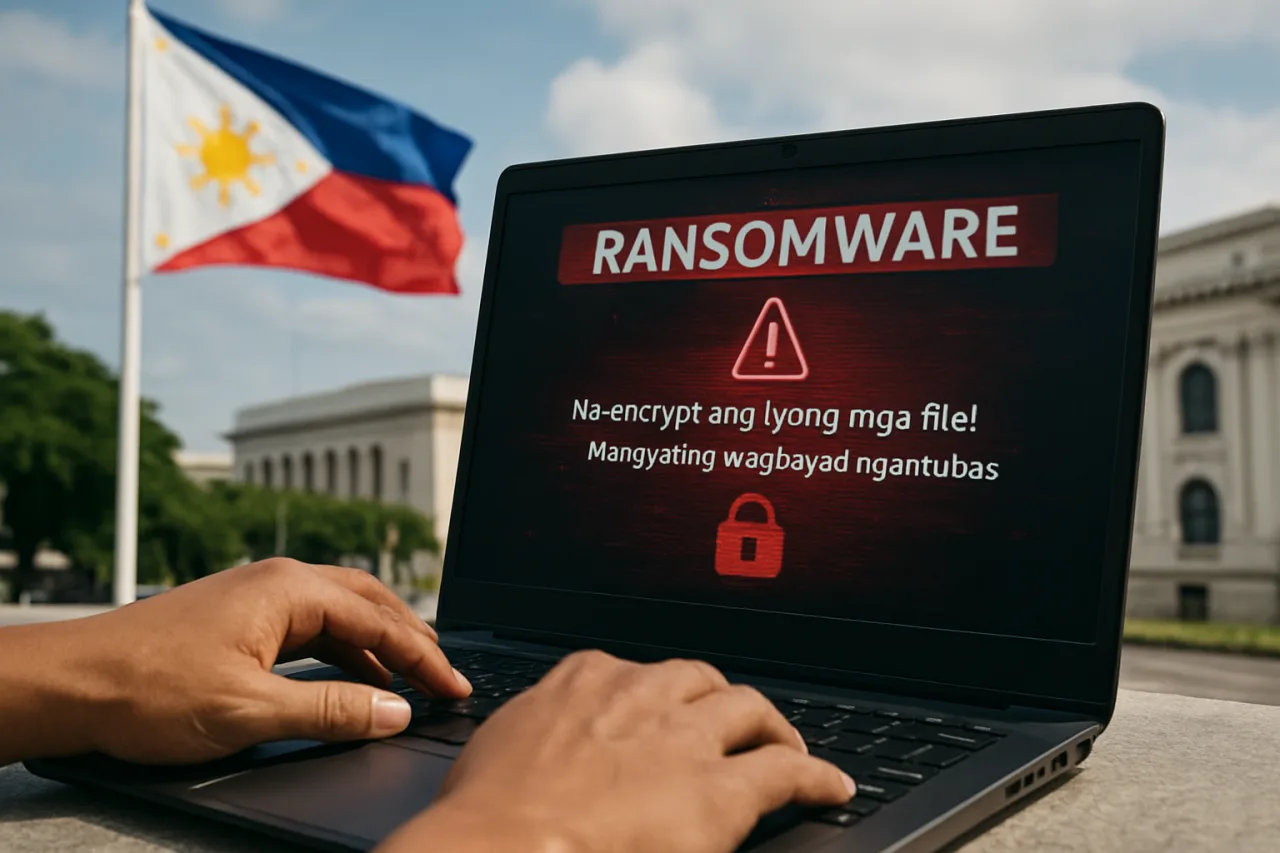
- 🔥 The doubling: Philippines ransomware claims more than doubled in 2026 — and the newest Philippines ransomware wave is not generic: attackers are using AI to target Pinoy users in their own language, on their own platforms.
- 🤖 The AI twist: Philippines ransomware crews now use AI to write flawless Tagalog and Cebuano phishing, clone government SMS formats, and time threats to paydays — the language barrier that once protected many users is gone.
- 🛡️ What still works: five non-negotiable defenses — offline backups, email/SMS verification habits, the 24-hour ransom delay rule, account separation, and the PNP-ACG reporting path — block the overwhelming majority of Philippines ransomware attacks.
- 👨👩👧 The family layer: OFW households are prime targets precisely because remittance anxiety creates payment pressure — this piece includes the 3-message family drill that defuses it.
- 🧾 Report, never pay alone: the PNP Anti-Cybercrime Group accepts reports free; filing preserves your legal options and feeds the national disruption effort.
Table of Contents
The Doubling, in Context
The 2026 picture for Philippines ransomware is stark and measurable: incident claims more than doubled year over year, riding global trends (the Sophos State of Ransomware 2026 report documents the same escalation worldwide, with 54% of organizations hit in the last year) but with Philippine-specific accelerants. The World Economic Forum’s Global Cybersecurity Outlook 2026 ranks ransomware among the top-two concerns across regions — and Southeast Asian economies, with their fast digital adoption and comparatively young security tooling, sit squarely in the blast zone.
What distinguishes the Philippines ransomware surge is not the count — it is the targeting intelligence. The 2024-25 attacks skew opportunistic: shotgun phishing, spray-and-pray. The 2026 cohort researches victims: job-posting sites, marketplace chats, and remittance patterns feed the target list. That shift — from opportunistic to researched — is the number-one change this desk tracks, because it changes what defense looks like.
How AI Changed the Philippines Ransomware Attack Language
Three AI-era attack patterns define the current wave, each documented in September-October Philippines ransomware incident roundups:
- Flawless local-language lures. Older Philippine phishing was detectable by Taglish errors; AI-written lures now pass native review. The grammar red-flag heuristic — “check the spelling” — is dead as a primary defense. Verify by channel, not by prose quality.
- Cloned government formats. Attackers replicate official SMS layouts (SSS, PSA, LGU alerts) with AI-generated precision — complete with plausible case numbers. The 2025 fake-PNP wave and the 2026 SSS-refund scams share this fingerprint. Real agencies do not demand payment by e-wallet — the anchor fact in every cloned-format case this year of Philippines ransomware-adjacent fraud.
- Payday-timed extortion. AI analysis of posting patterns times threats to salary/remittance dates — maximizing pressure when funds are liquid. An extortion call arriving exactly at payday is not coincidence; it is Philippines ransomware-style targeting.
Why OFW Families Are Targeted First
Remittance economics create payment pressure — and payment pressure is what ransomware monetizes. A household expecting dollars on the 15th and 30th, holding accounts that show predictable inflows, and carrying urgent family obligations, is the ideal extortion target: funds exist, and fear moves faster than verification. Attackers exploit exactly this: fake “customs hold” messages on balikbayan boxes, cloned DMW/OWWA certification pages, and the classic kidnapped-relative scam now AI-enhanced with cloned voice notes.
The defensive insight is structural: build the verification habit BEFORE the crisis call. Families that rehearse the 3-message drill (below) respond to pressure with procedure; families without the Philippines ransomware drill respond with panic transfers. The money moves too fast to improvise — the defense must be pre-installed.
The Five Moves That Still Stop Philippines Ransomware
- The 3-2-1 backup rule, offline component non-negotiable. Three copies, two media, one offline/disconnected. Ransomware encrypts what it can see; an offline copy is untouchable. This single control reduces the “pay or lose everything” dilemma to an inconvenience.
- Channel verification over content verification. Any payment/demand message gets verified by calling the sender on a SEPARATE known number (bank’s official line, agency’s official hotline) — never the number in the message. AI killed the “looks real” test; channel verification survives it.
- The 24-hour delay rule for any demand. Legitimate institutions process through channels that tolerate a day’s delay; extortion clocks are designed to prevent thought. Instituting a hard 24-hour rule for ANY payment demand — family rule, workplace rule — collapses most of the attack surface, because AI-timed pressure attacks depend on immediacy.
- Account separation. Banking apps on a different device profile from browsing/social/email; remittance apps isolated with only known contacts. Containment beats cure.
- Report fast, report free. The PNP Anti-Cybercrime Group and CICC take reports at no cost — filing freezes legal options, feeds national takedown efforts (the 503-site seizure this desk covered is where those reports land), and builds the paper trail banks require for transaction reversal.
The Reporting Path: PNP-ACG and CICC
Primary path: the PNP Anti-Cybercrime Group operates regional offices and a 24/7 hotline; reports can be filed online or in person and cover extortion, identity theft, and fraud. Secondary: the CICC (Cybercrime Investigation and Coordinating Center) runs the citizen cybercrime reporting channel. Both are free. What reporting gets you: immediate guidance, the evidentiary paper trail, and — increasingly — operational takedowns, as this October’s 503-domain seizure demonstrated. The era when reporting felt futile has ended; the state’s disruption capacity is real and growing, but it sees only reported attacks.
Case Files: Three 2026 Attacks, Decoded
Real documented patterns from the year’s incident roundups — each decoded to the defense that fails it:
The Cebu marketplace clone. A family selling a used phone on a marketplace app received an “official buyer-protection release” SMS — pixel-perfect clone of the platform’s format, AI-written, with a ₱500 “release fee” e-wallet link. The tell was not the message (it was flawless) but the flow: platforms never collect release fees by e-wallet transfer. Channel verification — opening the app itself, checking the actual transaction state — kills this class instantly. Cost of attack to the crew: one AI subscription; potential haul: thousands of victims daily.
The payroll-timed device locker. A Manila accounting firm’s shared workstation encrypted at 5:47 PM on payday Friday, with the note demanding payment within 12 hours “or payroll files publish Monday.” The timing was AI-chosen: pressure peaks when payroll liquidity exists and IT staff have gone home. The firm’s offline backup (Move 1) converted the dilemma: restore Monday morning, report to PNP-ACG, lose zero — the demand letter expired unread. Attack economics collapse when the backup exists.
The voice-cloned son abroad. An OFW mother in Dubai received a WhatsApp voice note — her son’s voice, AI-cloned from his posted videos — claiming detention “in Kuala Lumpur” and needing bail via remittance. The clone passed a casual listen. What saved the family: the code word (drill message 1). The son, 4,000 kilometers away, answered a verified call in ten minutes. The clone’s makers moved to easier targets — and that is the strategic outcome families should aim for: make YOUR household the expensive one to attack.
The Economics Beat the Fear: Why Attackers Move On
Sympathy for fear-based messaging is low here deliberately: attackers are businesses with unit economics, and businesses abandon unprofitable targets. Every control above raises attack cost: offline backups delete the payment leverage; channel verification kills the lure conversion; the 24-hour rule breaks the timing model; account separation caps the blast radius; fast reporting feeds takedowns that raise crew operating costs nationally. A household running all five is, from the attacker’s spreadsheet, a bad customer — and bad customers get fired. That is the strategic frame this desk wants Filipino families to hold: not “we are safe because we are careful” but “we are unprofitable because we are instrumented.” Fear marketing sells products; economics wins this fight.
The doubling statistic, read correctly, is not a doom forecast — it is a market signal that the unprepared majority still funds the industry. Families and firms that exit that funding base this quarter move the national curve; the 503-site seizure showed where coordinated reporting lands, and the October enforcement wave in Zamboanga showed what inter-agency disruption looks like in practice. The defense gap is closable in an afternoon of setup; this piece’s five moves are that afternoon’s agenda. The Philippines ransomware surge is real; the defense against it is realer — and cheaper, measurable, and free where it matters most.
The Government Layer: What the State Is Actually Doing
Family defense does not operate in a vacuum — 2026’s government actions shape the battlefield. The October seizure wave (503 domains restrained, $938M in linked assets frozen — this desk’s October 6 coverage) demonstrates the disruption track: coordinated inter-agency actions against scam-farm infrastructure, including the Zamboanga hub raid that netted 244 arrests and 3,000 devices. The CICC’s coordination mandate expanded this year; the NPC’s privacy rulings add compliance pressure on data handlers; and the BSP’s reimbursement framework (AFASA) codifies bank liability standards for social-engineering losses — shifting some fraud losses from victims’ pockets to institutions’ balance sheets.
For the reporting path this changes the calculus: filing with PNP-ACG or CICC now feeds active disruption operations, not just statistics. The Zamboanga raid’s evidence base — 3,000 devices — was built substantially from victim reports. A Filipino family filing today is a node in that intelligence net: the report that feels routine locally aggregates into the next raid’s probable cause. The Philippines ransomware fight is distributed by design; the family drill and the state’s enforcement are the same architecture at two scales.
The Weekly Maintenance Plan (25 Minutes)
Security programs die when maintenance is unbounded — so this one is capped at 25 minutes weekly, and every minute is scheduled:
- Minute 0-5: backup status check. Confirm the offline copy updated in the last 7 days; spot-restore one random file. A backup unverified is a wish, not a backup.
- Minute 5-10: device health. Antivirus/OS updates applied on family devices; the banking-profile separation intact (new apps have not migrated onto the banking profile).
- Minute 10-15: family drill touch. One round of the code-word check with family members — rotate ages: the eldest this week, youngest next. Muscle memory decays in roughly a month without reps.
- Minute 15-20: scam-report sweep. One member reviews the week’s suspicious texts/emails against the three patterns (local-language lure, official-format clone, payday timing) and files anything new to PNP-ACG’s portal — two minutes per report, filed ones build the national evidentiary net.
- Minute 20-25: the receipts. Re-read the household’s money-flow rules: no transfer without dual confirmation, no demand answered inside 24 hours, remittance apps contact-listed. Update for any new family app or bank enrolled this week.
Twenty-five minutes, five checks, one weekly rep — that is the entire sustaining layer beneath the five structural moves. The doubling statistic describes families WITHOUT this sheet; the ones running it are, by the attacker’s own economics, no longer worth the call time.
Financial Disclaimer
This article is for general information and education only. It is not financial, legal, or investment advice, and not an offer of any financial product. Cybersecurity guidance described here does not guarantee protection against any specific attack. Consult duly registered professionals before making decisions with financial or legal consequences. WorldNgayon.com and its writers assume no liability for actions taken based on this content.
FAQ
Is ransomware really targeting ordinary Filipino families, or just companies?
Both — the doubling includes consumer-facing extortion (device lockers, fake-kidnap and customs scams) alongside business incidents. The AI-enhanced personal-scam wave hits families directly.
Why did attacks double in 2026?
Criminal infrastructure commercialized: ransomware-as-a-service plus AI tooling lowered skill requirements, and the Philippines’ digitized, remittance-heavy economy presents high-liquidity targets with improving (but incomplete) defenses.
Does antivirus still matter?
Yes, as a base layer — modern next-gen antivirus catches known encryption behaviors. But the 2026 wave defeats signature-only tools; behavior-based detection plus the five structural moves above is the working stack.
What do I do the moment I see a ransom note on my screen?
Disconnect network (WiFi off, cable out — stops spread), photograph the note, boot from clean media if possible, and call PNP-ACG. Do not pay first and report later — payment funds the next attack and forfeits bank-recall options.
How does AI make scams harder to spot in the Philippines?
Three ways: flawless local-language lures, cloned official layouts (complete with case numbers), and timing tuned to payday/remittance patterns. Defense shifts from “check the spelling” to “verify the channel” — the core lesson of the 2026 Philippines ransomware wave.
What is the 3-message family drill?
A rehearsed verification protocol: (1) any money-demand message gets answered only via the family’s pre-agreed code word on a verified call; (2) no transfer without a second family member’s confirmation; (3) any unresolvable demand waits 24 hours and goes to PNP-ACG. Families that rehearse it respond with procedure under pressure.
Where exactly do I report?
PNP-ACG (pnpacg .pnp.gov.ph portal and regional offices, 24/7) and the CICC report channel. Filing is free, and documentation supports bank transaction-recall requests.