Table of Contents
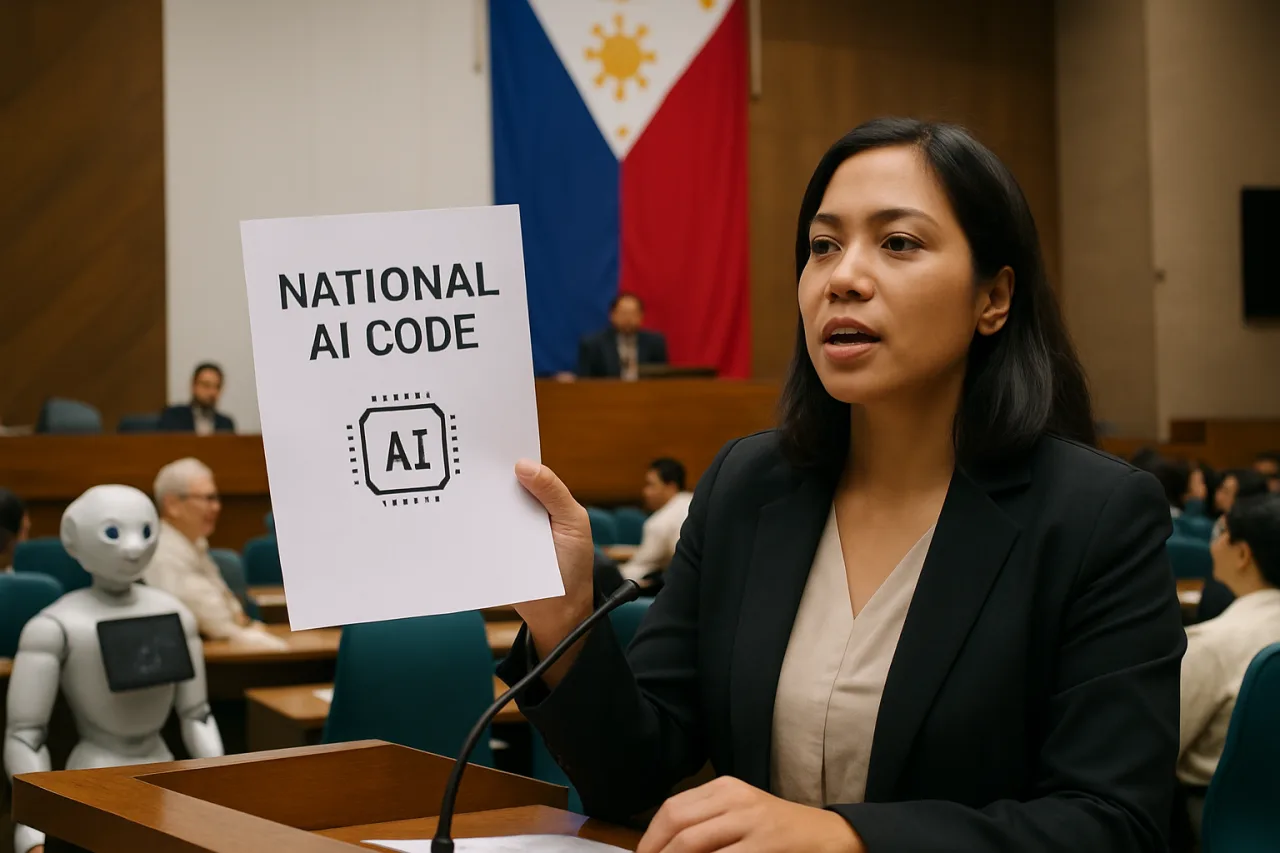
House Bill No. 7627, filed on February 4, 2026, by Representative Ma. Nina Francesca P. Lacson of the Manila Teachers Party-list, proposes the National AI Code of the Philippines — a comprehensive legislative framework that would create a Bureau of Artificial Intelligence Systems under the Department of Information and Communications Technology (DICT), classify high-risk AI systems, mandate transparency for AI-assisted decisions, and prohibit AI applications that exploit vulnerable groups or generate sensitive personal data without consent.
Key Takeaway
- 📜 The bill: HB 7627, the National Artificial Intelligence Code of the Philippines, was filed February 4, 2026 by Rep. Ma. Nina Francesca P. Lacson (Manila Teachers Party-list). It is pending with the Committee on Information and Communications Technology.
- 🏛️ New regulatory body: The bill creates the Bureau of Artificial Intelligence Systems (BAIS) under DICT, tasked with classifying high-risk AI, enforcing compliance, issuing penalties, and conducting algorithmic audits and bias testing.
- 🛡️ Worker protections: No Filipino may be dismissed by an algorithm alone — the bill requires human review, override, or appeal for AI-generated decisions affecting employment, livelihood, or fundamental rights.
- 🔒 Transparency mandate: AI systems must disclose when individuals interact with AI and when personal data influences automated decisions. Privacy impact assessments, data minimization, and purpose limitation are required before deployment.
- 🚫 Prohibited AI: The bill bans AI that exploits vulnerable groups, causes health and safety risks, generates sensitive personal data without consent, or produces deceptive content and unauthorized impersonation.
The National AI Code of the Philippines arrives at a moment when the country’s legislative landscape on artificial intelligence is rapidly expanding. The National AI Code, filed as HB 7627, is one of at least five AI-related bills filed in the 20th Congress, joining HB 7396 (AI Development and Regulation Act), HB 10362 (Diokno AI Governance Act), Senate Bill 25 (Cayetano AI Regulation Act), and Senate Bill 1714 (Digital Likeness and Deepfake Regulation Act). What distinguishes the National AI Code from the others is its scope — it is the most comprehensive AI governance bill filed to date, covering everything from regulatory body creation to worker protections, biometric identification rules, child safety provisions, and generative AI controls.
What the National AI Code of the Philippines Proposes
The National AI Code’s explanatory note frames the bill as a response to the rapid integration of AI into social and economic systems and the challenges this creates for data privacy, accountability, transparency, and human rights. The National AI Code’s stated objectives are six-fold: prevent high-risk AI systems that threaten safety and fundamental rights, align AI deployment with existing privacy laws, promote transparency through disclosure requirements, mandate data protection safeguards including privacy impact assessments, prohibit certain harmful AI applications, and regulate biometric identification and generative AI.
The bill’s short title is the “National Artificial Intelligence Code of the Philippines,” and its declared policy is to promote ethical, secure, and inclusive AI development that strengthens national innovation while protecting fundamental rights and human dignity. The State shall ensure that AI technologies deployed in the Philippines are human-centric, trustworthy, accountable, and aligned with constitutional and democratic principles.
The legislation applies to both public and private sector AI deployments. It requires that an appropriate legal basis be established for the processing of personal data by AI systems, in full alignment with the Data Privacy Act of 2012 (Republic Act No. 10173), which shall apply in a suppletory manner. The bill also ensures that algorithmic audits, red-teaming, bias testing, and post-deployment evaluations are not prohibited by the Data Privacy Act, provided such activities are conducted in accordance with lawful processing principles.
The Bureau of Artificial Intelligence Systems (BAIS)
The centerpiece of HB 7627’s institutional framework is the creation of the Bureau of Artificial Intelligence Systems (BAIS), a regulatory body under the DICT. BAIS would be tasked with several critical functions:
- Risk classification: Categorizing AI systems by risk level, with high-risk systems subject to stricter oversight, registration, documentation, and ethical safeguards.
- Compliance enforcement: Monitoring AI deployments, conducting audits, and issuing penalties for developers who violate the code’s provisions.
- Algorithmic audits: Conducting or mandating bias testing, red-teaming, and post-deployment evaluations of AI systems to identify and mitigate discriminatory outcomes.
- Standards development: Creating technical standards for AI safety, transparency, and data protection that developers and deployers must follow.
- Multi-stakeholder consultation: Engaging civil society, academia, and industry stakeholders to anticipate and mitigate the societal impacts of emerging AI technologies.
The creation of BAIS represents a significant institutional development for the Philippines. Currently, AI governance falls under the purview of multiple agencies — the DICT for technology policy, the National Privacy Commission for data protection, and the Department of Science and Technology for research and development. BAIS would consolidate AI-specific regulatory authority under a single bureau, providing clearer accountability and more consistent enforcement. This connects to the broader AI regulation landscape in the Philippines that has been developing through multiple congressional initiatives.
Worker Protections and the Algorithm Dismissal Ban
One of the most consequential provisions of the National AI Code is its protection of workers against algorithm-only employment decisions. The National AI Code prohibits AI systems from making final employment decisions without human review — no Filipino may be dismissed by an algorithm alone. Any AI-generated output or decision that affects employment, livelihood, or fundamental rights must include a mechanism for human review, override, or appeal.
This provision addresses a growing concern in the Philippine labor market, where AI-powered HR systems are increasingly used for resume screening, performance evaluation, and termination decisions. The BPO sector, which employs over 1.7 million Filipinos, has been an early adopter of AI for workforce management, and the potential for algorithmic bias in these systems has been documented in multiple studies. By requiring human oversight of AI-driven employment decisions, HB 7627 ensures that workers have recourse when an algorithm makes an error or exhibits bias.
The bill also mandates that AI systems used in employment contexts must be transparent about their role in decision-making. Workers must be informed when AI is used to evaluate their performance, determine their compensation, or make decisions about their employment status. This transparency requirement aligns with similar provisions in the European Union’s AI Act and reflects a global trend toward algorithmic accountability in the workplace. For professionals following the broader debate about AI’s impact on jobs, this provision is a concrete legislative response to the concerns raised by AI industry leaders themselves.
Transparency, Privacy, and Data Protection
HB 7627 establishes a comprehensive transparency framework for AI systems. Under the National AI Code’s provisions, individuals must be informed when they are interacting with an AI system, unless such interaction is clearly evident from the context. When personal data is processed by an AI system for decision-making, the individual must be informed of the logic involved in that decision-making. This “right to explanation” mirrors similar provisions in the EU’s General Data Protection Regulation (GDPR) and represents a significant expansion of AI transparency rights for Filipino citizens.
Privacy impact assessments are required before AI systems are deployed. The principles of data minimization and purpose limitation must be strictly observed, and data accuracy must be ensured at all times. Certain AI systems are prohibited from processing personal data or generating results where such processing poses high risks to individuals, particularly sensitive personal data.
The bill also addresses biometric identification systems, requiring strict regulation to prevent misuse. Generative AI that outputs personal or sensitive information is subject to controls, and the use of AI for unauthorized impersonation is explicitly prohibited. These provisions directly address the risks posed by deepfake technology and AI-powered social engineering, which have been identified as growing threats in the Philippines. The connection to AI transparency challenges faced by Filipino consumers makes this provision particularly relevant.
Child Safety and Vulnerable Group Protections
HB 7627 integrates a policy framework specifically for the protection of minors in the context of AI. This includes awareness campaigns for parents, corporate accountability in handling children’s data, the inclusion of children’s rights in national AI strategies, and safety-by-design principles for technologies accessible to minors. These provisions aim to safeguard children from digital exploitation and ensure their rights are respected in AI-driven environments.
The bill also prohibits AI applications that exploit vulnerable groups, cause health and safety risks, or produce sensitive personal data without consent. Deceptive AI — systems designed to mislead users about their nature or purpose — is explicitly banned. These prohibitions address some of the most harmful applications of AI, including deepfake pornography, AI-powered scam calls targeting elderly Filipinos, and algorithmic discrimination against marginalized communities.
According to the Foundation for Media Alternatives, which analyzed the bill’s provisions, the ban on deceptive and exploitative AI systems can help prevent harms like deepfake abuse and online harassment. Strong consent and data protection provisions can help address the non-consensual use of personal images or data — a concern that gained national attention when actress Angel Aquino testified before the Senate about being targeted by sexually explicit deepfakes. For those concerned about child online safety in the age of AI, HB 7627’s provisions complement existing legislative efforts like HB 9461.
How HB 7627 Compares to Other AI Bills
The 20th Congress has seen a proliferation of AI-related legislation, and understanding how HB 7627 fits into this landscape helps clarify its significance. The following table summarizes the key AI bills currently pending:
| Bill | Author | Key Feature | Status |
|---|---|---|---|
| HB 7627 | Rep. Lacson | Comprehensive AI Code, creates BAIS, worker protections, transparency | Pending, ICT Committee |
| HB 7396 | Rep. Co | AI Development and Regulation Act, creates AIDA | Passed 2nd reading |
| HB 10362 | Rep. Diokno | AI Governance Act, worker displacement protections | Pending |
| SB 25 | Sen. Cayetano | AI Regulation Act (AIRA), creates National AI Commission | Pending |
| SB 1714 | Sen. Padilla | Digital Likeness and Deepfake Regulation Act | Pending, Sci & Tech Committee |
HB 7627 is the most comprehensive of these bills in terms of scope. While HB 7396 focuses on creating an AI Development Authority (AIDA) and HB 10362 focuses on worker displacement, the National AI Code covers regulatory body creation, risk classification, worker protections, transparency, biometric regulation, child safety, and prohibited applications in a single legislative framework. If passed, the National AI Code would serve as the foundational AI governance law for the Philippines, with the other bills potentially complementing specific aspects.
What This Means for Filipino Professionals and Businesses
For Filipino professionals and businesses developing or deploying AI systems, the National AI Code of the Philippines would create new compliance obligations. Companies would need to conduct privacy impact assessments before deploying AI, classify their AI systems by risk level, register high-risk systems with BAIS, and ensure that AI-driven decisions include human review mechanisms. Transparency disclosures would be required for AI interactions, and biometric identification systems would face strict regulation.
The bill’s worker protection provisions are particularly relevant for the BPO and IT-BPM sector, which is the largest private employer in the Philippines. Companies using AI for hiring, performance evaluation, or workforce management would need to ensure that no employment decision is made by an algorithm alone — a human must review, approve, or be able to override every AI-generated decision affecting a worker’s employment status. This aligns with the broader conversation about how AI governance should work in practice that lawmakers have been advancing through multiple bills.
For startups and AI developers, the bill creates both obligations and opportunities. The compliance requirements — risk classification, registration, audits — add regulatory costs. But the bill’s emphasis on ethical AI and its creation of a formal regulatory body also provide clarity and legitimacy for companies that build AI systems responsibly. The Philippines could position itself as a leader in ethical AI governance in Southeast Asia, attracting investment from companies that prioritize compliance and trust. This aligns with the broader AI regulatory framework being developed across multiple bills in Congress.
The Road Ahead for the National AI Code
HB 7627 is currently pending with the Committee on Information and Communications Technology. The path from committee to enacted law in the Philippine Congress involves multiple steps: committee hearings, potential amendments, sponsorship speeches, second reading approval, third reading approval, Senate counterpart passage, bicameral conference committee reconciliation, and presidential signing. Each step presents opportunities for the bill’s provisions to be modified, strengthened, or weakened.
The bill’s comprehensive scope is both its strength and its challenge. A broad framework covering everything from regulatory body creation to child safety may face more opposition and require more amendments than a narrower bill focused on a single issue. However, the complexity of AI governance argues for a comprehensive approach — piecemeal legislation risks creating regulatory gaps and inconsistencies. The experience of the European Union, which spent over three years developing its AI Act, suggests that comprehensive AI legislation is a marathon, not a sprint.
For Filipino professionals watching this space, the key milestones to monitor are committee hearing schedules, the release of any committee report or substitute bill, and any sponsorship speeches that signal cross-party support. The 20th Congress has demonstrated a clear intent to regulate AI — the question is not whether the Philippines will have an AI governance law, but which bill or combination of bills will form its foundation, and how long the process will take.
Frequently Asked Questions About HB 7627
What is HB 7627?
HB 7627 is the National AI Code of the Philippines, filed on February 4, 2026 by Representative Ma. Nina Francesca P. Lacson of the Manila Teachers Party-list. The National AI Code proposes a comprehensive framework for AI governance in the Philippines, including the creation of a Bureau of Artificial Intelligence Systems under DICT, risk classification of AI systems, worker protections, transparency mandates, and prohibitions on harmful AI applications.
What is the Bureau of Artificial Intelligence Systems (BAIS)?
BAIS is the regulatory body proposed under HB 7627 to be created under the Department of Information and Communications Technology. BAIS would be responsible for classifying high-risk AI systems, enforcing compliance, conducting algorithmic audits and bias testing, developing technical standards, and engaging with civil society, academia, and industry stakeholders on AI governance.
Does HB 7627 protect workers from AI-driven dismissal?
Yes. HB 7627 prohibits AI systems from making final employment decisions without human review. No Filipino may be dismissed by an algorithm alone. Any AI-generated decision affecting employment, livelihood, or fundamental rights must include a mechanism for human review, override, or appeal. Workers must also be informed when AI is used in performance evaluation or employment decisions.
What AI applications does HB 7627 prohibit?
The bill prohibits AI applications that exploit vulnerable groups, cause health and safety risks, generate sensitive personal data without consent, or produce deceptive content and unauthorized impersonation. It also regulates biometric identification systems and controls generative AI that outputs personal or sensitive information.
How does HB 7627 relate to the Data Privacy Act?
HB 7627 is designed to work in harmony with the Data Privacy Act of 2012 (RA 10173), which applies in a suppletory manner. The bill ensures that algorithmic audits, red-teaming, bias testing, and post-deployment evaluations required under the National AI Code are not prohibited by the Data Privacy Act, provided such activities follow lawful processing principles and data minimization.
How is HB 7627 different from other AI bills in Congress?
HB 7627 is the most comprehensive AI governance bill filed in the 20th Congress, covering regulatory body creation, risk classification, worker protections, transparency, biometric regulation, child safety, and prohibited applications. Other bills like HB 7396, HB 10362, SB 25, and SB 1714 focus on specific aspects of AI governance. If passed, HB 7627 would serve as the foundational AI governance law, with other bills potentially complementing specific areas.
What is the current status of HB 7627?
HB 7627 is currently pending with the Committee on Information and Communications Technology in the House of Representatives. It was filed on February 4, 2026, and has not yet been reported out of committee. The path to enactment involves committee hearings, potential amendments, second and third reading approvals, Senate counterpart passage, bicameral reconciliation, and presidential signing.
Disclaimer: This article is for informational purposes only and does not constitute legal advice. Bill provisions and status are based on the filed text of HB 7627 and the Foundation for Media Alternatives analysis, verified as of August 2026. Legislative provisions may change during the committee and amendment process.
Sources: HB 7627 Full Text (Congress), Foundation for Media Alternatives, Philippine Star