
Key Takeaway
Here is the announcement in summary: what was announced, the terms that continue to apply, and what developers should consider this quarter.
🤝 The partnership, dated October 21, 2026: OpenAI announced that its frontier models and Codex agentic workflows are coming to Google Cloud’s Model Garden — announced on OpenAI’s own page, with president Greg Brockman calling Google Cloud a leading platform for building AI agents and writing software.
- 🧩 What is actually available now: the GPT-6 Astra, GPT-6.1 Sol and GPT-6 Luna models are rolling out now in private preview to select enterprise customers, and from today customers can connect local Codex CLI and Desktop workflows to the platform for inference. General availability is planned in the coming weeks. Not every Google Cloud customer can use the models yet, and that distinction matters.
- 🏗️ The sequence so far: the June 10, 2026 Oracle cloud commitment came first; the August 19, 2026 Zero Data Retention announcement covered OpenAI’s own API; the October 21 Google Cloud step brings OpenAI models to one more enterprise platform, with Zero Data Retention options on Google Cloud still marked “coming soon.”
- 🔁 The notable detail: Google, which competes with OpenAI in AI-powered search and develops its own frontier models, now also hosts OpenAI’s. Businesses have more options when choosing AI providers.
- 📈 What to watch: when the Codex Google Cloud listing reaches general availability, how the Zero Data Retention options land on Google Cloud, when Google Antigravity and Gemini Agent support arrives, and whether other model providers follow onto competitors’ clouds.
OpenAI and Google Cloud announced a partnership on October 21, 2026, bringing OpenAI’s advanced models and Codex workflows to Google Cloud. The agreement gives eligible enterprise customers another way to access OpenAI’s technology. OpenAI’s announcement quotes president Greg Brockman describing Google Cloud as “a leading platform for developers and businesses building AI agents, writing software, and putting AI to work,” and the partnership as one that gives customers “even more choice in how they use frontier AI.” Google Cloud’s own announcement, from VP of Product Management Michael Gerstenhaber, focuses on the same point: customers should be able to match each workload to the model that fits it.
The commercial logic behind the pairing matters as much as the announcement itself: businesses can now use OpenAI’s models within their existing cloud environment, which could simplify billing, integration, and access management, depending on their existing arrangements. This article explains the partnership from a developer’s perspective: what was announced and what it follows, plus what the Codex Google Cloud integration changes for teams, and what to verify before changing any current setup.
What was announced on October 21
The announcement covers distinct elements with different availability, and they should not be presented as one. First: OpenAI’s frontier models — identified by Google Cloud as GPT-6 Astra (for demanding coding, computer-use, professional and scientific work), GPT-6.1 Sol (near-Astra performance at lower cost), and GPT-6 Luna (a fast, cost-efficient model for everyday work) — are rolling out now in private preview to select enterprise customers in Google Cloud’s model garden. Second: customers can connect local Codex CLI and Desktop workflows to the platform for inference. Third: Google Cloud framed the announcement around enterprise choice, with no new research claim attached — a distribution move, not a research one.
Three further pieces of context complete the picture. The June 10 announcement of OpenAI models through Oracle cloud commitments set the earlier precedent. The August 19, 2026 announcement of Zero Data Retention for frontier models on OpenAI’s own platform set the enterprise privacy baseline. And the October 21 Google Cloud step extends the catalog: per Google’s blog, the platform is now the only hyperscale provider carrying all three leading closed-source model families, alongside more than 200 first-party, third-party and open models. What remains planned: general availability “in the coming weeks” for the Codex Google Cloud rollout, OpenAI models inside Google Antigravity and the Gemini Agent (soon), Zero Data Retention options on Google Cloud (coming soon), and Confidential Compute (coming soon).
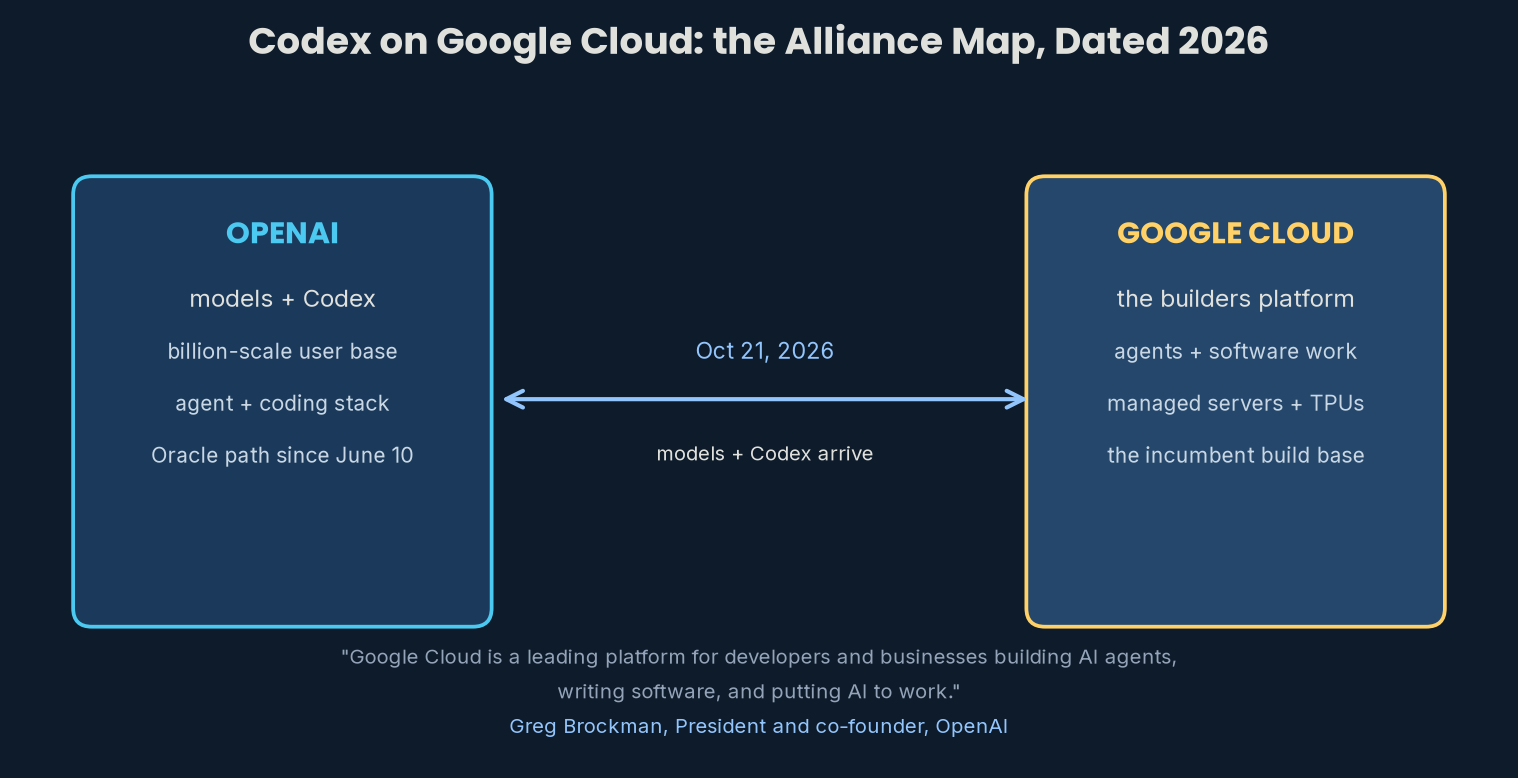
Why Google Cloud carries a competitor’s models
Both companies have commercial reasons to pursue the partnership. Google Cloud can attract additional AI workloads to a platform it already positions as model-neutral, and it now sells models from several providers (our managed MCP servers guide covers its managed tooling track). For OpenAI, Google Cloud’s enterprise customer base is a large audience of teams its own platform does not reach directly: offering models through the marketplace generates revenue for Google’s cloud business while giving OpenAI another route to organizations that have not moved to its own first-party products. Microsoft remains OpenAI’s primary cloud partner per the announcement, so the Codex Google Cloud partnership is an additional channel rather than a replacement.
The broader business implication: when one cloud account can run models from several leading AI providers, the providers’ competition increasingly depends on model performance and value rather than on which distribution channel a customer already holds. That is a change in how AI providers compete, and it favors buyers who evaluate models for their own workloads.
The enterprise terms that apply
The commercial terms Google documents are specific. Each Codex Google Cloud purchase made through the Google Cloud Marketplace appears on a single Google Cloud invoice, draws down existing spend commitments, and counts toward Flexible Savings Plans. That is a billing change with a defined effect — not an elimination of vendor due diligence. Procurement teams still need to complete vendor risk assessment, information security review and legal review for the new service; consolidated billing removes procurement friction, not the review process itself, and internal approval rules differ by company and by deployment (the August 19 OpenAI Zero Data Retention terms were announced for the platform — on Google Cloud, ZDR options are listed as coming soon).
Access requirements matter here too: the clearance requirements covered in our access-requirements guide determine which restricted models an organization is approved to use on a given service, and an approval obtained through one service does not automatically transfer to another deployment. Customers should confirm the relevant verification, security, and data-handling conditions for their chosen Codex Google Cloud deployment.
What developers should do before adopting it
Four practical steps fit this announcement. One: compare the cost of running the same AI-agent task through each available provider, because the same model can now be purchased through different cloud providers and charges set by each platform differ (the managed-server pricing covered in our MCP guide). Two: review identity and access management, because a second provider in the billing story does not remove the need for access controls on the new integration, and security reviews should examine the model, the hosting environment, and the applicable policies. Three: evaluate each model version using consistent tests, and separately check whether differences in hosting, configuration, or platform features affect performance. Four: treat migration as workflow work rather than platform work, since connecting an existing Codex CLI or Desktop setup is configuration where the workflow logic lives, and the Codex Google Cloud integration may require configuration rather than extensive new development, depending on the existing system.
Support, governance and skills
Customer support is another factor businesses should examine. For the Codex Google Cloud offering, they need to confirm which company handles problems involving the AI model, the cloud infrastructure, and any integrations, since support boundaries vary by service and agreement, and the managed-tooling arrangements documented for the platform set the precedent for where the boundaries typically sit. For teams without dedicated AI infrastructure staff, that clarity matters as much as model access itself. On skills: the platform’s documented tooling and training resources cover its supported services, including the Codex Google Cloud documentation, which may reduce the learning overhead of an additional vendor.
Inside the typical engineering team, the announcement changes the question from “can we buy this model” to “which platform best supports the workflow,” which is a common consideration when choosing infrastructure. The teams that keep a written record of which platform runs which workload make that decision easier.
How Businesses Can Compare Options Now
For a buyer, the available options can be compared directly. Each AI provider’s own products still sell with the provider’s own terms. Cloud marketplaces now sell multiple providers’ models with per-cloud pricing, the platform’s own tooling around them, and billing that draws on the existing cloud commitment (the platform relationship our OpenAI-Google record documents). An enterprise can map its AI spend once across three categories (first-party, incumbent cloud, alternative cloud) and price the same workload in each — noting that the same capability now bills in three places, at rates set independently.
Governance requirements apply across all three: each deployment inherits the model-level and platform-level terms, and an organization’s verification and security requirements stay constant while the billing route changes. A procurement team that has already completed its review work for one deployment confirms applicability for each additional one.
What may change in the AI market over the next year
Two developments look likely, as analysis rather than settled fact. First, if advanced AI models bill through several cloud providers, prices may become more similar across providers over time, and cloud providers may increasingly compete through additional services (the data-handling terms, the available deployment regions, the managed-tooling integrations). Second, competition may increasingly focus on coding agents and other workflow automation tools, and providers with effective agent tools may attract more customers — not just inference revenue. A third change follows from the first two: the partnership may make it easier for businesses to use advanced AI models from more than one provider, which used to require separate commercial agreements with each vendor.
A final note on what does not change. The evaluation practices this series keeps recommending (consistent tests per model version, fresh-session testing, release-note review) apply on any platform: the partnership provides another way to purchase access to the models, not a change in how its behavior is judged. Organizations should compare AI models using actual workload requirements, performance tests, operating costs, and security needs rather than relying on brand recognition. The teams that already run those evaluation habits can assess the new option quickly; the teams that chose by brand must build the evaluation practice now.
The Codex Google Cloud timeline carries one planning hint worth naming: the June 10 Oracle commitment gave enterprise buyers one alternative purchase route mid-year, the August 19 data terms addressed the privacy objection on OpenAI’s own platform, and October 21 brought OpenAI models onto a second major cloud. Developers can use these announcements as a reminder to evaluate model availability, contractual terms, and compatibility with their existing cloud infrastructure before adopting new services.
What it means for teams building on Google Cloud in the Philippines and beyond
The Codex Google Cloud partnership could be relevant to Philippine development teams using Google Cloud: agencies, startups and shared-services companies operating their systems on the platform with existing billing, which may be able to buy the advanced AI models with supported Codex workflows under the existing cloud agreement, where applicable. The practical effects are direct: a potentially simpler procurement process, subject to internal policies, the available deployment regions Google Cloud already offers, and (for eligible customers in the private preview now, or general availability later) one invoice. The same applies to AI-services firms whose clients expect the advanced capabilities under the client’s existing cloud agreements, where applicable.
The broader market implication, stated as analysis: as advanced AI models may become easier to purchase across different platforms, competitive differences may increasingly depend on applications and services built on top. For the services sector, that points to where industry-specific expertise may create commercial value.
Financial Disclaimer
This article is published for general information and analysis, not as investment advice, and it names no security for purchase. Cloud pricing, terms and platform arrangements change without notice, and figures cited reflect public reporting as of their dates. Assess your own requirements before acting on the guidance here; WorldNgayon accepts no liability for decisions taken on the basis of this article.
FAQ
Is Codex really available on Google Cloud now?
Partially, as of the October 21, 2026 announcement of the Codex Google Cloud integration. The OpenAI and Google Cloud announcements describe: OpenAI’s GPT-6 Astra, GPT-6.1 Sol and GPT-6 Luna models in private preview to select enterprise customers in Google Cloud’s model garden; local Codex CLI and Desktop workflows connecting to the platform for inference; and general availability planned in the coming weeks, with OpenAI models in Google Antigravity and the Gemini Agent coming later. Not every Google Cloud customer can use the models today.
Why would Google Cloud carry a competitor’s models?
Google Cloud can benefit by serving more AI workloads: it positions itself as model-neutral, already sells models from several providers, and earns revenue from the cloud usage of any model a customer runs. OpenAI gains another route to enterprise teams already on Google Cloud, and Microsoft remains OpenAI’s primary cloud partner per the announcement, so this is an added channel.
What was the sequence before the Codex Google Cloud partnership?
The June 10, 2026 announcement opened the route to OpenAI models and Codex through Oracle cloud commitments. August 19, 2026 set the Zero Data Retention terms for frontier models on OpenAI’s own platform. October 21, 2026 added Google Cloud, extending the model’s purchase options beyond OpenAI’s own products.
Do enterprise data terms carry over on the cloud marketplaces?
Zero Data Retention was announced August 19 for frontier models on OpenAI’s own platform; on Google Cloud, ZDR options are listed as “coming soon,” with prompts, context and outputs stated to remain within the customer’s data perimeter and never used to train foundation models. Customers should verify the applicable data-handling and retention terms for their specific purchase, along with the privacy, security and verification conditions of their deployment.
Should a developer move to the Codex Google Cloud integration now?
Start by comparing pricing: the same agent workload may bill differently through each provider (Google’s announcement states marketplace purchases draw down existing commitments and count toward Flexible Savings Plans). The integration may require configuration rather than extensive new development, depending on the existing system, since the local Codex CLI and Desktop connect for inference. Assess how the change may affect workflows and existing integrations, and evaluate each model version using consistent tests across deployments.
What does the partnership mean for the broader AI market?
As analysis: if every major cloud hosts models from several major labs, availability stops being the differentiator, and competition in AI agents, applications and related services grows. That shift, if it continues, could benefit developers and the services sector, where industry-specific expertise and workflow work sit.
- openai.com/index/access-openai-models-and-codex-through-your-oracle-c…
- openai.com/index/openai-models-google-cloud — Google Cloud Marketplace
- cloud.google.com/blog/products/ai-machine-learning/google-cloud-bring… — Zero Data Retention
External sources linked in this article, in order of first mention. Spotted an error or a broken link? Tell us.
Cite this pagePublished Nov 8, 2026
Agron, E. (2026, November 8). OpenAI Codex on Google Cloud: What’s Available and What Developers Should Know. WorldNgayon. https://worldngayon.com/openai-codex-google-cloud/
Agron, Edmon. “OpenAI Codex on Google Cloud: What’s Available and What Developers Should Know.” WorldNgayon, 8 Nov. 2026, worldngayon.com/openai-codex-google-cloud/.
Agron, Edmon. “OpenAI Codex on Google Cloud: What’s Available and What Developers Should Know.” WorldNgayon, November 8, 2026. https://worldngayon.com/openai-codex-google-cloud/.
Agron, E. (2026) ‘OpenAI Codex on Google Cloud: What’s Available and What Developers Should Know’, WorldNgayon, 8 November. Available at: https://worldngayon.com/openai-codex-google-cloud/.
E. Agron, “OpenAI Codex on Google Cloud: What’s Available and What Developers Should Know,” WorldNgayon, Nov. 8, 2026. [Online]. Available: https://worldngayon.com/openai-codex-google-cloud/
@online{agron2026openaicodex,
  author       = {Agron, Edmon},
  title        = {{OpenAI Codex on Google Cloud: What’s Available and What Developers Should Know}},
  year         = {2026},
  date         = {2026-11-08},
  organization = {WorldNgayon},
  url          = {https://worldngayon.com/openai-codex-google-cloud/},
  urldate      = {}
}TY - ELEC AU - Agron, Edmon TI - OpenAI Codex on Google Cloud: What’s Available and What Developers Should Know T2 - WorldNgayon PY - 2026 DA - 2026/11/08/ UR - https://worldngayon.com/openai-codex-google-cloud/ Y2 - ER -
Cite the version you read; the page may be updated. Zotero and Mendeley can also import this page directly.