Table of Contents
Key Takeaway
- 🌡️ Heat is the invoice: nearly every watt an AI chip draws becomes heat that must be moved out of the building — data center cooling is now a first-order engineering discipline, not a facilities footnote.
- 💧 Water is the hidden bill: evaporative cooling trades water for energy — US data centers drew an estimated 17.4 billion gallons of water in 2023 (EPRI estimate), and the tradeoff is measured by WUE, the water cousin of PUE.
- 🧊 Liquid went mainstream: direct-to-chip cooling cuts cooling’s share of facility power from as much as 38-40% (legacy air) to as little as 4-8%, pushing PUE toward 1.03-1.20 — liquid is no longer exotic, it is the default for AI halls.
- ⚖️ The design tension: the most water-efficient sites (WUE 0.02-0.19 L/kWh) often run in water-scarce regions — operators now explicitly trade energy, water, and location against each other.
Data center cooling used to be a line item buried in facilities budgets; now the entire AI expansion negotiates with it. In the AI era it decides where the industry can build, how much a token costs, and which towns will share their water with the world’s fastest-growing industrial load. This reference article explains the physics of removing heat at rack densities the technology was never designed for, the working vocabulary (PUE, WUE, CDU, TUE), the cooling options in plain language, and how operators balance the electricity-water tradeoff that defines modern AI infrastructure.
The Physics: Why Removing Heat Is the Whole Job
Every computation ends as heat. A modern AI accelerator draws 700 to 1,400 watts in a package smaller than a playing card — the heat flux approaches that of a cooktop surface — and a full AI rack concentrates tens of kilowatts to well over 100 kW in roughly the footprint of a refrigerator. Thermodynamics is uncompromising: that energy must be carried out of the room, continuously, or silicon throttles and fails. Data center cooling exists to move heat from chip to atmosphere with minimum energy and (increasingly) minimum water.
The vocabulary that governs every design conversation:
PUE (Power Usage Effectiveness) — the headline metric of data center cooling efficiency — — total facility power ÷ IT equipment power. A PUE of 1.5 means half again as much power as the computers themselves draw; world-class facilities run 1.03-1.20. It measures energy overhead, ignoring water entirely.
WUE (Water Usage Effectiveness) — annual site water (liters) ÷ IT energy (kWh), the Green Grid metric for the water bill per unit of compute. Industry averages run near 1.8 L/kWh; the best sites achieve 0.02-0.19; EPRI’s survey of US facilities reports a huge 0.1 to 9.0 L/kWh range with a 2023 US average near 0.36 L/kWh — numbers that vary enormously by climate and cooling design.
TUE (Total Usage Effectiveness) — the whole-facility metric that accounts for how effectively energy reaches the compute itself; specialists increasingly prefer it when liquid cooling enters the picture, because liquid changes both sides of the PUE ratio and can make PUE comparisons between air and liquid designs misleading.
The Cooling Spectrum: Four Architectures in Plain Language
1. Air (CRAC/CRAH) — the legacy default. Computer room air conditioners or air handlers blow chilled air through raised-floor plenums or containment aisles. Practical ceiling: roughly 20-35 kW per rack. It still serves most of the world’s facilities, but AI racks blew past its ceiling years ago.
2. Rear-door heat exchangers — the retrofit lane. A water-cooled door on the rack’s back pulls heat from exhaust air before it enters the room. It upgrades existing halls without replacing servers — the bridging technology in data center cooling for 30-70 kW racks — and pairs an air pathway with a liquid loop at the rack boundary.
3. Direct-to-chip liquid — the AI era’s workhorse. Cold plates bolt directly onto CPUs and GPUs; pumped coolant (usually treated water with biocides) carries heat to a Coolant Distribution Unit (CDU), which exchanges it to a facility water loop. Dober’s comparison of the architectures puts D2C’s advantage starkly: it supports 60-120+ kW racks, cuts cooling’s share of facility energy from as much as 38-40% to as little as 4-8%, and drives PUE down to 1.03-1.20 from air’s typical 1.5-2.0. Two design variants matter: single-phase (coolant stays liquid) and two-phase (coolant boils at the plate, absorbing much more heat per liter). Liquid’s specific heat capacity is roughly 3,200x that of air — the physics behind the whole shift. Our AI data center power explainer picks up the electricity side of this equation.
4. Immersion — the niche extreme. Servers submerged in dielectric fluid (single-tank or two-phase boiling designs) remove virtually all heat without fans. It delivers the highest densities and dry-cooling options, at the cost of serviceability and materials licensing. It remains a niche, but a growing one for edge and specialized deployments.
The Water Story of Data Center Cooling: Evaporation and the WUE-PUE Tradeoff
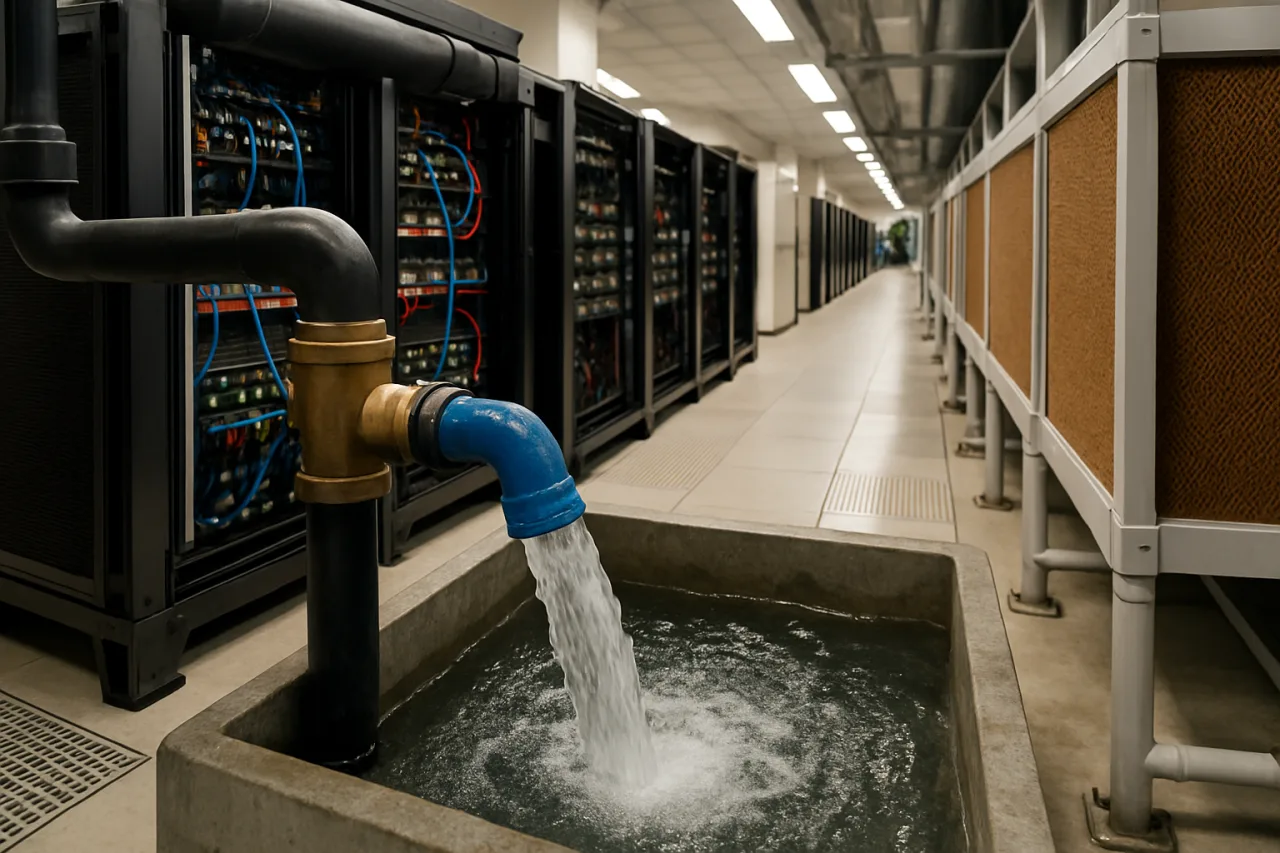
Here is the uncomfortable design tension at the heart of data center cooling: the cheapest way to reject heat, in most climates, is to evaporate water. Cooling towers and evaporative adiabatic systems are energy-cheap because evaporation carries enormous amounts of heat away per liter. But that means water-smart and energy-smart pull in opposite directions — the WUE-PUE tradeoff operators navigate site by site.
The numbers make the tradeoff concrete. Microsoft’s own published efficiency data pairs its Arizona facilities (1.52 L/kWh) against Singapore (0.02 L/kWh) — a 75-fold spread driven by climate and design choices. Amazon reports fleet-wide WUE of 0.19 L/kWh. At the extremes, air-cooled facilities using no evaporative systems can reach a literal zero WUE — by paying for it in higher energy (and PUE). Meanwhile the industry’s direct consumption is anything but theoretical: US data centers used an estimated 17.4 billion gallons of water directly in 2023 (EPRI estimate), with indirect water use from grid electricity often exceeding the direct figure several times over — our power analysis covers why that indirect number matters.
The ways out of the tradeoff, ranked by water savings:
- Closed-loop chip-level liquid cooling — the coolant never evaporates; Microsoft’s design brief cites 125 million liters saved per year per facility with zero-water chip cooling.
- Raising towers’ cycles of concentration — operating at 6 cycles rather than the typical 2-4 cuts makeup water ~20% and blowdown ~50%.
- Two-phase dielectric systems — waterless options that cut energy dramatically while eliminating evaporative draw.
- Siting for free cooling — cool-climate locations use outside air or cool water bodies instead of towers.
How Data Center Cooling Works: From Chip to Sky
The full chain, from transistor to weather:
Chip → cold plate → CDU → facility loop → heat rejection. Heat leaves the silicon into the plate, rides pumped coolant to the CDU (which isolates the dirty/outdoor loop from the clean indoor one), then into a facility water loop, and finally to the reject stage: a cooling tower (evaporating some water to reject heat), a dry cooler (air, no water), or a hybrid depending on climate and water politics. Roughly 70-75% of rack heat typically rides the liquid loop in D2C halls; the remainder exits through air paths that still handle CPUs, memory, and power electronics.
The controls layer is what separates the efficient from the wasteful: sensors through every loop trim flow rates to actual load, raise supply temperatures as high as reliability allows (warmer water rejects heat more cheaply and enables more free-cooling hours), and increasingly hand heat back to the neighborhood as a product — district heating tie-ins from warm liquid loops (60-75°C) turn “waste” heat into a saleable asset in Nordic and European sites.
Resilience: When Data Center Cooling Fails
Cooling is also a resilience discipline, and AI halls raise the stakes. A facility loses cooling margin in layers: a pump fails (N+1 redundancy covers it), a CDU goes down (its rack set throttles within seconds), facility power blips (the chillers ride through on generators with lag the batteries must bridge), or — the worst case — a thermal runaway cascade where rising temperatures push chips to throttle, which lowers their own cooling airflow, which raises temperatures further. Modern controls break that loops with fast valve actuation, per-rack telemetry, and load-shedding scripts that park workloads before silicon protects itself destructively.
Leak management is the other resilience frontier. Direct-to-chip loops put water millimeters from live electronics, so the engineering response is layered: negative-pressure cables that suck coolant out of a breach, drip sensors under every tray, quick-disconnect couplings that seal on separation, and non-conductive coolant additives where regulations allow. The industry’s leak record with modern D2C has been good enough that insurers now cover it routinely — but every operator budgets for the day the discipline pays off.
Where Water Politics Meets AI Siting
Data center cooling has become a siting variable with community consequences. Water-stressed regions court data centers for investment — then discover the aquifer math: hyperscale campuses can demand millions of gallons a day, and municipal fights from Chile to the American Southwest to Southeast Asia have hardened permitting. Operators answer with closed loops, dry coolers and air-side economizers in arid regions (paying an energy penalty instead of a water penalty), and — increasingly — with published WUE reporting as a social license requirement. The direction of travel in 2026 is unambiguous: closed-loop liquid at chip level, plus transparent water accounting, is becoming the price of admission in water-stressed markets. Our Philippine power-crisis analysis documents the parallel siting calculus in Southeast Asia’s power-constrained markets.
What Changes Next: Density, Heat Reuse, and the TUE Era
The cooling frontier is moving on three axes.
Density keeps ratcheting. Rack power has climbed from 10 kW (the old standard) through current GB300-class racks at 120-140 kW, toward announced 250-600 kW architectures. Every stop up that ladder removes another architecture from viability — air is already gone at the top, rear doors are bridging, and full-immersion keeps waiting at the extreme.
Heat reuse turns liability into product. Warm-water liquid loops make data center heat a commodity: Nordic campuses sell it into district heating networks; greenhouses, pools, and industrial process heat are natural buyers. Expect heat-reuse terms to appear in more siting agreements as communities bargain for local benefit.
Measurement matures. PUE is quietly losing its monopoly: with liquid in both loops, specialists argue for TUE and for water-plus-carbon dashboards that report PUE, WUE, and carbon together. Microsoft’s published regional tables (both PUE and WUE by geography) point where reporting is heading — operators disclosing both numbers per site rather than a single flattering global average.
FAQ: Data Center Cooling and Water Questions
Why is liquid cooling needed for AI?
AI accelerators pack thousands of watts into chip packages and 100+ kW into racks — heat fluxes that air cannot move economically. Liquid carries roughly 3,200x more heat per unit volume, keeps chips at sustained boost clocks, and cuts cooling’s energy share from almost 40% of facility power to under 10% in optimized designs.
Do data centers waste water?
Evaporative designs consume water by design — US facilities used an estimated 17.4 billion gallons directly in 2023 — but consumption varies 75-fold by climate and technology (Microsoft: 1.52 L/kWh in Arizona vs 0.02 in Singapore). Closed-loop liquid systems eliminate evaporation for most heat; the industry trajectory is toward exactly those designs, especially in water-stressed regions.
What is a good WUE score?
Below the industry average near 1.8 L/kWh is solid; best-in-class is 0.02-0.19 L/kWh (Amazon’s fleet, Microsoft’s Singapore sites). But WUE is climate-dependent — a fair comparison is against facilities in similar climates with similar designs, never against a global average.
What is a CDU in data center cooling?
The Coolant Distribution Unit is the pump-and-heat-exchanger module that bridges the clean technology loop (cold plates on servers) and the facility water loop — regulating flow, temperature, and pressure while keeping the loops isolated so a leak or contamination on one side never reaches the chips.
Can data centers run without water at all?
Yes — with closed-loop chip cooling plus dry (air) heat rejection, a facility can reach effectively zero operational water. The cost is energy: eliminating evaporative cooling usually raises PUE and the power bill, which is why operators choose per climate and per local water politics rather than universally.
Is immersion cooling the future?
At the extreme densities, plausibly; at the mainstream, probably not soon. Immersion holds the highest density ceiling and runs waterless, but its serviceability costs keep direct-to-chip liquid the practical default for most AI halls. Watch two-phase dielectric systems as the technology to watch in edge and military-adjacent deployments.
Financial Disclaimer
Financial Disclaimer: This article is for informational and educational purposes only and does not constitute investment or engineering advice. Cooling and water figures are industry-published estimates (EPRI, operator disclosures) that vary by climate, design, and load; they should be verified against current operator data before any business, siting, or investment decision. WorldNgayon holds no positions in or affiliations with the vendors or operators named.
Sources and Further Reading
- Dober — Direct-to-Chip Cooling Benefits in Modern Data Centers: dober.com
- Introl — Water Usage Efficiency: AI data center cooling guide: introl.com
- Microsoft — Measuring energy and water efficiency for datacenters (PUE/WUE by region): datacenters.microsoft.com
- Nona Technologies — Data Center Water Consumption (EPRI data summary): nona-technologies.com
- Data Center Knowledge — A Guide to WUE and best practices: datacenterknowledge.com
If this intelligence helps you, you can add WorldNgayon as a preferred source on Google — free, one click, and it helps other readers find the answers faster.