Table of Contents
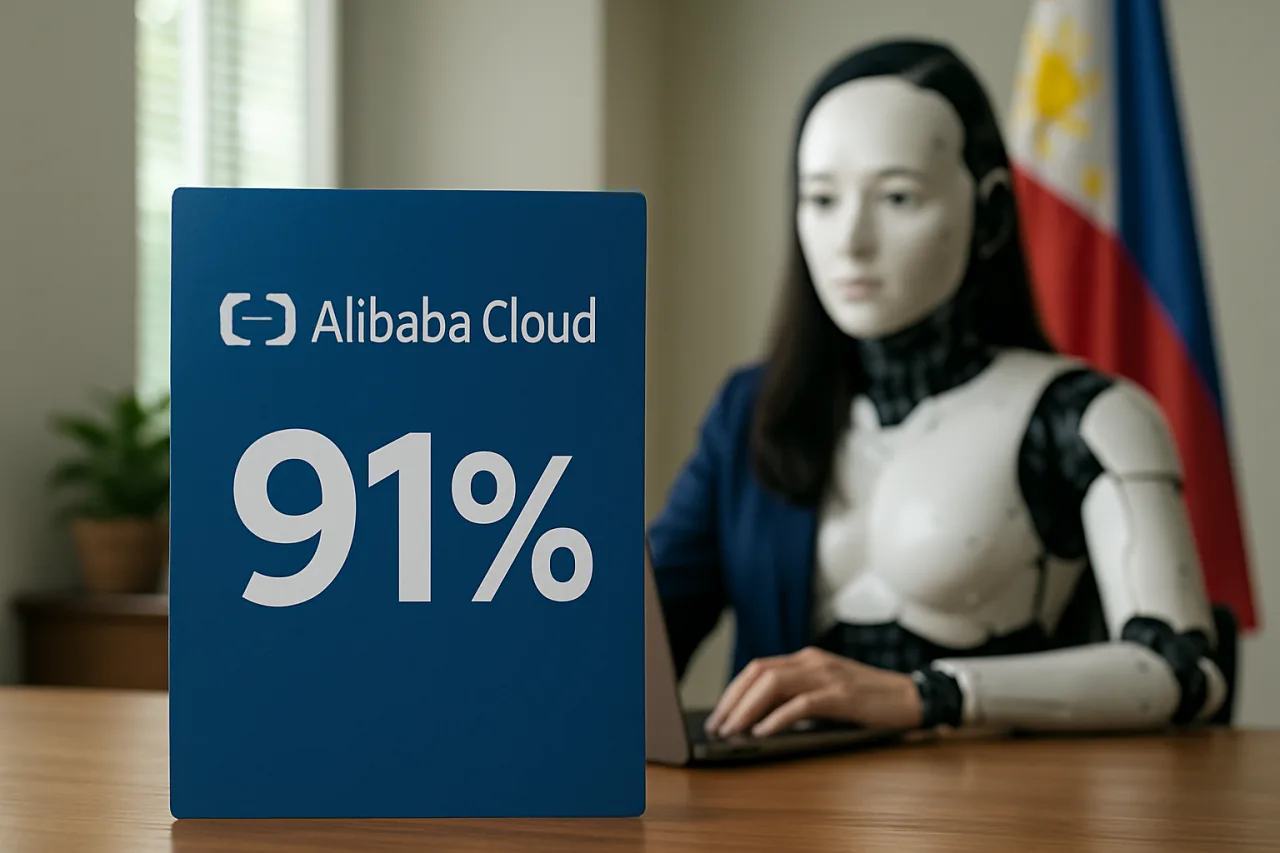
Alibaba Cloud survey Philippines results reveal that 91 percent of Philippine enterprises are optimistic about AI adoption — slightly above the regional Asian average of 90 percent — with 57 percent already actively exploring or implementing artificial intelligence in their organizations. The AI Business Application Readiness and Accessibility Survey, commissioned by Alibaba Cloud and reported on July 29-30, 2026, provides the most comprehensive look yet at how Filipino businesses are embracing AI.
Key Takeaway
- 📊 Headline Number: 91% of Philippine enterprises are optimistic about AI adoption, with 57% “very positive” and already exploring or deploying AI.
- ☁️ Cloud Foundation: 74% of Philippine companies have already migrated all or most of their IT infrastructure to the cloud, giving them a strong base for AI deployment.
- 🎯 Top Priority: Driving innovation and creating new business opportunities ranked first (68%), ahead of cost reduction (54%) — Filipino firms want AI for growth, not just savings.
- ⚠️ Key Barriers: Data privacy and security concerns top the list at 51%, followed by high implementation costs at 41%.
- 💰 Investment Plans: 95% of organizations plan to increase AI spending, with over half expecting to raise budgets by more than 20%.
What the Alibaba Cloud Survey Philippines Reveals
The AI Business Application Readiness and Accessibility Survey was commissioned by Alibaba Cloud, the global AI infrastructure provider and intelligence backbone of Alibaba Group. The survey covered eight Asian markets, with the Philippine findings reported by BusinessWorld, Manila Bulletin, Back End News, and Newsbytes.PH on July 29-30, 2026. The full report was published on July 30.
According to the survey, 91 percent of Philippine enterprises expressed optimism about adopting AI — slightly above the regional average of 90 percent. More than half (57 percent) described themselves as “very positive,” with many already exploring or deploying AI in their organizations. This optimism is supported by strong cloud adoption: 74 percent of Philippine companies have already moved all or most of their IT infrastructure to the cloud, giving them a stronger foundation to deploy AI applications compared to companies still operating on legacy systems.
Grant Gong, Head of Solutions Architect at Alibaba Cloud Philippines, explained the dual driver of adoption: “The pace of AI adoption in the Philippines is driven by two factors: large enterprises are pursuing AI initiatives as part of their top-level strategic digital transformation, while small and medium-sized enterprises (SMEs) are adopting software to meet their operational needs for cost reduction and efficiency improvement.”
Gong noted that Philippine businesses in the financial services and retail sectors are showing particularly strong interest in AI adoption.
How Philippine Enterprises Use AI According to Alibaba Cloud Survey Philippines
The Alibaba Cloud survey Philippines found that, unlike businesses in many markets that initially adopt AI primarily to lower costs, Philippine respondents ranked driving innovation and creating new business opportunities as their top goal. The survey found the following AI objectives among Philippine enterprises:
- Driving innovation and new business opportunities: 68%
- Improving efficiency and reducing costs: 54%
- Enhancing customer experience: 51%
- Gaining competitive advantage: 50%
- Increasing revenue: 39%
The specific AI applications being deployed by Philippine companies include:
- Data analysis and decision-making: 66%
- Customer service (including chatbots): 64%
- Marketing and content creation: 58%
- Software development and coding: 55%
- Human resources operations: 38%
The high adoption rate for data analysis and customer service reflects the maturity of the Philippine BPO sector, where AI-powered analytics and chatbot solutions are already reshaping operations. For Filipino professionals in these sectors, the DICT eTrabaho platform offers AI-powered job matching that can connect them with new opportunities as the AI transformation accelerates.
Barriers to AI Adoption in the Philippines
Despite the optimism, the Alibaba Cloud survey Philippines identified significant barriers to wider AI adoption. Data privacy and security topped the list of concerns at 51 percent, followed by high implementation costs at 41 percent. These findings align with the broader Philippine cybersecurity landscape, where the Philippine data leak crisis has exposed 155.6 million compromised accounts since 2004.
Regional comparison shows similar concerns across Asia. Data privacy and security concerns led the list at 48 percent regionally, followed by implementation costs at 42 percent and insufficient internal expertise at 37 percent. Regulatory and ethical concerns were cited by 31 percent, particularly among respondents in financial services, education, and the public sector.
Other challenges identified in the survey include system integration difficulties, limited access to suitable AI products, uncertain returns on investment, and the lack of clear business cases for AI deployment. These challenges reflect the reality that AI adoption is not just a technology decision but a strategic transformation that requires organizational change, skills development, and governance frameworks.
The Alibaba Cloud survey Philippines also found strong demand for industry-specific AI solutions is also significant. About 54 percent of Philippine respondents wanted more customized solutions, while 49 percent called for greater access to skilled workers and 45 percent sought more affordable AI products.
Investment Plans From Alibaba Cloud Survey Philippines
The survey found that 95 percent of organizations plan to increase spending on AI products, with more than half expecting to raise budgets by over 20 percent. This investment is directed across three key areas:
- Infrastructure-as-a-Service (IaaS): 69% plan to increase spending on computing, storage, and networking by more than 20%
- Platform-as-a-Service (PaaS): 61% plan to increase spending on platform tools by more than 20%
- Model-as-a-Service (MaaS): 58% plan to increase spending on model services by more than 20%
The heavy investment in infrastructure reflects the recognition that AI requires significant computing power. The Philippine data center build-out, which has reached 500 MW of capacity, is directly connected to this demand — without robust data center infrastructure, the AI ambitions revealed by the survey cannot be realized.
Across the eight Asian markets surveyed, 75 percent of companies said AI is now indispensable to their business, while only 1 percent said it is not a priority. This near-universal recognition of AI’s importance represents a fundamental shift in how Asian businesses view technology.
Expert Analysis: What the Alibaba Cloud Survey Philippines Means
Dr. Feifei Li, Chief Technology Officer and President of International Business at Alibaba Cloud Intelligence Group, provided the strategic context for the survey findings: “The research findings reinforce Alibaba Cloud’s belief that AI, delivered on top of scalable, secure cloud infrastructure and models, will be the defining technology platform for the next decade.”
“As we enter the agentic AI era, our focus is shifting from producing efficient tokens to enabling actionable outcomes,” Dr. Li continued. “By building a comprehensive agentic cloud, we provide the critical infrastructure — such as runtime sandboxes and orchestration — that empowers enterprises to build the agent-native products of tomorrow seamlessly.”
The reference to “agentic AI” signals the next phase of AI evolution, where AI systems move beyond generating text and images to taking autonomous actions on behalf of users. For Philippine enterprises, this means the AI investments they make today in cloud infrastructure and data governance will determine their ability to participate in the agentic AI era.
The Broader Philippine AI Landscape in 2026
The Alibaba Cloud survey Philippines results align with other data points from 2026 that paint a picture of rapid AI adoption:
- 73% of Philippine organizations are running active AI initiatives — according to a Boomi/Omdia study reported by InsiderPH on June 16, 2026, nearly matching the regional average of 74%.
- 78% of Filipino workers use AI at work — Philstar reported on July 22, 2026 that the majority of Filipino workers are already using AI tools, though few receive formal training.
- Half of Philippine firms have AI success KPIs — the Boomi/Omdia study found that 50% of Philippine organizations have defined KPIs for AI success, the highest rate among surveyed markets and well above the regional average of 37%.
- 97% expect increased focus on data governance — Philippine organizations recognize that AI adoption demands better data quality and governance, though only 57% currently have formal AI-specific data governance frameworks.
However, the Boomi/Omdia study also found that data fragmentation, governance gaps, and technology sprawl remain major obstacles to achieving AI return on investment. David Irecki, Chief Technology Officer APJ at Boomi, noted: “There’s a lot of excitement around AI in the Philippines right now, with many organizations clearly defining KPIs to measure success. However, there is a need to reduce tool sprawl, improve governance, and connect data across the enterprise for those KPIs to translate into real business value.”
The Gemini Southeast Asia report similarly documented how 600 million people across the region are adopting AI at unprecedented rates. The Alibaba Cloud survey Philippines adds enterprise-level data to this regional picture, showing that the adoption is not just consumer-driven but is embedded in business strategy.
What the Alibaba Cloud Survey Philippines Means for Filipino Professionals
For Filipino professionals, the Alibaba Cloud survey Philippines results signal a clear direction: AI skills are no longer optional. With 95 percent of organizations planning to increase AI spending and 75 percent considering AI indispensable, professionals who can deploy, manage, and govern AI systems will be in high demand.
Key takeaways for career planning:
- Data analysis and AI deployment skills are the most in-demand — 66% of companies are using AI for data analysis, making this the top application area.
- Customer service AI (chatbots) is the second most common — 64% of companies deploy AI for customer service, directly affecting the BPO workforce.
- Cloud infrastructure expertise is essential — 74% of companies have migrated to the cloud, and 69% plan to increase IaaS spending by more than 20%.
- Data governance and security skills are critical — 51% cite data privacy as the top barrier, creating demand for professionals who can bridge AI and cybersecurity.
- Industry-specific AI knowledge is valuable — 54% want customized solutions, meaning professionals who understand both AI and specific industries (finance, retail, healthcare) will be especially sought after.
The AFP cybersecurity recruitment drive also underscores the demand for professionals who can bridge the gap between AI and security — a skill set that the Alibaba Cloud survey identifies as the most pressing need in Philippine enterprise AI adoption.
The Regional Context: Philippines vs. ASEAN Peers in AI Adoption
The Alibaba Cloud survey Philippines data takes on added significance when compared with regional peers. Across the eight Asian markets covered by the survey, 90 percent of respondents said their organizations were optimistic about AI — putting the Philippines one point above the regional average. The 74 percent cloud migration rate among Philippine companies also exceeds several ASEAN neighbors, reflecting the country’s accelerated digital transformation since the pandemic.
The Business Times reported on March 27, 2026 that Southeast Asia is outpacing the global average in AI adoption, with Singapore building a regional AI hub. McKinsey’s February 2026 report on AI in Southeast Asia described the region as entering “an era of opportunity” with AI poised to add $1 trillion to Southeast Asian GDP by 2030. The Alibaba Cloud survey Philippines confirms that Philippine enterprises are positioning themselves to capture a share of this opportunity.
However, the AMRO July 2026 quarterly update projected the Philippines as the fourth slowest-growing ASEAN economy this year, despite stronger regional growth driven by AI demand. This gap between AI adoption optimism and macroeconomic performance suggests that Philippine enterprises are investing in AI as a strategy to close the competitiveness gap with faster-growing ASEAN peers — but the returns on those investments will depend on addressing the barriers identified in the survey, particularly data security and skills shortages.
The Philippine government’s push for ethical AI use as 2026 ASEAN chair, combined with DICT’s digital infrastructure investments and the Philippine AI Infrastructure Master Plan, creates a policy environment that supports the enterprise adoption revealed by the Alibaba Cloud survey Philippines. The convergence of private-sector optimism and public-sector infrastructure investment positions the Philippines to translate AI enthusiasm into measurable economic outcomes — if the barriers of data security, implementation costs, and skills gaps can be systematically addressed.
Frequently Asked Questions
What is the Alibaba Cloud survey Philippines?
The AI Business Application Readiness and Accessibility Survey was commissioned by Alibaba Cloud and covered eight Asian markets. It found that 91% of Philippine enterprises are optimistic about AI adoption, with 57% already exploring or implementing AI.
What percentage of Philippine companies use AI?
According to the Alibaba Cloud survey, 57% of Philippine enterprises are actively exploring or implementing AI. A separate Boomi/Omdia study found that 73% of Philippine organizations are already running active AI initiatives.
What are the main barriers to AI adoption in the Philippines?
Data privacy and security concerns top the list at 51%, followed by high implementation costs at 41%. Other barriers include insufficient internal expertise, system integration difficulties, and uncertain ROI.
How are Philippine companies investing in AI?
95% of organizations plan to increase AI spending, with over half expecting to raise budgets by more than 20%. Investment priorities include infrastructure (69%), platform tools (61%), and model services (58%).
Which Philippine sectors are leading in AI adoption?
According to Alibaba Cloud Philippines, financial services and retail sectors show particularly strong interest in AI adoption. Data analysis (66%) and customer service (64%) are the most common AI applications.
What does the survey mean for Filipino professionals?
With 75% of companies considering AI indispensable and 95% planning to increase AI spending, professionals with AI, cloud, and data governance skills will be in high demand across the Philippine job market.
Sources: Alibaba Cloud AI Business Application Readiness and Accessibility Survey (July 2026); BusinessWorld (July 29, 2026); Manila Bulletin (July 30, 2026); Back End News (July 29, 2026); Newsbytes.PH (July 30, 2026); InsiderPH/Boomi-Omdia study (June 16, 2026); Philstar (July 22, 2026).