Table of Contents
Key Takeaway
- 💰 The Proposal: Senate Bill 2338 and House Bill 10345 would raise the annual income tax exemption from P250,000 to P350,000, meaning workers earning up to P30,000 per month would pay zero income tax starting January 1, 2027.
- 📊 Who Benefits: The Department of Finance estimates over 6 million Filipino workers would benefit, with those earning above the threshold also saving up to P15,000 per year in reduced taxes.
- 🏛️ Legislative Status: SB 2338 was filed by Sen. Vicente Sotto III on July 29, 2026, following President Marcos SONA endorsement. HB 10345, filed by Speaker Dy and Rep. Majo Marcos, cleared the House Ways and Means Committee on August 10, 2026.
- 📉 Revenue Cost: DOF estimates P60 billion in foregone annual revenue, part of a P66 billion total tax relief package that also includes small business corporate tax exemptions.
- ⚡ What You Should Do: Filipino professionals earning near the P350,000 threshold should calculate their potential savings, track both bills through Congress, and prepare for adjusted withholding tax tables if the law takes effect in 2027.
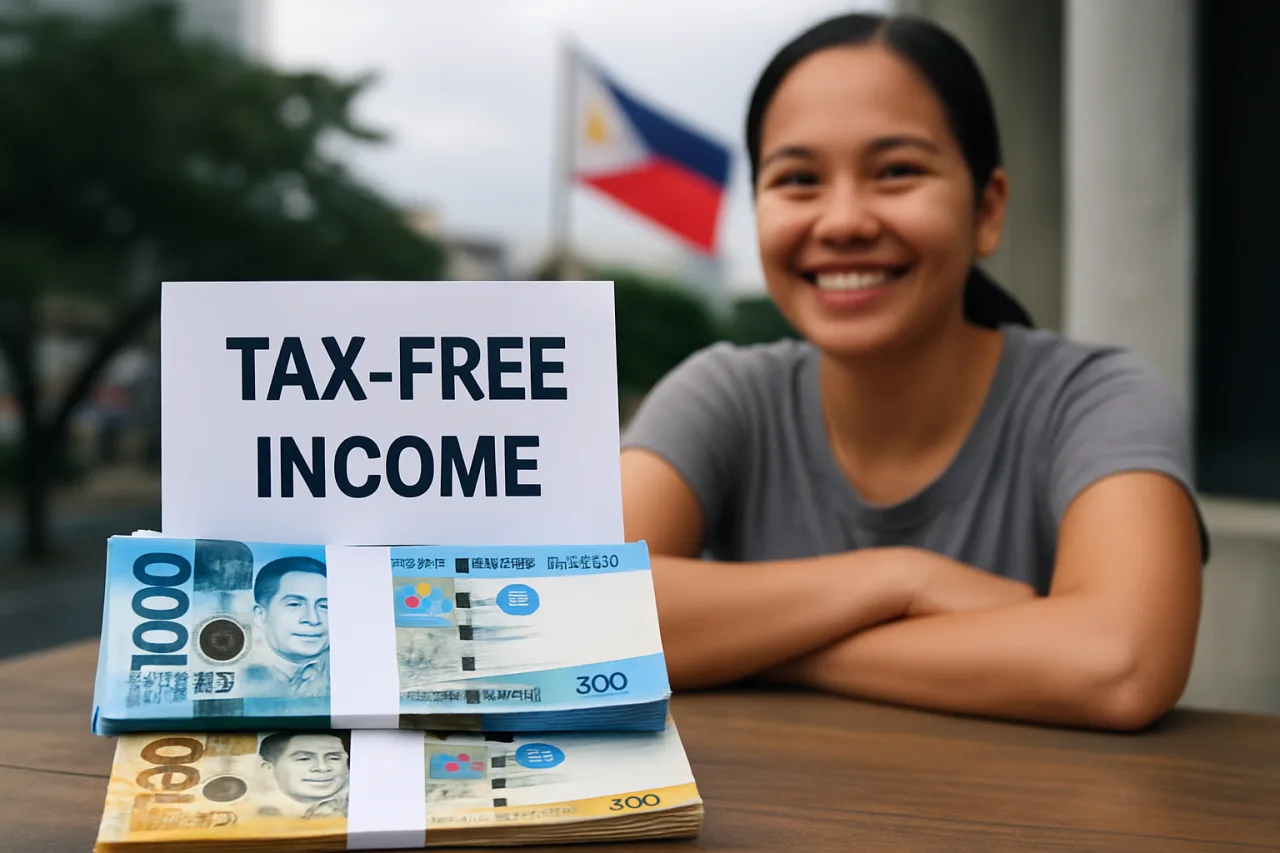
The tax-free income Philippines threshold has not moved since 2018, when the TRAIN Law (Republic Act 10963) set the annual income tax exemption at P250,000. Eight years later, that ceiling has been overtaken by inflation, wage hikes, and a peso that has lost 25 percent of its purchasing power. Two bills now moving through Congress, Senate Bill 2338 and House Bill 10345, propose raising the tax-free income Philippines threshold to P350,000, effective January 1, 2027. The Department of Finance estimates the change would benefit over 6 million workers and cost the government P60 billion annually in foregone revenue.
President Ferdinand Marcos Jr. endorsed the measure in his fifth State of the Nation Address on July 28, 2026, urging Congress to cover more workers in tax exemptions. Within 24 hours, both chambers had filed counterpart bills. The House Ways and Means Committee approved HB 10345 on August 10, 2026, sending it toward plenary deliberations. The Senate bill, filed by Senate President Pro Tempore Vicente Sotto III, is pending in committee.
What the Tax-Free Income Philippines Bills Propose
Both SB 2338 and HB 10345 amend Section 24 of the National Internal Revenue Code, as last amended by the TRAIN Law. The core change is straightforward: the zero-percent income tax bracket would expand from P250,000 to P350,000 in annual taxable income. Workers earning at or below P350,000 per year, approximately P29,167 per month, would pay no income tax.
The bills also recompute the succeeding tax brackets to prevent disruption to the overall tax schedule. Under the current TRAIN Law rates, workers earning above P250,000 but not exceeding P400,000 pay 15 percent of the excess over P250,000. Under the proposed amendment, that 15-percent bracket would apply to income above P350,000 but not exceeding P400,000. Sotto stated that taxpayers above the new exemption threshold would pay P15,000 less per year.
| Annual Taxable Income | Current Rate (TRAIN Law) | Proposed Rate (SB 2338 / HB 10345) |
|---|---|---|
| P250,000 and below | 0% (exempt) | 0% (exempt) |
| P250,001 to P350,000 | 15% of excess over P250,000 | 0% (newly exempt) |
| Above P350,000 to P400,000 | 15% of excess over P250,000 | 15% of excess over P350,000 |
| Above P400,000 to P800,000 | P22,500 + 20% of excess over P400,000 | P7,500 + 20% of excess over P400,000 |
| Above P800,000 to P2,000,000 | P102,500 + 25% of excess over P800,000 | P87,500 + 25% of excess over P800,000 |
The practical effect: a worker earning P350,000 annually currently pays P15,000 in income tax (15 percent of the P100,000 excess over P250,000). Under the proposed law, that same worker would pay zero. A worker earning P400,000 currently pays P22,500; under the amendment, they would pay P7,500, a saving of P15,000.
Why the Tax-Free Income Philippines Threshold Needs Updating
The P250,000 exemption was set in 2018 when the TRAIN Law was enacted. Since then, the economic ground has shifted. According to the Philippine Statistics Authority, the purchasing power of the peso has declined by 25 percent, meaning P1 in 2018 is worth only P0.75 as of March 2026. Successive rounds of regional wage hikes have pushed minimum wage and entry-level workers past the P250,000 ceiling without any real improvement in what their earnings can buy.
SB 2338 explicitly addresses this disconnect. The bill states that successive rounds of wage and salary adjustments have pushed minimum wage and entry-level workers past a tax exemption ceiling that has not moved, drawing them into the tax net without any real improvement in what their earnings can buy. Sotto cited the Middle East conflict and its inflationary impact on food, transportation, and electricity costs, which have risen faster than wages.
To continue taxing the incomes of workers in these circumstances, at a ceiling fixed eight years ago, is to ask the least able to bear the most, Sotto said, referring to RA 10963 which was enacted in 2018.
The National Wages and Productivity Commission reports that the daily minimum wage in the National Capital Region reached P695 in 2025, translating to approximately P18,070 monthly or P216,840 annually for a 22-day work month. In Davao Region, the minimum wage reached P525 per day. Workers in these brackets remain below the current P250,000 threshold, but recent wage orders effective through 2026 are pushing entry-level salaries above it, especially in sectors like BPO where starting pay often exceeds P25,000 monthly.
How Many Workers Benefit from the Tax-Free Income Philippines Change
The Department of Finance provided the first official estimate of the tax-free income Philippines proposal reach. Finance Secretary Ralph Recto stated that raising the exemption threshold to P350,000 would benefit over 6 million Filipino workers, including both those who would become fully exempt and those above the threshold who would see reduced tax burdens.
BusinessWorld reported that DOF Undersecretary Daisy Go placed the revenue cost at approximately P60 billion per year from the income tax exemption alone, with an additional P6 billion from the proposed small business corporate tax exemption, bringing the total tax relief package to P66 billion annually. The DOF is exploring excise tax adjustments to plug the revenue gap.
The 6 million figure represents a significant expansion of the current tax-exempt population. Under the TRAIN Law, workers earning P250,000 or less are already exempt. The P100,000 increase in the threshold would pull in workers who currently fall into the 15-percent bracket, many of whom are entry-level professionals, BPO agents, retail workers, and skilled tradespeople whose wages have crossed the P250,000 line through incremental raises rather than career advancement.
What This Means for OFWs and Overseas Filipino Professionals
For overseas Filipino workers, the tax-free income Philippines amendment has a specific but limited application. Under existing law, OFW income arising from overseas employment is already exempt from Philippine income tax, per BIR Revenue Regulations No. 1-2011. The Philippines also maintains tax treaties with 44 countries, including Saudi Arabia, the United Arab Emirates, Qatar, Kuwait, and Bahrain, major OFW destinations, which prevent double taxation on foreign-earned income.
However, the proposed amendment matters for OFWs in three scenarios. First, OFWs who return to the Philippines and take local employment would benefit from the higher exemption threshold, giving them more take-home pay during reintegration. Second, OFWs with passive income from Philippine sources, such as rental income or business earnings, would benefit if that income falls below the new P350,000 ceiling. Third, family members of OFWs who depend on remittances but also earn local income would see reduced tax burdens, stretching household budgets further.
The broader economic context also affects OFWs indirectly. The P60 billion in foregone government revenue must be recovered through other means, potentially including excise taxes on fuel, tobacco, or sugary drinks, which affect consumer prices that OFW families pay. The DOF has signaled it will propose compensating revenue measures alongside the exemption increase.
Legislative Timeline and What Comes Next
The tax-free income Philippines proposal is moving faster than most tax legislation. The timeline so far:
- July 28, 2026: President Marcos endorses raising the exemption threshold in his fifth SONA.
- July 29, 2026: Sen. Sotto files SB 2338. Speaker Dy and Rep. Marcos file HB 10345 in the House.
- August 10, 2026: House Ways and Means Committee approves HB 10345, moving it to plenary for second reading.
- Pending: Senate committee hearings on SB 2338, House plenary votes, bicameral reconciliation if needed.
The LEDAC Common Legislative Agenda for the 20th Congress, updated August 6, 2026, includes tax relief measures as priority items. Speaker Dy has signaled intent to fast-track the bill through the House. The Senate, however, has not yet scheduled committee hearings on SB 2338, and tax legislation historically moves slower in the upper chamber.
If both chambers pass the bill by late 2026, the effective date of January 1, 2027, would give the Bureau of Internal Revenue time to issue updated withholding tax tables and for employers to adjust payroll systems. Workers would see the change in their first January 2027 paycheck.
How to Calculate Your Potential Savings
Filipino professionals can estimate their tax-free income Philippines savings using the proposed brackets. If your annual taxable income is P350,000 or less, your income tax drops to zero, saving you up to P15,000 per year compared to the current TRAIN Law rate. If your annual income is above P350,000, you still benefit from the reduced rate on the first P350,000, saving P15,000 regardless of your total income.
For practical guidance on filing taxes under the current system, this step-by-step BIR eBIRForm guide walks through the process. For broader economic context on how tax policy intersects with Philippine growth forecasts, the World Bank 3.7 percent GDP forecast analysis provides the macro backdrop. Investors tracking how tax changes affect market sentiment can refer to the PSEi August 2026 market outlook.
The Department of Finance maintains a full text of the TRAIN Law and its veto message on its official website. The BIR official website provides current withholding tax tables and revenue regulations that would be updated if the amendment passes.
Frequently Asked Questions About the Tax-Free Income Philippines Proposal
What is the current tax-free income threshold in the Philippines?
Under the TRAIN Law (Republic Act 10963), enacted in 2018, workers earning P250,000 or less annually are exempt from income tax. The proposed amendment would raise this to P350,000.
How much would I save under the new tax-free income Philippines threshold?
If your annual taxable income is P350,000 or less, you would save up to P15,000 per year, the amount you currently pay under the 15-percent bracket. Workers earning above P350,000 would also save P15,000 because the first P350,000 would be exempt.
When would the new tax exemption take effect?
Both SB 2338 and HB 10345 propose an effective date of January 1, 2027. The bills must pass both chambers of Congress and be signed by the President before this date.
Are OFWs affected by the tax-free income Philippines change?
OFW income from overseas employment is already exempt from Philippine income tax under existing law. The amendment primarily benefits locally employed workers. However, returning OFWs who take local jobs, and OFW family members earning local income, would benefit from the higher threshold.
How much revenue would the government lose from this tax cut?
The Department of Finance estimates P60 billion in foregone annual revenue from the income tax exemption increase, plus P6 billion from the small business corporate tax exemption, totaling P66 billion. The DOF is exploring excise tax adjustments to offset the loss.
What is the difference between SB 2338 and HB 10345?
Both bills propose the same P350,000 exemption threshold and effective date. SB 2338 was filed in the Senate by Sen. Vicente Sotto III. HB 10345 was filed in the House by Speaker Dy and Rep. Majo Marcos. If both pass with differing provisions, a bicameral conference committee would reconcile them.
How does inflation affect the need for this tax change?
The Philippine Statistics Agency reports that the peso has lost 25 percent of its purchasing power since 2018, when the P250,000 threshold was set. Wage hikes have pushed workers past the exemption ceiling without improving real purchasing power, making the current threshold outdated.
Disclaimer: This article is for informational purposes only and does not constitute tax, legal, or financial advice. Readers should consult a certified public accountant or the Bureau of Internal Revenue for guidance specific to their tax situation. Legislative proposals may change during the congressional process.